On Neurodivergence and Otherness
Show Table of Contents
INTRO
1. On Neurodivergence and Otherness: An Introduction
SENSES AND SENSORY SENSITIVITIES
2. Senses Count
3. Neurobiology for Dummies
4. Sensory Transmission and our Reward System
5. Sensory Receptors are the Body’s Cellular Plan
6. A Synthesis: Sensory Systems and our Emotions — Part I
7. A Synthesis: Sensory Systems and our Emotions — Part II
8. Sensory Disorders and Sensitivities
9. Etan’s Story
SYNESTHESIA
10. Synesthesia: Difference, But Not Disorder
11. Synesthesia, Creativity, Artistry — Part I
12. Synesthesia, Creativity, Artistry — Part II
AUTISM AND THE NEURODIVERSITY MOVEMENT
13. From “Mental Defectives” to Autism Spectrum Disorder
14. Changing Conception of Autism
15. Autism Diagnoses and Behavior Patterns
16. Autism Treatments that Help
17. Early Start Autism Treatment: A Case Study
18. Neurodivergence and the Neurodiversity Movement
19. Neurodiversity Takes Flight
20. ADHD and Neurodevelopmental Disorders
21. ADHD: A Preponderance of Risk Factors and Symptoms
22. ADHD: Inattentive, Impulsive … and Hyperactive?
23. ADHD: Named, Renamed, Still Needs a New Name
24. ADHD: Treatment and Coping Skills for All Ages
LGBTQ+
25. Neurodiversity and the LGBTQ+ Fight
26. LGBTQ+ Identity and Expression
27. LGBTQ+ and Mental and Behavioral Healthcare
ON LANGUAGE
28. Language Matters In and Around Neurodiversity
29. Neuroinclusion and Disability Language
30. Neurodivergent Language Difficulties
ON CREATIVITY AND GIFTEDNESS
31. Neurodiversity and Creativity
32. Giftedness is a Piece of Neurodivergence
SELF-IDENTITY
33. Self-Identity: The Cornerstone of Neurodiversity
34. Early Theories of Self-Identity Formation
35. Contemporary Theories of Self-Identity Formation
36. Authenticity and the Search for Self
37. Self-Concept and Self-Schema
38. Self-Labeling and Parts Work
39. Complexity, Clarity, and Self
40. Cognitive Complexity and Neurodivergence
41. Cognitive Complexity Meets Self-Identity
IMPROVING LIFE FOR NEURODIVERGENT PEOPLE
42. Empathy and Difference – Recognition and Effort
43. Empathy and Difference – Response
44. Reducing Neuroatypical-Neurotypical Conflict – Part I
45. Reducing Neuroatypical-Neurotypical Conflict – Part II
46. Communicating Across the Neurospectrum – Part I
47. Communicating Across the Neurospectrum – Part II
48. Neurodiversity: Advocacy and Education
49. Neuroinclusion in the Workplace
50. A Neurodiverse Lifestyle
IN CONCLUSION
51. In Conclusion: Neurodivergence and Inspiration
38. Self-Labeling and Parts Work

In the prior post, we saw self-schemas as semi-hidden mental shortcuts to our sense of self that can sometimes help us identify and surmount barriers to improving our lives. But most of us can’t navigate the journey by ourselves — maybe none of us can. Recognizing and changing troublesome self-schemas can take time, often helped along by supportive family, friends, community, and/or professionals. This is not overnight work. But the benefits of better understanding and living our true selves, inside and out, can be significant.
In this post, I want to keep tackling concepts that might help us clear the underbrush before we run and jump into the warm, blue ocean (or whatever dream image you hold). I’ll explore the labels we give ourselves and the different parts of ourselves — ideas that go some distance toward advancing our understanding of identity and belonging.
Source: Greg Bodin. Photo: Marco Bianchetti, Unsplash

I don’t think anyone would argue that we’re complicated people, made up of multitudes, as the poet Walt Whitman wrote a very long time ago. We’ve long recognized our complexity in the uneven give and take of everyday life. We feel confident in one situation and insecure in the next. Generous and selfish. Brave and afraid. Part of us wants to take the risk or exert leadership, while another part can’t be bothered. We behave differently depending on the roles we occupy at various moments: parents, children, partners, friends, workers, loners, joiners, caretakers, rebels — and sometimes several of these at once.
This doesn’t mean we’re confused about our identity. In fact, researchers and psychologists have spent decades puzzling over something seemingly contradictory: How can we contain so many different — and sometimes conflicting — aspects of ourselves and still have a clear sense of who we are?
Researchers have tried to identify and measure the structure of our self-concept. Clinicians have developed ways to help people recognize and work with competing feelings and impulses. Some of these ideas have been extensively studied; others remain more firmly rooted in clinical practice, with research still developing. Together they raise the surprisingly difficult question: What holds together all these contradictory aspects of ourselves into one coherent whole?
Parts Language/Parts Work

Photo: Psychology Fanatic
We often name these different aspects of ourselves as a natural part of the process of making sense of it all. Researchers and therapists examine self-labeling to understand how the names we give ourselves — or receive from others — become incorporated into our self-perception, for better or worse. Therapists may also use parts work to help people recognize different, sometimes conflicting, aspects of themselves.
Some labels are given to us, as in a diagnosis of ADHD, autism, or dyslexia. Others we choose for ourselves. We may identify as an introvert, artist, caregiver, feminist, intellectual, loner. Still others are applied to us by parents (She’s the pretty one, and she’s the smart one), friends, teachers, or even schoolyard bullies.
The labels pull from countless descriptive words people commonly use to describe something they perceive is important about themselves or someone else — and some of them stick.
Such labels can assume remarkable power. Something that once felt confusing or isolating suddenly has a name. It may connect us with other people who share similar experiences. It can even alter the story we’ve been telling ourselves: Maybe I wasn’t lazy. Maybe there was a reason school was so difficult for me.
But labels can constrain as well as clarify. We can absorb the stereotypes attached to them, resist labels that other people impose on us, or allow one label to become so large that it obscures other parts of who we are. I’m always the last picked one to play softball. I’m clearly uncoordinated. Research on diagnostic labels bears out this complexity: people describe them as validating and explanatory, but also sometimes stigmatizing or limiting. I have OCD. I could never handle a job like that.
In her paper, “Labels and the Self: Identity Labels as Scaffold” — 2023, Journal of Analytical Psychology, PubMed/NIH — psychotherapist Leigh Money describes identity labels as “scaffolding” — something that can support us while understanding of ourselves is still taking shape. A label may give us something to hold onto while we’re still figuring out what an experience, feeling, behavior, or difference means. It can help make visible something about ourselves that we recognize but don’t yet completely understand.
Such labels can be thought of as shortcuts, a way to define identity and sum up a feeling state, attitude, or behavior… allowing growth or development to take place (or compensate for its absence). —Leigh Money, “Labels and the Self: Identity Labels as Scaffold,” PubMed/NIH
Money then provides a poetic sense of what labels can do:
Label as mirrored reflection
Label as creative defense
Label as something with which to play
Label as container for that which cannot yet be known
Parts Language and Parts Work: “Part of Me…”
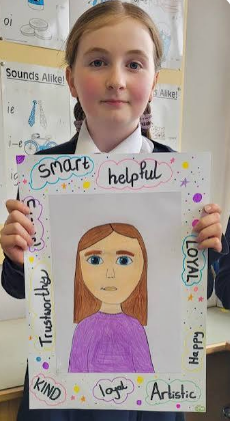
Photo: “Positive Affirmation Self Portrait”
Parts of ourselves want new experiences, get anxious, worry about money, get angry with our spouse/neighbor/parent. We use the language of parts all the time without thinking much about it. Part of me wants to go to the party, but another part wants to stay home. Part of me is furious with him, but another part knows he didn’t mean it. Part of me wants to take the new job, but another part is terrified I’ll fail.
A simple use of parts language — for example, part of me is anxious, instead of I am anxious — doesn’t take away the reality of anxiety. But it no longer has to describe the whole person. In his post, “Working with Your Parts Can Help You Heal,” counseling psychologist Greg Bodin describes it this way. If we’re too anxious, he says, we could describe it as the anxiety part convincing us to stay home, not try new things, or avoid challenging situations — eventually believing we’re always anxious.
Bodin uses parts language with clients as part of what’s called Internal Family Systems (IFS) therapy. He offers an ordinary example of friends inviting us on a Friday afternoon to go out later. Part of us wants to blow off steam and see them, another part wants to stay home and relax, and a third part is aggrieved by the last-minute invitation. All feelings can be true at the same time, regardless of the outcome.
Bodin’s workplace example is equally complicated.
You might notice you’re of two minds around someone you work with: a part of you respects their technical skills and abilities but another part of you gets irritated with their lack of people skills. You find yourself caught up in frustration — observing the conflict you feel toward your colleague and struggling with how to act because of it. Part of you appreciates them and part of you wants to yell at them. And perhaps another part is worried you’re overreacting and even another part is saying just shut up and get on with your work! —Greg Bodin, “Working with your parts can help you heal.”

In therapy or parts work, the point isn’t to eliminate one of these voices so the others can win. Parts language gives us a way to separate them enough to recognize what each is saying and help prioritize what needs to be addressed first. Bodin describes the shift this way: I am really angry. I’m noticing a part of me feels really angry. Just adding those few words, he argues, can create some distance between the person observing the anger and the part experiencing it. Instead of being completely engulfed by the emotion, we may become curious about it: Why is this part of me so angry? What is it afraid of? What does it need?
Therapist Annie Wright takes this a step further in describing what parts work can involve:
Norman Rockwell, Triple Self-Portrait, 1960, Norman Rockwell Museum
“[Parts language is] specifically getting to know the disowned and disavowed parts of us and then actively working to reclaim and integrate them into our conscious adult lives…. By bringing our awareness to these many different parts within us—giving each a voice, learning what each needs, wants, and fears—understanding when, how, and why each gets triggered—we are then more able to lovingly integrate (but not eliminate) the many aspects within us to create more choice, expand our capacity to creatively problem-solve, and to give us a greater sense of wholeness and aliveness in our daily lives.” —Annie Wright, “How Parts Work Helps Us Get to Know Ourselves,” Psychology Today
PARTS LANGUAGE BETWEEN PEOPLE

Parts language can also change how we communicate with other people, as mediator Kathy Brown points out in her blog post, “Helping Parties Navigate Conflict Using a ‘Parts’ Language and Framework,” Relationship Conflict Resolution. She uses it when people are locked in conflict because, she says, it can move us out of conflict and on to the path of resolution. Part of me wants to tell you what happened, but another part worries I’ll be embarrassed sounds different from a sweeping declaration about ourselves — or an accusation directed at someone else.
The parts language and framework helps the listener not hear blame, because the speaker is phrasing things to provide space for a more calm and curious view of the issues. When this happens, solutions often arise spontaneously.
In a mediated dispute, I help the parties to identify and speak for the fearful, angry, or wounded parts of themselves that are driving the conflict. Once these parts are witnessed, the parties often become more relaxed. And they’re more open to talking about the situation with a sense of genuine concern and curiosity. —Kathy Brown, “Helping Parties Navigate Conflict Using a ‘Parts’ Language and Framework,
Relationship Conflict Resolution
Brown add, parts language “draws on our natural instinct to describe what’s going on inside us. And it offers a safe way to speak for intense emotions and to give voice to mixed feelings.”
Parts language isn’t a theory proving the mind is composed of separate compartments, but a way of describing an experience most of us already recognize: different feelings, motives, fears, and desires can coexist within us.
As we’ll see, psychotherapist Richard Schwartz took that familiar experience considerably further. Beginning in the 1980s, he developed the IFS model that recognizes different parts as members of an internal system (the “family”), whose relationships can be understood — and sometimes changed.
What is Self?
When people are in conflict, they are often hijacked by parts of them that see the other as trying to exploit, dominate, or hurt them. Consequently, they act in ways that trigger the protective parts of the other and things escalate. —Attorney/mediator David Hoffman, founding member, Boston Law Collaborative Institute, and Lecturer on Law, Harvard Law School, as quoted by Kathy Brown, Relationship Conflict Resolution
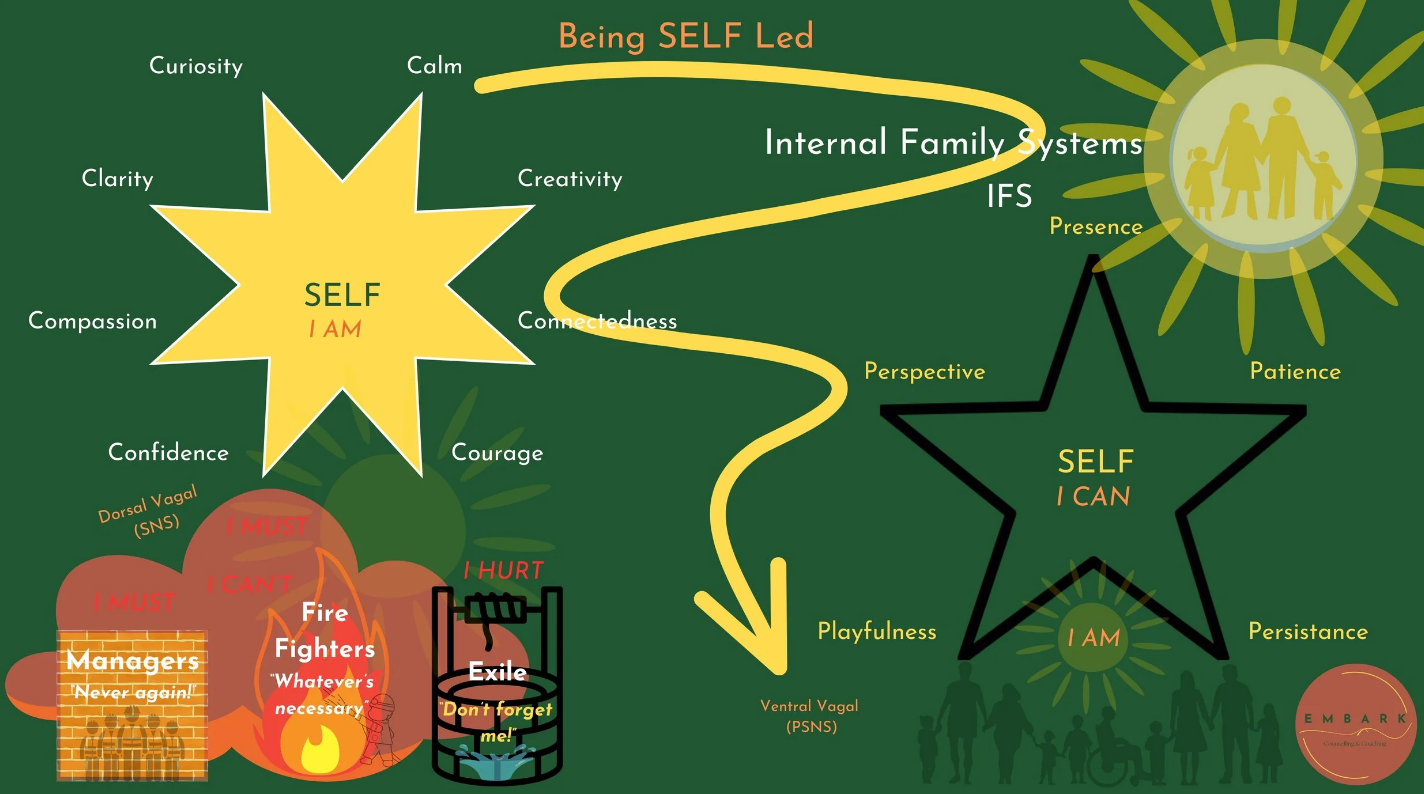
Illustration: Lucy Parker, “IFS in pictures,” Embark Counselling, UK
If we have all these competing parts, then, who is actually in charge? Schwartz’s answer is what he calls SELF. In IFS, SELF isn’t another competing part but ever-present, even when our more reactive parts seem to have taken over. As he describes it, SELF “doesn’t need to develop or change, and it can’t get damaged. While parts absolutely can become extreme and overwhelmed, activated or reactive, SELF remains the true leader of our systems.” The point Schwartz is making is that we can always return to the SELF when we need to.
I relate to this image summoned up by Hoffman:
Self can be used to describe the state in which we are all able to drop into at certain times in our lives or in the day-to-day. The example I use is when we find ourselves lying on the grass staring at the sky on a warm summer’s day, without an agenda or to-do list; we are noticing the world around us, we feel at peace and in our “best selves.” —David Hoffman, as quoted by Kathy Brown, Relationship Conflict Resolution
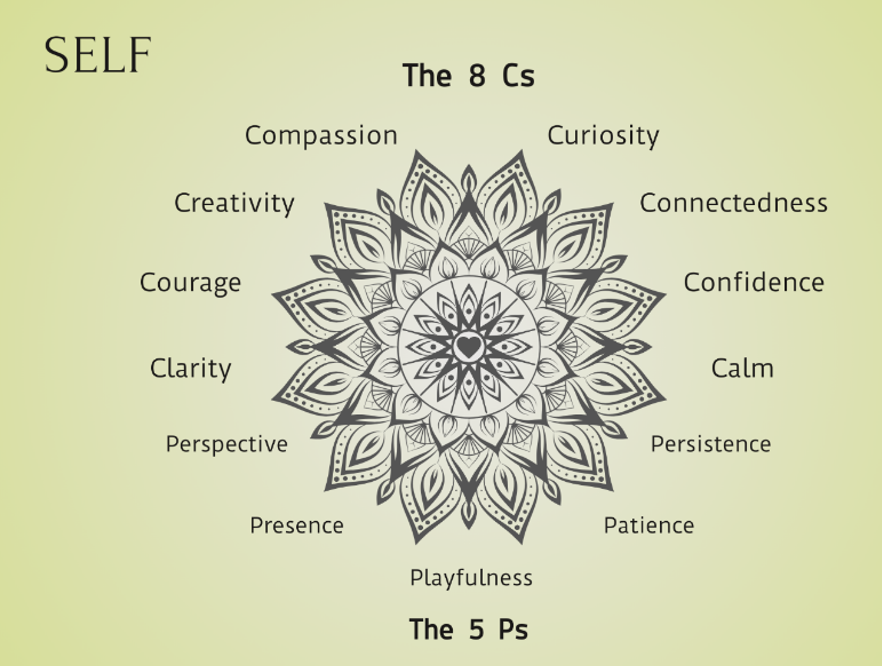
In his article, “Evolution of the Internal Family Systems Model,” IFS-Institute, Richard Schwartz further defines SELF as innate and containing eight (alliterative) qualities — the 8 Cs: curiosity, compassion, clarity, connectedness, creativity, courage, confidence, and calm. When SELF rather than a frightened, angry, defensive, or impulsive part is leading, the goal isn’t to banish those other parts. SELF can listen to them, understand what they’re trying to do, and help them take less extreme roles. Later, Schwartz added five further attributes — the 5 Ps: persistence, patience, playfulness, presence, perspective — for a total of 13 characteristics that aim at a caring, loving, and healing approach for individuals, families, and groups.
Systems Model (C) Lucy Orton Therapy 2024
MEET THE MANAGERS, FIREFIGHTERS, AND EXILES
Source: Autonomy Therapy, adapted from Richard Schwartz’s Internal Family Systems Model
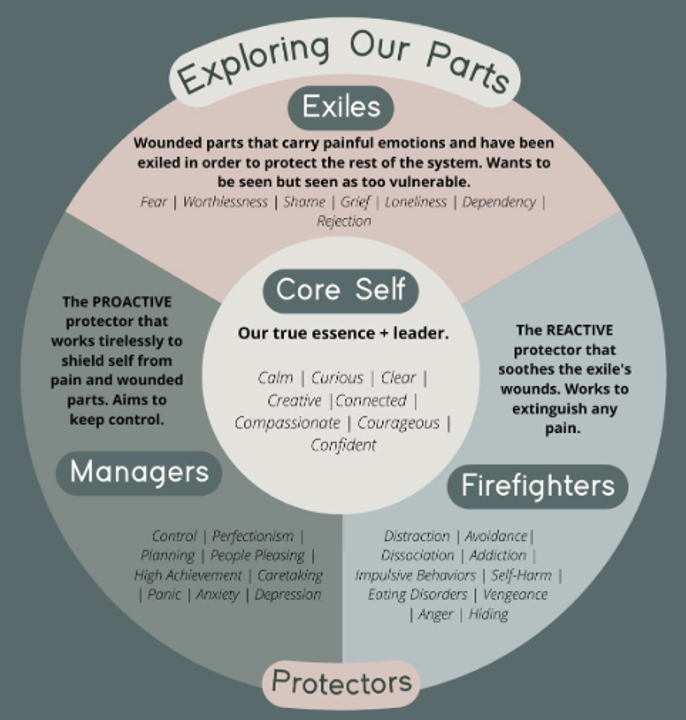
If SELF represents the calm leader in Schwartz’s internal family, the other members are considerably more colorful. He groups our protective and wounded parts into three categories:
- Managers are planners and worriers. They try to keep us organized, responsible, successful, and — above all — out of trouble. A manager may insist we prepare for every possibility, work harder, keep everyone happy, look competent, stay in control. Perfectionism, people-pleasing, self-criticism, and relentless planning can all become managerial strategies — their basic attitude being: If I stay on top of everything, nothing terrible will happen.
- Exiles are vulnerable parts overloaded with experiences and emotions of hurt, shame, fear, loneliness, rejection. They’re exiles because our protective parts try to keep them out of sight. But they haven’t disappeared. Something in the present can touch an old wound and suddenly an exile appears.
- Firefighters don’t plan ahead but respond when the alarm has gone off. When painful feelings break through, firefighters want immediate relief — to lose ourselves in food, substances, overspending, work, sex, videogames, rage, or anything capable of distracting or numbing us. Firefighters will do whatever it takes to put out the emotional fire, even if they make quite a mess in the process.
What makes Schwartz’s model more compelling than a collection of vivid personalities is that none of them are considered inherently bad. Even troublesome behavior is understood as an attempt, however misguided or extreme, to protect us. In therapy, we learn to ask lessWhat is wrong with me? and more What is this part trying to do for me — and why does it believe it has to work so hard?

Richard Schwartz, Scott Barry Kaufman podcast
Your protectors’ goals for your life revolve around keeping you away from all that pain, shame, loneliness, and fear, and they use a wide array of tools to meet those goals —achievements, substances, food, entertainment, shopping, sex, obsession with your appearance, caretaking, meditation, money, and so on.
The difference here is that the SELF says no to impulsive parts firmly but from a place of love and patience, in just the same way an ideal parent would. Additionally, in IFS, when parts do take over, we don’t shame them. Instead, we get curious and use the part’s impulse as a trailhead to find what is driving it that needs to be healed. —Richard Schwartz, No Bad Parts: Healing Trauma and Restoring Wholeness with the Internal Family Systems Model [both quotes found on Goodreads]
WHAT THE RESEARCH SAYS
IFS has become increasingly popular among therapists and their clients, but its research base hasn’t kept pace. In 2025, psychologist Megan Buys published the first study of peer-reviewed research on IFS, which came down to 27 studies meeting the review criteria. The evidence was difficult to evaluate because the studies weren’t equal in scientific weight: 17 case studies, 5 quasi-experimental studies, 3 qualitative exploratory studies — with only 2 randomized controlled trials (RCTs). RCTs can provide much stronger evidence that the treatment itself, rather than other circumstances, is producing an effect. Most of the research was also conducted in the U.S. and with adults.
Still, the findings were encouraging, especially in areas including trauma and PTSD, depression, chronic pain, self-compassion, and self-forgiveness. Study participants who assessed their reactions to IFS generally liked the approach, but Buys is careful about how far the evidence takes us. She describes IFS as a “promising treatment,” while concluding that the research remains “limited in scope.”
The lack of a large research base doesn’t mean IFS doesn’t work. Nor does its popularity, or the fact that people find its language intuitively meaningful, prove that it does. At this point, IFS is a compelling clinical model with encouraging early evidence — and a lot more testing still to be done.
Source: Megan Buys, “Exploring the Evidence for Internal Family Systems Therapy: A Scoping Review of Current Research, Gaps, and Future Directions,” 2005, Clinical Psychologist, Taylor & Francis Online
We don’t have to behave the same way in every situation, remain the person we were at 20 when we reach 45 — or 75, or whitewash the parts of our lives we wish had gone differently. We can recognize all of them as belonging to us.
Perhaps that is what coherence really asks of us. Not a perfectly consistent life story. Rather, enough understanding of ourselves to say: These are the different parts of me. This is where I’ve been. This is who I am now. And I can still imagine who I might become.
Coming Up Next

Thinking about ourselves in parts can help us recognize that no single feeling, label, diagnosis, or difficulty defines the whole person. But that leaves another question: How do all those different parts of ourselves fit together?
In Post 39. Complexity, Clarity, and Self, I look at two seemingly competing ideas — self-complexity and self-concept clarity (SCC) — and what they can tell us about constructing a sense of self that is both multifaceted and coherent.
Copyright ©2026 Jan Swan
 English