
On Neurodivergence and Otherness
Show Table of Contents
INTRO
1. On Neurodivergence and Otherness: An Introduction
SENSES AND SENSORY SENSITIVITIES
2. Senses Count
3. Neurobiology for Dummies
4. Sensory Transmission and our Reward System
5. Sensory Receptors are the Body’s Cellular Plan
6. A Synthesis: Sensory Systems and our Emotions — Part I
7. A Synthesis: Sensory Systems and our Emotions — Part II
8. Sensory Disorders and Sensitivities
9. Etan’s Story
SYNESTHESIA
10. Synesthesia: Difference, But Not Disorder
11. Synesthesia, Creativity, Artistry — Part I
12. Synesthesia, Creativity, Artistry — Part II
AUTISM AND THE NEURODIVERSITY MOVEMENT
13. From “Mental Defectives” to Autism Spectrum Disorder
14. Changing Conception of Autism
15. Autism Diagnoses and Behavior Patterns
16. Autism Treatments that Help
17. Early Start Autism Treatment: A Case Study
18. Neurodivergence and the Neurodiversity Movement
19. Neurodiversity Takes Flight
20. ADHD and Neurodevelopmental Disorders
21. ADHD: A Preponderance of Risk Factors and Symptoms
22. ADHD: Inattentive, Impulsive … and Hyperactive?
23. ADHD: Named, Renamed, Still Needs a New Name
24. ADHD: Treatment and Coping Skills for All Ages
LGBTQ+
25. Neurodiversity and the LGBTQ+ Fight
26. LGBTQ+ Identity and Expression
27. LGBTQ+ and Mental and Behavioral Healthcare
ON LANGUAGE
28. Language Matters In and Around Neurodiversity
29. Neuroinclusion and Disability Language
30. Neurodivergent Language Difficulties
ON CREATIVITY AND GIFTEDNESS
31. Neurodiversity and Creativity
32. Giftedness is a Piece of Neurodivergence
SELF-IDENTITY
33. Self-Identity: The Cornerstone of Neurodiversity
34. Early Theories of Self-Identity Formation
35. Contemporary Theories of Self-Identity Formation
36. Authenticity and the Search for Self
37. Self-Concept and Self-Schema
38. Self-Labeling and Parts Work
39. Complexity, Clarity, and Self
40. Cognitive Complexity and Neurodivergence
41. Cognitive Complexity Meets Self-Identity
IMPROVING LIFE FOR NEURODIVERGENT PEOPLE
42. Empathy and Difference – Recognition and Effort
43. Empathy and Difference – Response
44. Reducing Neuroatypical-Neurotypical Conflict – Part I
45. Reducing Neuroatypical-Neurotypical Conflict – Part II
46. Communicating Across the Neurospectrum – Part I
47. Communicating Across the Neurospectrum – Part II
48. Neurodiversity: Advocacy and Education
49. Neuroinclusion in the Workplace
50. A Neurodiverse Lifestyle
IN CONCLUSION
51. In Conclusion: Neurodivergence and Inspiration
39. Complexity, Clarity, and Self

The last post explored some of the language we use to understand ourselves — the labels we acquire or choose, the different “parts” we recognize within ourselves, and a therapeutic approach that takes those parts seriously. But recognizing that we contain many aspects of self raises another question: How do we put them together?
Researchers and psychologists have approached our multitude of selves from directions other than the parts language framework. This brings us to two concepts that approach the construction of self from different directions: self-complexity and self-concept clarity (SCC).
Complexity and Clarity in Imaginative Tension
Self-complexity asks: How many different aspects of ourselves do we recognize and how distinct are they from one another?
Self-concept clarity asks something different: How clearly and confidently do we know who we are, and how consistent and stable does that understanding feel?
Since we recognize ourselves in many different roles, full of contradictions, changing over time — and still experience those many selves as belonging to one recognizable person — we won’t be surprised to learn that both complexity and clarity can coexist within a coherent self-concept.
Self-concept is a rich and complex social representation of who we are, encompassing both our internal characteristics and our social roles. In addition to our thoughts about who we are right now, the self-concept also includes thoughts about our past self — our experiences, accomplishments, and failures — and about our future self — our hopes, plans, goals, and possibilities. The multidimensional nature of our self-concept means that we need to consider not just each component in isolation, but also their interactions with each other and their overall structure. Two particularly important structural aspects of our self-concept are complexity and clarity. —Open Textbook
SELF-COMPLEXITY: EGGS IN THE BASKET

Following Open Textbook’s premise, self-complexity is what it sounds like. We’re pretty complex people, which means different and relatively independent ways of thinking about ourselves. Some of us are more complex than others in how we think about ourselves, involving fairly dramatically different psychological outcomes. And researchers have explored whether those differences have psychological consequences.
In the 1980s, psychology researcher Patricia Linville introduced the self-complexity concept. In a familiar list, we might see ourselves as a parent, spouse, friend, writer, tennis player, volunteer, gardener, traveler, political junkie. But Linville added this. The more numerous and differentiated these self-aspects are, the greater our self-complexity.
Here’s how she organized all these “self-aspects”:
Patricia Linville’s original formulation of the self-complexity model assumes that the representation of the self in memory consists of multiple self-aspects. They may be organized in terms of contexts (home, school, with friends), roles (student, athlete), traits (creative, nurturing), behaviors (studying, playing tennis), and time frames (past, present, future selves).
Intuitively, greater self-complexity involves having a more differentiated view of the self. The greater the extent to which a person makes distinctions among the attributes or features associated with various self-aspects, the greater the person’s self-complexity is.
Furthermore, a person who is higher in self-complexity is likely to associate different emotions and self-appraisals with different self-aspects. For example, a person may feel good about himself or herself as an athlete but not as a student. —Text and image: “Self-Complexity,” Psychology.iResearch.net
Linville expanded on this idea in one of her early papers “Don’t Put All Your Eggs in One Cognitive Basket.” It goes like this:
Suppose an important part of my identity is my work, and I lose my job. If worker dominates how I think about myself, the loss can reverberate through much of my sense of who I am. But if work is important alongside family, friendships, tennis playing, artmaking, community, and other sources of competence and meaning, the damage might be less shattering. One part of my life has taken a terrible hit. Not all of me has.
Linville tested her idea in a 1987 study. People with greater self-complexity appeared less vulnerable to depression, perceived stress, physical symptoms, and illness following stressful life events. Her hypothesis was that our multiple, relatively distinct self-aspects could act like a psychological buffer: trouble in one part of life would be less likely to spill across the whole self.
In other words, such distinctive self-aspects are contained:
For those with high self-complexity, the various aspects of the self are separate, as the positive and negative thoughts about a particular self-aspect do not spill over into thoughts about other aspects. —Open Textbook
The idea was very appealing some forty years ago, but it’s turned out to be considerably more complicated.
Two sources both by Patricia Linville: “Self-Complexity and Affective Extremity: Don’t Put All of Your Eggs in One Cognitive Basket,” 1985, Social Cognition, Guilford Journals; and “Self-Complexity as a Cognitive Buffer Against Stress-Related Illness and Depression, 1987, Journal of Personality and Social Psychology, PubMed/NIH
SELF-COMPLEXITY: WHEN A GOOD IDEA GETS COMPLICATED
Researchers testing Linville’s hypothesis had inconsistent results. In a 2002 review/meta-analysis, psychologists Eshkol Rafaeli-Mor and Jennifer Steinberg found little evidentiary support for Linville’s stress buffer. With great variation among the studies, the review also showed greater self-complexity to have a weak negative relationship with wellbeing — certainly not the expected result.
Part of the problem may lie in what researchers were measuring — how many different self-aspects a person has, how much they overlap, and whether those aspects are positive or negative. They asked: Is a person whose identities are highly differentiated psychologically better protected — or potentially more fragmented?

Photo: iStock
A 2004 review revealed researchers were struggling to compare apples to apples. Erika Koch and James Shepperd found self-complexity had been associated with both better and worse coping. They traced much of the inconsistency to disagreements about how self-complexity should be defined and measured. Rather than dismiss Linville’s original idea, they argued that researchers needed greater precision before they could know when complexity helps and when it doesn’t.
At this point in the research, we’re left with a more nuanced version of Linville’s appealing proposition. Having several meaningful parts of life may indeed keep one major loss — like a job or relationship loss — from becoming everything. But complexity by itself doesn’t necessarily tell us whether those different and independent aspects we recognize within ourselves add up to a strong and coherent sense of who we are.
SELF-CONCEPT CLARITY: KNOWING WHO WE ARE
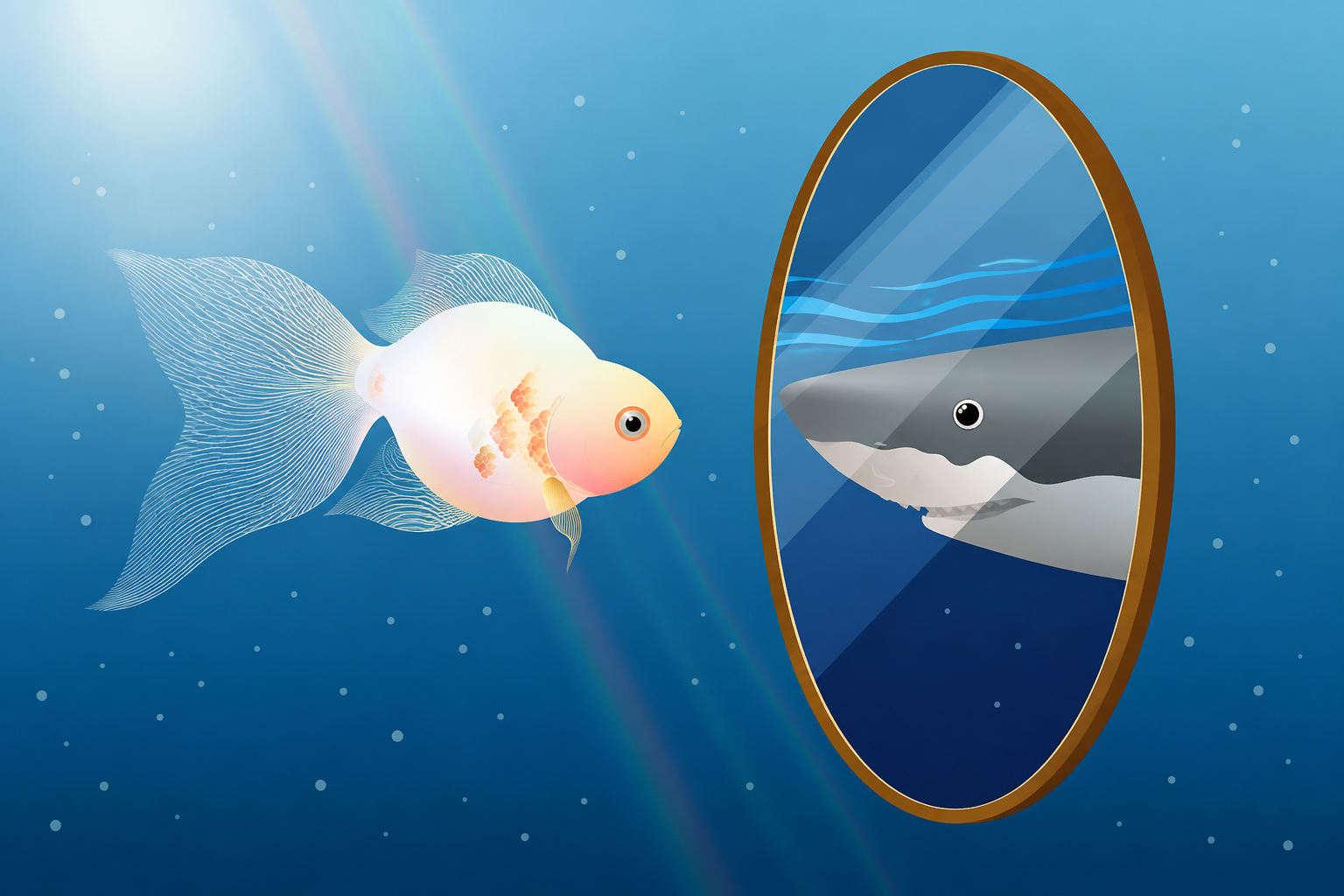
Self-concept clarity describes how clearly and consistently we understand who we are. It’s a logical companion to self-complexity because having many different aspects of ourselves tells us nothing about how well we understand or integrate them.
Psychologist Jennifer Campbell and colleagues gave the concept its enduring definition in 1996: the extent to which our beliefs about ourselves are “clearly and confidently defined, internally consistent, and stable.”
Self-concept is another big egg basket when it comes to identify — it holds all aspects of ourselves, including how we see ourselves compared to others and to our earlier selves, as well as how we project to our future self.
It doesn’t require us to act consistently in every setting — we can be serious at work and silly with friends, confident about our abilities and insecure about our appearance, devoted to our family and fiercely protective of time alone. Clarity lies in understanding these differences as parts of the same recognizable self.
Moreover, clarity in our self-concept is not a rigid picture. We absolutely change as we learn, age, succeed, fail, gain and lose relationships, acquire new roles, and change what we once believed about ourselves. Clarity is more about whether, amid all that complexity and change, we have a reasonably coherent answer to Who am I? Our different self-aspects have to make sense to us as belonging to the same person.
After 30 years of research, greater SCC is linked to a broad range of psychological outcomes. People with clearer self-concepts tend to report greater wellbeing and more stable self-esteem, along with better emotion regulation and interpersonal functioning. Low clarity, meanwhile, has been associated with greater anxiety, depression, rumination, and identity disturbance.
But — as we just discovered with self-complexity — an association doesn’t imply cause. A major 2026 research review concludes the evidence is strongest for low SCC as a marker of psychological vulnerability, while much weaker for claims that low clarity itself causes those problems. A person may struggle because they don’t have a clear sense of themselves. Or depression, anxiety, difficult relationships, major life changes, and other experiences may make a once-clear sense of self harder to hold onto. Most likely, the relationships travel in more than one direction.
One place this relationship may become particularly important is when our sense of ourselves is challenged by stress. Open Textbook connects self-concept clarity with self-esteem and wellbeing, particularly when we’re under stress:
Perhaps people with higher self-esteem tend to have a more well-defined and stable view of their positive qualities. Those with lower self-esteem show more inconsistency and instability in their self-concept, which is then more vulnerable to being negatively affected by challenging situations. Consistent with this assertion, self-concept clarity appears to mediate the relationship between stress and wellbeing. —Open Textbook
Two Portraits of Self-Concept Clarity
By now, this may seem somewhat confusing. We recognize that most of us carry within us many different roles and contradictory aspects of ourselves and still are able to say, This is me. Researchers and psychologists call this a coherent self-concept. We can change considerably over a lifetime and still have self-concept clarity. And researchers themselves are still working out exactly how clarity relates to wellbeing, stress, relationships, and mental health.
So how are we supposed to recognize SCC in ourselves or in someone we care about? And what does it mean if what we recognize is low clarity?
There’s no simple dividing line between high and low self-concept clarity. Most of us will fall somewhere in between and may feel more certain of ourselves at some times in our lives than others. But I think these next two intentionally contrasting portraits can help illuminate the differences. Both portraits are made up.
Ramon

Photo: Shutterstock
Ramon is 38 and has worked his way into a management position he’s proud of. He thinks of himself as competent, independent, loyal, somewhat reserved, and good in a crisis. His marriage recently ended, however, and he’s struggling.
He never imagined himself divorced. He misses his children when they’re with their mother, hates coming home to an empty apartment, and sometimes wonders whether he failed at the role that mattered most to him.
None of this leaves Ramon untouched. But it hasn’t rattled his foundation.
He still believes he was a good husband, just not in enough ways — and he’s learned from the experience. He hates the changes divorce has forced on him, yet he remains a good father, also a good son, brother, and friend. Not only that, he’s a loyal manager, devoted baseball fan, and the friend others call when something goes wrong. His future looks different from the one he expected, but he can imagine a different future taking shape.
In a psychologist’s office, Ramon would likely be seen as someone with relatively high self-concept clarity. That doesn’t give him a pass to coast along, nor does it mean he always holds himself in high regard, knows exactly what he wants, or sails through adversity. It means his understanding of himself remains reasonably clear and coherent while his life is changing.
Esther

Photo: Shutterstock
Esther is 35 and has also built a successful career. But her sense of herself changes markedly with circumstances and other people’s responses to her. When her boss praises her, she feels talented and ambitious. A critical performance review leaves her wondering whether she has fooled everyone and chosen the wrong career. When a relationship is going well, she sees herself as warm, desirable, and easy to love. After an argument, she can become convinced that she is difficult, selfish, and destined to be alone.
Ask Esther what she really wants, and the answer changes.
She sometimes adopts the interests and plans of her current boyfriend, but as her boyfriends change so does her outlook. It’s not much better when she looks backward. She sees her efforts to survive her childhood as trying desperately to fit in, without a clue as to what that meant for herself. At different times, she tries on different stories about who she was as a child and young adult, never fully landing on something that feels real. In fact, feeling like she fools people may be her most consistent attribute. Looking forward, she has trouble imagining a future that feels recognizably hers.
In that same psychologist’s office, Esther would likely be seen as someone with relatively low self-concept clarity. Her problem isn’t that she contains more contradictions than Ramon does. Both are complicated people. The difference is that Esther has more difficulty maintaining a clear, stable understanding of herself when circumstances and relationships change.
Can We Gain Self-Concept Clarity?

Recognizing some of Esther in ourselves doesn’t mean we’re stuck there. Self-concept clarity can change. It develops across our lives and can be unsettled by major transitions, losses, difficult relationships, and mental health struggles. Researchers also find that clarity generally increases as young people move toward adulthood, and their identities become more settled.
What’s less clear is exactly how we deliberately improve it.
There isn’t yet a well-established SCC treatment, and much of the research on possible ways to strengthen clarity is indirect. Still, the possibilities are remarkably familiar.
Psychotherapy can help us examine conflicting beliefs about ourselves and make better sense of them. Exploring our values can help distinguish what we actually believe and want from what we’ve absorbed from other people. And constructing a coherent story about our lives — how the person we once were connects with the person we are now and the person we might become — may help integrate experiences that otherwise seem disconnected.
Constructing that coherent story doesn’t mean rewriting the unpleasant chapters or presenting ourselves in the best possible light. Whitewashing the past or masking parts of ourselves in the present may actually make it harder to understand how the pieces fit together. Greater clarity can require acknowledging experiences, choices, failures, feelings, and contradictions we would rather leave out — and recognizing that they belong to our story, too. And, in the spirit of Schwartz’s IFS model, we can try to look at what we find with curiosity and compassion rather than self-loathing. Understanding why we became who we are is different from condemning ourselves for it.
Researchers have even found preliminary evidence that structured conversations about life stories, values, failure, and regret can increase self-concept clarity.
None of this requires arriving at a final answer to Who am I? A clear self-concept isn’t a finished self. In fact, too much certainty can become its own problem when our understanding of ourselves grows rigid or simply isn’t accurate. The goal is something more flexible: enough clarity to recognize ourselves across different roles, relationships, experiences, and stages of life while leaving room for the person we are still becoming.
SELF-CONCEPT CLARITY AND RELATIONSHIPS
SCC doesn’t stop at the self’s boundaries. The clarity with which we understand ourselves may affect how we function in our closest relationships.
Research has found greater SCC associated with greater relationship satisfaction and commitment. In one interesting study, researchers Gary Lewandowski and colleagues experimentally prompted participants to experience greater self-concept clarity or confusion. Subsequently, those placed in the clarity group reported greater relationship satisfaction and commitment than those in the confusion group.
The connection makes intuitive sense.
Greater clarity may promote relationship satisfaction in a number of ways. When we have a clear self-concept, we may be better able to consistently communicate who we are and what we want to our partner, which will promote greater understanding and satisfaction. Also, perhaps when we feel clearer about who we are, we feel less of a threat to our self-concept and autonomy when we find ourselves having to make compromises in our close relationships. —Open Textbook
Conversely, relationships themselves can affect our clarity about who we are — for better and worse. The research increasingly describes SCC and relationships as a two-way street.
That brings Esther back to mind. Her uncertainty about herself doesn’t remain tucked away inside her. Every new relationship provides another person against whom she may begin defining herself. Greater clarity wouldn’t mean becoming less flexible or less responsive to someone she loves. It could mean knowing more clearly what is hers to change — and what she wants to keep.
And cutting to the quick, I certainly understand the appeal of someone who is comfortable in their own skin.
In Sum: Many Parts, One Recognizable Self

Photo: Elijah Hiett, Unsplash, from article by Nicola Blunden, Metanoia Institute, London
We began this post with a surprisingly difficult question: How do all the different aspects of ourselves fit together into a coherent whole?
Not surprisingly, there’s no single answer. Research on self-complexity suggests that having many different self-aspects may sometimes be useful, though the evidence is more complicated than researchers expected.
We learn from self-concept clarity that we don’t have to resolve all our contradictions to know who we are.
We don’t have to behave the same way in every situation, remain the person we were at 20 when we reach 45 — or 75 — or whitewash the parts of our lives we wish had gone differently. We can recognize all of them as belonging to us.
Perhaps that’s what coherence really asks of us. Not a perfectly consistent life story. Rather, enough understanding of ourselves to say: These are the different parts of me. This is where I’ve been. This is who I am now. And I can still imagine who I might become.
Coming Up Next

We’ve spent the last several posts looking inward at how we develop, organize, and make sense of who we are. But our sense of self is also connected to how we think — how we perceive other people, hold competing ideas in mind, adapt our thinking to different situations, and make sense of an increasingly complicated world.
In Post 40. Cognitive Complexity and Neurodivergence, I’ll explore the concept of cognitive complexity and what it might tell us about the relationship between identity and thinking, particularly for neurodivergent people. The subject is not nearly as tidy as a simple progression from “less” to “more” complex thinking — which is exactly what makes it worth exploring.
Copyright ©2026 Jan Swan
 English