
On Neurodivergence and Otherness
Show Table of Contents
INTRO
1. On Neurodivergence and Otherness: An Introduction
SENSES AND SENSORY SENSITIVITIES
2. Senses Count
3. Neurobiology for Dummies
4. Sensory Transmission and our Reward System
5. Sensory Receptors are the Body’s Cellular Plan
6. A Synthesis: Sensory Systems and our Emotions — Part I
7. A Synthesis: Sensory Systems and our Emotions — Part II
8. Sensory Disorders and Sensitivities
9. Etan’s Story
SYNESTHESIA
10. Synesthesia: Difference, But Not Disorder
11. Synesthesia, Creativity, Artistry — Part I
12. Synesthesia, Creativity, Artistry — Part II
AUTISM AND THE NEURODIVERSITY MOVEMENT
13. From “Mental Defectives” to Autism Spectrum Disorder
14. Changing Conception of Autism
15. Autism Diagnoses and Behavior Patterns
16. Autism Treatments that Help
17. Early Start Autism Treatment: A Case Study
18. Neurodivergence and the Neurodiversity Movement
19. Neurodiversity Takes Flight
20. ADHD and Neurodevelopmental Disorders
21. ADHD: A Preponderance of Risk Factors and Symptoms
22. ADHD: Inattentive, Impulsive … and Hyperactive?
23. ADHD: Named, Renamed, Still Needs a New Name
24. ADHD: Treatment and Coping Skills for All Ages
LGBTQ+
25. Neurodiversity and the LGBTQ+ Fight
26. LGBTQ+ Identity and Expression
27. LGBTQ+ and Mental and Behavioral Healthcare
ON LANGUAGE
28. Language Matters In and Around Neurodiversity
29. Neuroinclusion and Disability Language
30. Neurodivergent Language Difficulties
ON CREATIVITY AND GIFTEDNESS
31. Neurodiversity and Creativity
32. Giftedness is a Piece of Neurodivergence
SELF-IDENTITY
33. Self-Identity: The Cornerstone of Neurodiversity
34. Early Theories of Self-Identity Formation
35. Contemporary Theories of Self-Identity Formation
36. Authenticity and the Search for Self
37. Self-Concept and Self-Schema
38. Self-Labeling and Parts Work
39. Complexity, Clarity, and Self
40. Cognitive Complexity and Neurodivergence
41. Cognitive Complexity Meets Self-Identity
IMPROVING LIFE FOR NEURODIVERGENT PEOPLE
42. Empathy and Difference – Recognition and Effort
43. Empathy and Difference – Response
44. Reducing Neuroatypical-Neurotypical Conflict – Part I
45. Reducing Neuroatypical-Neurotypical Conflict – Part II
46. Communicating Across the Neurospectrum – Part I
47. Communicating Across the Neurospectrum – Part II
48. Neurodiversity: Advocacy and Education
49. Neuroinclusion in the Workplace
50. A Neurodiverse Lifestyle
IN CONCLUSION
51. In Conclusion: Neurodivergence and Inspiration
41. Cognitive Complexity Meets Self-Identity

Tony Toscani, The Observer, painting, This is Colossal
The past several posts on self-identity have collectively been asking the philosopher’s favorite question: Who am I? Cognitive complexity has added another: How do I make sense of everything that goes into the answer?
For most of us, the answers to big sweeping rhetorical questions encompass a milky way of issues. My origins, my family, my circumstances, and how everything shifts and changes as I grow up, out, and old. For the neurodivergent person, it’s this set of responses and more. They need to make sense of difference itself: what comes easily and what doesn’t, what other people expect and how they meet those expectations, where they belong, what needs to be hidden or explained, how to communicate, and which parts are accepted, accommodated, misunderstood, ignored, or stigmatized.
Some of that complexity resides within each person, of course. But some of it is created by the environment — and our interaction with it. All these variables make it difficult for research to produce generalities that neatly describe any one of us. And perhaps that’s the point.
We are each a unique accumulation of temperament, abilities, experiences, relationships, circumstances, identities, strengths, difficulties, and choices. No theory of self-identity or cognitive complexity can sort all that out for us. But the concepts can help us sort it out for ourselves. They give us ways to recognize what we’re experiencing, distinguish one influence from another, understand how the pieces interact — and perhaps see more clearly the person they have collectively become.
Who Am I — At Every Stage of Life?
We don’t answer Who am I? one time and then contentedly tuck it away. We keep answering it throughout our lives, under changing circumstances and with new information available to us. The child trying to understand why school seems harder for them than for everyone else is asking a different version of the question than the teenager desperate to belong, the young adult choosing work and relationships, or the 50-year-old who has just learned there is a name for something they’ve been struggling with their entire life.
Nor does neurodivergence simply add one more item to the list of things that make us who we are, like mother, sister, daughter, neurodivergent. Because it involves differences in how the brain processes information and experience, neurodivergence can interact with many other parts of self-identity, belonging, and the reality in which a life unfolds.
Meet Maya

Photo: iStock
Meet Daniel
I knew Maya. She was an imaginative, intensely curious 7 year-old. She could talk a mile a minute about her favorite subjects but rarely could finish worksheets on time. Before she knew anything about ADHD, what Maya learned at school was other children could do things she couldn’t. Her teachers told her parents she was “bright but careless,” “full of potential if she would only apply herself.” By adolescence, she absorbed those judgments as part of her own vocabulary for who she was. The mismatch between how her mind worked and what school rewarded had begun to look like a flaw in Maya herself. An ADHD diagnosis didn’t change her brain or erase those experiences. It changed what they meant. She could revisit the same life with different information.

Many considered Daniel to have escaped the worst of his autism. His ability to analyze complicated systems helped him excel in college and land a demanding first job. At work, however, success depended on more than doing the work — and much of what it depended on was invisible to him. He had difficulty following both the substance and the banter in fast-paced work meetings. Likewise with changing priorities, which seemed to happen without explanation. Colleagues seemed to know when a request wasn’t really a request and when an apparently casual conversation was important. His analytical abilities were still needed, but the environment had required more from him. His understanding of himself now had to accommodate an uncomfortable contradiction: How can I be so capable and so lost at the same time?
Photo: iStock
Meet Leah
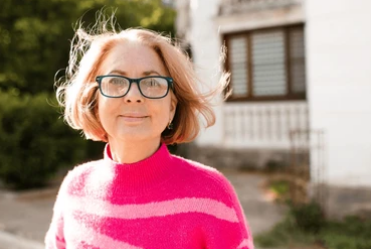
Photo: Shutterstock
Still working at midlife, her children on their own, Leah never received a diagnosis at all. She found ways to manage what she thought of as her peculiarities and to arrange her life around them: exhaustion after social occasions, elaborate routines that keep life manageable, sensitivity to noise, a need to rehearse conversations beforehand. When one of her children suggests autism, she doesn’t reject the idea and begins reading. It’s revelatory. She starts connecting scattered events across 50 years and a picture emerges. In time, Leah does receive diagnoses of autism and OCD. Her past hasn’t changed — only her understanding of the person who lived it has.
Submerged Identities
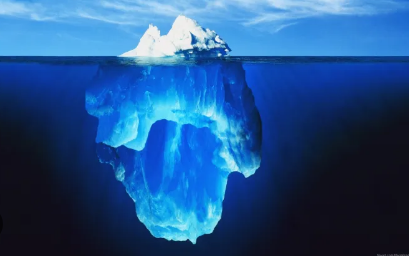
Photo: Iceberg Illusion
Disability researcher Diane Roberts, from the University of Huddersfield, UK, identified another dimension of self-identity in interviews with adults aging with physical or sensory disabilities. Beneath the more obvious roles they described — worker, parent, spouse, son/daughter — she found what she called submerged identities. Disability had affected how the older adults experienced those roles, what choices were available to them, how others responded to them, and how they interacted with the world.
Roberts was interested in the distance between contemporary ideas about identity and the reality of living them.
Identity may be fluid; diversity and difference may be embraced; people who are “different” may also be “normal.” But, as she put it: “The question is whether and how they are translated into ‘everyday life.’” Her research uncovered some of what happened in that everyday life:
Their identity is an amalgam not only of the outcome of deliberate choices but from major and ongoing inputs from those whose influence would normally wane across the life course. — Diane Roberts, ‘I’ For Identity: Reflections on Ageing with a Disability, ResearchGate
What is submerged isn’t necessarily secret or suppressed. It may simply be something that has been influencing the construction of self all along, before we can understand what it is or what it has meant.
Although Roberts was studying physical and sensory disability, I think the idea works well in relation to neurodivergence. We don’t construct identity solely from the parts of ourselves we consciously choose or even recognize. What is submerged isn’t necessarily secret, suppressed, or even hidden from other people. It may be influencing self-formation long before we have the language to identify it — or before we recognize its significance.
In Roberts’ formulation, submerged identities can affect the choices we make, the environments in which we flourish or struggle, the judgments we absorb, and the stories we tell ourselves about why life has unfolded as it has. Sometimes it takes new information, a new environment, or simply more life experience before we can bring those influences to the surface — and reconsider what they have meant all along.
Analysis: Different Minds, Different Configurations of Self
Original graphic: Jan Swan, with ChatGPT
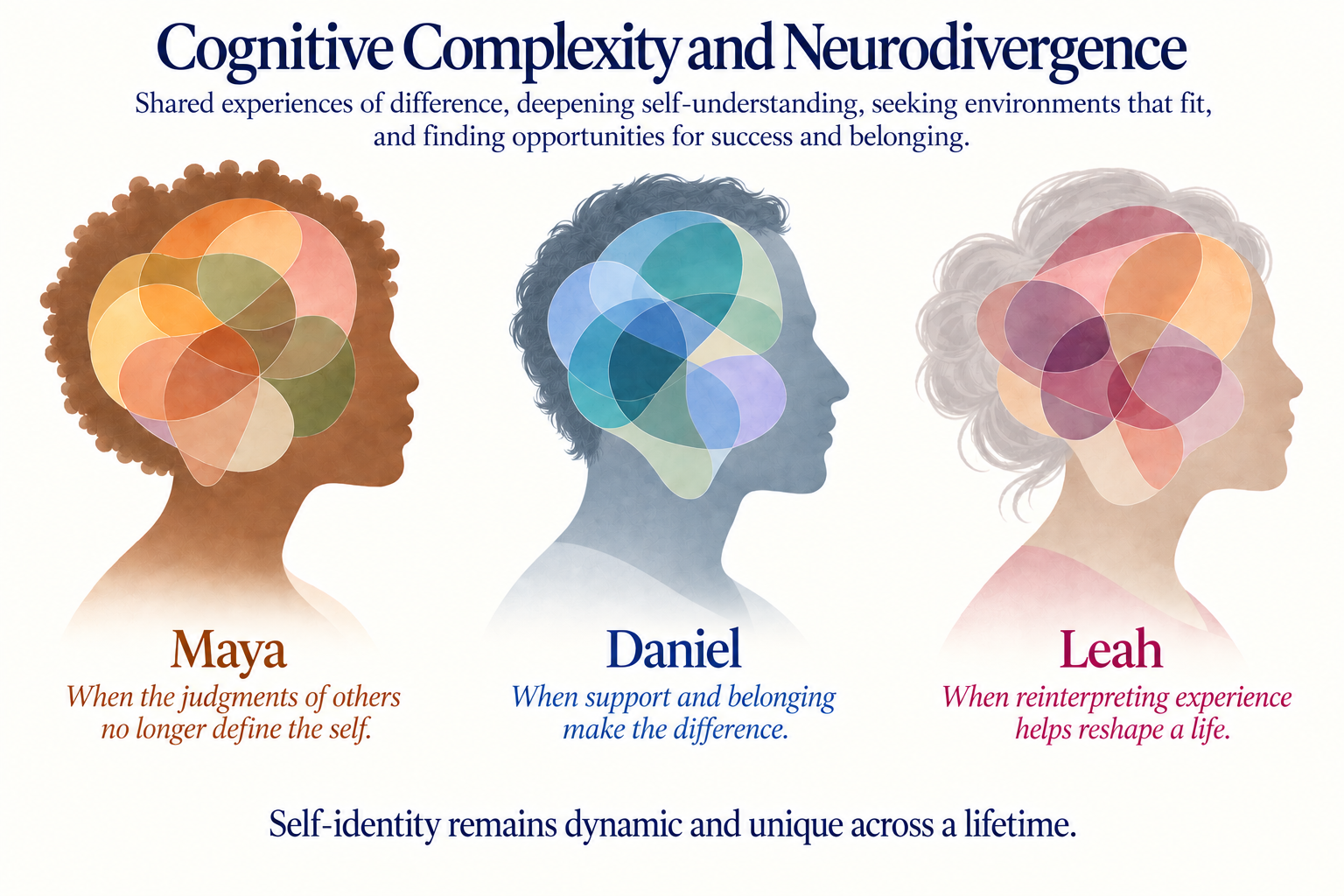
Let’s play out these concepts in the lives of Maya, Daniel, and Leah. We’ve established that each person is neurodivergent (ND), but each represents a different kind of identity complexity:
- Maya learned about her difference first through other people. Before she had an ADHD diagnosis, curiosity sustained her even as she struggled with worksheets. Judgments that she was careless, not trying, or not living up to her potential became part of the information from which she constructed a sense of herself.
- Daniel knew he was capable because he had abundant evidence of it. His analytical ability landed him a job, but then the demands on him changed. Abilities that had carried him successfully through college were no longer enough.
- Leah spent much of her life adapting to differences she couldn’t name at all, in part because information she needed wasn’t yet available to her. Only much later could she reconsider seemingly unrelated experiences and recognize a pattern running through them.
What we’re told by other people about our differences can easily merge with parts of who we think we are. What we decide to do can depend on what our environments ask us to do. As we gain new information, we can reorganize our understanding of the particular circumstances of the life we’ve been living. Submerged within all three identities are influences whose significance becomes apparent much later.
What the theory of self-complexity suggests is that a person with several meaningful and somewhat independent sources of identity — work, family, friendships, interests, community, abilities — may have stronger psychological support when one part of life goes badly. In contrast, a person whose self-worth is concentrated in one or two closely connected identity sources may be more vulnerable when one of them is threatened. And when different parts of the self seem contradictory or difficult to reconcile, answering Who am I? becomes harder still.
As noted above, more complexity is not always better, nor does coherence require every part of us to agree. Various aspects of ourselves can be mutually reinforcing, while difficulties in one area can spill into others. A varied sense of self may provide protection, while conflicting demands can become confusing. What matters most is how multiple identities fit together — and how much of the self rises or falls when one part is under strain.
A poor fit with one’s environment can communicate something is wrong with me. A better fit can reveal strengths that were there all along. Support, accommodation, belonging, and understanding can give people more room to use their strengths, meet difficulties with greater self-knowledge, and build lives that fit them better.
For ND people, environmental fit is a particularly complicating factor, but it also doesn’t predict the future. Vulnerability at one stage of life can become experience to draw on in the next. People can learn what they need, where they function best, and what kinds of support help them thrive.

Photo: The New Yorker
We can imagine some of those possibilities in our three profiles:
- Daniel may learn what kinds of workplaces allow him to contribute without feeling defeated by opaque expectations.
- Maya may eventually discard judgments she absorbed as a child and build other sources of competence and belonging
- Leah can use her new understanding not merely to reinterpret her past, but to make choices that better fit the future she wants.
What changes is the meaning each unique person makes of who they are, the environments in which they place themselves, the support they seek and accept — and the possibilities they see for who they can become.
Coming Up Next

In Post 42. Empathy and Difference — Recognition and Effort, I leap from exploring the complexities of the neurodivergent mind toward concluding with posts dealing with more practical matters. I intend this next post to have a foot in both worlds: research and practical living.
How people are treated — with empathy as the stand-in word for humane and supportive treatment — can make all the difference. And if that were the norm, I believe we’d have a better world. But of course it isn’t. Sure, there have been dramatic improvements over the past 50 years, but not enough progress for what we know, empirically and intuitively, is the right thing.
Copyright ©2026 Jan Swan
 English