On Neurodivergence and Otherness
Show Table of Contents
INTRO
1. On Neurodivergence and Otherness: An Introduction
SENSES AND SENSORY SENSITIVITIES
2. Senses Count
3. Neurobiology for Dummies
4. Sensory Transmission and our Reward System
5. Sensory Receptors are the Body’s Cellular Plan
6. A Synthesis: Sensory Systems and our Emotions — Part I
7. A Synthesis: Sensory Systems and our Emotions — Part II
8. Sensory Disorders and Sensitivities
9. Etan’s Story
SYNESTHESIA
10. Synesthesia: Difference, But Not Disorder
11. Synesthesia, Creativity, Artistry — Part I
12. Synesthesia, Creativity, Artistry — Part II
AUTISM AND THE NEURODIVERSITY MOVEMENT
13. From “Mental Defectives” to Autism Spectrum Disorder
14. Changing Conception of Autism
15. Autism Diagnoses and Behavior Patterns
16. Autism Treatments that Help
17. Early Start Autism Treatment: A Case Study
18. Neurodivergence and the Neurodiversity Movement
19. Neurodiversity Takes Flight
20. ADHD and Neurodevelopmental Disorders
21. ADHD: A Preponderance of Risk Factors and Symptoms
22. ADHD: Inattentive, Impulsive … and Hyperactive?
23. ADHD: Named, Renamed, Still Needs a New Name
24. ADHD: Treatment and Coping Skills for All Ages
LGBTQ+
25. Neurodiversity and the LGBTQ+ Fight
26. LGBTQ+ Identity and Expression
27. LGBTQ+ and Mental and Behavioral Healthcare
ON LANGUAGE
28. Language Matters In and Around Neurodiversity
29. Neuroinclusion and Disability Language
30. Neurodivergent Language Difficulties
ON CREATIVITY AND GIFTEDNESS
31. Neurodiversity and Creativity
32. Giftedness is a Piece of Neurodivergence
SELF-IDENTITY
33. Self-Identity: The Cornerstone of Neurodiversity
34. Early Theories of Self-Identity Formation
35. Contemporary Theories of Self-Identity Formation
36. Authenticity and the Search for Self
37. Self-Schemas and Neurodivergence
38. Self-Labeling and Parts Work
39. Complexity, Clarity, and Self
IMPROVING LIFE FOR NEURODIVERGENT PEOPLE
40. Empathy Recognizes and Navigates Difference
41. Reducing Neurotypical-on-Neuroatypical Conflict – Part I
42. Reducing Neurotypical-on-Neuroatypical Conflict – Part II
43. Communicating Across the Neurospectrum – Part I
44. Communicating Across the Neurospectrum – Part II
45. Neurodiversity: Advocacy and Education
46. Neuroinclusion in the Workplace
47. A Neurodiverse Lifestyle
IN CONCLUSION
48. In Conclusion: Neurodivergence and Inspiration
30. Neurodivergent Language Difficulties

In the prior two posts, I talked about the rapidly shifting landscape of language in neurodiversity and what’s formally acceptable “disability-inclusive” language since the 1990s. Language change is at the heart and soul of the neurodiversity movement, but also a defining feature — or symptom — of neurodivergence, a potentially lifelong struggle with speaking, comprehension, reading, and writing for many on the ND spectrum from mild to severe.
Some extraordinary but locked-in minds were only able to surface once technology could capture their words (autism).
Others have language issues stemming from attention deficits (ADHD), reading and writing impairment (dyslexia), speaking (apraxia), or hearing and seeing words but not comprehending them (auditory processing disorder/APD).
Language Issues in Children and Adults with ADHD and Autism
Language tells others who we are and what we believe in. It shapes how we think. Language deficits cloud the ability to communicate, understand, decipher body language and gestures, do well in school/work, and pick up social cues toward creating successful relationships [from my notes, unattributed].
Though many physical and mental disorders have language impairments, I’ll focus on ADHD and autism to discuss how such issues affect development and daily functioning. Early diagnosis and treatment interventions go a long way in correcting language deficits for children, so they don’t necessarily carry through adult life. But language disorders can affect identity formation and self-esteem, which are harder to turn around as a person ages.
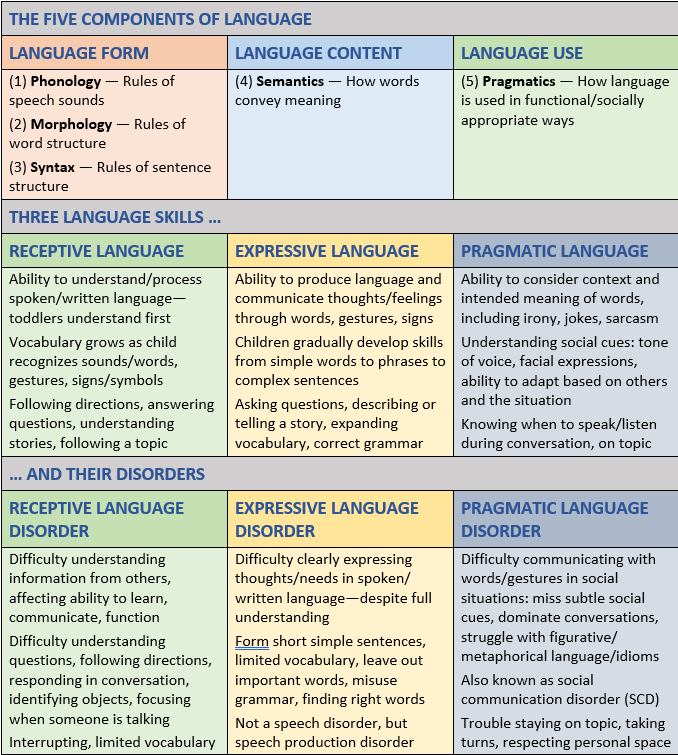
Understanding the components of language helps explain deficits. One way to organize the component parts is by form, content, and use — deficits can be in one component or all of them.

Photo: “Adult Dyslexia: When It’s as Good as It Gets,” Author Don Winn Blog
Common Patterns of Language Use in Children with Autism
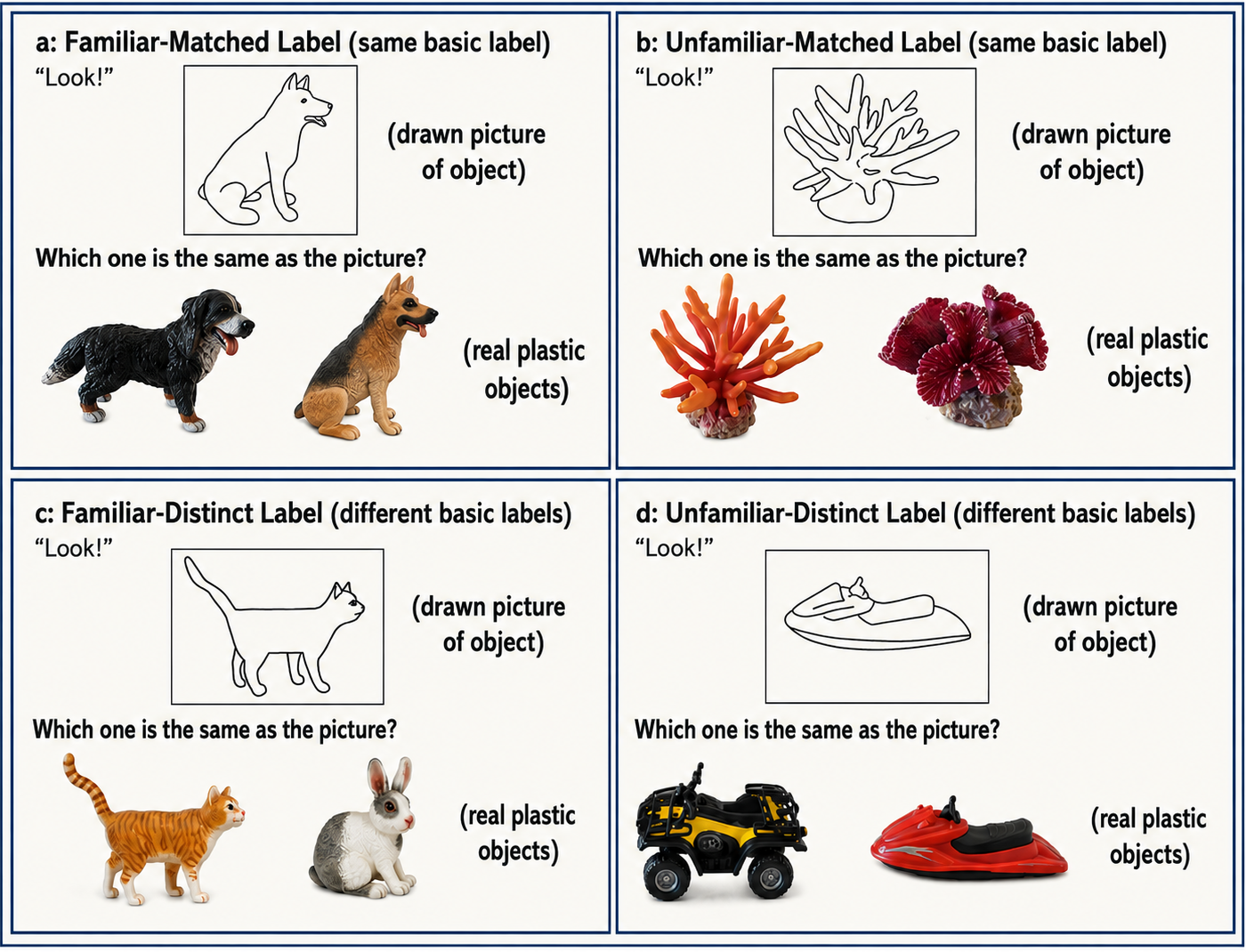
Picture comprehension test, “Receptive and expressive language ability differentially support symbolic understanding over time in late talking and typically developing children,” Journal of Experimental Child Psychology, Science Direct
- Repetitive or rigid language — They might speak words without
meaning or without relating to the conversation, perhaps repeatedly counting to five instead. A condition called echolalia is continuously repeating someone else’s words, responding to a question by asking the same question (immediate echolalia), repeating words heard at an earlier time (delayed echolalia), or using stock phrases to start a conversation (My name is Tom when talking to family or
repeating phrases from TV or commercials). - Narrow interests and exceptional abilities — Some may have rich vocabularies and be able to talk about specific subjects in detail. They might be able to give an in-depth monologue about their favorite
topic but can’t hold a two-way conversation on it. - Uneven language development — Many develop speech/language skills at an uneven rate of progress, starting as young as age 2. They may quickly develop a strong vocabulary in an area of interest, remember recent information, or read words before age 5 without comprehension, while not responding to other’s speech or to their own names.
- Poor nonverbal conversation skills — They often can’t use meaningful gestures, like pointing or other nonverbal skills that enhance oral language. They can become frustrated in trying to make their feelings, thoughts, and needs known.
- Semantics — They may have difficulties relating to the meaning of words and how words are used. This may include getting confused discerning words like man and boy. (More below.)
Treating Receptive and Expressive Language Disorders
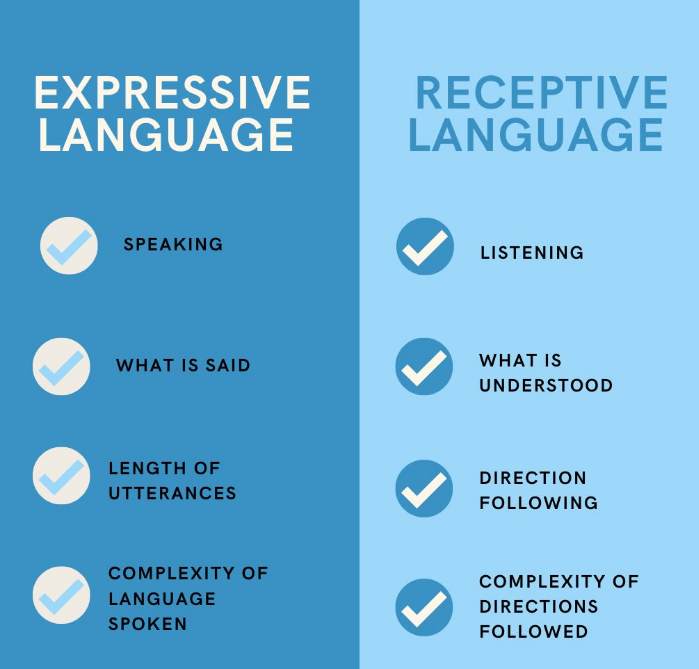
Graphic: “Expressive vs Receptive Language Skills,” @It’s Remotely Speech, Pinterest
Language deficits can be treated — the earlier the intervention, the more positive the outcome, though treatment may need to be continued long term. Child therapies include developing receptive vocabulary, expressive understanding, expanding vocabulary and sentence complexity, and helping with clear expression of wants, needs, and ideas.
A successful outcome includes educating parents/teachers to reinforce language strategies daily and use augmentative and alternative means of communication (AAC), which is a strategy with lots of tools and devices — gestures, picture boards, computers — to facilitate communication [augmentative: add to someone’s speech; alternative: use instead of speech]. ACC also teaches sign language or natural gestures (pointing or pretending to eat or drink).
Understanding Semantics
Semantics is the study of language, language development, and language-processing. It looks for meaning in single words, phrases, and relationships between words: synonyms, antonyms, polysemes, and homonyms. Use of metaphors, irony, humor, work play (puns).
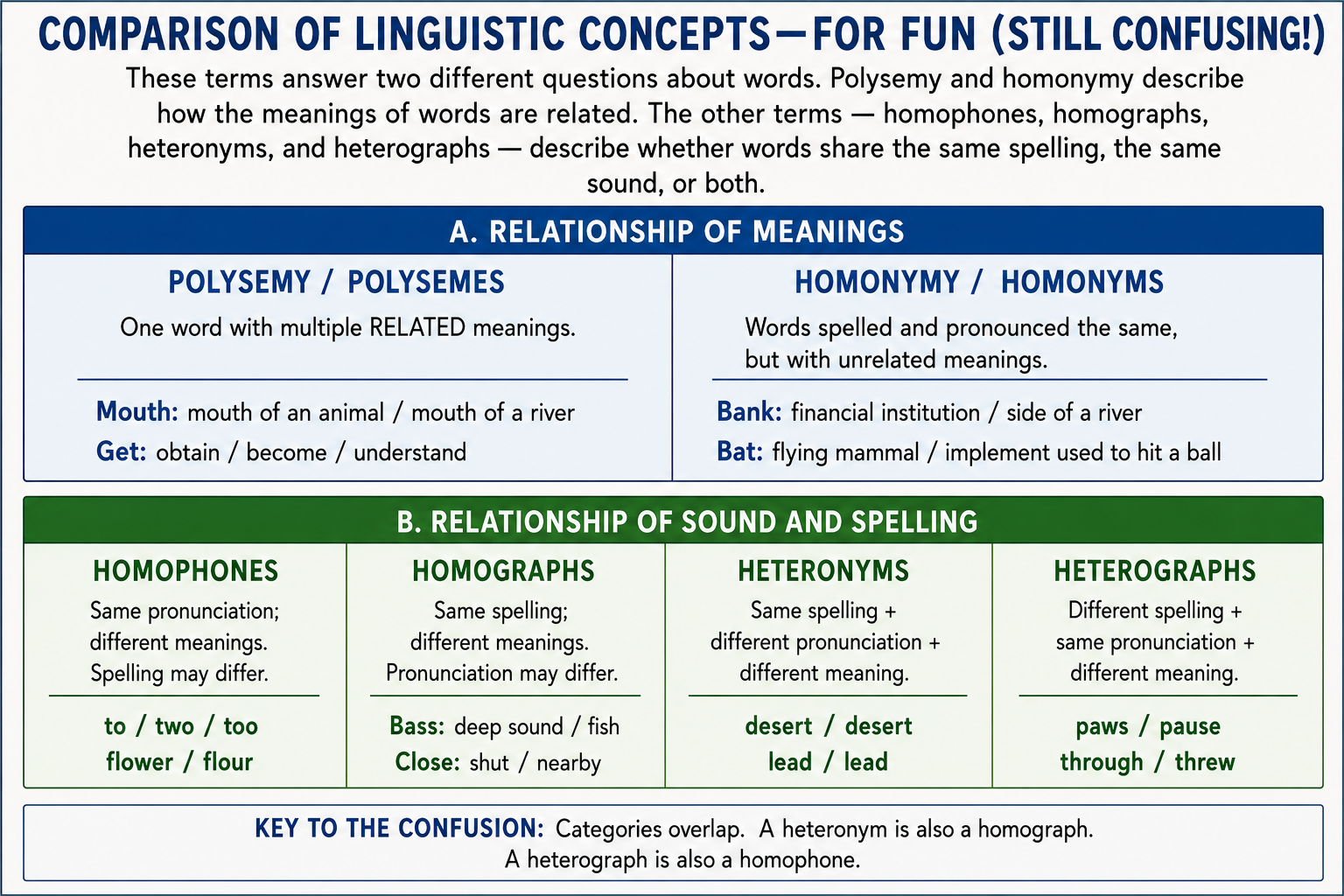
Graphic: Jan Swan, with ChatGPT
We develop semantic skills as children to express thoughts and feelings to be understood by others — to gain an understanding of the world. That includes verbal communications, but also nonverbal: signs, gestures, symbols, and grammar. I was very taken by toddlers in my family learning to sign, which helped reduce their frustration before they had language — and especially important if they happened to have language and communications delays or impairments. Speech and language therapists figure out the reasons a child is struggling with speaking, understanding, reading, and/or writing and then can provide targeted therapy.

Photo: Adobe Stock
Semantics also studies how people draw different meanings, based on cultural, social, political context, and national, age, racial, or sexual identities. And for our purposes, this includes neurodivergence, especially autism, ADHD, dyslexia, and dyspraxia.
Semantic Language Difficulties and Semantic Conflict
In “Pragmatic Deficits and Social Impairment in Children with ADHD,” PubMed Central/NIH, Ekaterina Staikova, et al., indicate individuals with ADHD and autism experience more semantic difficulties than their peers—which vary depending on the individual and the severity.
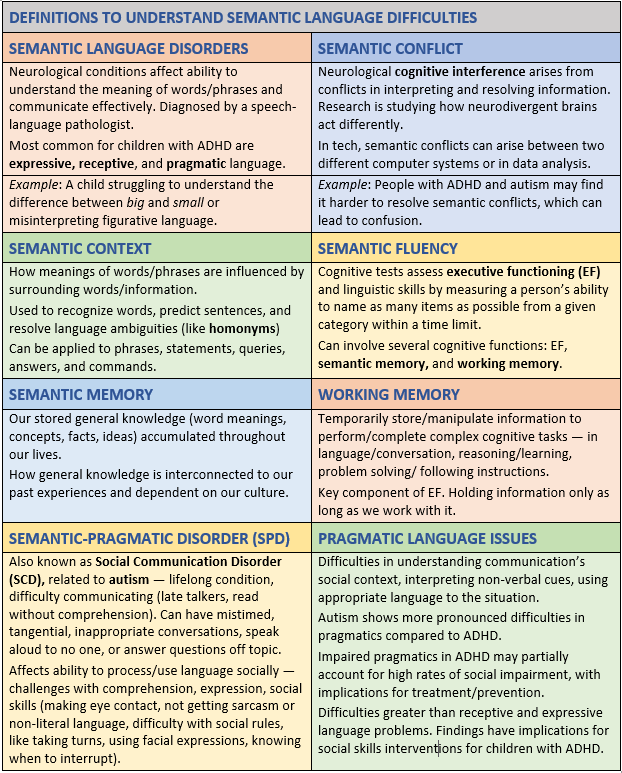
Source: Ekaterina Staikova, et al., Pragmatic Deficits/Social Impairment in Children with ADHD,” PubMed Central/NIH
Semantic and ADHD Research
Highlights of recent research into semantic language disorders and semantic conflict have shown clear areas of impairment for those with ADHD and autism, among other conditions, like semantic-pragmatic disorder and hearing impairments:

Photo: iStock
Language problems reportedly occur in nearly half of ADHD children. They have later onset of talking and are less mature in their self-talk. Reports on the nature of language deficits in ADHD have been inconsistent, with several studies suggesting that language difficulties in ADHD may be primarily characterized by impairment in pragmatics (social use of language, managing how many aspects of language are used to make conversation) — and includes both verbal (language) and non-verbal (gestures) skills. General language ability correlates with pragmatic skills. Impairment in pragmatic language has been shown to contribute to problems in school functioning/performance, peer relationships and overall psychiatric adjustment, and is associated with many psychiatric disorders.
Given that communication requires the ability to initiate, respond, and maintain attention, it is not surprising that several symptoms of ADHD are associated with pragmatic deficits. [Researchers] showed both inattention and hyperactivity/ impulsivity can interfere with verbal and non-verbal aspects of communication, including staying on topic and maintaining proper physical proximity.
Pragmatic deficits in children with ADHD, reported by parents and teachers, found that not only were children with ADHD rated as having more pragmatic deficits and social difficulties compared to typically developing children, but ratings of their pragmatic skills were only marginally different from children with [autism]. Similar to [autism], children with ADHD were rated as having relatively more difficulties with pragmatics than with structural language. —Ekaterina Staikova, et al., “Pragmatic Deficits and Social Impairment in Children with ADHD,” PubMed Central/NIH

Photo: Canva
- Adults with ADHD were less able than non-ADHD adults at resolving semantic conflicts between literal and metaphorical meanings in sentence pairs. While both groups could understand metaphors in writing (I’m on cloud nine, Your room is a pigsty, All the world’s a stage…), ADHD adults performed less well on tasks of word retrieval, working memory, and non-verbal abilities — all of which relates to their deficits in sustained, executive attention compared to others. Attention plays a major role in ADHD adults resolving semantic conflicts, according to “Semantic conflicts are resolved differently by adults with and without ADHD,” by Dorit Segal, et al, PubMed/NIH.
- In the ADHD group, semantic fluency was related to the ability to resolve semantic conflict. In the non-ADHD group, semantic fluency was related to executive attention (ability to select what to focus on) — a clear deficit area for those with ADHD.
- Children with ADHD had more language difficulties and semantic conflicts, including understanding metaphor, than children without ADHD.
Semantic and Autism Research

Children with autism don’t use semantic context to interpret ambiguous sentences, identify the correct meaning of words, or infer how to pronounce homographs (same spelling, different meaning, like entrance, a way into a room or to hypnotize). Other difficulties: understanding complex sentence structure, conveying story narratives, using pronouns correctly, adding irrelevant information, delayed/impaired language processing speed, integration with cognition.
Autistic adults struggle more with central coherence — difficulty integrating information from different parts of a sentence or situation to understand the overall meaning — leading to semantic misinterpretation.
Semantic Research Comparing ADHD and Autism Groups

Source: Child Mind Institute
- Both autistic and ADHD groups struggle in understanding the nuances of language, interpreting figurative language (more descriptive, literary language with metaphors,
comparisons, imagery), understanding idioms and sarcasm, interpreting language with
multiple meanings, or drawing conclusions based on context. - Studies comparing language abilities in children with ADHD and autism found both
groups show pragmatic difficulties, but the autism group shows more severe semantic
impairments, especially with understanding complex social cues and interpreting subtle
meanings. The severity of semantic difficulties in both groups varies depending on the
individual’s developmental level.
- Semantic difficulties also have a significant impact on social interaction for both ADHD and autism groups, leading to misunderstandings and difficulties forming relationships.
Coming Up Next

In Post 31: Neurodiversity and Creativity, I leave language change and impairment to reflect how thinking has evolved and humanity toward difference is peeking out from behind the clouds. Treatments are getting better, and interventions are started younger. At the same time, there’s more understanding of neurodivergence and art, science, and creativity. In a progressive neurodiverse society, the arts and sciences thrive. The next post is on creativity and neurodivergence.
Copyright ©2026 Jan Swan
 English