On Neurodivergence and Otherness
Show Table of Contents
INTRO
1. On Neurodivergence and Otherness: An Introduction
SENSES AND SENSORY SENSITIVITIES
2. Senses Count
3. Neurobiology for Dummies
4. Sensory Transmission and our Reward System
5. Sensory Receptors are the Body’s Cellular Plan
6. A Synthesis: Sensory Systems and our Emotions — Part I
7. A Synthesis: Sensory Systems and our Emotions — Part II
8. Sensory Disorders and Sensitivities
9. Etan’s Story
SYNESTHESIA
10. Synesthesia: Difference, But Not Disorder
11. Synesthesia, Creativity, Artistry — Part I
12. Synesthesia, Creativity, Artistry — Part II
AUTISM AND THE NEURODIVERSITY MOVEMENT
13. From “Mental Defectives” to Autism Spectrum Disorder
14. Changing Conception of Autism
15. Autism Diagnoses and Behavior Patterns
16. Autism Treatments that Help
17. Early Start Autism Treatment: A Case Study
18. Neurodivergence and the Neurodiversity Movement
19. Neurodiversity Takes Flight
20. ADHD and Neurodevelopmental Disorders
21. ADHD: A Preponderance of Risk Factors and Symptoms
22. ADHD: Inattentive, Impulsive … and Hyperactive?
23. ADHD: Named, Renamed, Still Needs a New Name
24. ADHD: Treatment and Coping Skills for All Ages
LGBTQ+
25. Neurodiversity and the LGBTQ+ Fight
26. LGBTQ+ Identity and Expression
27. LGBTQ+ and Mental and Behavioral Healthcare
ON LANGUAGE
28. Language Matters In and Around Neurodiversity
29. Neuroinclusion and Disability Language
30. Neurodivergent Language Difficulties
ON CREATIVITY AND GIFTEDNESS
31. Neurodiversity and Creativity
32. Giftedness is a Piece of Neurodivergence
SELF-IDENTITY
33. Self-Identity: The Cornerstone of Neurodiversity
34. Early Theories of Self-Identity Formation
35. Contemporary Theories of Self-Identity Formation
36. Authenticity and the Search for Self
37. Self-Concept and Self-Schema
38. Self-Labeling and Parts Work
39. Complexity, Clarity, and Self
40. Cognitive Complexity and Neurodivergence
41. Cognitive Complexity Meets Self-Identity
IMPROVING LIFE FOR NEURODIVERGENT PEOPLE
42. Empathy and Difference – Recognition and Effort
43. Empathy and Difference – Response
44. Reducing Neuroatypical-Neurotypical Conflict – Part I
45. Reducing Neuroatypical-Neurotypical Conflict – Part II
46. Communicating Across the Neurospectrum – Part I
47. Communicating Across the Neurospectrum – Part II
48. Neurodiversity: Advocacy and Education
49. Neuroinclusion in the Workplace
50. A Neurodiverse Lifestyle
IN CONCLUSION
51. In Conclusion: Neurodivergence and Inspiration
42. Empathy and Difference — Recognition and Effort

John Kilduff, David’s Dream, painting, Saatchi Art
Empathy as a subject may seem an odd choice following several posts on self-identity formation, self-labeling, self-concept clarity (SCC), and cognitive complexity. But I’ve come to see that this is where those ideas have been taking me — to this discussion of neurodivergence/neurodiversity and how we live together in a pressure-cooker world.
Because, as I understand it from those living it, people with difference tend to succeed in life to the extent there’s empathy and support around them. I don’t offer this as scientific fact. My upfront observations are personal and anecdotal.
We’ve been looking inward at how we develop, organize, and make sense of who we are. But we don’t live inwardly. We take that self into families, friendships, schools, workplaces, and communities, where we encounter people whose experiences of the world are plainly different from our own. And we encounter one another.
I’ve witnessed with my sons how the presence or absence of empathy can make a difference. One authoritarian teacher, one nasty boss, one parental misstep (guilty as charged), and they can shut down. They stop making progress. Anxiety and depression replace hope.
This, in a nutshell, has been an essential motivating factor for me in writing this blog. If I can’t understand and respond appropriately to my sons’ emotions and needs — no matter at what stage of life — I can forget about having an authentic relationship with them, truly supporting them in their life choices, and continuing my own growth and fulfillment as a mother and a person.
But the questions go well beyond my sons and even beyond neurodivergence. Difference takes many forms. People can be ignored, misunderstood, stigmatized, or pushed to the margins because of neurological difference, mental illness, disability, sexual orientation, gender identity, or other aspects of who they are.
So I want to turn the questions around. Can we recognize and accept another person’s experience when it’s profoundly different from our own? Can we recognize when difference might not be visible? Do we layer our own experiences over theirs, as if ours are the ones that count?
Empathy and Difference
Empathy is often described in terms of three types — cognitive, emotional, and compassionate empathy — distinctions that help explain different ways we understand, share, and respond to another person’s experience. The graphic summarizes those familiar terms.
But across this series, I keep coming back to what empathy requires when the other person’s experience is not only different from our own, but different in ways that may be difficult to see, interpret, or even imagine. This is a harder question and more significant for a series on neurodivergence and neurodiversity.
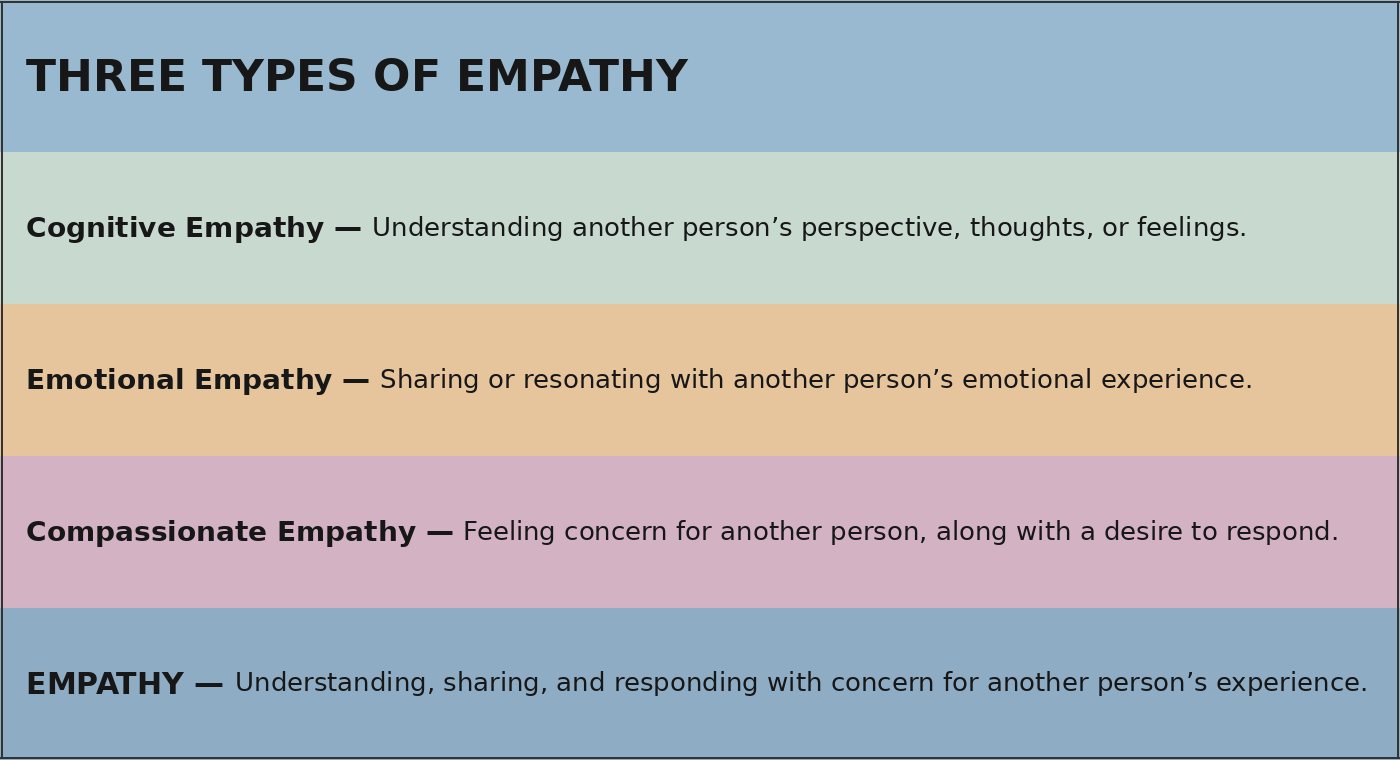
Original graphic: Jan Swan, with ChatGPT
Reading the research on neurodivergence, masking, stigma, identity, and belonging lead me to think about empathy here less as a set of types and more as a sequence of demands placed on the person doing the empathizing. This is a shift: from the burden placed on the ND person and how they must behave to the people and environment around them.
In the context of difference, those demands come down to three connected challenges.
- First is recognition: can we see and accept another person’s experience without assuming it resembles our own?
- Then comes effort: can we appreciate how much work it may take for someone who is different to navigate a world built largely around other people’s ways of functioning?
- And finally, response: does what we recognize and understand change how we treat that person — the expectations we place on them, the support we offer, and the room we make for them to live as themselves?
In this post, I’ll take up recognition and effort. Response, which follows, deserves a post of its own.
1. Recognition: Authenticity and Self-Labeling

Photo: iStock
Recognition is less simple than it sounds. It asks something different from us when another person describes an experience, identity, or way of being that we don’t share — or perhaps genuinely don’t understand.
In post 38, I discussed self-labeling as a way to understand the multiplicity of our various aspects and how they accumulate into a coherent whole. Here I want to explore how recognizing our own “multiple selves” can help us appreciate that another person’s self-labeling may involve selves we can’t imagine. And this can open the door to mutual understanding and empathy.
An article by Justin Sides, “Authentic Identity,” Sexual and Gender Institute, pulls it together for me.
Sides considers a question the institute had received: How should someone respond to a gay person who argues that choosing a particular religious identity is a way of fooling oneself and not being authentic? The question assumes that the only authentic identity for someone experiencing same-sex attraction is a gay identity label.
Then he turns the question around. Rather than deciding whether another person’s label is authentic, he suggests becoming curious about what “authentic” means to that person and what their chosen identity means to them. As he writes, “This does not necessarily mean that anyone is fooling themselves; rather, it gives space for people to make meaning of the multiple parts of their life that are congruent with their values.”
This is where recognition becomes more demanding than noticing another person’s difference. That person’s understanding of their own experience belongs to them — and our interpretation of their experience is certainly not more authentic than theirs.
This is the value of understanding concepts like self-labeling and cognitive complexity as potential “preconditions” to empathy. If we recognize that many different aspects make up our own identities, we may be better able to accept that another person’s identity includes aspects we don’t understand. And that can involve sexuality or religion, hypersensitivity to sensory stimulation, dyslexia, or autism and ADHD.
If there can be that heightened level of recognition, then what might otherwise be cause for further retrenchment into self could instead shift to an opportunity for insight, change, and empathy for self and others.
2. Effort: Invisible Difference

Photo: Shutterstock
Writing this 51-post series has taken me places I had no idea I’d travel. Especially because I was unprepared for a journey that caused me to reassess my role as a mother — and later, as a neurotypical (NT) mother of two neurodivergent sons.
Because they both invested in me in different ways, I gained a kind of “second sight” (minus the supernatural part) into what had been invisible about their lives: the massive expenditure of energy it can take to be neuroatypical in a neurotypical-dominant culture.
My sons have given me a chance to see the jittery cold sweat and nervous exhaustion of overloaded lives masquerading as “normal.” It has sometimes been difficult and hurtful to hear what they needed to tell me, but also crucial to our progress.
This neurodivergence series began because of something of minor consequence that happened a few years back but crystallized a breakthrough. I told this story in my introductory post to the series. I’ll briefly retell it here, along with other personal experiences and accounts from autistic people — this time through the lens of empathy and invisible effort.
ETAN AND SENSORY DISRUPTION

In post 1, I tell the story of a conversation with my son and his friend Lena about being neuroatypical — an altogether new term for me and one I’m trying hard to understand. After all, this is my son telling me the label applies to him, catching me off-guard as if he were revealing membership in a secret society.
As I concentrate on what they’re telling me, they both burst out laughing. I know it isn’t at me, but I’m nonplussed all the same.
I ask what’s funny. They tell me Max, their dog, is drinking water from a metal bowl, her tags clanking against the side — setting up a noisy racket. I join them in laughing, and our connection grows closer as a result. Etan and Lena are distracted by the noise, while my attention remains focused on our conversation. My senses have effectively filtered out the interruption. Theirs have not.
Here’s why I’m retelling this story. Our exchange creates an opportunity for empathy. Not pity or sympathy, and certainly nothing major. I notice something I don’t understand and ask about it. They explain an experience that is foreign to me, and I learn something.
But change one move. Suppose I push past their laughter, treating the interruption as odd or irrelevant.

Photo: Shutterstock
They may feel chastened by their inability to stay with the conversation. To rejoin it, they have to recover their attention and pick up the thread. Something is lost, and I probably don’t notice.
Nothing dramatic happens — but that’s precisely the problem. The moment passes unnoticed by me, while adding one more small experience of being misunderstood to theirs. Perhaps among thousands of tiny moments like this.
SENSORY OVERLOAD AT THE RESTAURANT

Photo: Shutterstock
In a second, more recent incident, Etan abruptly leaves a restaurant in the middle of a family meal. It’s particularly noisy and chaotic, with waiters rushing around, loud music, the smells of seafood — sensory inputs accumulating until he literally can’t remain at the table another minute. He quietly tells me why he’s leaving and that he’ll be back. When another family member inquires after him — Headache? Stomachache? Something we said? — I explain that it was sensory overload. Their faces tell me they don’t understand.
In other words, the NT people at the table haven’t experienced the accumulating sensory load — only its consequence: Etan leaving. When he returns, nothing is said.
This is the empathy problem in its most ordinary — and possibly most revealing — form. Etan withdraws, but no one around him (beside me) understands why, setting up the possibility for misunderstanding among people who absolutely know and care about him. Absent an explanation they understand, they may reach for one they do: perhaps he’s being rude, overly sensitive, or odd.
Sensory processing helps explain why environmental information that barely enters one person’s awareness can compete strongly for another’s. What looks like a sudden decision to leave comes only after considerable effort to remain.
The people at the table see Etan leave. They don’t see how hard he has worked to stay.
MY LEARNING CURVE

Photo: Magnific
For most of his childhood and young adult years, I thought of Etan as quiet, shy, reserved, anxious. At large family gatherings, he often couldn’t get a word into fast-moving conversations. Nobody made enough room for him to enter — including me. Eventually, he stopped trying.
I love my son. But love doesn’t automatically provide insight into his experience.
Etan eventually gave me that insight himself. There was enough love between us that he invested in explaining things I never understood, including things about myself and my parenting that were painful for me to hear. I heard judgment and it hurt. Then I got over myself and started to change.
Over the years, my interpretation of Etan’s outward behavior shifted from what I believed was happening to what was actually happening from inside his experience. His quiet mood didn’t necessarily signal shyness, nor did leaving necessarily signal emotional withdrawal. What I never considered was the effort it took to stay present with me. What I thought I knew about my son would still be wrong today if he hadn’t explained himself to me.
As I changed my thinking, our relationship changed from one about love and duty to one about love and authenticity. I feel like I know more that’s real about my son and his difference because I believe what he’s told me — including the invisible effort I never knew he was making.
JADEN AND COGNITIVE LOAD
Well before he became ill and diagnosed with bipolar disorder, my older son Jaden was attending college as a math major. By his junior year, math classes became more demanding, shifting from 75-minute lectures three times a week to three-hour seminars twice a week.
Jaden’s ADHD made that kind of sustained attention challenging enough. But one seminar met in a classroom with an old clanking radiator and was taught by a professor whose heavily accented English required additional concentration for Jaden to understand. He called me convinced he was going to fail the class.
I suggested he speak to his advisor and request an accommodation. Unbelievably, they moved the classroom. Jaden was shocked they took him seriously.
At the same time, he sought treatment for his ADHD and moved his seat to the front of the classroom. With greater support from the college and steps he took himself, he passed the course.
None of the demands confronting him — three hours of sustained attention, processing speech that required additional concentration, intrusive ambient noise, and ADHD — would necessarily defeat Jaden. Taken together, however, they placed substantial demands on limited attentional and working-memory resources. This is where the concept of cognitive load becomes useful: the demands placed on working memory as we process and learn information.
The mathematics didn’t get easier. The conditions under which he had to learn became more manageable.

Photo: istock
What stays with me is how surprised Jaden was that the college took him seriously. He expected to be told to just deal with it. Instead, someone listened to his account of what was interfering with his ability to learn and changed the environment. Feeling validated and supported, Jaden was further motivated to take additional steps himself.
No one lowered the expectations of a rigorous mathematics course. They made it more possible for him to access it. A three-hour math seminar, in other words, isn’t necessarily the same three-hour math seminar for every student. The observable demand isn’t always the actual demand.
AUTISM: THE EFFORT OF APPEARING EFFORTLESS

Photo: Magnific
In reading both autism research and personal writing by autistic people, I can see the irony, and a cruel irony at that, of people who work hard at empathy and are nevertheless judged as lacking it. I find this unimaginably hurtful.
For decades, autistic people with social communication challenges have been labeled as empathy deficient. Yet when researchers ask autistic people themselves about empathy, a much more complicated picture emerges.
Researchers Lesley Kimber, Diarmuid Verrier, and Stephen Connolly asked 76 autistic adults about their experiences of empathy, and their responses varied widely.

Photo: Magnific
Some described difficulty recognizing what another person was feeling. Others described intense empathic responses that became distressing. (Both Kimber and Connolly are autistic.)
One of the four themes the researchers identified was “Empathy as an effortful process.” Some participants described actively working to identify the social and emotional cues that call for an empathic response — an expenditure of energy that could become exhausting.
Source: Lesley Kimber, et al., “Autistic People’s Experience of Empathy and the Autistic Empathy Deficit Narrative,” 2024, Autism in Adulthood, PubMed/NIH
In an ordinary conversation, a person may be trying to understand what someone is saying while simultaneously considering facial expression, tone of voice, when to respond, how much eye contact is expected, whether something was meant literally, and whether their own face and body are conveying what other people expect to see.
For many neurotypical people, much of this happens with relatively little conscious effort. But for some autistic people, these aspects of dialogue may themselves require attention and work — at the same time the person is trying to follow the conversation.
The difficulty may not be apparent precisely because so much work is going into making sure it isn’t apparent. Masking or camouflaging can involve suppressing or compensating for autistic behaviors to conform more closely to NT social expectations. An autistic person who appears to be navigating a social encounter successfully may be devoting considerable cognitive and emotional resources to doing so.
Kimber and her colleagues write:
These different experiences of empathy contrast with societal expectations of empathy, which often result in additional labor for autistic people as they navigate the non-autistic centered world. —Lesley Kimber, et al., “Autistic People’s Experience of Empathy and the Autistic Empathy Deficit Narrative,” 2024, Autism in Adulthood, PubMed/NIH
Researchers Romy Hume and Henry Burgess, both autistic, illustrate just how different those experiences can be. Hume describes sometimes being overwhelmed by too much empathy. Burgess experienced little emotional empathy for much of his life but deliberately worked at learning cognitive empathy. Their dramatically different experiences show why the idea of a single autistic empathy deficit is too simple.
First-person accounts tell us something else about how invisible effort can accumulate over time. Jeanie Gee, who identifies as AuDHD and as a longtime high masker, writes about gradually learning which behaviors upset NT people and modifying her behavior in response. Experience teaches what may not come intuitively.
The effort in learning how to do this also accumulates. Say the wrong thing and see what happens. Remember what went wrong and do a better job of monitoring yourself next time. Live in fear that you’ll get it wrong again.
One incident may be almost inconsequential to everybody else. But the person being corrected, misunderstood, overlooked, or negatively judged is the one accumulating the experiences. Like death by a thousand cuts.
Sometimes that person adapts so successfully that the adaptation itself disappears from view. We see someone participating in a work meeting, making conversation, smiling at the right moment, getting through the extended family’s holiday dinner. We don’t see the constant monitoring, filtering, interpreting, suppressing, compensating, and recovering that may be taking place underneath.
This person, doing all this hidden work, may be devoting extraordinary attention to understanding other people’s reactions and adjusting their own behavior. And yet they may still be judged as “in their own head,” aloof, disinterested, rude, insensitive — or lacking empathy.
Sources: Romy Hume and Henry Burgess, “‘I‘m Human After All’: Autism, Trauma, and Affective Empathy,” PubMed/NIH; Jeanie Gee, “How Empathy is Experienced as a Neurodivergent,” Jeanie Gee on Substack
In Sum
Recognition and effort have brought us this far. Empathy asks us to recognize that another person’s experience may be quite different from our own — and then to appreciate that what we see on the outside may tell us very little about what it takes for that person to navigate the world. We see behavior. We don’t necessarily see the effort behind it. And sometimes the very success of that effort makes it invisible.
Coming Up Next

Recognition and understanding are important, but empathy ultimately asks something more of us. Does what we have learned about another person’s experience change how we respond to them?
In Post 43: Empathy and Difference — Response, I’ll look at what happens when empathy moves from understanding another person to changing our own behavior — the judgments we make, the expectations we set, the support we offer, and the autonomy we respect. Through experiences of ADHD, autism, and LGB young people coming out to their families, I’ll explore what it can mean to take another person’s account of themselves seriously enough so that the way we respond changes, too.
Copyright ©2026 Jan Swan
 English