On Neurodivergence and Otherness
Show Table of Contents
INTRO
1. On Neurodivergence and Otherness: An Introduction
SENSES AND SENSORY SENSITIVITIES
2. Senses Count
3. Neurobiology for Dummies
4. Sensory Transmission and our Reward System
5. Sensory Receptors are the Body’s Cellular Plan
6. A Synthesis: Sensory Systems and our Emotions — Part I
7. A Synthesis: Sensory Systems and our Emotions — Part II
8. Sensory Disorders and Sensitivities
9. Etan’s Story
SYNESTHESIA
10. Synesthesia: Difference, But Not Disorder
11. Synesthesia, Creativity, Artistry — Part I
12. Synesthesia, Creativity, Artistry — Part II
AUTISM AND THE NEURODIVERSITY MOVEMENT
13. From “Mental Defectives” to Autism Spectrum Disorder
14. Changing Conception of Autism
15. Autism Diagnoses and Behavior Patterns
16. Autism Treatments that Help
17. Early Start Autism Treatment: A Case Study
18. Neurodivergence and the Neurodiversity Movement
19. Neurodiversity Takes Flight
20. ADHD and Neurodevelopmental Disorders
21. ADHD: A Preponderance of Risk Factors and Symptoms
22. ADHD: Inattentive, Impulsive … and Hyperactive?
23. ADHD: Named, Renamed, Still Needs a New Name
24. ADHD: Treatment and Coping Skills for All Ages
LGBTQ+
25. Neurodiversity and the LGBTQ+ Fight
26. LGBTQ+ Identity and Expression
27. LGBTQ+ and Mental and Behavioral Healthcare
ON LANGUAGE
28. Language Matters In and Around Neurodiversity
29. Neuroinclusion and Disability Language
30. Neurodivergent Language Difficulties
ON CREATIVITY AND GIFTEDNESS
31. Neurodiversity and Creativity
32. Giftedness is a Piece of Neurodivergence
SELF-IDENTITY
33. Self-Identity: The Cornerstone of Neurodiversity
34. Early Theories of Self-Identity Formation
35. Contemporary Theories of Self-Identity Formation
36. Authenticity and the Search for Self
37. Self-Concept and Self-Schema
38. Self-Labeling and Parts Work
39. Complexity, Clarity, and Self
40. Cognitive Complexity and Neurodivergence
41. Cognitive Complexity Meets Self-Identity
IMPROVING LIFE FOR NEURODIVERGENT PEOPLE
42. Empathy and Difference – Recognition and Effort
43. Empathy and Difference – Response
44. Reducing Neuroatypical-Neurotypical Conflict – Part I
45. Reducing Neuroatypical-Neurotypical Conflict – Part II
46. Communicating Across the Neurospectrum – Part I
47. Communicating Across the Neurospectrum – Part II
48. Neurodiversity: Advocacy and Education
49. Neuroinclusion in the Workplace
50. A Neurodiverse Lifestyle
IN CONCLUSION
51. In Conclusion: Neurodivergence and Inspiration
40. Cognitive Complexity and Neurodivergence

In the last post, I looked at self-complexity and self-concept clarity (SCC) — two ways researchers and psychologists have tried to understand how we organize what we know about ourselves. Now I’ll widen the lens to cover cognitive complexity. It asks a different question: How do we make sense of the information, contradictions, possibilities, and competing perspectives we encounter in the world?
While self-complexity/clarity specifically refer to how we think about ourselves, cognitive complexity is a broader term for how we think about the world. Yet cognitive complexity is not an extension of self-complexity, nor does it mean that some people are simply “more complex” than others. Taken together, all these concepts provide a rich set of evolving insights into our self-concept and how we perceive, interpret, and respond to our experience.
In this post, use of “high/complex” and “low/simple” descriptions for individuals are illustrations of the concept, not value judgments. By offering the extreme ends of a proposed continuum, the differences are easier to see. Most of us live somewhere in between — and where we fall may change with the situation, experience, and resources we can bring to it. Understanding that gives us another way to see ourselves — and perhaps help us move in a positive direction going forward.
Photo: Stockcake

Cognitive complexity develops as we think more broadly and deeply about problems, experiences, and situations — in consideration of more information and perspectives, including the complexities of other people and our social world. Greater complexity can give us more ways to understand what we experience, the environments we move through, and ourselves. Adapted and simplified by Jan Swan, with ChatGPT, from Gerald Young, “Comparing two major approaches to unifying psychology: Different goals, different outcomes,” Current Psychology, ResearchGate
How Cognitive Complexity Works
Used in research and clinical practice, cognitive complexity explores how we understand or solve a problem when information comes from many sources or involves competing perspectives. Researchers look at two aspects that together that enhance understanding and problem-solving. They are:
- Differentiation among the information we encounter: Our ability to recognize distinctions, nuances, and varying perspectives.
- Integration: Our ability to see how those different pieces relate to one another and fit into a larger understanding.
This ability to differentiate and integrate helps explain why one person may see a relatively straightforward problem and solution, while another sees layers of possibilities, relationships, and competing explanations.
Source: Marie Kovářová and Miroslav Filip, “Integrating the Differentiated: A Review of the Personal Construct Approach to Cognitive Complexity,” 2015, Journal of Constructivist Psychology, Taylor & Francis.
COGNITIVE COMPLEXITY IS A CONTINUUM
We don’t only accumulate more information as we move from relatively simple to increasingly complex on the cognitive complexity continuum. At the higher-complexity end, we make finer distinctions among the information at hand: This could mean X, but it could also mean Y. This piece doesn’t fit either explanation. What happens if I look at it another way?
Our tendency is to turn the prism and see the light through multiple possible perspectives, filtered through our own experiences and knowledge. We recognize explanations and relationships that may not be immediately obvious. Then comes the harder part of integrating what we see — including information that may be ambiguous or contradictory — toward an understanding that becomes the basis for what we do next.
At the lower-complexity end, we make fewer distinctions and see a less complicated web of relationships. We perceive problems to be more black-and-white, with a relatively straightforward explanation or solution. And yet, more complex isn’t always better. Sometimes the answer is simple.
But when a situation is indeed complicated, the ability to distinguish among possibilities without losing sight of how they fit together can give us more ways to understand it — and more options for problem-solving.
Source: Shailee R. Woodard, et al., “In Search of the Cognitively Complex Person: Is There a Meaningful Trait Component of Cognitive Complexity?” 2021, Personality and Social Psychology Review, 2021, PubMed/NIH
Esther and Ramon: Two Ways of Seeing the Same Problem
In the last post, we met Esther and Ramon as we explored self-concept clarity (SCC). Esther had more difficulty maintaining a clear, stable understanding of herself when circumstances and relationships changed, while Ramon’s sense of himself remained more coherent despite a major disruption in his life. Since they’re made-up people, I can give them the same problem and see how they might approach it differently — through the lens of cognitive complexity.
Their earlier propensities don’t determine what happens next. Self-concept clarity and cognitive complexity are different concepts. But since we already know something about these two people, we can put them to work again.
Esther

Esther has a colleague she has worked closely with for several years who has become increasingly difficult. He has stopped asking for her opinion, twice failed to tell her about meetings she should have attended, and yesterday dismissed one of her suggestions in front of their boss.
Esther is angry. He doesn’t respect me anymore. She thinks back over the past month and finds more evidence that supports her conclusion. She decides she has tolerated enough and needs to confront him.
There is nothing irrational about Esther’s reasoning. Without knowing it, she has differentiated and integrated information from several events, recognized a pattern, arrived at an explanation, and decided what to do. She has also settled fairly quickly on one interpretation of what that pattern means and one way to confront her coworker. It may work perfectly well — if she got it right.

Ramon
Encountering the same problem, Ramon reacts in much the same way as Esther: He doesn’t respect me anymore. But then he tries to understand why a seemingly good relationship has grown contentious. Why now? Did something happen between us? Is he treating other people differently too? Could he be under pressure from our boss? What am I missing?
Ramon remembers that his colleague was recently tasked with a difficult assignment and didn’t seem to want any help. Still, that doesn’t explain being excluded from meetings. He also remembers disagreeing with him rather sharply several weeks earlier. Now Ramon has several possible explanations, none of which completely accounts for what he’s seeing.
Ramon doesn’t abandon his original interpretation, but keeps the alternatives in mind as he looks for more information. He may ultimately decide, like Esther, that he needs to confront his colleague directly. Or he might ask him to lunch, find out how the difficult assignment is going, and perhaps learn why he didn’t ask for help. The additional possibilities Ramon considered have given him additional options for what to do next.
Bloom’s Taxonomy and Cognitive Complexity
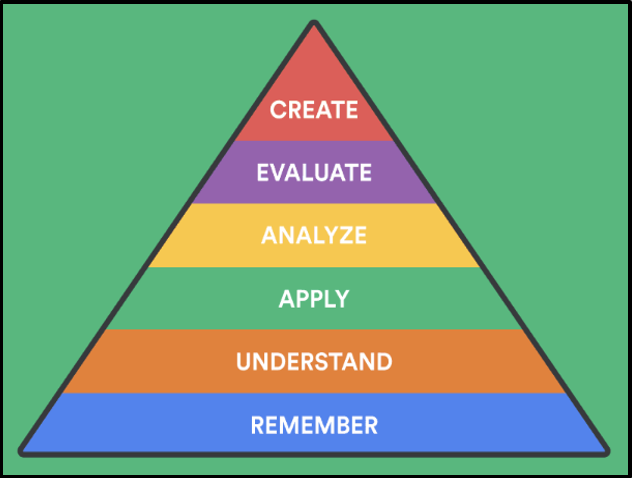
Bloom’s revised taxonomy, 2001. Source for illustration: Kathleen Jasper
One of the best-known attempts to illustrate increasingly complex thinking comes from education. In 1956, psychologist Benjamin Bloom and colleagues developed Bloom’s Taxonomy to classify different kinds of learning. The original idea was the higher the level, the greater the cognitive complexity involved, with each level absorbing all the levels below.
Revised in 2001, the taxonomy describes six cognitive processes, moving roughly from simpler to more complex, with local color provided by “action verbs”:
- Remember facts/basic concepts from long-term memory — specifics and universals, methods and processes, or patterns, structures, settings. Action verbs: define, duplicate, label, memorize
- Understand ideas/concepts. Action verbs: explain, classify, discuss, identify, locate, recognize, select, compare, differentiate, paraphrase
- Apply information in new situations — use abstractions in specific and concrete situations. Action verbs: Execute, solve, use, demonstrate, interpret, schedule, sketch, experiment
- Analyze connections among ideas — using critical reasoning to see patterns, connections, hierarchy of ideas. Action verbs: organize, relate, compare/contrast, examine, integrate
- Evaluate based on information and criteria presented to justify a stand or a decision. Action verbs: appraise, argue, defend, judge, support, value, conclude, consider, rank
- Create new or original work — connects separate elements to form a detailed final product. Action verbs: design, assemble, construct, develop, formulate, compile, generate, modify
Original examples:
- Low cognitive complexity (remember): Asking a student to list the capitals of countries.
- High cognitive complexity (evaluate): Asking a student to critically analyze the effectiveness of a proposed policy and justify their position.
The Bloom pyramid makes this progression look perfectly compact and logical: from learning something to examining and assessing it to creating something new. While the revised taxonomy allows levels to overlap, it’s still a more-or-less straightforward progression. Real thinking, of course, is considerably messier — and we all experience light bulbs exploding without benefit of a series of orderly steps.
Still, I find Bloom useful here — and not just as a historical relic nor because his taxonomy measures cognitive complexity, which it doesn’t. I like it because it makes thinking visible — a way to picture different cognitive tasks and the demands they place on us. Remembering a fact is quite different from comparing competing explanations, evaluating evidence, or assembling information from different sources into something comprehensible and new.
Source: Mary Forehand, “Bloom’s Taxonomy,” Vanderbilt University
Neurodivergence and Cognitive Complexity

I wish there was a Bloom Taxonomy for the neurodivergent mind — something concrete that people could grab onto as the virtuous path toward logic, creativity, and the full expression of human potential. Since we know a triangle of successively more complex levels doesn’t work for the neurotypical mind, it certainly would deconstruct for the ND mind.
What I imagine instead is a construction site where a new office building’s going up, with external elevators. Cranes and buckets on ropes bring supplies up and debris down at different levels, speeds, and complexities. If we peered at the site through infrared glasses, we’d see lines connecting disparate parts of the site, jumping floors, backtracking, running too long around or too straight across. It would not look orderly, but we’d also know the work was happening. The building was getting built.
While that to me illustrates the ND mind (and certainly doesn’t represent a scientific model of ND cognition), research does find that cognitive abilities can be uneven within individuals and that performance depends partly on the task and circumstances. It doesn’t establish a “neurodivergent profile of cognitive complexity,” which shouldn’t surprise us. Meet two ND persons and we meet two ND persons. Indeed, diversity within neurodivergent populations makes such a profile unlikely to tell us much about any particular person.
The Bloom pyramid asks us to picture cognitive demands moving roughly upward in complexity. The construction site asks: What happens when a person’s ability to understand, analyze, evaluate, and create doesn’t line up in a neat ascending order?
Although autism and ADHD, for example, can involve impaired executive functioning, research also finds areas of relative strength — including, in some studies and populations, perception, originality, divergent thinking, and reasoning. Of course, research findings are rarely all-or-nothing, and strengths and difficulties vary enormously among individuals. Some ND people may be impeded by complexity. Others may come alive in it. And the same person may experience both. In fact, all of us probably do at different moments.
Unfortunately, abilities can go unnoticed when other things are more obvious. A person may reason extremely well but need more time to process information. Another may have difficulty organizing or communicating what they know. Anxiety, sensory overload, social expectations, time pressure, or the particular demands of a task can further affect what another person gets to see. What someone can understand, what they can do with that understanding, and how successfully they can demonstrate it may be quite different things in an ND mind.
Across more than 1,800 people, autistic groups showed relative strengths in verbal and nonverbal reasoning alongside substantially lower processing speed and somewhat lower working memory; ADHD showed a less distinctive pattern. Crucially, the author cautions against using these group patterns to characterize individuals diagnostically. Source: Alexander C. Wilson, “Cognitive Profile in Autism and ADHD: A Meta-Analysis of Performance on the WAIS-IV and WISC-V,” Archives of Clinical Neuropsychology, published 2023, 2024 issue, PubMed Central/NIH
Across 31 studies, increased divergent thinking appeared more consistently among people with high ADHD traits than among clinically diagnosed ADHD groups, while creative abilities/achievements were high in both. Source: Martine Hoogman et al., “Creativity and ADHD: A Review of Behavioral Studies, the Effect of Psychostimulants and Neural Underpinnings,” Neuroscience & Biobehavioral Reviews, 2020, ScienceDirect
Coming Up Next

Cognitive complexity gives us another way to think about how differently we perceive, interpret, and respond to the world. But we don’t leave all that thinking outside ourselves. How we make sense of experience also becomes part of how we make sense of who we are.
In Post 41. Cognitive Complexity Meets Self-Identity, I bring these ideas back to the question that has run through this entire group of posts: Who am I?
Copyright ©2026 Jan Swan
 English