On Neurodivergence and Otherness
Show Table of Contents
INTRO
1. On Neurodivergence and Otherness: An Introduction
SENSES AND SENSORY SENSITIVITIES
2. Senses Count
3. Neurobiology for Dummies
4. Sensory Transmission and our Reward System
5. Sensory Receptors are the Body’s Cellular Plan
6. A Synthesis: Sensory Systems and our Emotions — Part I
7. A Synthesis: Sensory Systems and our Emotions — Part II
8. Sensory Disorders and Sensitivities
9. Etan’s Story
SYNESTHESIA
10. Synesthesia: Difference, But Not Disorder
11. Synesthesia, Creativity, Artistry — Part I
12. Synesthesia, Creativity, Artistry — Part II
AUTISM AND THE NEURODIVERSITY MOVEMENT
13. From “Mental Defectives” to Autism Spectrum Disorder
14. Changing Conception of Autism
15. Autism Diagnoses and Behavior Patterns
16. Autism Treatments that Help
17. Early Start Autism Treatment: A Case Study
18. Neurodivergence and the Neurodiversity Movement
19. Neurodiversity Takes Flight
20. ADHD and Neurodevelopmental Disorders
21. ADHD: A Preponderance of Risk Factors and Symptoms
22. ADHD: Inattentive, Impulsive … and Hyperactive?
23. ADHD: Named, Renamed, Still Needs a New Name
24. ADHD: Treatment and Coping Skills for All Ages
LGBTQ+
25. Neurodiversity and the LGBTQ+ Fight
26. LGBTQ+ Identity and Expression
27. LGBTQ+ and Mental and Behavioral Healthcare
ON LANGUAGE
28. Language Matters In and Around Neurodiversity
29. Neuroinclusion and Disability Language
30. Neurodivergent Language Difficulties
ON CREATIVITY AND GIFTEDNESS
31. Neurodiversity and Creativity
32. Giftedness is a Piece of Neurodivergence
SELF-IDENTITY
33. Self-Identity: The Cornerstone of Neurodiversity
34. Early Theories of Self-Identity Formation
35. Contemporary Theories of Self-Identity Formation
36. Authenticity and the Search for Self
37. Self-Concept and Self-Schema
38. Self-Labeling and Parts Work
39. Complexity, Clarity, and Self
40. Cognitive Complexity and Neurodivergence
41. Cognitive Complexity Meets Self-Identity
IMPROVING LIFE FOR NEURODIVERGENT PEOPLE
42. Empathy and Difference – Recognition and Effort
43. Empathy and Difference – Response
44. Reducing Neuroatypical-Neurotypical Conflict – Part I
45. Reducing Neuroatypical-Neurotypical Conflict – Part II
46. Communicating Across the Neurospectrum – Part I
47. Communicating Across the Neurospectrum – Part II
48. Neurodiversity: Advocacy and Education
49. Neuroinclusion in the Workplace
50. A Neurodiverse Lifestyle
IN CONCLUSION
51. In Conclusion: Neurodivergence and Inspiration
7. A Synthesis: Sensory Systems and Our Emotions — Part II
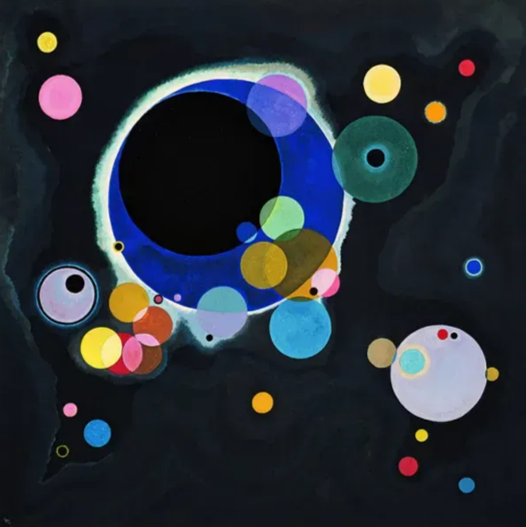
In “The purpose of emotion: An overlooked self-regulatory sense,” Research Outreach, scientist, thinker, writer, and speaker Katherine Peil-Kauffman goes further than other researchers [see post 2]. Like Kandinsky’s bold colorful circles floating against a black background, Peil-Kauffman dramatically redefines emotion as a sense, “a complex elaboration of the first simple sensory system to have evolved.”
Peil-Kauffman explains our everyday emotions are an ancient, self-regulatory “guidance system” essential to health, psychosocial development, moral conscience, and spirituality. In this respect, she agrees with Ninivaggi [see post 6].
Wassily Kandinsky, Several Circles, 1926, The Solomon R. Guggenheim Museum, New York,
Emotion is best understood as a primal sense, the grandparent of all senses, still evident within touch, smell, sight, and sound …. As these other senses offer cues about the external world, good and bad feelings provide a stream of evaluative information about important environmental changes. The biological job of the emotional sense is to regulate “the self,” to inform and control living creatures in response to circumstances that are potentially harmful or beneficial. —Katherine Peil-Kauffman, Research Outreach
“Emotion Moves the Body and Informs the Mind”
Peil-Kauffman delivers a one-two punch to what we were taught: “Emotion, not reason, governs our behavior in modern society …. Emotion moves the body and informs the mind.” Like others, she offers a theory to explain our emotional selves in relation to how our brain structure developed over the millennia [paraphrased/edited for brevity):
- Oldest layer: At the oldest level of the brain’s limbic system, emotional information is binary, delivered by simple signals. Pleasure/pain. Yes to life/no to death. Emotions move us to protect and develop ourselves: from bad (poison) to good (food, mating partners). Our minds develop along with crude memory structures.
Graphic: Dreamstime
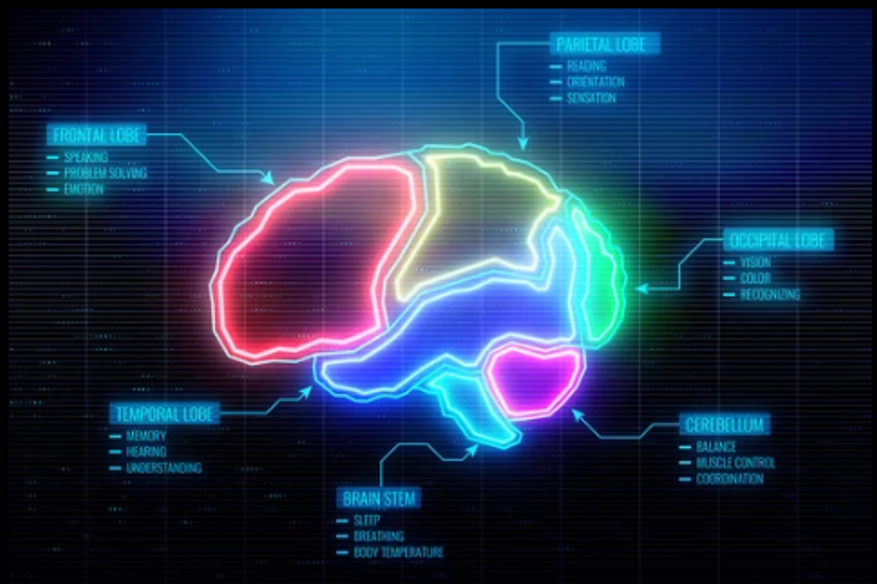
- Second layer: Next the brain’s middle structure or limbic system delivers emotional information — the primaries, like joy, sadness, disgust, anger, fear — which evolve to meet/prioritize our most basic psychosocial needs. These mostly painful emotions send fight-or-flight distress signals to avoid what threatens survival.
- Third and newest layer: The neocortex (largest part of the brain’s cerebral cortex) is the most individualized layer—processing and shaping more nuanced emotional information, from learning experiences, language, society and culture, complex beliefs and attitudes, and creative will. Our ancestors could feel more complex, “social” or “moral” emotions and their opposites: trust/mistrust, pride/shame, gratitude/contempt, admiration/envy, love/hate.
Emotions Form Our Values

Source: LinkedIn
One implication of Peil-Kauffman’s theory is that emotions not only govern our behavior but also form our values. From the evolutionary logic of her argument, the binary of yes/no becomes the binary of good/bad or right/wrong.
Over the millennia, she suggests, nature selects against those experiencing complex negative emotions that were about survival and advancement of the species. Humankind now plays an active role in its own evolution by getting real-time emotional feedback about more positive attributes of living. The impact of this, over time, is:
- Our individual fitness increases.
- Our painful experience decreases.
- We enjoy more flexible freedom and creative control.
The author calls this adaptive self-development — a way of becoming who we are to ourselves and to the world we show up for. “Becoming” is a central feature of our individual and collective lives over the millennia. [See posts 33-35 on self-identity development.]
Peil-Kauffman (P-K) says our fully developed brains form self-concepts by building positive mindscapes (what we think about/believe) and by contributing to complex cultural landscapes (natural environment and its “visible reflection of society, including cultural icons, beliefs, and practices that change over time.” Think Stonehenge). Positive emotional experiences validate adaptive self-development, in P-K’s telling, leading individuals and society “to actualize their individual and collective potential—our innate potential.” In sum [I paraphrase and editorialize]:

Source: Freepik
- In survival mode, four basic expressions of pain — sadness, fear, disgust, anger — suffice.
- An aberration of our origin story is the extent to which we experience increasingly complex but negative emotions — mistrust, resentment, worry, rage, shame, hate.
- Rather, nature selects against unremitting expressions of intense negative emotion.
This is dense stuff. Even if slightly off topic, P-K’s theory of emotion as an evolved, self-regulatory system can help us see our own emotions as more than simple reflections of our day or how we were raised or how much pressure we’re under—or of our weak characters. Rather, our emotions are layered in terms of natural selection, neurobiology, physiology, and our sensory system built up brick-by-brick over millennia. Hard to fight against that.
A Compass for the Inner Life
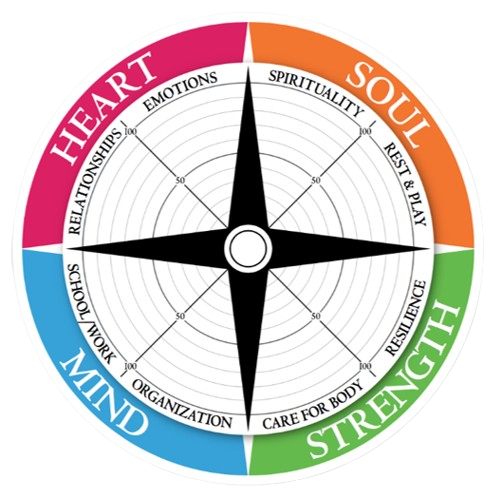
P-K builds a case for how different disciplines misunderstand emotion. How science and religion miss emotions’ vital messages and blame the messenger:
According to the model offers us guidance in four dimensions of our being: heart, soul, strength, and mind. Each of the four compass points focuses on two areas of well-being, and each of the eight areas helps to guide and equip us to be more intentional about the way we live our lives. Each requires something different, but together they make a whole life possible.
The Living Compass describes four dimensions of our being: heart, soul, strength, and mind. Each compass point holds two areas of wellbeing — eight in all. It’s a simple structure, but a useful one: a way of noticing where attention goes, and where it’s been missing. Each requires something different, but together they make a whole life possible.
Source: Living Compass
- Science ignores emotion as the biological source of our values.
- Religion confounds the evolutionary logic of emotion within social constructions of good vs evil, framing negative emotions as evidence of sin.
- Religion credits supernatural deities for the “fruits of spirit,” the divine inner “wisdom of the heart” delivered naturally by wonder, curiosity, trust, honor, compassion, faith, and love.
Understanding the deeper function of emotion adds a new framework for moral and ethical theory, including interpretations of spirituality.
Designed without the benefit of nature’s emotional compass, many sociocultural approaches inadvertently reverse the evaluative logic, increasing the very conditions that trigger basic distress signals. Indeed, humans have pressed all painful feelings into the service of punishing and controlling one another—a third-party perversion of nature’s personal guidance system. —Katherine Peil-Kauffman, Research Outreach
Emotional Self-Regulation
A new science — emotional self-regulation — helps us understand emotion sensation or sensation emotion [see post 6] as a set of intertwined biophysical functions that, evolutionarily speaking, lead us to “trust in and use our everyday emotions to guide thought and behavior.”
In P-K’s theory, emotional self-regulation gives purpose to our feelings. She writes, “If we allow it to, if we believe it can, we can trust in and use our everyday emotions to explore and cultivate the entire dimension of positive emotional experience, to enable and unleash the greater truth, beauty, and goodness inherent in our human nature.”
Emotional self-regulation, then, is crucial to our overall mental and physical wellbeing. Most of us learn to manage our emotions and impulses as children growing into our teens and young adulthood. We feel our strong emotions and then learn how to respond with appropriate behavior, with the least negative consequences. Lacking self-regulation prolongs negative emotions and socially unacceptable behavior, which together can be self-destructive and damaging to relationships.
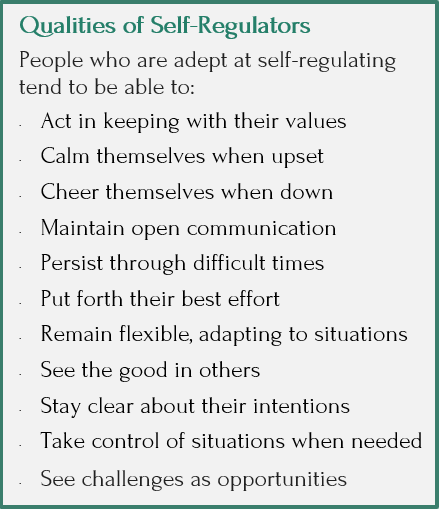
Source: VeryWellMind
So how do we actually regulate emotion in real life? Researchers point to a small set of common strategies—each shaping our emotional experience in different ways.
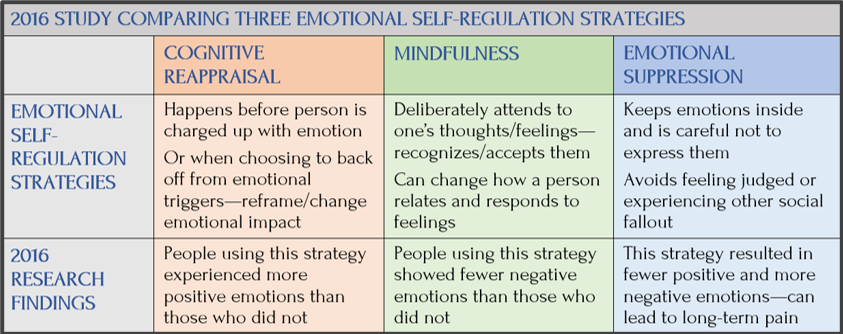
“The Senses: A (Surprisingly) Often Overlooked Emotion Regulation Modality”
In their article, “Sensory Emotion Regulation,” Trends in Cognitive Sciences, Micaela Rodriguez and Ethan Kross note decades of evidence behind “intimate links between sensation and emotion.” Despite this, they bemoan the lack of current theory on how sensory experiences can be used therapeutically to promote emotion regulation. They argue for harnessing sensation to “up-or-down-regulate emotion.”
Source: Sean Grover, “The Joy of Sadness,” Psychology Today

Throughout history, cultures around the world have turned to their senses to manage emotions. Ancient Chinese civilizations used aromatic essential oils to treat insomnia, Egyptian healers living during the time that the Giza pyramids were built applied gentle touch on their patients’ feet to ease tension, and, in Ancient Greece, Plato soliloquized about the power of music to positively transform negative emotional states. Indeed, the use of sensation to modulate emotion is far from a new phenomenon. On the contrary, it is a tool that cultures have relied on for millennia. —Michaela Rodriguez and Ethan Kross, Trends in Cognitive Sciences
Now, 6,000 years later, we know there are links. We know this intuitively. Sensation and emotion are inextricably linked. And senses are a powerful way to activate emotions.
Sensation allows us to quickly detect information about our physical surroundings. Without it, we would be incapable of successfully navigating the world; gone would be our ability to discern a friendly greeting from a fire alarm, a paved street from a pothole, or salubrious fruit from rotten milk. —Rodriguez and Kross, Trends in Cognitive Sciences
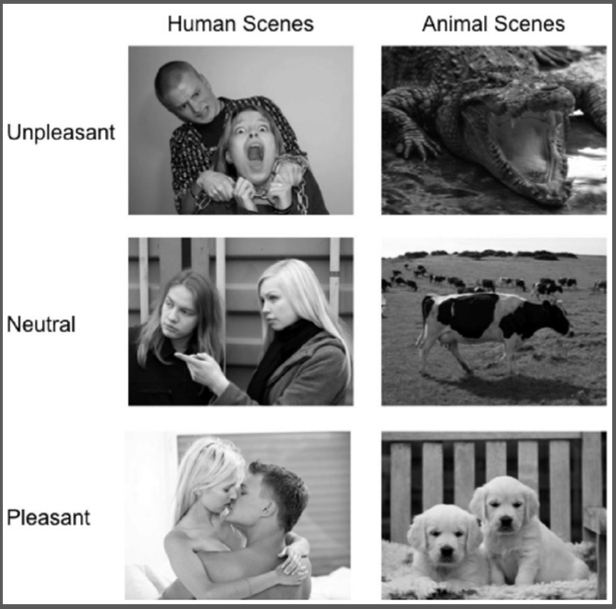
Unpleasant, neutral, and pleasant pictures used in experiments. Source: Research Gate
In post 2, I explained the difference between general (internal body) and special (eyes, ears, skin, tongue, and nose) senses and how differentiated sensory receptors transmit neurons (electrical signals) to the central nervous system (CNS) to sort, interpret, and respond. This sensory process doesn’t involve emotions. Except research and common experience indicate many sensory experiences do involve emotion. Rodriguez and Kross write, “Part of the reason why sensation is effective at informing us whether to approach/avoid stimuli is because of its ability to activate brain networks that produce emotional responses.”
Aha! Once stimulated by our senses, the brain is prepped to transmit emotional reactions. As Ninivaggi explained, sensory information is transmitted to specific brain parts (thalamus, amygdala, cerebral cortex). Per each sensory channel (sight, sound, motion, balance, temperature change, stomach rumblings), neural signals travel fast and directly to the right sensory cortex (auditory, visual, gustatory, olfactory, somatosensory). At the speed of light or sound, we can determine if stimuli are pleasant/safe or unpleasant/threatening.
Process of Sensation is Linked with our Experience of Emotion
In my anxiety blog series, I described how emotions were essential to our ancient forebear’s survival. These sensory–activated brain regions rapidly activate emotional processing, which — evolutionarily speaking — has also been essential to our survival, as these examples show:
- Tastes are encoded as appetizing/repellant to promote nutrition/survival.
- Bitter/sour tastes ensure we don’t eat poisonous/rotten food.
- Sweet/salty tastes ensure we receive crucial nutrients, like carbohydrates for fuel.
- Hedonic sound or odor guides adaptive behaviors in response to situations, something nice or threatening (hedonic tone or valence describes pleasure/displeasure).
Furthermore, as Rodriguez and Kross explain, strong evidence indicates sensation can influence emotion via indirect pathways, like “diverting attention, promoting cognitive reframing, and activating autobiographical memories.” The authors’ conclusions (paraphrased/reorganized):
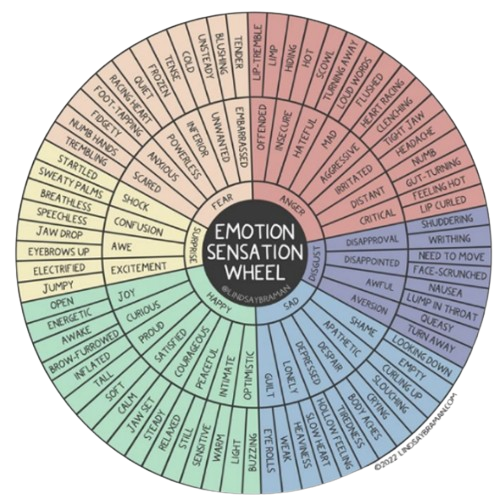
Source: LindsayBrahmin
- Sensory processing is inherently emotional.
- Sensation-driven emotion can be deliberately harnessed to provide a way for people to manage their own emotions (think EI).
- Sensation effortlessly activates emotional processes humans have used for millennia and continue to use today.
- Sensation often activates emotions automatically, but how long the effects last varies. Tasting chocolate boosts mood for moments, while listening to music can improve mood for hours.
- Perception of sensory input is affected by current emotional states — so how we perceive a sensation today when feeling lonely may be different than how we might perceive it tomorrow when we’re with our friends.
Emotion sensation is a two-way interaction. Sensations trigger emotions, but emotions can color what we take in through our senses. The authors presented evidence of the following:

Photo: Getty Images
- Socially anxious people interpret images of ambiguous faces as more threatening than socially typical people.
- Thirsty people perceive a water bottle to be spatially closer to them compared with nonthirsty people.
- Happy people taste ice cream as sweeter and more enjoyable than unhappy people.
- Negatively affected people perceive sounds as louder, more negatively valenced (leaning to anxiety, sadness, frustration, loss) and more fear-inducing than neutrally or positively dispositioned people
In real life, as opposed to the lab, senses don’t come at us one by one. Our daily experiences are filled with multisensory interactions among what we see, smell, hear, touch, and taste, how we move, and how hungry, cold, or in pain we are in any given place and time.
Emotion Sensation is Not the Same for Neurodivergents
Because our jumping off place for this foray into emotion sensation is to understand neurodivergence, I won’t go too –much further with Ninivaggi’s, Rodriquez-Kross’s, or Peil-Kauffman’s theories on sensation, emotion, emotional intelligence, emotional regulation, and emotion-sensation health and wellbeing. Except to say these are ways of conceptualizing how our biophysical and environmental functions work in neurotypicals—to reach a layered, nuanced grasp of what it means to be neurodivergent. How complicated it is for the atypicals among us to live their lives.
Coming Up Next

In Post 8: Sensory Disorders and Sensitivities, I’ll dig into sensory disorders, which affect upward of 20% of children, where it’s mostly diagnosed. Undiagnosed and untreated, however, sensory disorders can be mistaken for other conditions — leading to confusion, misdiagnoses, self-confidence issues, and unnecessary anguish.
Copyright ©2026 Jan Swan
 English