On Neurodivergence and Otherness
Show Table of Contents
INTRO
1. On Neurodivergence and Otherness: An Introduction
SENSES AND SENSORY SENSITIVITIES
2. Senses Count
3. Neurobiology for Dummies
4. Sensory Transmission and our Reward System
5. Sensory Receptors are the Body’s Cellular Plan
6. A Synthesis: Sensory Systems and our Emotions — Part I
7. A Synthesis: Sensory Systems and our Emotions — Part II
8. Sensory Disorders and Sensitivities
9. Etan’s Story
SYNESTHESIA
10. Synesthesia: Difference, But Not Disorder
11. Synesthesia, Creativity, Artistry — Part I
12. Synesthesia, Creativity, Artistry — Part II
AUTISM AND THE NEURODIVERSITY MOVEMENT
13. From “Mental Defectives” to Autism Spectrum Disorder
14. Changing Conception of Autism
15. Autism Diagnoses and Behavior Patterns
16. Autism Treatments that Help
17. Early Start Autism Treatment: A Case Study
18. Neurodivergence and the Neurodiversity Movement
19. Neurodiversity Takes Flight
20. ADHD and Neurodevelopmental Disorders
21. ADHD: A Preponderance of Risk Factors and Symptoms
22. ADHD: Inattentive, Impulsive … and Hyperactive?
23. ADHD: Named, Renamed, Still Needs a New Name
24. ADHD: Treatment and Coping Skills for All Ages
LGBTQ+
25. Neurodiversity and the LGBTQ+ Fight
26. LGBTQ+ Identity and Expression
27. LGBTQ+ and Mental and Behavioral Healthcare
ON LANGUAGE
28. Language Matters In and Around Neurodiversity
29. Neuroinclusion and Disability Language
30. Neurodivergent Language Difficulties
ON CREATIVITY AND GIFTEDNESS
31. Neurodiversity and Creativity
32. Giftedness is a Piece of Neurodivergence
SELF-IDENTITY
33. Self-Identity: The Cornerstone of Neurodiversity
34. Early Theories of Self-Identity Formation
35. Contemporary Theories of Self-Identity Formation
36. Authenticity and the Search for Self
37. Self-Schemas and Neurodivergence
38. Self-Labeling and Parts Work
39. Complexity, Clarity, and Self
IMPROVING LIFE FOR NEURODIVERGENT PEOPLE
40. Empathy Recognizes and Navigates Difference
41. Reducing Neurotypical-on-Neuroatypical Conflict – Part I
42. Reducing Neurotypical-on-Neuroatypical Conflict – Part II
43. Communicating Across the Neurospectrum – Part I
44. Communicating Across the Neurospectrum – Part II
45. Neurodiversity: Advocacy and Education
46. Neuroinclusion in the Workplace
47. A Neurodiverse Lifestyle
IN CONCLUSION
48. In Conclusion: Neurodivergence and Inspiration
37. Self-Concept and Self-Schema
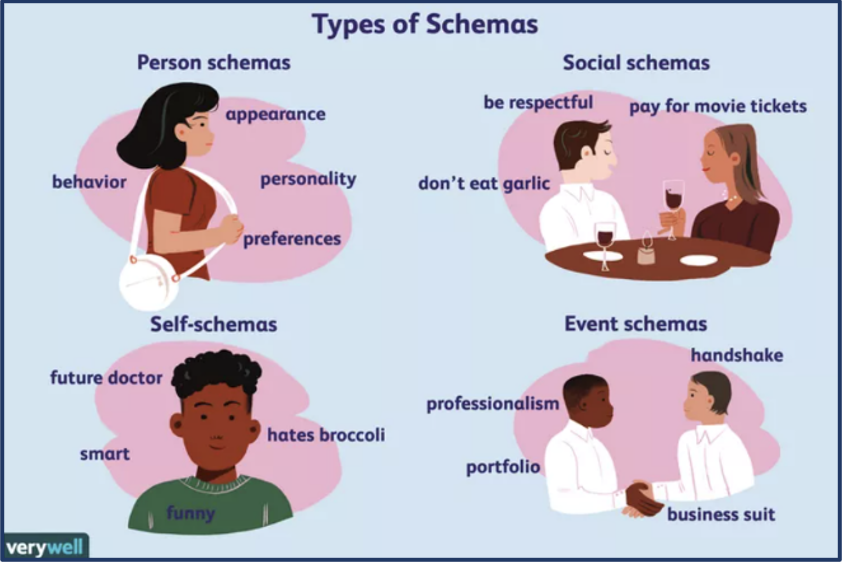
Graphic: Emily Roberts, VeryWellMind
Self-concept invariably leads us to the concept of self-schemas — varied sets of stable, long-lasting knowledge about ourselves, built from experience. Our brains create mental shortcuts to retrieve and reinforce this information based on what we know, think we know, or tell ourselves, based on all the possible ways we’ve been. We each have multiple self-schemas — thoughts and perceptions about our personalities, abilities, interests, moods, physical traits, and more — which provide personal, idiosyncratic descriptors that maybe tell our story.
Despite accumulating experiences and inevitable changes over time, ideas about ourselves can be remarkably stubborn, often inaccurate — and sometimes self-fulfilling. I believe I’m lazy, despite the effort I put into my work and despite “lazy” being a label often attached to behaviors associated with my ADHD.
Self-schemas help us catalogue new information by comparing it to what we already believe about ourselves. This helps us think on our feet, interpreting and assimilating information quickly and often automatically. But there’s a catch: what makes self-schemas so efficient can also make them resistant to information that contradicts what we already believe.
The Origins of the Self-Schema
American social psychologist Hazel Markus (b. 1949) gave the concept of self-schema its modern formulation in her landmark 1977 paper, “Self-Schemata and Processing Information About the Self,” Stanford.edu. She described self-schemas as “cognitive generalizations about the self, derived from past experience” that organize and guide how we process self-related information.
Markus’s experiments showed just how much work these schemas do. They help us make judgments and decisions about ourselves, retrieve supporting memories, predict our own future behavior (does this have a name?), and resist information that contradicts an established self-schema. And she made an especially important distinction: a self-schema isn’t simply a storage place for memories of who we’ve been. It actively influences what happens to new information about ourselves.
That means I’m smart, I’m resilient, I’m lovable — or I’m stupid, I can’t cope, I’m worthless — can become more than descriptions. They can influence what evidence we notice, remember, and accept about ourselves.
In one experiment, Markus studied women who thought of themselves as independent, dependent, or neither. Those with a strong self-schema for independence could more readily recall examples of behaving independently and were more confident predicting that they would behave independently again. The same pattern appeared among women who saw themselves as dependent. In other words, once this is who I am becomes part of a self-schema, it helps organize both the past we remember and the future self we expect to be.
Schemas

Schemas are the cognitive theory underpinning self-schemas. The theory proposes that we have mental structures that help us take in, filter, organize, and interpret new information from our environment — connecting what’s happening now to what we know from the past and anticipating what to expect going forward.
Schemas develop through experience and are highly influenced by culture, family, society, and identity. They also evolve as we absorb new information. This happens rapidly and naturally for kids. A child learns her tiger doesn’t fit with her dog schema — so she creates a tiger schema. As we age, changing an established schema can take more effort.
Common Schema Types

Actor Will Kempe dancing in a play, from his book cover, 16th century, Victoria and Albert Museum, England
- Role schema defines expected roles and actions within a social structure. We develop expectations about teachers, doctors, parents, bosses, police officers — and how someone in that role is supposed to behave. Role schemas can be useful shortcuts but can also contribute to stereotypes when we make assumptions about people based on age, gender, race, occupation, or other group characteristics.
- Person schema focuses on information about specific people — their traits, behaviors, appearance, likes and dislikes — so we can anticipate how they might act. My boss is demanding but fair. My friend is empathetic but unreliable.
- Self-schema is the knowledge and beliefs we’ve accumulated about ourselves — including ideas about who we are now and who we might become.
- Attention schema is a proposed internal model of attention that helps the brain represent and control how we direct attention toward items or tasks.
- Object schema helps us interpret inanimate objects and informs what they are, how they should function, and what to expect from them: how to use a pen, open a door, start a car.

Pierre-Auguste Renoir, “Luncheon of the Boating Party” (1880-81), The Phillips Collection
- Group schema organizes what we believe or expect about people who belong to a particular social group. These expectations can concern occupations, gender, age, race, culture, social class, or other group identities. A business schema might include expectations about proper attire, punctuality, professionalism, and achievement. Group schemas can help us navigate familiar social situations, but when we generalize presumed characteristics to individual members of a group, they become stereotypes.
- Social schemas apply social dynamics and norms to a given context. We interpret and adapt our behavior and predict what will happen based on past experience: We get called on when we raise our hands. We don’t cut ahead of everyone waiting in line.
- Event schema, also called a cognitive script, gives us an expected sequence for a familiar situation — how to get tickets, attend a concert, find our seats. Scripts help us anticipate what comes next and plan our actions rather than figuring out every familiar situation from scratch.
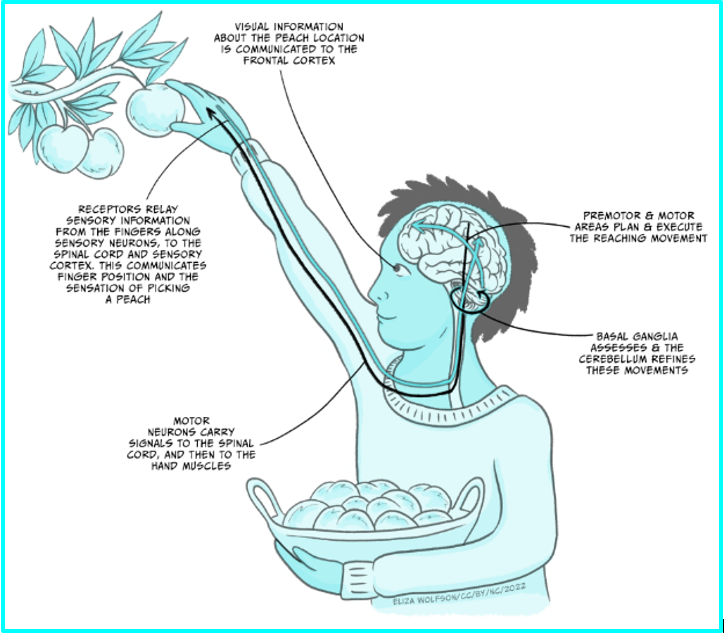
Steps and regions involved in a seemingly simple movement like picking a ripe peach. Jimena Berni, “The Motor System.” Illustration: Eliza Wolfson, 2022, Open Press University of Sussex, England
- Body schema is our largely unconscious sensorimotor map of the body — where its parts are and how they can move through space. We don’t ordinarily have to look down to know where our hands or feet are before we move them. This is different from body image — our perceptions, thoughts, and feelings about what our bodies look like.
- Body-image or appearance schema organizes our thoughts, beliefs, feelings, and perceptions about our physical appearance. It can influence how much importance we give appearance in defining ourselves, how we interpret other people’s reactions to us, and how we compare ourselves with others.
No wonder schemas are so fascinating. Learning about them lets us appreciate, layer by layer, the complexity of what goes on largely outside our awareness as we interpret the world, other people, and ourselves — sometimes all at once. My person schema says this friend is safe. My group schema carries assumptions about people like her. My social schema tells me how I’m supposed to behave here. My self-schema says I’m awkward. My body-image schema tells me everyone is looking at me. All of those can be operating in the same encounter.
Self-Schemas
Self-schemas help us process and make sense of new experiences by filtering and organizing them in a way that’s congruent with our existing self-concept. Self-schemas can influence our thoughts, feelings, and behaviors, as well as our interactions with others …. When we construct an autobiographical narrative of our experiences, we rely heavily on self-schemas to give structure and meaning to our self-story.” —T. Franklin Murphy, Psychology Fanatic
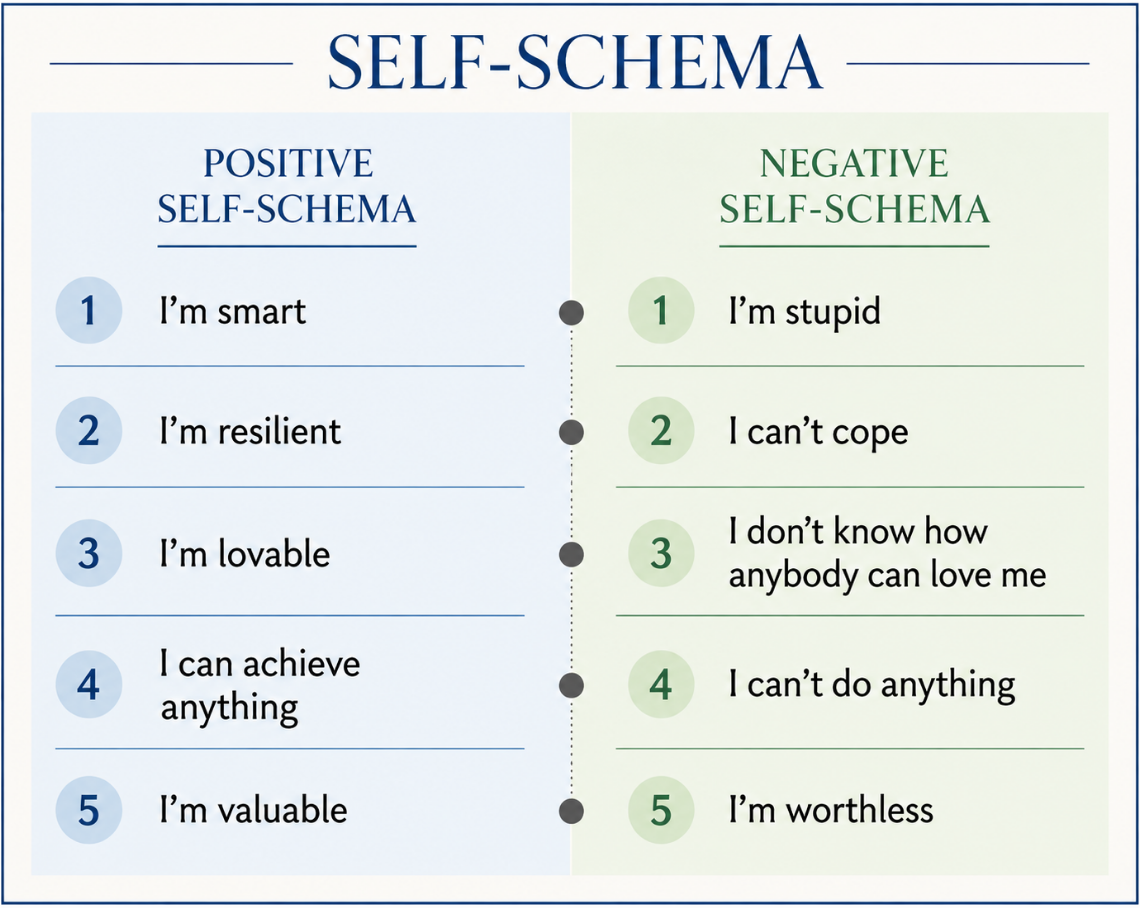
More than a belief about ourselves, a self-schema assembles aspects of what we think we are like, memories that seem to confirm it, and expectations about how we’ll behave — including predictions about who we will be. This helps explain the staying power of self-schemas. We interpret new experiences in relation to what we already believe about ourselves, while memories of earlier experiences provide supporting evidence.
Markus’s experiments demonstrated how powerful these processes could become over time. People with a strong self-schema in a particular area more readily retrieved examples of past behavior consistent with it and more confidently predicted that they would behave that way in the future.
Self-schema chart, Psychology Fanatic. Redesigned by Jan Swan
Self-schemas even made some people more resistant to information that contradicted what they already believed about themselves. Murphy writes how self-schemas become “self-perpetuating, stored in long-term memory, which both facilitates and biases the processing of personally relevant information.”
If someone has a self-schema of extroversion — they think of themselves as extroverted and also believe their extroversion is central to who they are — their self-schema may include general self-categorizations (I am sociable), beliefs about how they would act in certain situations (At a party, I would talk to lots of people.) and also memories of specific past events (On my first day at college, I made lots of new friends.). —T. Franklin Murphy, Psychology Fanatic
HOW SELF-SCHEMAS AFFECT LEARNING
Self-schemas influence what we notice and learn from new experiences. Information that fits what we already believe about ourselves may get our attention more readily, seem more important, and be easier to absorb and remember. Information that doesn’t fit may receive less attention, be discounted, explained away, or interpreted in ways that allow an existing self-schema to survive.
That makes self-schemas remarkably efficient. We don’t have to reconsider who we are every time something happens. But the same efficiency can become a bias: once a self-schema is established, we may keep finding evidence for it while overlooking evidence that could change it.
Because we act on scripts that support our schemas, the results force situations to conform to our beliefs. Our tainted realties are supported by experience, even when the data would suggest otherwise. Over and over again, life supports our self-schemas, whether we believe ourselves to be smart or stupid, socially adept or awkward …. When evidence [arises that conflicts] with the schemas, everybody … is quick to explain away the oddity and keep self-limiting schemas alive. —T. Franklin Murphy, Psychology Fanatic

Murphy calls this self-confirmation bias, but there’s more to it. Our self-schemas can influence not only how we interpret information we receive, but also what information we seek in the first place.
In a 1982 study — “Self-Schemas and Judgments about Others,” Social Cognition, 1982, Guilford Journals — Geoffrey Fong and Hazel Markus asked people with either extraverted or introverted self-schemas to choose questions to learn about another person. Extraverts disproportionately chose questions pertaining to extraversion; and the same about introverts choosing questions about introversion. When participants later evaluated recordings of people they had listened to, they more confidently judged traits related to their own self-schemas. The authors suggested we become “experts” when it comes to our own self-schemas. In other words, my self-schema doesn’t just affect what I believe about me. It may influence what I look for in you.
Source: Geoffrey Fong and Hazel Markus, “Self-Schemas and Judgments about Others,” Social Cognition, 1982, Guilford Journals.
Another process, self-verification, takes this a step further. Psychologist William Swann and Stephen Read — “Self-Verification Processes: How We Sustain Our Self-Conceptions,” Journal of Experimental Social Psychology, 1981, Science Direct — found people can draw responses from others that reinforce what they already believe about themselves. They are also more likely to remember feedback consistent with their existing self-views.
Most surprisingly, this desire for consistency isn’t limited to positive beliefs. Later research found people with negative self-views can sometimes prefer evaluations that confirm those negative views over more favorable ones.
Source for this latter finding: WB Swann, “Depression and the search for negative evaluations: more evidence of the role of self-verification strivings,” Journal of Abnormal Psychology, PubMed/NIH
In sum: Putting these processes together shows why self-schemas can be so stubborn. The beliefs we have about ourselves can influence what we notice, what we ask, whom we believe, what we remember, and even how we interact with other people — continually supplying new material from which the old self-schema can be rebuilt.
Self-Transcendence

Self-transcendence is an even more distant and ethereal goal, when we expand and shift our personal boundaries from the self to caring for others, reducing suffering, or doing something else greater than ourselves. The theory of self-transcendence is a framework for understanding how people cope with difficult life situations and enhance their wellbeing—and for those among us with a more spiritual bent—to achieve (in Maslow’s words) “a state of feeling at one with the world and those in it.”
Maslow coined the term self-transcendence and added it to his revised hierarchy in 1969, describing it as a “higher state in which self-actualized people see beyond their own concerns and perspectives.”
J.W. Turner, The Fighting Temeraire, 1838. Source: Baani’s ArtPoint

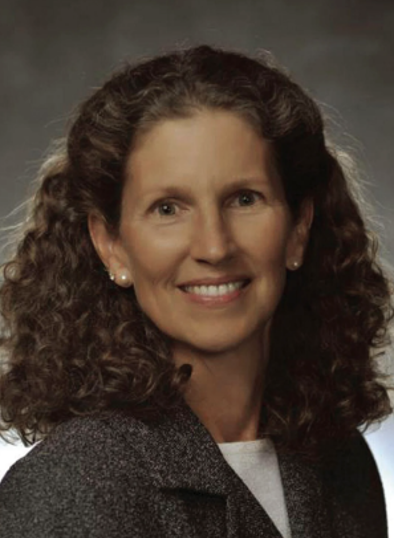
Wikipedia defines self-transcendence as a personality trait that involves the “expansion or evaporation of personal boundaries” — the first spiritual concept incorporated into a major theory of personality. In addition to Maslow, other renowned psychologists — Austrian neurologist, psychiatrist, and Holocaust survivor Viktor Frankl (1905-1977) and American psychologist, nursing theorist, professor Pamela G. Reed — contributed to self-transcendence theory.
Frankl wrote, “The essentially self-transcendent quality of human existence renders man a being reaching out beyond himself.” Frankl invented logotherapy, a form of psychotherapy that describes a search for life’s meaning as “the central human motivational force.”
Reed saw self-transcendence as a natural, desired stage before self-fulfillment and purpose. Her 1991 theory suggested perspectives and behaviors expand (transcend) self-boundaries in multidimensional ways:
- Inwardly: Through introspection, we gain awareness of our values, philosophy, and dreams.
- Outwardly: We relate to others’ and our environment.
- Temporally: We integrate our pasts and futures to have meaning in the present.
In 2015, Reed added transpersonally (we connect with dimensions beyond reality). APA PsycNet (2014) researchers wrote Reed’s theory offers a “holistic and humanistic perspective on human development and wellbeing, especially during events or [when] vulnerability can diminish wellbeing. It has also been tested empirically and has shown positive associations between self-transcendence and wellbeing, quality of life, hope, and coping.”
Sources: Self-Transcendence Research and Scott Barry Kaufman. Photos: Viktor Frankl, Springer Nature Link; Pamela G. Reed, Tucson.com
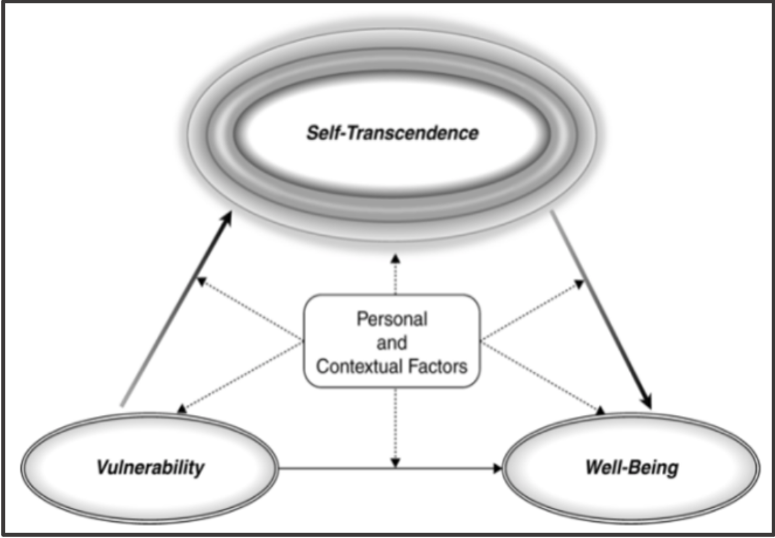
Reed’s nursing theory of self-transcendence is based on vulnerability, wellbeing, and self-transcendence. Singly and together, these three concepts are moderated by age, gender, cognitive ability, health status, personal beliefs, spiritual support, and other sociocultural factors. Transcendence may be an underlying process explaining how wellbeing is possible in the difficult or life-threatening situations we endure.
Self-Transcendence Theory © PGReed, 2012, Nursology
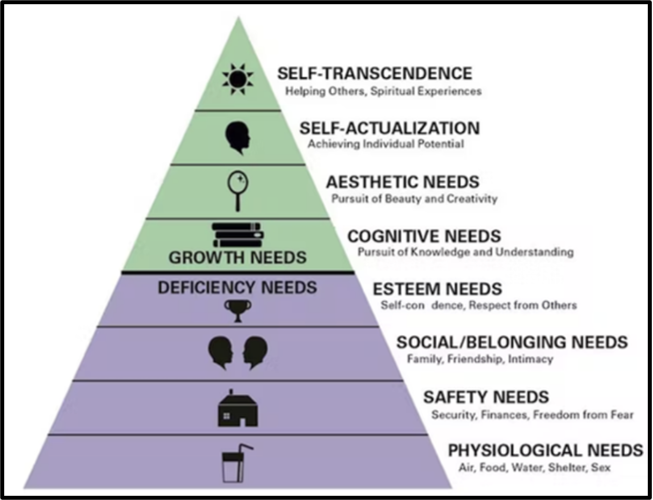
Maslow evaluated self-transcendence from the “perspectives of time, space, culture, ego, others’ opinions, and identification-love.” He’s quoted as saying, “This means transcendence of the selfish Self. It also implies a wider circle of identifications — with more people approaching the limit of identification with all human beings.”
Kaufman notes Maslow’s writings remain relevant today, largely since it was misrepresented at the time (70 years ago) that self-actualizing people were selfish or purely individualistic. “What Maslow believed was “self-actualization is healthy self-realization on the path to self-transcendence.” This conceptualization has been all but lost, and Kaufman is helping bring it back, with fresh insights from research.
Source: Wikipedia
Maslow recognized the peak of human experience was more than achieving a person’s individual potential. Being our best self isn’t just about our self. He recognized through his research that people could, and do, rise above themselves and connect to something greater, and that humans need this connection to the whole in order to be whole. His revised theory looks like this with self-transcendence at the peak of human potential. —Andrea Hunsaker, “Get Over Yourself: Cultivating Self-Transcendence,” MyBestSelf101
There is, however, little evidence that self-transcendence is specifically achievable. Yet it seems the journey toward an ideal gives us more hope, makes us like ourselves better, and creates more meaning in life.
Love doesn’t appear as a standalone word on the hierarchy but belongs to the social/belonging level—our need for relationships, intimacy, friendship, family, and a sense of belonging in a group. This is the desire to feel loved and accepted by others and to give love in return. If this need is not fulfilled, individuals may experience loneliness, depression, and difficulty forming healthy relationships.
Love, belonging, dreaming, connection: This attainment can be more difficult for ND/ neurodiverse populations, especially for those who grow up in homes expecting rigid conformity to neurotypical notions of daily life.
Researcher/author Brené Brown describes authenticity as “the choice to show up and be real. The choice to be honest. The choice to let our true selves be seen.” Brown says, self-transcendence “connects the dots between authenticity, vulnerability, and belonging …. Because true belonging only happens when we present our authentic, imperfect selves to the world, our sense of belonging can never be greater than our level of self-acceptance.” —Quoted by Linda Fisher Thornton, “How Are Authenticity and Self-Actualization Connected?” Leading in Context
The privilege of a lifetime is to become who you truly are. —Carl Gustav Jung
Coming Up Next
Post 37. Self-Concept and Self-Schema is on a subject I stumbled over like roots on a path. And like roots that become sturdy enough to support and feed a tree, we can’t become the people we’re meant to be or would like to be without strong self-schema. In the neurotypical world, this journey to selfhood is hard enough. In neurodivergence, it takes an effort of a different caliber to achieve selfhood, wellbeing, and fulfillment.
Copyright ©2026 Jan Swan
 English