On Neurodivergence and Otherness
Show Table of Contents
INTRO
1. On Neurodivergence and Otherness: An Introduction
SENSES AND SENSORY SENSITIVITIES
2. Senses Count
3. Neurobiology for Dummies
4. Sensory Transmission and our Reward System
5. Sensory Receptors are the Body’s Cellular Plan
6. A Synthesis: Sensory Systems and our Emotions — Part I
7. A Synthesis: Sensory Systems and our Emotions — Part II
8. Sensory Disorders and Sensitivities
9. Etan’s Story
SYNESTHESIA
10. Synesthesia: Difference, But Not Disorder
11. Synesthesia, Creativity, Artistry — Part I
12. Synesthesia, Creativity, Artistry — Part II
AUTISM AND THE NEURODIVERSITY MOVEMENT
13. From “Mental Defectives” to Autism Spectrum Disorder
14. Changing Conception of Autism
15. Autism Diagnoses and Behavior Patterns
16. Autism Treatments that Help
17. Early Start Autism Treatment: A Case Study
18. Neurodivergence and the Neurodiversity Movement
19. Neurodiversity Takes Flight
20. ADHD and Neurodevelopmental Disorders
21. ADHD: A Preponderance of Risk Factors and Symptoms
22. ADHD: Inattentive, Impulsive … and Hyperactive?
23. ADHD: Named, Renamed, Still Needs a New Name
24. ADHD: Treatment and Coping Skills for All Ages
LGBTQ+
25. Neurodiversity and the LGBTQ+ Fight
26. LGBTQ+ Identity and Expression
27. LGBTQ+ and Mental and Behavioral Healthcare
ON LANGUAGE
28. Language Matters In and Around Neurodiversity
29. Neuroinclusion and Disability Language
30. Neurodivergent Language Difficulties
ON CREATIVITY AND GIFTEDNESS
31. Neurodiversity and Creativity
32. Giftedness is a Piece of Neurodivergence
SELF-IDENTITY
33. Self-Identity: The Cornerstone of Neurodiversity
34. Early Theories of Self-Identity Formation
35. Contemporary Theories of Self-Identity Formation
36. Authenticity and the Search for Self
37. Self-Schemas and Neurodivergence
38. Self-Labeling and Parts Work
39. Complexity, Clarity, and Self
IMPROVING LIFE FOR NEURODIVERGENT PEOPLE
40. Empathy Recognizes and Navigates Difference
41. Reducing Neurotypical-on-Neuroatypical Conflict – Part I
42. Reducing Neurotypical-on-Neuroatypical Conflict – Part II
43. Communicating Across the Neurospectrum – Part I
44. Communicating Across the Neurospectrum – Part II
45. Neurodiversity: Advocacy and Education
46. Neuroinclusion in the Workplace
47. A Neurodiverse Lifestyle
IN CONCLUSION
48. In Conclusion: Neurodivergence and Inspiration
29. Neuroinclusion and Disability Language
Graphic: Shutterstock
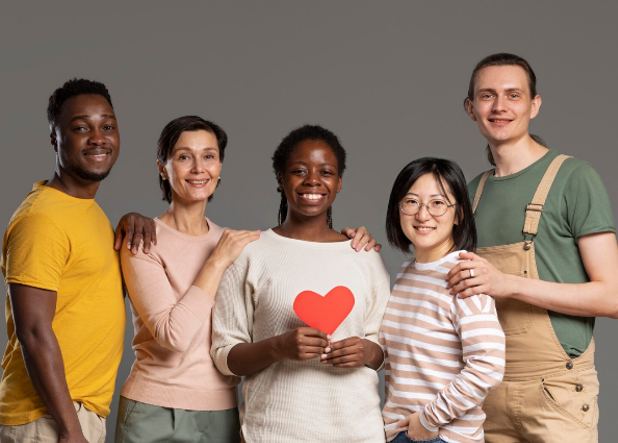
I have worked on DEI initiatives, including writing targeted definitions of what the words diversity, equity, and inclusion (also accessibility) mean for an organization, according to its mission and goals. But as noble as DEI is in college admissions or job workplaces, it doesn’t — but needs to — include ND people. This inhibits their ability for vibrant neurodiverse environments, with all great potential for innovation and collaboration. Neurodiversity is an umbrella that’s as big as it needs to be for individuals and their people. It takes masses of people — linked communities of people — to fight the power elites to change laws and end hateful, discriminatory policies and practices that still prevail in our nation’s institutions and around the world.
Neuroinclusion involves changing policy, practice, and attitudes. Creating environments that value and accommodate people with neurological difference requires the commitment of leadership — changing hearts and minds to respect the humanity of individuals and see their strengths, perspectives, and needs as a contribution, not as a drain on productivity. When institutions stop seeing difference as disorder, they can better promote equal opportunity and build — literally and figuratively — flexible, adaptable workplaces. This gives ND people a chance at independence, which is the best way for people to reach their full potential. As a company spokesperson said, “Neuroinclusion can help employees feel seen, heard, and valued, which can lead to more productive employees and less turnover for organizations.”
In a translated passage from the book, Di Pari Passo (translated by DeepL as Of Equal Pace, The Work Beyond the Idea of Inclusion), Italian author Fabrizio Acanfora, described as autistic, writes:
Fabrizio Acanfora, Of Equal Pace: The Work Beyond the Idea o f Inclusion, 2023, Luis University Press, translated to English by Special Listerne
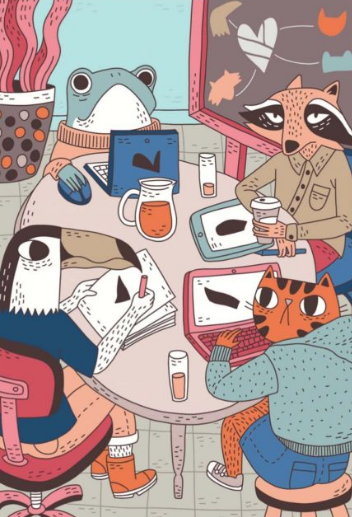
And this is the point I wanted to emphasize, the real meaning of neuroinclusion which is not only the inclusion of neurodivergence because it would still be based on the classical, paternalist, and dysfunctional model of inclusion imposed from above. The idea that one group of people is better than another, and that they can allow “inferior” beings to become a part of their world. In contrast, we think of neuroinclusion as the cohabitation of different neurotypes — neurodivergent and typical ones — the cohabitation of neurodiversity, in fact, the “neurocoexistence.” —Fabrizio Acanfora, Of Equal Pace: The Work Beyond the Idea of Inclusion, 2023, translated to English by Special Listerne
Disability-Inclusive Language
Graphic: Sonny Jane Wise, Lived Experience
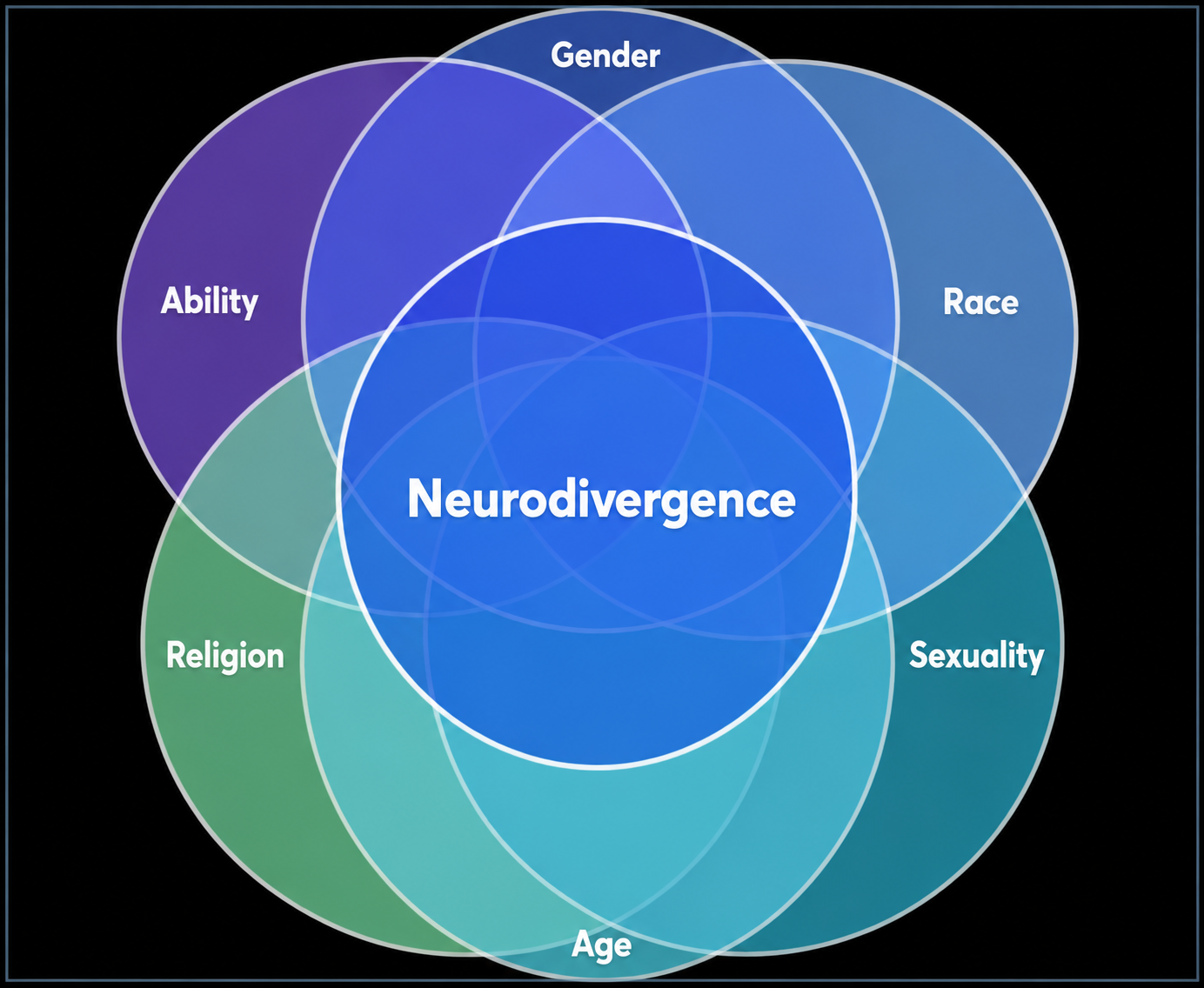
Neuroinclusive practices help create a more positive environment for social change. It invites neurodivergent people to participate in creating this positive space. Lived Experience educator Sonny Jane Wise designed this Venn diagram illustrating where ND meets diversity, all the aspects of who we are as people. And some people may need supports and accommodations to thrive.
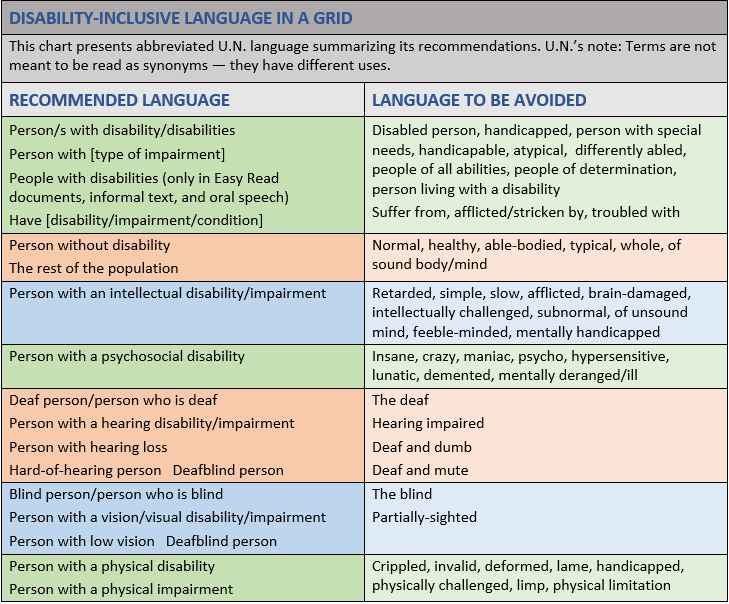
A United Nations document on language guidelines for talking/writing about disability details explanations for why yesterday’s language is no longer acceptable today. Presented here is my edit and take on each “standard.” The document is silent on words like neurodivergence and neurodiversity, which is a miss. This section is intended for anyone wondering how to talk about disability.
Disability-Inclusive Language Guidelines was published in 2019 by the United Nations Office at Geneva, based on standards set by the U.N. Convention on the Rights of Persons with Disabilities (CRPD). CRPD’s efforts are part of the 2019 U.N. Disability Inclusion Strategy, a policy and action framework. The language guidelines are aimed at U.N. workers, so through their language use they can help remove barriers and engage persons with disabilities “in all spheres of work and life to achieve sustainable and transformative progress on disability inclusion.”
Words matter. Undeniably, the language we use to refer to persons with disabilities has an impact, as it shapes our perception of the world. This language has evolved over time, and terms that were commonly used some years ago are no longer acceptable …. Inclusive language is a key tool in combating ableism and its entrenched manifestations. Ableism is a misguided and biased understanding of disability that leads to the
assumption that the lives of persons with disabilities are not worth living. Ableism can take many forms, including harmful language. —Disability-Inclusive Language Guidelines, 2019, United Nations Office at Geneva
- Inappropriate language can make people feel excluded or offend them and can be a barrier to full and meaningful participation.
- Use of derogatory or inappropriate language may amount to discrimination and impinge on the enjoyment of human rights.
- By adopting language that celebrates diversity, we strengthen the human rights model of disability.
- People shouldn’t be identified by their disability, unless relevant. Yet
disability shouldn’t be made invisible either. You should openly and respectfully discuss disability issues and prioritize disability inclusion. For too long, persons with disabilities have lacked representation, participation, and have been neglected, ignored, or left behind. - The way people self-identify should be respected and recognized. “However, as this rich diversity of identities may hinder efforts to establish unified terminology, these guidelines recommend terminology that is commonly used and accepted.”
United Nation’s Disability Inclusion Standards (Plus My Commentary)
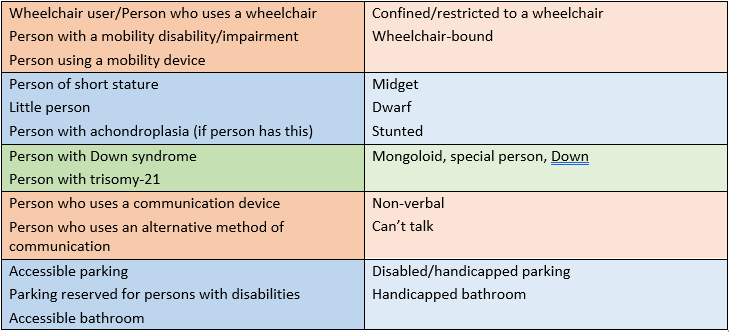
Use People-First Language
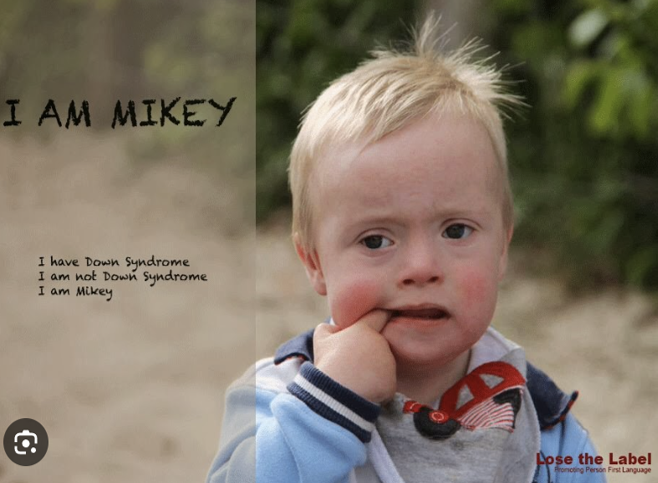
The CRPD uses the most widely accepted way to refer to persons with disabilities: people-first language emphasizing the person, not the disability. Exceptions refer to persons who are blind and/or deaf: blind/deaf persons, persons who are blind/deaf, or deafblind persons.
Source: Downs Side Up
My Commentary
- Another exception: neuroatypicals are more comfortable with emphasizing disability first as a political badge of honor. As an autistic writer and advocate …
- It’s too cumbersome to write persons with a psychosocial disability (as is suggested) in, say, an article about mental illness (a term disallowed). Not happening here or elsewhere.
- Typical is on the list of terms NOT to use, which is disappointing — I thought it was a fair, neutral way to distinguish neuroatypicals from neurotypicals without resorting to normal. They suggest the rest of the population. See comment on cumbersome.
Avoid Labels and Stereotypes
Disability is a part of life and of human diversity, not something to be dramatized or sensationalized. Persons with disabilities should therefore not be portrayed as inspirational or superhuman.
It’s patronizing to use language implying it’s unusual for persons with disabilities to be successful, productive, and living happy and fulfilling lives, especially adjectives like courageous, brave, or as
having overcome their disability.
Also avoid using survivor and/or battling disability, unless specifically in treatment for/recovering from a health condition: like brain injury survivor or battling cancer. Although widely used, many consider war rhetoric inappropriate, and some find it offensive.
Stop portraying people with disabilities as intrinsically vulnerable. Everyone is vulnerable at some time or other. When specific barriers and circumstances causing vulnerability are addressed, there’s no more vulnerability.
My Commentary
Photo: Inclusive City Maker

- Interesting about being an [illness] survivor or battling [illness]. These terms have been around for so long, they’re pretty much drained of impact. This seems individual. Some may be motivated to keep up the fight, while others may hate the cliché.
- The larger point is about positive framing and empowerment, as in referring to someone’s skill in reading braille without supplying the reason, unless relevant.
Photo: Malvern Behavioral Health
Do Not Use Condescending Euphemisms
Many popular alternate expressions reflect the misguided idea that disability needs softening, so avoid terms like differently abled, people of all abilities, disAbled, or people of determination. Euphemisms are a denial of reality, patronizing, offensive, or inaccurate (we’re all differently abled) — and a way to avoid talking about disability.
This applies to the term special, considered offensive and condescending because it stigmatizes difference. Instead, replace special needs or special assistance with neutral or positive language — like tailored assistance. The term special education is widely used but also carries negative connotations since it refers to segregated education.
My Commentary
- My next-door neighbor is a retired special education teacher — won’t she be surprised! Another source suggested inclusive education teacher or learning support teacher.
- Yes, to ridding all language of clichés and too-cute terms, especially ones like disAbled that get autocorrected so you have to retype the cap A.
Disability is Not an Illness or a Problem

Photo: “Overcoming the Stigma of Mental Illness,” Family Kickstart Georgia
Under the medical model, disability is a health condition that needs to be fixed and persons with disabilities are not seen as rights holders. The charity model views disability as a burden or a problem that persons without disabilities must solve. This depicts persons with disabilities as objects of charity and pity — perpetuating negative attitudes and stereotypes.
Inappropriate expressions — suffers from, afflicted with, or is a victim of — suggest constant pain or powerlessness and suggest a poor quality as if the person were harmed by a crime or subjected to a human rights violation.
My Commentary
This is the language of the neurodiversity movement — too bad it’s not referenced. New to me was the charity model, which I hope is less true now than it once was.
Use Proper Language in Oral and Informal Speech
Most persons with disabilities are comfortable with common expressions, like Let’s go for a walk to a person in a wheelchair or Have you heard the news? to a deaf person. Unacceptable expressions are: blind as a bat or deaf as a post, as well as metaphors like blind to criticism and falls on deaf ears.
Misused terms that can be inappropriate and hurtful are I must have Alzheimer’s when you forget something or They’re paranoid when people seem mistrustful.
Never use disability-related terms as an insult or to express criticism, such as the word lame to mean boring or uncool.
My Commentary

- On a hot day in December, someone innocently said, Looks like we’re having an Indian summer, and then said, Oh, can I say that? Well, I looked it up and, though it’s not the worst thing to say, it’s ready for the language junkyard.
- Alternate terms my Google search suggested included carnicular. Imagine this: I say, Looks like we’re having a carnicular day! What might my friend’s response be?
- As to the language of disability: I wouldn’t call a person lame, but maybe their excuse is lame? Would anyone think of the original, literal meaning of that term?
Gustav Klimt, Birch Trees, 1903, painting
Disability-Inclusive Language
Paired Terms Needing Further Clarification
The U.N. language guidelines paired some terms that required further clarification before being used in their communications. The words have different meanings, sometimes subtle, but aren’t interchangeable. I’ve highlighted some paired terms that are more relevant to neurodivergence, even though ND was not used in 2019:
Impairment vs Disability
- Impairment refers to any loss or abnormality of psychological, physiological, or anatomical structure or function (World Health Organization). [Today we would NOT use abnormal.]
- Disability results from interaction between persons with impairments and attitudinal and environmental barriers that hinders their full and effective participation in society on an equal basis with others (Convention on the Rights of Persons with Disabilities).
Declaration or Disclosure
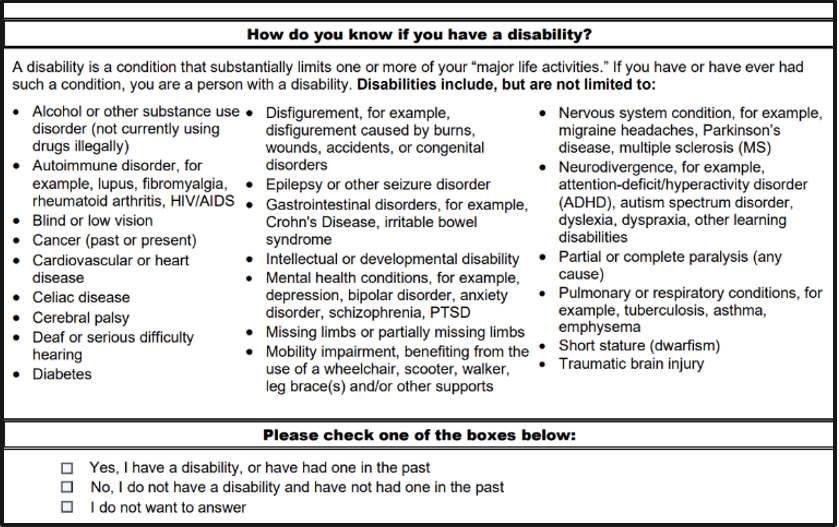
Persons with disabilities have the right to share or not share information about their disability status. In the workplace, we should move away from traditional terms of disclosure or declaration of disability, as it can make it seem like the person is revealing a secret.
The phrase identify as a person with disability should also be avoided, as it raises other issues around identity and belonging. Someone may have an impairment but still not identify as a person with a disability. A more appropriate phrase is choose to share information about [one’s] disability/impairment when talking about a person’s choice to let their employer or colleagues know about their impairment or specific requirements.
Integration vs Inclusion
In the language of disability, inclusion is seen as positive and integration as negative:
- Integration is the process of making a person adapt to or fit into society.
- Inclusion refers to the process of changing society to include everyone, regardless of their impairment status.
Needs VS Requirements
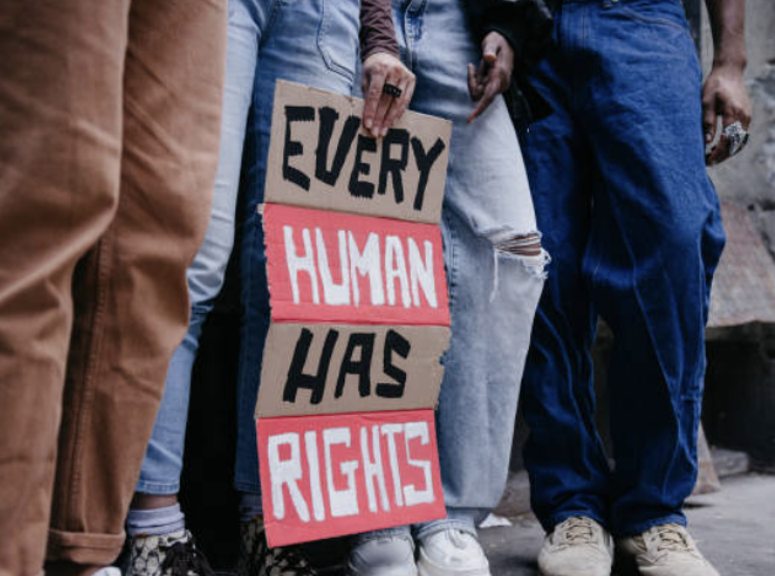
Requirements is preferred over needs, in line with how the human rights approach perceives disability:
- Persons with disabilities are rights holders.
- Needs perpetuates a stereotype that persons with disabilities are a burden, especially when referring to care needs. Schools must provide Braille materials to students with visual impairments, for example, not because they need them, but because of the requirement that people with disabilities have an equal right to a quality education as other students have.
Standards for language need to separate the insulting from the merely dated, even if wrong. Thus, person with a physical impairment or disability is correct. Person with a physical limitation or who is physically challenged were well-intentioned terms, but are no longer right. But a crippled person is insulting and intentionally so.
Understanding ND Identity in Light of Disability
Some findings in Diane Roberts’ 2007 research paper, “For Identity: Reflections on Aging with a Disability,” University of Huddersfield, UK, are relevant when faced not only with disability — but also with neurodivergence. Roberts is most interested in whether and how disability and aging concepts are translated into everyday life. As Roberts’ explains, legislative changes over past decades mandate reasonable adjustments to discrimination. Advances in social theory and policy lead to these current identity concepts:
- Identity is fluid and under individual control.
- Disability and age are socially constructed.
- Demographic change means accepting an aging population and a longer working life.
- Diversity and difference are to be embraced.
- Those who are different are also normal.
In this next diagram on the left — Influences on “Normal” Lifecourse — is drawn from prior research into lifecourse and identity formation, indicating the major influences and assumptions attached to each stage.
The second diagram on the right — Differential/Additional Impacts for those with Disabilities — resulted from the Robert’s research.
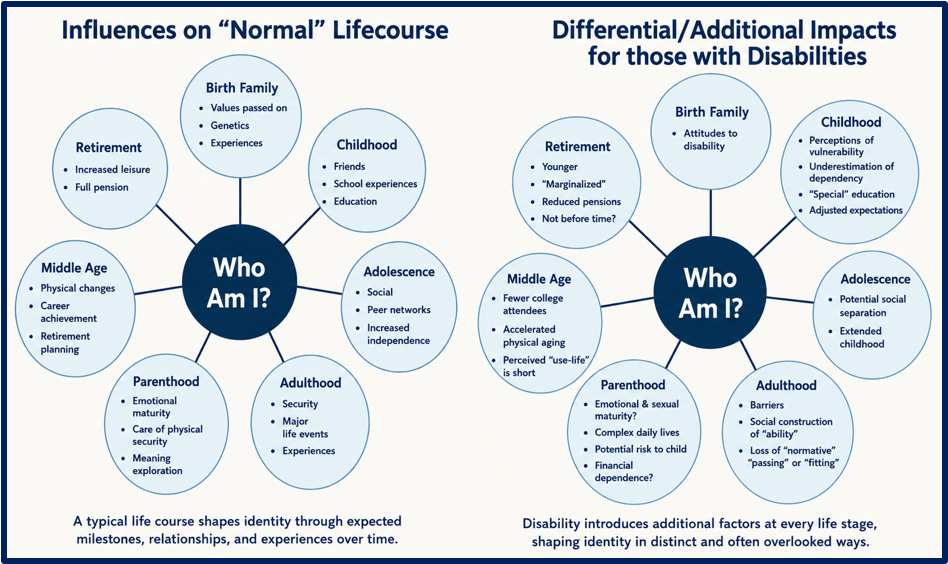
“For Identity: Reflections on Aging with a Disability,” by Diane Roberts, 2007, University of Huddersfield, UK; re-created for legibility on this website
Roberts’ gives an example [paraphrased]: Where normal means external acceptance and development, with disabilities implies more uncertainty, complexity, and a struggle not to lose ground. The author didn’t anticipate the variety of roles her data identified. “Not only can roles be identified, but they provide the basis for some very obvious differences and tensions in the identities attached to them.” She also mentions a theme of “submerged’ identities — identities coming from their disability.”
No matter what the practicalities of their lives, the people I spoke to all indicated that their disability had given rise to issues which either would not otherwise have affected them or affected them to a lesser extent and had changed their interaction with the world about them. We all have multiple roles and identities bound up within the “rich tapestry of life.” Some of those will not be deliberately chosen roles or identities, but for people with disabilities that is exacerbated by living with a disability. — Diane Roberts, University of Huddersfield
Coming Up Next
Post 30: Neurodivergent Language Difficulties — the final in this trio of posts on how the terms we choose to use reflect our mindset in the moment — looks into language difficulties often accompanying specific neurodivergent conditions, like autism and ADHD.
Copyright ©2026 Jan Swan
 English