On Neurodivergence and Otherness
Show Table of Contents
INTRO
1. On Neurodivergence and Otherness: An Introduction
SENSES AND SENSORY SENSITIVITIES
2. Senses Count
3. Neurobiology for Dummies
4. Sensory Transmission and our Reward System
5. Sensory Receptors are the Body’s Cellular Plan
6. A Synthesis: Sensory Systems and our Emotions — Part I
7. A Synthesis: Sensory Systems and our Emotions — Part II
8. Sensory Disorders and Sensitivities
9. Etan’s Story
SYNESTHESIA
10. Synesthesia: Difference, But Not Disorder
11. Synesthesia, Creativity, Artistry — Part I
12. Synesthesia, Creativity, Artistry — Part II
AUTISM AND THE NEURODIVERSITY MOVEMENT
13. From “Mental Defectives” to Autism Spectrum Disorder
14. Changing Conception of Autism
15. Autism Diagnoses and Behavior Patterns
16. Autism Treatments that Help
17. Early Start Autism Treatment: A Case Study
18. Neurodivergence and the Neurodiversity Movement
19. Neurodiversity Takes Flight
20. ADHD and Neurodevelopmental Disorders
21. ADHD: A Preponderance of Risk Factors and Symptoms
22. ADHD: Inattentive, Impulsive … and Hyperactive?
23. ADHD: Named, Renamed, Still Needs a New Name
24. ADHD: Treatment and Coping Skills for All Ages
LGBTQ+
25. Neurodiversity and the LGBTQ+ Fight
26. LGBTQ+ Identity and Expression
27. LGBTQ+ and Mental and Behavioral Healthcare
ON LANGUAGE
28. Language Matters In and Around Neurodiversity
29. Neuroinclusion and Disability Language
30. Neurodivergent Language Difficulties
ON CREATIVITY AND GIFTEDNESS
31. Neurodiversity and Creativity
32. Giftedness is a Piece of Neurodivergence
SELF-IDENTITY
33. Self-Identity: The Cornerstone of Neurodiversity
34. Early Theories of Self-Identity Formation
35. Contemporary Theories of Self-Identity Formation
36. Authenticity and the Search for Self
37. Self-Schemas and Neurodivergence
38. Self-Labeling and Parts Work
39. Complexity, Clarity, and Self
IMPROVING LIFE FOR NEURODIVERGENT PEOPLE
40. Empathy Recognizes and Navigates Difference
41. Reducing Neurotypical-on-Neuroatypical Conflict – Part I
42. Reducing Neurotypical-on-Neuroatypical Conflict – Part II
43. Communicating Across the Neurospectrum – Part I
44. Communicating Across the Neurospectrum – Part II
45. Neurodiversity: Advocacy and Education
46. Neuroinclusion in the Workplace
47. A Neurodiverse Lifestyle
IN CONCLUSION
48. In Conclusion: Neurodivergence and Inspiration
35. Contemporary Theories of Self-Identity Formation

In following 100 years of theories about how we form our identities, especially during the years of peak formation — the teen years — we can also think about how neurodivergent self-identity forms. One thing I might add here, before I go onto more recent theories, is the process is even more fraught for them.
The formative theories covered in post 34 emerged over many decades, but share an assumption: forming a self-identity is a developmental process. We gradually — but not always smoothly — come to understand who we are, what we believe, where we belong, and what we want our lives to become. While the process tends to be similar for all of us, the circumstances in which it takes place couldn’t be more different.
For neurodivergent young people, identity formation can be especially complicated. Their years of peak formation — the teen years — are also years of struggling to understand why they feel different, why things seem harder for them than their peers, or why they don’t seem to fit.
I specifically asked my son Etan about his own identity formation. He’s now 34. Here’s what he remembers.
Etan Swan on his Identity Formation
I didn’t gain a sense of who I was until I was 29. I spent so much of my life being anxious or seriously depressed, especially through my 20s, that I started to identify myself as a person who’s suffering and has depression and is having trouble with life—not any way to identify yourself. That’s just what I was dealing with.
When I started focusing on my mental health and exercising, I thought more about my positive traits—my artistic ability and the people in my life loving me and wanting to be around me. I felt good about where I was and what I believed in. I started self-actualizing. I know who I am now.
I didn’t have strong feelings of my own ideals or my own identity until late. Without self-esteem, it’s hard to feel you have an identity that’s positive. So I guess you could say I had an identity, but that identity was being somebody who’s having trouble coping with life.
So, though I still identify with my struggling a lot, now that I’ve experienced self-actualization I know it’s not my real self asking questions. —Etan Swan
Etan defines self-actualization as having a strong feeling of who he is, what he believes in, what he’s trying to do with his life — and also loving himself and not wanting to be somebody else.
He told me:
A lot of people who have what I have but aren’t doing what I do have it hard — and I know how hard that is. For me exercise is medicine in a very literal sense. If I don’t do this, I will not be OK. Gaining this feeling in a genuine internalized way has taken a long time, and I never imagined I would get here. So I feel good about that. It’s satisfying. —Etan Swan
What strikes me is that Etan didn’t really lack an identity before he was 29. As he says himself, he had one. But much of it had become organized around struggling and low self-esteem. Only later could he recognize that what he was dealing with wasn’t the whole of who he was.
Sources for the next sections: James Marcia, “Development and Validation of Ego-Identity Status,” 1966, Journal of Personality and Social Psychology, Psych DWEEB; Jeffrey Arnett, “Emerging Adulthood: A Theory of Development From the Late Teens Through the Twenties,” 2000, American Psychologist, ResearchGate; Erik H. Erikson (1956), “The Problem of Ego Identity,” Journal of the American Psychoanalytic Association, Sage Journals or Google Books preview
James Marcia: Exploration and Commitment

In 1966, Canadian-American developmental psychologist James Marcia — known for research and writings on identity development from adolescence through the lifespan — took Erikson’s ideas about adolescent identity and made them more specific.
Rather than seeing adolescence as a choice between achieving an identity (what Erikson called identity resolution) or remaining confused (identity confusion), Marcia proposed two processes involved in developing an identity: what he originally called crisis — the period of considering meaningful alternatives, now generally described as exploration — and commitment.
- Exploration: When teens question existing beliefs and possibilities and decide whether to consider identity alternatives.
- Commitment: When teens do decide to choose among these alternatives — values, beliefs, intimate relationships, friendships, gender roles, politics, religion, or ways of living — to achieve a successful identity of their own.
From different combinations of exploration and commitment, Marcia identified the following four identity “statuses”:
- Identity diffusion: A young person has neither seriously explored alternatives nor committed to them.
- Identity foreclosure: The person has made commitments without much exploration — perhaps accepting beliefs, expectations, or a life direction handed down by parents or others
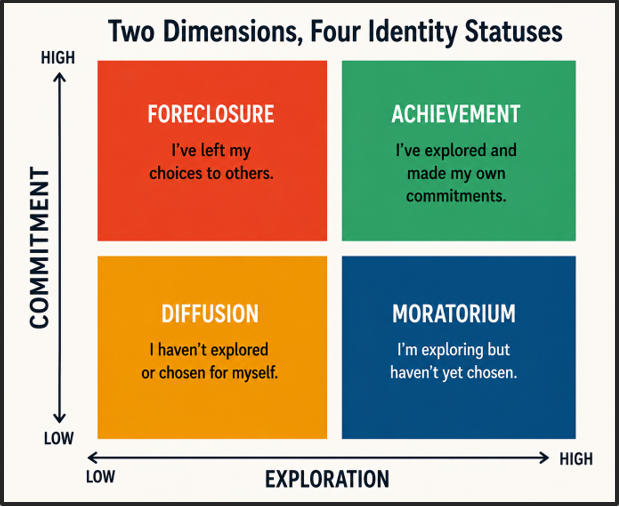
Marcia’s four identity statuses reflect different combinations of exploration and commitment — how actively we consider possibilities and how fully we make our choices our own, representing low to high levels of engagement in each part of the process. Graphic: Jan Swan, with ChatGPT
- Identity moratorium: This status is quite different. The person hasn’t committed but is actively exploring. Marcia found that this can be an anxious and uncertain period. As he described these young people: “The world for them is not, currently, a highly predictable place; they are vitally engaged in a struggle to make it so.”
- Identity achievement: Finally, this status describes people who have explored alternatives and made commitments that feel their own.
The statuses don’t function as life stages that we move through in sequence. As we learned in post 34, identity development continues across adulthood, and we can be in different statuses in different parts of our lives. We may feel settled in a relationship, for example, but uncertain about work, or confident in deeply held values while still trying to understand where we belong.
Marcia gives us something more useful than four labels: exploration and commitment as signs of an awakening self-identity. We have to encounter possibilities before we can decide which ones fit — and eventually say, This is part of who I am.
When Exploration Is Harder

Redefining or pulling away from inherited notions of identity likely causes a degree of turmoil in most of us, especially when we were young. But for neurodivergent young people, undertaking that exploration is often under dramatically different circumstances than what their neurotypical peers might experience.
For ND teens, the same years may be consumed by anxiety or depression, executive-function difficulties, masking, social rejection or isolation, academic struggles, or simply trying to understand why they seem so different from everyone else.
Like Etan, their self-exploration is colored as much by the struggle as it is by determining who they are apart from parents and other role models. They may feel stuck in place, increasingly isolated as they watch peers appear to move on with their lives.
External barriers can make the process harder still. A young person may not understand they might benefit from seeking help. Others may know perfectly well they need help but don’t know what kind, can’t persuade adults, encounter long waiting lists, can’t afford services, or have needs that haven’t been recognized. Even when parents and teens recognize that something is wrong, understanding what would help and gaining access to it can take years. Without appropriate support and validation, the consequences can be devastating.
Identity Formation Continues into Adulthood


Daniel Levinson, Photo: Getty Images. Gail Sheehy, Wikipedia
The next developments in identity theory are less obvious — and more surprising. Accepting Erikson and Marcia’s conclusions that identity continues to develop into adulthood, the next generation of psychologists wanted to test assumptions about the milestones of identity development. They questioned when a person should have figured out who they are, what adulthood itself is supposed to look like, cultural norms defining adulthood, and how the changing circumstances of our lives affect the time and opportunity we have to get there.
In the 1970s, psychologist Daniel Levinson studied adult development and described the late teens through the 20s as a period when people experiment with different jobs, ideas, relationships, and possible futures. Journalist Gail Sheehy later popularized many of Levinson’s ideas in her hugely popular 1976 book, Passages.
Side note: I remember Sheehy’s book coming out: it had an enormous impact on our thinking, which tells me how little we did think about all the transitional moments of our life. I suspect rereading the book now would feel dated.
Meanwhile, reflecting a newer generation’s dilemma, psychologist Jeffrey Arnett focused specifically on the increasingly long transition between adolescence and settled adult life. He called the period from roughly ages 18 to 25 emerging adulthood — years in which many young people have left some of the constraints of adolescence but have not yet taken on enduring adult roles.

Jeffrey Arnett, Wikipedia
Arnett identified three major areas of identity exploration:
- Love: What kind of relationship — and what kind of person — fits me?
- Work: What am I good at, what would satisfy me, and what kind of working life do I want?
- Worldview: Which beliefs and values have I inherited, and which do I choose for myself?
Some of these explorations and commitments, to keep Marcia’s language, were also taking place in a world where the old markers of adulthood were becoming less reliable. Continued dependency on parents, the rising cost of college, the decreasing emphasis on marriage as a requirement for intimacy, delayed marriage and childbearing, and the decreasing desirability of jobs once acceptable to earlier generations left young people with more choices — but fewer prescribed answers.

Perennial questions of Who am I? and What do I believe? were harder to tackle against a backdrop of a prolonged period of uncertainty. Same with Who do I want as my partner? and What do I want to do with my life? The shifting mores of the “sixties” meant the only thing not delayed was gratification.
While it would seem a good thing that some young people might have more time before those answers become fixed by the responsibilities of mature adulthood, prolonged uncertainty can also wreak havoc on self-worth. The mantra of the times may have been “don’t trust anyone over 30,” but nearing 30 without knowing who you were or where you were headed could feel like falling frighteningly behind.
But who gets to use those extra years for exploration? And what happens when finding your identity involves more than choosing a career, partner, or worldview?
For a neurodivergent 20-something, the questions may include Why am I so different from other people? Why is this harder for me? What am I capable of? Where do I fit? For an LGBTQ+ young person, exploration may include understanding an identity that family, community, or culture doesn’t recognize or accept. And young people with fewer economic resources may have less freedom to explore at all: necessity can force decisions about work, education, housing, or family long before they feel ready to make them.
So the extended road to adulthood can be both opportunity and burden. More time may allow a young person to discover who they are. But having time is not the same as having the freedom, resources, acceptance, or support to use it for self-discovery.
The Privilege of Time

Another wrinkle in this evolving story of provisional adulthood raises the question: Is this really a new stage of development in the modern era — or have young people always needed time to figure themselves out?
In a 2021 Harvard Gazette interview, “What’s the matter with kids today?” Harvard professor Nancy Hill and instructor Alexis Redding — co-authors of The End of Adolescence: The Lost Art of Delaying Adulthood — push back against the familiar complaint that today’s young adults are less motivated, overly dependent on parents, or simply resistant to growing up.
Redding says versions of the “kids today” narrative go back centuries (even to Aristotle). What changes is our memory:
…our own forgetting about what it’s like to be in this profound period of transition and to be making decisions at a moment when we’re still uncertain about how things are going to work out. When we look back across our lives, we can connect the dots in a way that makes sense because we know the end of the story. But we forget that young people are in the midst of a story where they don’t yet know that ending. —Interview with Alexis Redding, “What’s the matter with kids today?”, Harvard Gazette,
This is indeed confusing. Is it a new feature of our time or not? Perhaps some older adults rejigger the narrative of their younger lives to make them look far more orderly than they felt while living them. But that’s not true for me — I look back and think of those post-college years as unbelievably messy and unnecessarily prolonged. Still, I take the point.
Comparing young people in the 1970s to young people today, Hill and Redding found they worried about many of the same things: finding friends and fitting in, getting the right education or training for the right work, finding a life partner, and wondering whether they were making good decisions that would set their lives on the right course.
Young People Reach the Markers of Adulthood Later
What has changed is the timing of some traditional markers of adulthood. Take a longer historical view and the picture changes again. Hill and Redding point out that the unusually young age of marriage in the mid-20th century wasn’t necessarily the historical norm. At that time, many young people could leave high school, find a job paying enough to support a household, marry, buy a home, and start a family in their early 20s. In fact, go back more than a century, and the age of first marriage looks surprisingly similar to today.
Economic and cultural changes — along with far greater access to college — have altered the timetable. As Hill explains, those with the privilege of attending college have long delayed conventional markers of adulthood. What’s different today is that many more young people go to college, raising the average age at which those markers are reached. And increasingly, young people choose not to marry or have children at all — defining adulthood for themselves rather than reaching a prescribed set of milestones.
That makes “delayed adulthood” a much more complicated idea than failure to grow up.
For some young adults, then, additional time can be an enormous advantage. But not everyone gets that time. For Hill and Redding, this becomes a question of equity. Young people with fewer economic resources may have to earn money, leave school, support family members, or assume other adult responsibilities much earlier. They can’t afford to take years to figure out their life course. Hill writes:
It’s an equity issue, and if we can name it and understand the costs of pressing some people into adulthood and others getting the privilege of time, then we can really deal with it and give everyone the benefits of time and then help them understand what to do with it. —Interview with Nancy Hill, “What’s the matter with kids today?” Harvard Gazette
Hill and Redding therefore leave us with a more interesting question than Why are young people taking longer to grow up? Their work leads me to ask: Who gets enough time, support, and freedom to become themselves?
The “privilege of time” alone doesn’t create a strong self-identity, of course. But time can provide room for exploration, mistakes, reconsideration, and the ability to figure out who we are before major commitments narrow our choices. And those who may need more time to understand themselves — including neurodivergent young people and others whose paths toward adulthood may already be more complicated — aren’t necessarily the people who are given it.
Delayed Adulthood and Neurodivergence
But for a neurodivergent young person, the issue may go deeper than needing more time. The conditions under which identity develops can alter the identity taking shape. Anxiety, depression, executive-function difficulties, social rejection, or simply not understanding why everyday life seems so much harder aren’t happening off to the side while a young person figures out who they are. Those experiences can become part of the answer. I struggle can become I’m incapable. I do things differently can become There’s something wrong with me. I’m excluded can become I don’t belong.
And some of those messages come from other people: Why can’t you just do it? Try harder. What’s the matter with you? Get with the program. A young person who repeatedly hears they’re somehow getting life wrong may begin not only to believe it, but to fear being found out. Masking then adds another complication to identity formation: Who am I? Who do they think I am? Who do I need to appear to be? What happens if they find out?
Sources for this section: Krista N. Drapalik, et al., “Camouflaging and identity development among autistic female and gender-diverse youth: A qualitative exploration,” 2025, Autism, Pub Med/NIH; Jade Davies, et al., “Autistic identity: A systematic review of quantitative research,” 2024, Autism Research, Wiley Online Library
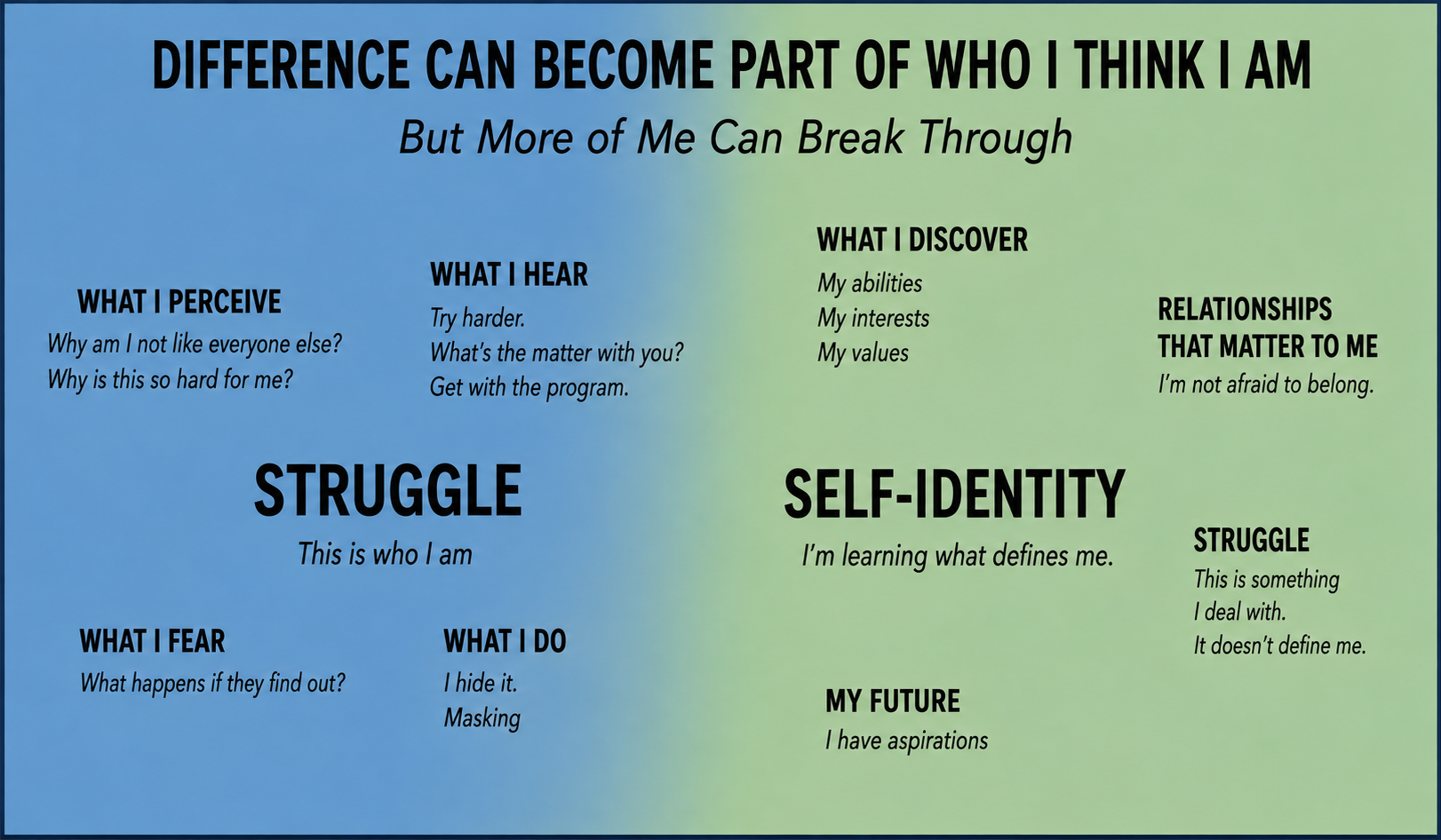
When difference is experienced through difficulty, criticism, fear, and concealment, struggle can become part of how a young person defines themselves. As they discover their abilities, interests, values, relationships, and aspirations, struggle may remain — but it no longer has to define the self. Original graphic: Jan Swan, with ChatGPT
Hill and Redding also see something hopeful in recognizing how much the generations share: it can help parents, teachers, and other adults respond to young people with greater understanding.
By knowing commonalities across generations, we can better support youth today and have a greater empathy for the challenges that they’re facing. The people in our book are now in their 60s and 70s and their lives turned out OK; not without bumps and struggles…. If we could tell every youth that it’s going to turn out OK, how much freedom would that give them to be their authentic selves. —Nancy Hill and Alexis Redding, Harvard Gazette
Developing a self-identity is one thing. Having the freedom and confidence to live as that person is another.
Coming Up Next

That last Hill and Redding thought takes us directly to the next question. Developing a self-identity is one thing. Having the freedom and confidence to live as that person is another. In Post 36: Authenticity and the Search for Self, we turn from figuring out who we are to what it means to live authentically as ourselves.
Copyright ©2026 Jan Swan
 English