On Neurodivergence and Otherness
Show Table of Contents
INTRO
1. On Neurodivergence and Otherness: An Introduction
SENSES AND SENSORY SENSITIVITIES
2. Senses Count
3. Neurobiology for Dummies
4. Sensory Transmission and our Reward System
5. Sensory Receptors are the Body’s Cellular Plan
6. A Synthesis: Sensory Systems and our Emotions — Part I
7. A Synthesis: Sensory Systems and our Emotions — Part II
8. Sensory Disorders and Sensitivities
9. Etan’s Story
SYNESTHESIA
10. Synesthesia: Difference, But Not Disorder
11. Synesthesia, Creativity, Artistry — Part I
12. Synesthesia, Creativity, Artistry — Part II
AUTISM AND THE NEURODIVERSITY MOVEMENT
13. From “Mental Defectives” to Autism Spectrum Disorder
14. Changing Conception of Autism
15. Autism Diagnoses and Behavior Patterns
16. Autism Treatments that Help
17. Early Start Autism Treatment: A Case Study
18. Neurodivergence and the Neurodiversity Movement
19. Neurodiversity Takes Flight
20. ADHD and Neurodevelopmental Disorders
21. ADHD: A Preponderance of Risk Factors and Symptoms
22. ADHD: Inattentive, Impulsive … and Hyperactive?
23. ADHD: Named, Renamed, Still Needs a New Name
24. ADHD: Treatment and Coping Skills for All Ages
LGBTQ+
25. Neurodiversity and the LGBTQ+ Fight
26. LGBTQ+ Identity and Expression
27. LGBTQ+ and Mental and Behavioral Healthcare
ON LANGUAGE
28. Language Matters In and Around Neurodiversity
29. Neuroinclusion and Disability Language
30. Neurodivergent Language Difficulties
ON CREATIVITY AND GIFTEDNESS
31. Neurodiversity and Creativity
32. Giftedness is a Piece of Neurodivergence
SELF-IDENTITY
33. Self-Identity: The Cornerstone of Neurodiversity
34. Early Theories of Self-Identity Formation
35. Contemporary Theories of Self-Identity Formation
36. Authenticity and the Search for Self
37. Self-Schemas and Neurodivergence
38. Self-Labeling and Parts Work
39. Complexity, Clarity, and Self
IMPROVING LIFE FOR NEURODIVERGENT PEOPLE
40. Empathy Recognizes and Navigates Difference
41. Reducing Neurotypical-on-Neuroatypical Conflict – Part I
42. Reducing Neurotypical-on-Neuroatypical Conflict – Part II
43. Communicating Across the Neurospectrum – Part I
44. Communicating Across the Neurospectrum – Part II
45. Neurodiversity: Advocacy and Education
46. Neuroinclusion in the Workplace
47. A Neurodiverse Lifestyle
IN CONCLUSION
48. In Conclusion: Neurodivergence and Inspiration
10. Synesthesia: Difference, But Not Disorder
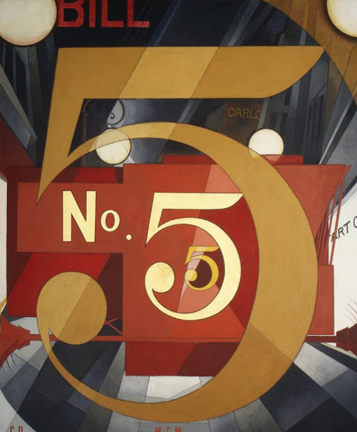
Charles Demuth, I Saw the Figure 5 in Gold, 1928
For decades, scientists ignored or disbelieved so-called synesthetes who claimed they could hear colors, taste words, or see pain. Yet, synesthesia may be the purest form of neurodivergence: difference, but not disorder. It may challenge or disrupt aspects of living — especially with other conditions — but it may also enhance cognition, learning, and creativity. Understanding this sensory anomaly might provide insight into sensory experiences’ influence on the workings of our minds.
We’ve learned how the sensory system falls off “normal” when it’s disorganized and functions less well — affecting the senses and the ability to navigate the environment. Sensory processing disorder (SPD) can be standalone or a set of underlying symptoms for something else.
Neuroscience sees synesthesia as a rare sensory condition that occurs when the steps in sensory processing become entangled — in a confounding but not disabling way. Researchers estimate 4% of people worldwide are synesthetes, which may be conservative given the myriad forms this condition can take. Many with synesthesia don’t know what it is or even that it’s unusual.
- Hearing loss makes it harder to be in conversations, especially in noisy situations. Tuning out repeatedly over time can reduce mental acuity.
- Reduced vision makes driving impossible and limits independence.
- Balance disorders cause falls and physical calamity or, at the least, limit safe movement.
- Proprioceptive curtailment limits ability to move without carefully observing hands or feet.
- Vestibular disequilibrium throws off a sense of balance and causes vertigo, increasing the likelihood of feeling uneasy in unfamiliar spaces.
Ranu summarizes impressive research studies looking at possible non-invasive, safe, and drug-free treatments for these and other sensory challenges, from Harvard’s Five Senses: Input & Response program, Harvard Medical School teaching hospitals [edited for brevity]:
In the Middle Ages, synesthesia was linked with mystical and religious experiences — and described by religious scribes, according to Frontiers in Human Neuroscience. During the Renaissance, it was linked to artistic expression. Leonardo da Vinci was known to have been inspired by his synesthetic experiences. Same with philosopher-poet John Milton, who described seeing colors and shapes in response to music.

Source: Synesthesia-test [green outline added by me]
Scientific study began in the 19th century. Researchers believed synesthetic experiences were learned — but also helped with learning, especially in mathematics, remembering sequences, and other complex structured learning. Early 20th-century studies focused on its psychological and cognitive aspects but rejected learning as either cause or function.
More recently, physician neuroscientist Richard E. Cytowic, author of Synesthesia: A Union of the Senses, showed how healthy brains experience synesthesia, how these experiences are “real” (not metaphors), and how we’re all possibly born with “neonatal synesthesia” or are unconsciously synesthetic. It opens our understanding of mental health, which he recognizes as an emotional experience. Cytowic writes, it’s “accompanied by a sense of certitude” — a “this is it” feeling — as seen in the ecstatic religious writings of American philosopher/ psychologist William James.
Learning and Synesthesia are Profoundly Interconnected
Synesthesia affects people’s perceptions, artistry, cognition, and memory—allowing for easier connections between concepts. Newer research notes the profound impact of learning in synesthetic development and its influence on learning new conceptual material. In sum:
- Synesthesia development is clearly influenced by learning.
- Synesthesia arises due to the demands of early learning by helping children successfully reflect on and remember what they learned through synesthetic associations.
Recent research shows synesthetic associations are not just arbitrary, as Cytowic writes: “The theory states synesthetic associations are not merely learned but learned for strategic purposes.” For example:
- Sensory stimuli can “induce” synesthetic experiences, like learning letters, musical notes, numbers, or months of the year.
- Letter frequency and position in the alphabet can determine the “colors” of letters.
- Mnemonic devices can convert the learning of unusual or novel, abstract information.
The Neuroscience of Cross-Sensory Perceptions
Synesthesia is a neurological phenomenon that causes the senses to cross over and blend. For those who experience it, sounds may be seen as colors, letters may have distinct personalities, and emotions may be associated with specific tastes or smells. —Synesthesia-test
Research identifies synesthesia as a neurological condition. A sensory stimulus along one neural pathway triggers an involuntary stimulus along another pathway, resulting in seeing colors when hearing music, tasting words, or other cross-sensory perceptions.
As synesthete Maureen Seaberg writes in Psychology Today, it’s a form of neurodivergence. Here are her insights [paraphrased]:
- Stimulation of a primary sensory pathway (hearing) leads to automatic, involuntary experiences in second sensory pathways (vision, balance). Activation of the primary sense triggers activations of unrelated secondary senses — resulting in a person hearing music while sensing the sound as swirls of color.
- Magnetic resonance imaging (MRI) technology can identify the neural pathways involved in synesthetic perception, showing activity in the brain’s fusiform and angular gyrus regions associated with visualizing colors and shapes.
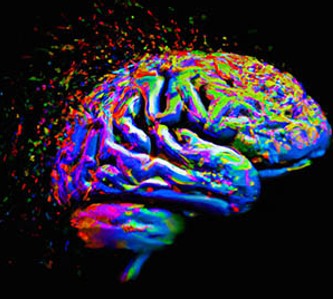
Will Storr, “Brain’s miracle superpowers of self-improvement,” BBC. Credit: Getty Images
- Seaberg notes Cytowic’s theory of a link between synesthesia and the limbic brain, associated with emotion and lucidity.
- Other studies relate synesthesia to differences in brain wiring. Scientists use brain imaging to observe more connectivity between brain regions in synesthetes — allowing for sensory cross-activation — than in non-synesthetes.
genetics
Synesthesia runs in families, suggesting a genetic component—more likely, part genes, part neuro-brain, part learned—influencing learning and affecting perception.
In some forms of synesthesia, such as sound-color synesthesia, a person may experience colors when they hear sounds or music. This can lead to a richer and more complex experience of music, with each note or chord triggering a specific color. —Synesthesia-test
Science is interested in how synesthetes can use their sensory perceptions to learn new skills or enhance cognitive abilities. One area of study is how brain mechanisms underlying synesthesia change sensory information processing—leading to advances in understanding the brain, perception, and the nature of consciousness, according to Synesthesia-test.
How Synesthesia Departs from Normal Sensation
Seaberg quotes V.S. Ramachandran, University of California at San Diego: “Synesthesia is as high as eight times more common in creative people: poets, writers, musicians, and artists of various kinds.” In his TED talk, Ramachandran said, “If you assume there’s greater cross-wiring and concepts are located in different parts of the brain, then it’s going to create a greater propensity toward metaphorical thinking and creativity in people with synesthesia.”
Ramachandran … believes the gene for synesthesia is expressed more diffusely throughout synesthetes’ brains than just the known hotspots, providing pathways that create an environment for linking seemingly unrelated things. If connected neurons live in concentrated groups in some minds, the synesthesia brain may have a wider fishing net of interconnected nerves. —Maureen Seaberg, Psychology Today blog
Synesthesia is not always a positive experience. Some may find it difficult to cope and not share their perceptions with others, feeling isolated or misunderstood as a result. Others sensitive to sensory overload find their experiences overwhelming, particularly if strong emotions are associated with their perceptions.
ASSOCIATIVE VS PROJECTED SYNESTHESIA
Chemistry expert Anne Marie Helmenstine, Thought Co., notes synesthesia works in two ways:
- Associative synesthesia: An “associator” feels the connections between a stimulus and a sense—hearing a violin and strongly associating it with the color blue.
- Projective synesthesia: A “projector” actually projects images and colors into reality — hearing a violin and seeing the color blue projected in space as if it were a physical object.
In another explanation, the Cleveland Clinic explains “normal” sensory processing in three easy steps (covered in prior posts):
- Detection: Sensory receptors pick up on stimuli.
- Signaling: Sensory receptors transmit neurosignals to the brain describing the experience.
- Processing: The brain receives the signal and routes it to a certain area for processing, making sense of the external/internal world from these sensory descriptions.
Each sense has many perception abilities. For example:
- Sight: Colors, patterns, textures, shapes
- Hearing: Volume, pitch, frequency
- Touch: Temperatures, pressure, textures, vibrations, pain
- Balance: Perception abilities involve more than one sense
- Concepts understood using senses: time, numbers, language
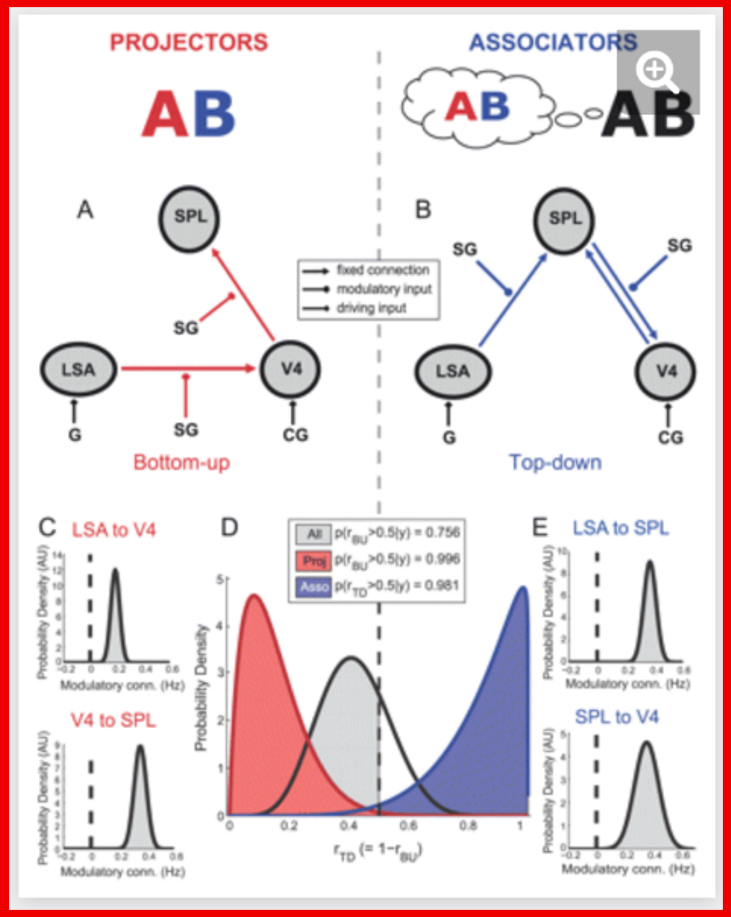
Dynamic causal modeling suggests: projector synesthesia is driven more by bottom-up sensory pathways; associator synesthesia relies more on top-down cognitive processing. Highlighting distinct neural mechanisms behind how synesthetic color experiences are generated. Graphic: K.E. Stephan, et al., “Computational Neuroimaging Strategies for Single Patient Predictions,” NeuroImage
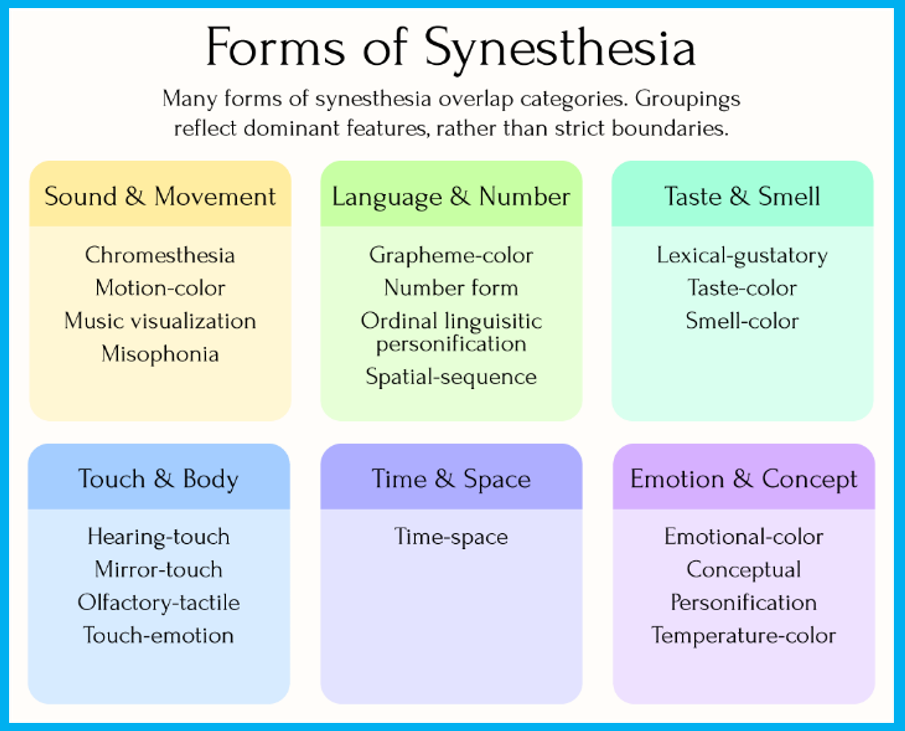
Graphic: Etan Swan
People with synesthesia process the steps differently, usually sending the same information through two or more brain areas at once—resulting in primary and secondary effects:
- Primary effect: What is experienced because of sensory input. Hearing sounds and recognizing them as music.
- Secondary-plus effect: A sense seems to be working, but without input from that sensory receptor. Seeing colors because of hearing music.
With so many possible combinations of senses and perception abilities, researchers have identified 60-150 different forms of synesthesia. Some synesthetes perceive texture in response to sight, hear sounds in response to smells, or associate shapes with flavors. Nearly any combination is possible, but here are the most common:
- Visual: The brain combines secondary sensory effects and projects them into sight (music producing colors) or visualizes an experience in their head as if seeing it directly. Chromesthesia happens when a sound (like a car horn) triggers seeing colors.
- Auditory-tactile: Sounds cause tactile sensations, such as temperature changes, pressure, pain. Or a sound prompts a specific bodily sensation (tingling on back of the neck).
- Day-color: Associate certain colors with days of the week.
- Ordinal linguistic personification: Happens when ordered sequences (days of the week) are associated with personalities or genders.
SENSORY INTEGRATON
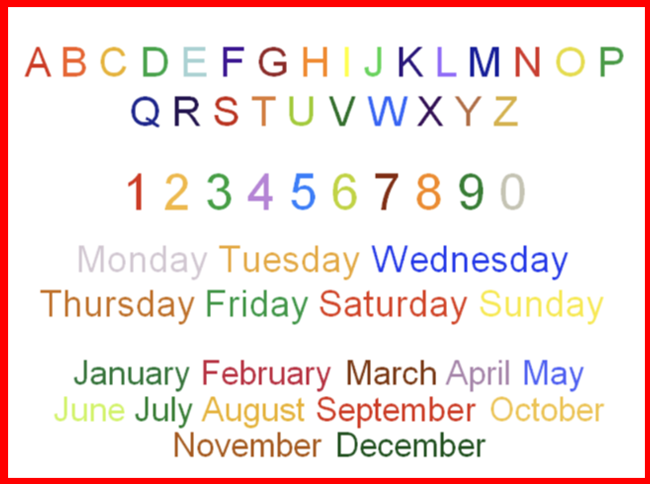
- Grapheme-color: In a common form, graphemes — letters, numbers, symbols — are associated with specific colors. Visual input from graphemes activates the brain responsible for processing color, triggering color perceptions. University of Toronto psychologists showed perceptual grapheme-color experiences boost statistical learning (ability to discern patterns), learning language, and memory recall (brain function).
- Hearing-motion: Experience sounds related to movement, like a whoosh when a person passes by.
- Lexical-gustatory: Occurs when hearing certain words triggers distinct tastes.
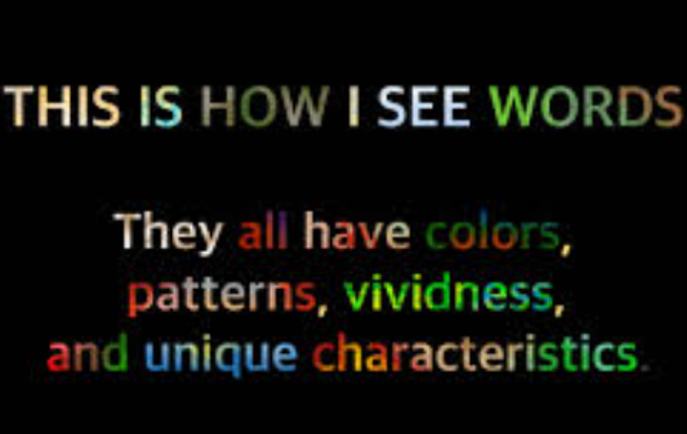
“This is how I see words,” by Herbie53101, Synesthesia Tree

- Mirror-touch: Feeling something happen to you — like being touched or feeling pain — if you witness it happening to someone else, like “supercharged empathy.” It can be benign — recognizing facial expressions — or burdensome. A neurologist felt intense chest pressure when he saw a patient getting CPR.
- Sound-color: See specific colors when you hear certain sounds or music. Musicians and artists often describe having this form.
Image: Dreamstime
- Time-space: Mentally map sequences with specific patterns or forms, like a calendar or a string of numbers, in vivid or detailed ways.
- Spatial sequence: Seeing numbers or numerical sequences as points in space (close or far)
- Number form: A mental map of numbers involuntarily appears when thinking of numbers.
Subjective colors for letters, numbers, days of the week, and months of the year, by photographer/artist Kristina Kasparian, “Your name is dark purple: How synesthesia shapes what I see,” Veni Etiam Photography blog
Developing Synesthesia
Synesthesia is not an illness nor mental disorder. Rather, it’s a unique way of experiencing the world through a mixing of the senses. Most synesthetes can usually learn to manage the secondary effects, which are mostly short-lived. In severe, but rare cases, synesthesia can be strong enough to disrupt concentration or focus. Three main causes:
1) Developmental synesthesia is a form of neurodivergence. People’s brains work differently from neurotypical people’s, the synesthesia effects can be longer-lasting, and they can shift and change to follow along with the primary effects. It’s not fully understood why their brains develop and work as they do, but it might be due to multiple factors:
- Brain development: Evidence suggests we start life with some degree of synesthesia as part of the brain’s natural development and fades in most people — why it affects only a small percentage of adults. But this is still not definitive (see Genetics).
- Brain structure: Different brain areas seem to have more connections in people with synesthesia — a possible reason why multiple brain areas activate from more than one type of sensory input. It also affects those with autism spectrum disorder (ASD) at three times the rate in people without ASD.
- Genetics: While research has shown signs of a genetic component, there’s some debate over whether everyone is born with some degree of synesthesia, or if it’s a special perception of the world that only some individuals share.
2) Acquired synesthesia: Brain damage can cause people to “acquire” synesthesia — possibly due to brain connections changing as it recovers from injury. It’s a less consistent condition than for those born with it, and it might go away over time. Compared to developmental synesthesia, acquired synesthesia effects are brief, simple, and don’t follow primary effects.

Tomas Chapa, “Color of Sound: Exploring Synesthesia,” Consciousness Uncovered. Created using DALL-E by OpenAI/ChatGPT
3) Drug-induced synesthesia: Nonmedical use of psychedelics — causing pseudohallucinations (false hallucinations) or, rarely, hallucinations — can cause synesthesia, especially at higher doses. Drugs include: dimethyltryptamine (DMT), LSD, peyote (and mescaline), psilocybin. Hallucinogenic drugs like LSD and psilocybin can induce synesthetic experiences in some people. Ways how drug-induced synesthesia can affect people:
- Emotion dependent: Your emotional state affects if and how you experience synesthesia.
- Can alter perception: Developmental and acquired synesthesia may affect how you experience something, but they don’t change what you experience. Drug-induced synesthesia can cause hallucinations, which can change what you experience.
- Not automatic. You can sometimes minimize or stop drug-induced synesthesia by focusing on specific things or changing certain things in your environment (lighting).
Inducing Synesthesia
Science is divided, but there’s a growing conviction that most people are born with synesthesia. It’s also possible to learn or induce the condition — even if it’s less vivid, consistent, or long-lasting. While inducing synesthesia can be a transformative and fascinating experience, there are potential risks, side effects, and ethical concerns.
In addition to drug-induced, some experience synesthetic perceptions during meditation and mindfulness practices—deep states of concentration or awareness can elicit periods of heightened sensory awareness and perception. Others induce synesthesia through sensory deprivation or enhancement techniques, like listening to binaural beats (see Glossary) or using sensory deprivation tanks.
Potential applications will evolve as researchers explore new ways of inducing and experiencing synesthesia. Synesthesia-test calls sensory systems ground zero for many aspects of neurodivergence, and induction may be evidence of the brain’s plasticity or neuroplasticity.
Induction may also have applications in art and design, where synesthetic perceptions can create more immersive experiences. Some artists have used sound and light to create synesthetic installations designed to evoke viewers’ emotional responses.
Coping with Synesthesia

When I see font colors that are incongruent with my ‘own colors,’ it is a tremendously unsettling experience. I genuinely have trouble focusing on colored font or on objects like alphabet toys when the colors differ from the ones I instinctively see.” Image: Photograph by synesthete Kristina Kasparian, Veni Etiam Photography blog
Everyone’s experience with synesthesia is different, and what works for one person may not work for another. I’ve paraphrased and added to Synesthesia-test’s coping strategies:
- Embrace it: Synesthesia can be a unique and beautiful part of who you are, even with its Understanding your synesthesia, talking openly with others, developing coping strategies, and seeking support from healthcare professionals can help you manage its effects and live a fulfilling life.
- Focus on the positive: Synesthesia can be overwhelming, beautiful, enriching — with potential to learn in different ways. Therapy can help you to keep a positive focus.
- Create a calming environment: For synesthetes overcome by anxiety and sensory overload, create a sensory-soothing, relaxing, and comfortable environment, like dimming lights, using noise-cancelling headphones, or deep breathing meditation. Aromatherapy might work unless it contributes to sensory overload.
- Take breaks: If you feel overstimulated but unable to find a calming environment, take a break and step away from a noisy or visually stimulating environment. Try not to allow yourself to get overwhelmed.
- Use sensory tools: Some people with synesthesia manage negative effects by using sensory tools, like fidget toys, weighted blankets, or sensory cushions.
Coming Up Next
Synesthesia reinforces that people have sensory differences. Neurodivergent people make such richly rewarding contributions to the world. It’s time to pay attention. In Post 11: Synesthesia, Creativity, Artistry — Part I, I profile famous artist and scientist synesthetes who are inspired by their multi-sensory ability to hear music when they paint or see color when they play music, think, or read. Through the ages, those with synesthesia have described their experiences as if shared by the rest of us.
 English