On Neurodivergence and Otherness
Show Table of Contents
INTRO
1. On Neurodivergence and Otherness: An Introduction
SENSES AND SENSORY SENSITIVITIES
2. Senses Count
3. Neurobiology for Dummies
4. Sensory Transmission and our Reward System
5. Sensory Receptors are the Body’s Cellular Plan
6. A Synthesis: Sensory Systems and our Emotions — Part I
7. A Synthesis: Sensory Systems and our Emotions — Part II
8. Sensory Disorders and Sensitivities
9. Etan’s Story
SYNESTHESIA
10. Synesthesia: Difference, But Not Disorder
11. Synesthesia, Creativity, Artistry — Part I
12. Synesthesia, Creativity, Artistry — Part II
AUTISM AND THE NEURODIVERSITY MOVEMENT
13. From “Mental Defectives” to Autism Spectrum Disorder
14. Changing Conception of Autism
15. Autism Diagnoses and Behavior Patterns
16. Autism Treatments that Help
17. Early Start Autism Treatment: A Case Study
18. Neurodivergence and the Neurodiversity Movement
19. Neurodiversity Takes Flight
20. ADHD and Neurodevelopmental Disorders
21. ADHD: A Preponderance of Risk Factors and Symptoms
22. ADHD: Inattentive, Impulsive … and Hyperactive?
23. ADHD: Named, Renamed, Still Needs a New Name
24. ADHD: Treatment and Coping Skills for All Ages
LGBTQ+
25. Neurodiversity and the LGBTQ+ Fight
26. LGBTQ+ Identity and Expression
27. LGBTQ+ and Mental and Behavioral Healthcare
ON LANGUAGE
28. Language Matters In and Around Neurodiversity
29. Neuroinclusion and Disability Language
30. Neurodivergent Language Difficulties
ON CREATIVITY AND GIFTEDNESS
31. Neurodiversity and Creativity
32. Giftedness is a Piece of Neurodivergence
SELF-IDENTITY
33. Self-Identity: The Cornerstone of Neurodiversity
34. Early Theories of Self-Identity Formation
35. Contemporary Theories of Self-Identity Formation
36. Authenticity and the Search for Self
37. Self-Schemas and Neurodivergence
38. Self-Labeling and Parts Work
39. Complexity, Clarity, and Self
IMPROVING LIFE FOR NEURODIVERGENT PEOPLE
40. Empathy Recognizes and Navigates Difference
41. Reducing Neurotypical-on-Neuroatypical Conflict – Part I
42. Reducing Neurotypical-on-Neuroatypical Conflict – Part II
43. Communicating Across the Neurospectrum – Part I
44. Communicating Across the Neurospectrum – Part II
45. Neurodiversity: Advocacy and Education
46. Neuroinclusion in the Workplace
47. A Neurodiverse Lifestyle
IN CONCLUSION
48. In Conclusion: Neurodivergence and Inspiration
33. Self-Identity: The Cornerstone of Neurodivergence

Relationship between the conscious and subconscious mind. Source: Dr. Ed Santana
Talking about neurodivergence has opened me to a world beyond mental health topics toward life in a world that can be indifferent, unaccommodating, or cruel. What looms large for me now is how our individual identities are enmeshed in neuropsychological and societal difference. How we develop our sense of self — what researchers call self-concept or self-identity — is the very story of difference.
What’s remarkable is that identity develops through the same basic process for all of us. From childhood onward, we gradually construct an understanding of who we are from our temperament and abilities, our experiences and relationships, how other people respond to us, where we belong, and what we come to believe about ourselves. Yet no two people encounter the same combination of influences. The process is shared, but the experience is individual.
Part of what is developing in children as they grow is the fundamental cognitive part of the self, known as the self-concept. The self-concept is a knowledge representation that contains knowledge about us, including our beliefs about our personality traits, physical characteristics, abilities, values, goals, and roles, as well as the knowledge that we exist as individuals. Throughout childhood and adolescence, the self-concept becomes more abstract and complex …. —”The Cognitive Self: The Self-Concept,” Open Textbook
That helps explain why the outcomes can be so different. A strong, coherent sense of self can help us navigate difficult life circumstances. A fragile or uncertain one can leave us more vulnerable to self-doubt, isolation, and psychological distress. For people whose differences are repeatedly misunderstood, criticized, excluded, or treated as deficiencies, the consequences can be profound: they may withdraw, mask who they are, turn their distress against themselves, or reach for dangerous ways to escape it.
Perceiving Difference Through a Spectrum
Since medical and psychiatric science recognize that almost everything exists on a spectrum — or multiple spectra — we should as well. Some spectra range from mild to severe. Others have extremes at the polar ends and moderation in the middle. Still others slide between binary endpoints. And some reflect not degrees of a single condition, but increasingly complex combinations of symptoms arising from two or more comorbid conditions.
A neurodivergent (ND) person’s symptoms may mildly disrupt daily life or moderately to severely compromise their independence. They might have ADHD alone. Autism alone. Or ADHD and dyslexia. ADHD, dyslexia, and sensory processing disorder (SPD). ADHD, dyslexia, and autism. They may have body dysmorphia and gender dysphoria. Or ASD, gender dysphoria, and dyspraxia.
And combinations aren’t simply additive. Co-occurring conditions can interact, intensifying some difficulties while moderating or complicating others. ASD plus ADHD, for example, can be particularly tricky because some traits may pull in opposite directions: order vs. chaos.
No matter where an ND person sits across these multiple spectra, the challenges are real — but so are the strengths. Skills and talents may need to be recognized and harnessed through education, mentoring, accommodations, and therapies, to their own benefit and ours.
This complexity is fundamental to self-identity. Developing a sense of self requires recognizing our differences — our strengths and difficulties, how others respond to us, and where we fit or don’t. What matters is recognizing where you are, how you got there, and where — if anywhere — you want to go.
The same process of identity formation is underway in everyone. But the raw material from which we draw to construct a self is uniquely our own.
Self-Identity Stakes are High
We meet ourselves time and again in a thousand disguises on the path of life. —Carl Jung, quoted in Fractal Enlightenment
We don’t develop a sense of ourselves in isolation. We learn who we are partly by noticing what we can do, what comes easily or doesn’t, what interests us, and what feels right. But we also learn from the responses of other people. Long before we can explain who we are, the world is telling us something about who it thinks we are.
For a child who is different, those messages can be affirming: You’re creative. You’re curious. You notice things other people miss. Or they can become painful: You’re difficult. You’re lazy. You’re too sensitive. Why can’t you just behave?
Being ridiculed feeds our secret fears we’ve been found out — we are losers. Fear of rejection can make us wary of revealing ourselves — even when rejection hasn’t happened. We may begin masking to pass for people we’re not, hiding the very traits we fear will bring criticism or exclusion. Over time, other people’s perceptions can become entangled with our own.
This is why self-recognition is key. A child who knows, My brain works differently, has a better explanation for difficulty than one who concludes, There’s something wrong with me. An adult who finally understands lifelong difference may be able to look back and reinterpret experiences once understood as personal failures.
The consequences go beyond how we describe ourselves. Feeling unsafe at home can be devastating to a developing person. A child who depends on others for love, guidance, and a sense of their own worth but instead encounters abuse, neglect, or persistent rejection can only construct a self from profoundly distorted feedback.
A strong self-concept cannot protect us from everything life throws at us. But knowing and accepting who we are gives us something to stand on when the world challenges that understanding.
The Making of Self
Source: Study.com
What differs in how we develop a sense of self is what each of us brings to that process, the relationships we experience, and the social world in which we develop.
Identity formation isn’t entirely inside us, nor entirely done to us. We contribute our temperament, abilities, physical characteristics, and neurodevelopmental differences. We respond to our parents, siblings, friends, romantic partners, teachers, and colleagues — and they respond to us. These interactions take place amid culture, school and work opportunity, economic circumstances, representation and difference, along with stigma and discrimination. These influences help shape our self-concept — what we believe about ourselves. And our self-identity — who we understand ourselves to be. The process is shared, but the combination is uniquely our own.
When it comes to child development and identity formation, we are born with simple identities that are generally self-serving — we see our mothers purely as a person there to care for us and meet our needs. It’s only as we grow that we begin to understand identity in a more sophisticated and thoughtful way. —Karen Simpson, Fostering Therapeutically
As we figure ourselves out, we shouldn’t be alone, as if no one else gets our pain or can help.
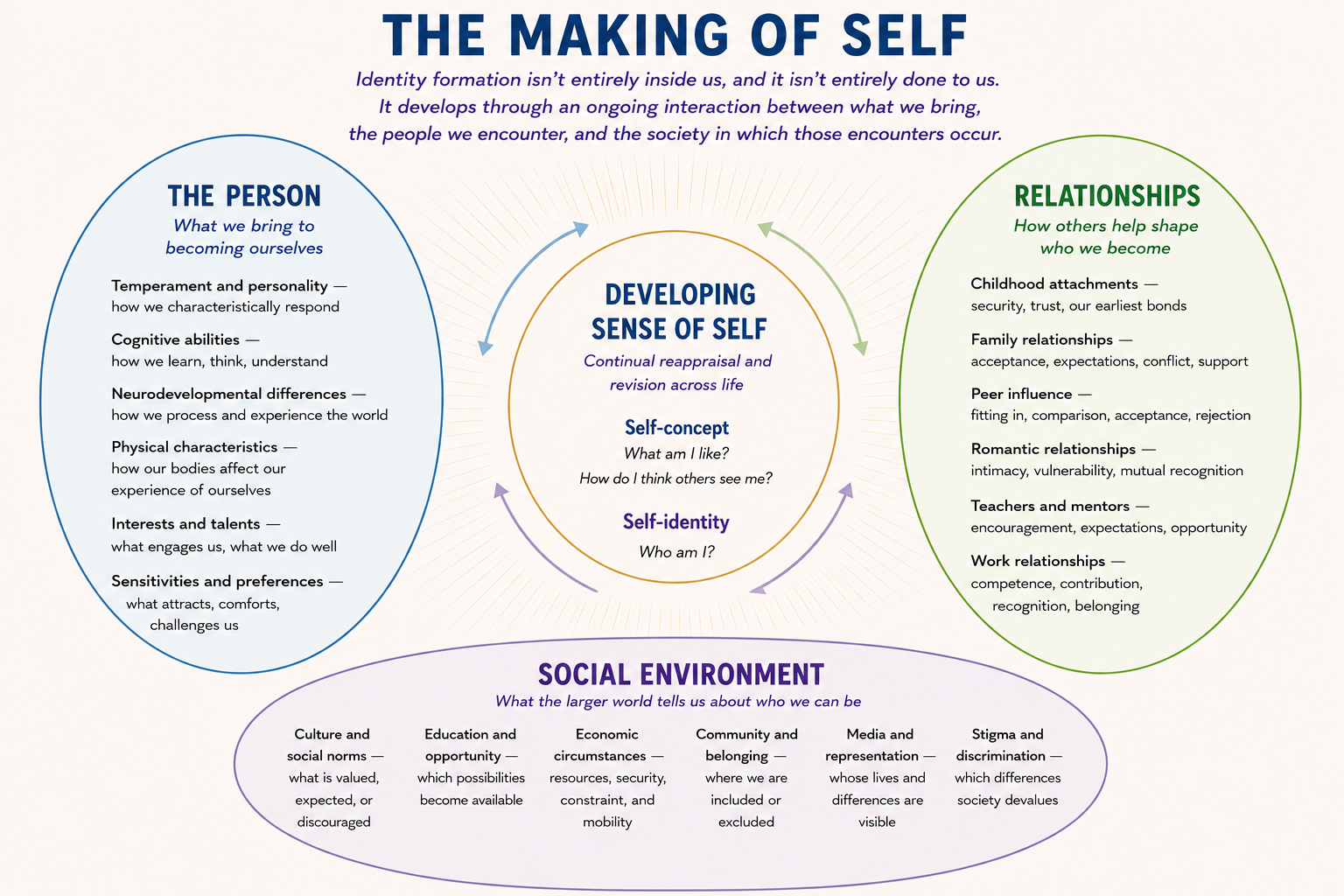
The person we bring, the relationships we experience, and the social world we inhabit interact over time to shape what we believe about ourselves and who we understand ourselves to be. Graphic: Jan Swan, with ChatGPT
Experiencing Ourselves from the Inside
By now, we should realize our sense of self isn’t just a collection of traits and identities. It involves a growing sense of how well we know ourselves and whether the different parts of who we are seem to hold together in a coherent, somewhat stable picture.
But our experiences vary so widely that we can easily feel clear about who we are in some periods of life and uncertain in others. Different parts of us may coexist comfortably or be difficult to reconcile. We may recognize ourselves across situations — or find who we seem to be depends heavily on context: where we are and who we’re with. And despite changing across a lifetime, we may/may not feel a connection between who we once were, who we are now, and who we’re becoming.
Psychologists capture some of this through self-concept clarity (SCC): how clearly and confidently our beliefs about ourselves are defined, how internally consistent they are, and how stable they remain over time. Clarity and stability don’t mean rigidity. A coherent sense of self can — and should — accommodate change. When change doesn’t challenge our core being, we can also imagine and welcome change as we grow, learn, and mature.
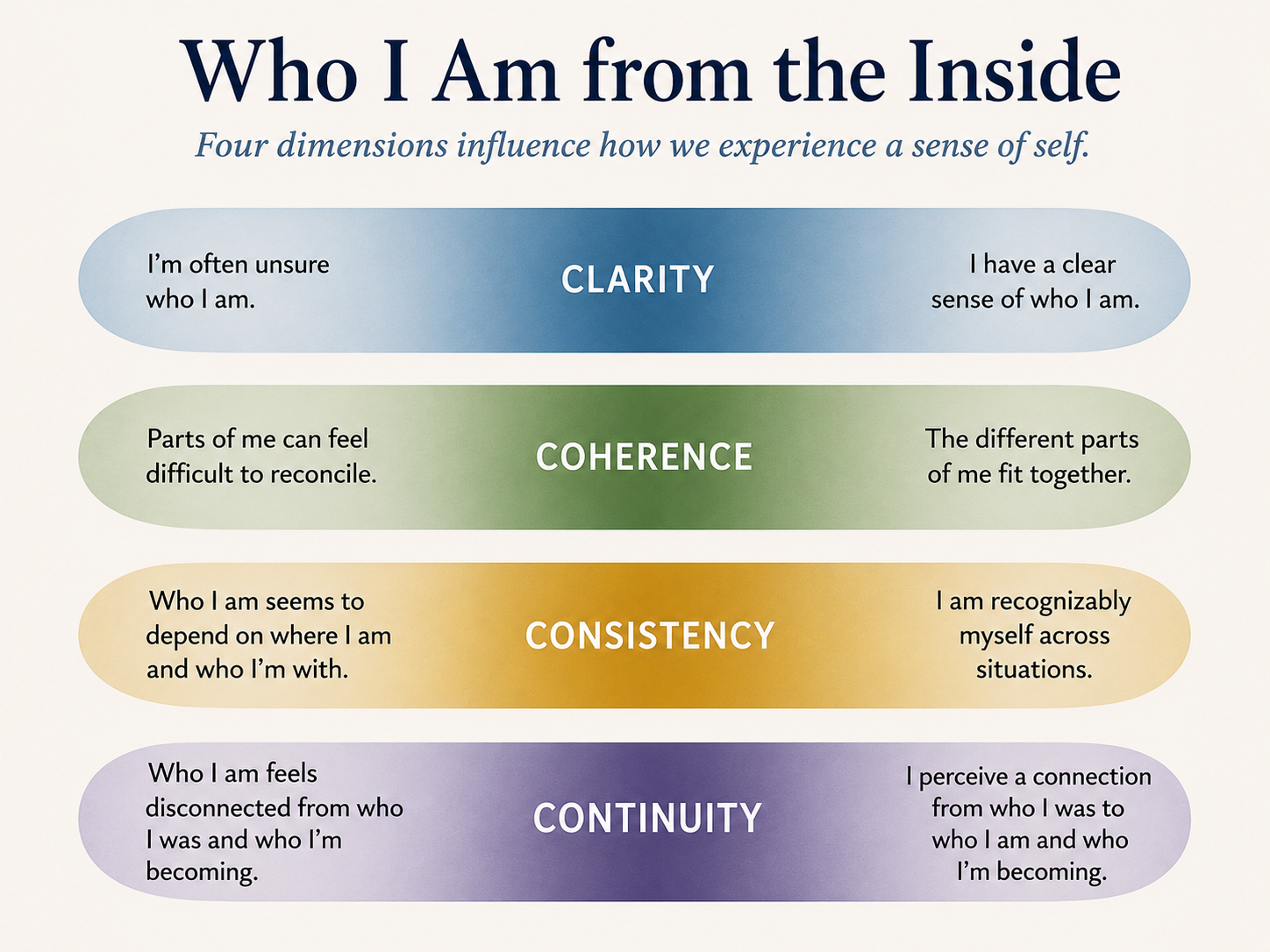
No one is at the extremes all the time. We move within these dimensions across circumstances and over time as experience continually informs and revises our sense of who we are. Graphic: Jan Swan, with ChatGPT
The Self We Take into the World
By now, we should realize our sense of self isn’t just a collection of traits and identities. It involves a growing sense of how well we know ourselves and whether the different parts of who we are seem to hold together in a coherent, somewhat stable picture.
But our experiences vary so widely that we can easily feel clear about who we are in some periods of life and uncertain in others. Different parts of us may coexist comfortably or be difficult to reconcile. We may recognize ourselves across situations — or find who we seem to be depends heavily on context: where we are and who we’re with. And despite changing across a lifetime, we may/may not feel a connection between who we once were, who we are now, and who we’re becoming.
Psychologists capture some of this through self-concept clarity (SCC): how clearly and confidently our beliefs about ourselves are defined, how internally consistent they are, and how stable they remain over time. Clarity and stability don’t mean rigidity. A coherent sense of self can — and should — accommodate change. When change doesn’t challenge our core being, we can also imagine and welcome change as we grow, learn, and mature.
LIFE TALKS BACK
We’ve heard the saying that success begets success. Nothing is more energizing than success for confirming a sense of competence and accomplishment. This in turn tells us that we’re accepted on some level for who we are — we can belong without hiding or pretending. Maybe to some extent, we’ve shown ourselves to be equipped to cope with difficulty. As we learn what we’re capable of while recovering from setbacks, we accumulate evidence that we can survive disappointment, adapt, and try again. Even failure can strengthen rather than diminish us when we can think, I failed at this, rather than I am a failure. These experiences reinforce a secure sense of self — or challenge an old belief that underestimated who we are.
On the other hand, failure can also deepen existing self-doubt. No one deals well with rejection, but some allow it to confirm fears that we don’t belong, aren’t acceptable as we are, or don’t deserve to belong. When stress overwhelms our ability to cope, or setbacks feel impossible to recover from, we may see ourselves as incapable, powerless, or without a way forward. A fragile sense of self can make an adverse experience feel like evidence not simply about what happened, but about who we are. Repeated experiences of this kind may reinforce uncertainty — or disrupt a sense of self we once thought was secure.
Experience, then, gives us new information about ourselves, but we don’t receive that information neutrally. We interpret it through the self we already know. What we make of the experience can reinforce or revise that self — in both positive and negative ways — and the process continues.
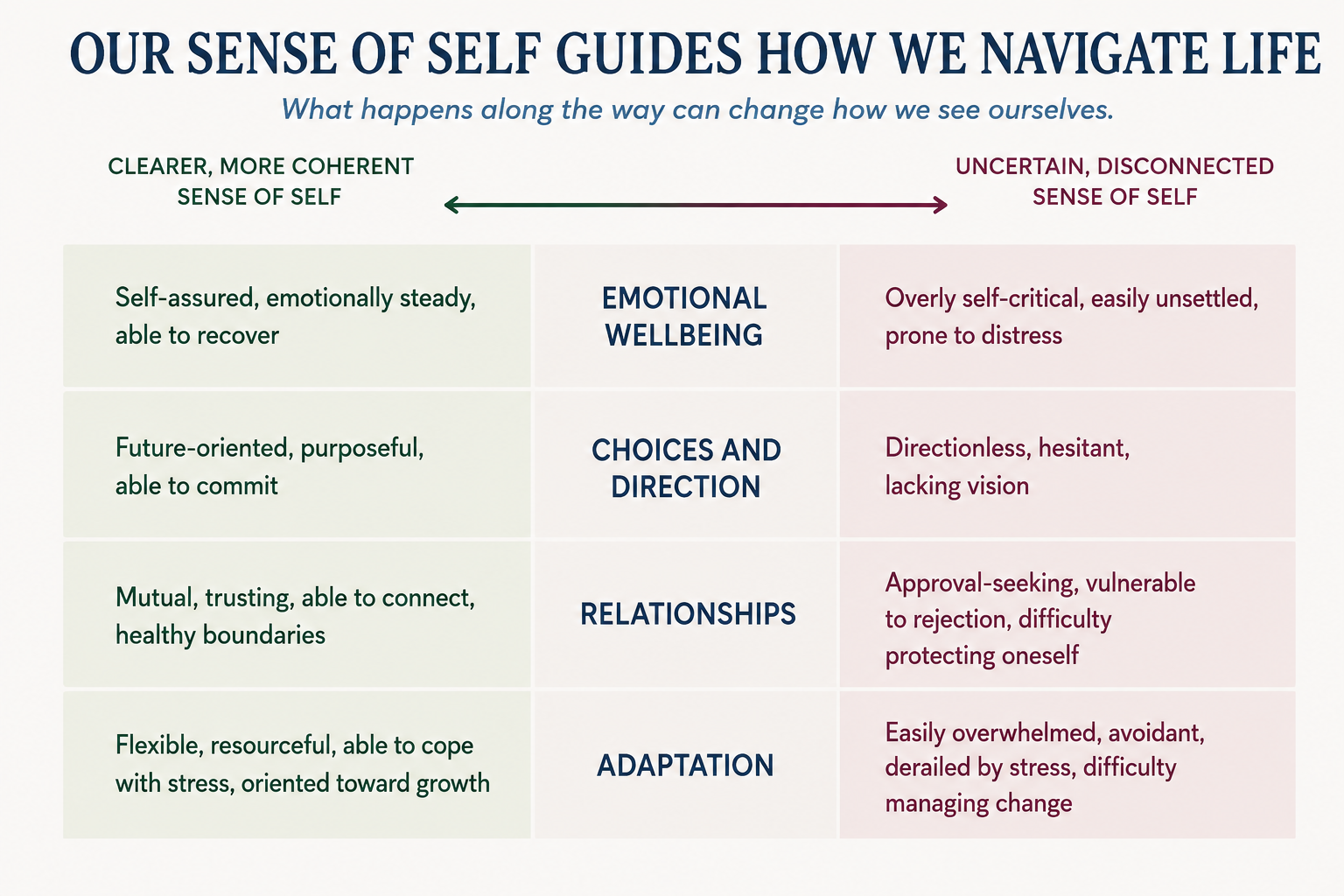
Our sense of self influences how we experience and navigate life, while what happens along the way can reinforce or revise how we see ourselves. Graphic: Jan Swan, with ChatGPT
Research supporting the above sections include: Jennifer D. Campbell, et al., “Self-Concept Clarity: Measurement, Personality Correlates, and Cultural Boundaries,” 1996, ResearchGate; Srikant Manchiraju, “Self-Concept Clarity: A Comprehensive and Integrative Review,” 2026, Frontiers; and Constantine Sedikides, Emily K. Hong, and Tim Wildschut, “Self-Continuity,” 2023, Annual Reviews
The Need to Belong and Belonging Uncertainty
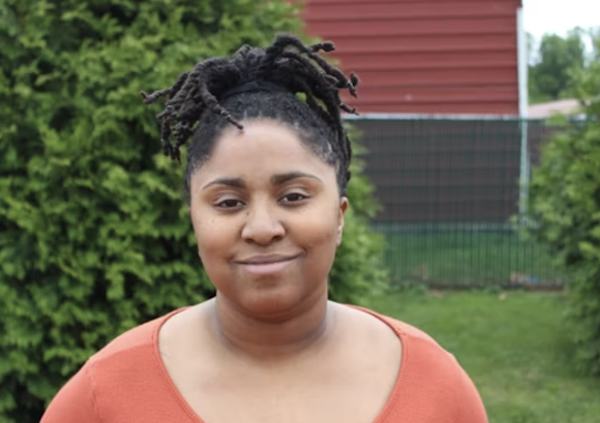
As individuals, we’re hurt by exclusion. But we don’t have to be explicitly rejected to feel its effects. Not knowing whether we belong can be painful in itself. We watch for signs that we’re accepted, that we fit, that we’re safe among other people — or signs that we’re not.
Psychologists like Kelly-Ann Allen and colleagues consider belonging a fundamental human need:
A sense of belonging — the subjective feeling of deep connection with social groups, physical places, and individual and collective experiences — is a fundamental human need that predicts mental, physical, social, economic, and behavioral outcomes. —Kelly-Ann Allen, et al., “Belonging: A Review of Conceptual Issues, an Integrative Framework, and Directions for Future Research,” PubMed Central/NIH
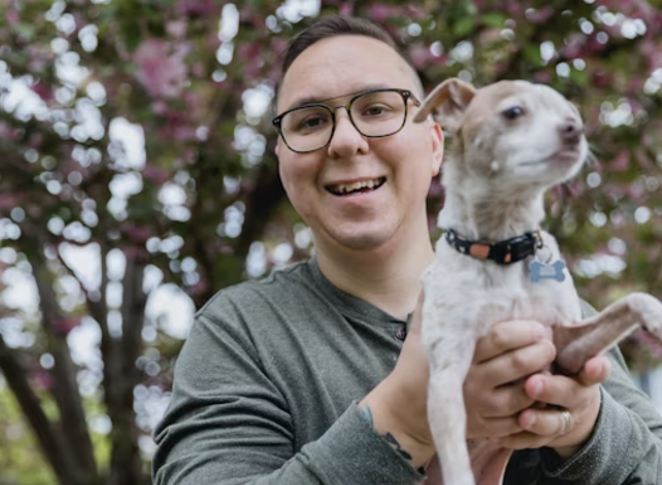
Social psychologist and Stanford professor Geoffrey Cohen goes further. In “A Crisis of Belonging,” Harvard Graduate School of Education, he describes what can happen when connection is missing. Feeling alone can activate the body’s threat response — useful when we face immediate danger, but damaging when that response becomes chronic.
Cohen actually believes a crisis of belonging is destroying us. He cites 1/5 Americans suffer from chronic loneliness, writing, “Young people are struggling with high levels of anxiety and mental health issues at times when they desperately need a sense of connection and belonging ….
Belonging isn’t just a touchy-feely construct. It’s actually that touchy-feely has hard consequences. It’s associated with physical illness, cardiovascular disease, early death, also vulnerability.”
Cohen and colleague Greg Walton coined the term belonging uncertainty to describe something more subtle than outright exclusion: the nagging doubt about whether we’re fully accepted — or ever could be. It can happen at any age and almost anywhere: at school, in the workplace or, as Cohen says, even in a “snooty restaurant.”
Belonging uncertainty has adverse effects. When we perceive threats to our sense of belonging, our horizon of possibility shrinks. We … interpret ourselves, other people, and the situation in a defensive and self-protective way. We more readily infer we are incapable or we aren’t meant to be there, we will not understand or be understood. We’re less inclined to accept challenges that pose a risk of failure. —Geoffrey Cohen, “Understanding and Overcoming Belonging Uncertainty,” Behavioral Scientist
And uncertainty changes how we interpret what happens next.
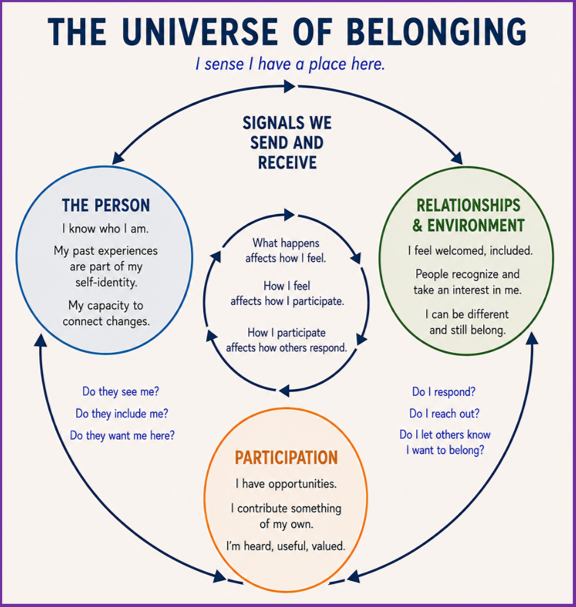
Our need and expectation to belong are part of being human. Our sense of belonging develops through an ongoing exchange between who we are, the environments and relationships we enter, how we participate, and the signals we send and receive. Graphic: Jan Swan, with ChatGPT
When you feel like you don’t belong or when you have that sense of I’m not part of a larger cause, it turns out there’s biological research that suggests one of the worst things our central nervous system can say to the rest of our body is you are alone here. It puts us in a sort of fight-or-flight response. That’s very good evolutionarily to deal with physical threat, preparing to be wounded, but when it’s chronically activated, it can really wreak havoc on our health. —Geoffrey Cohen, “Crisis of Belonging,” Harvard Graduate School of Education
Self-identified neurodivergent (ND) Krysia Waldock, writing in the NDC Journal, Neurodiverse Connection, UK, makes an important distinction between being “present in a space” and actually experiencing a sense of belonging.
It is important that we as neurodivergent people have input on what belonging looks like when done right and in a manner which is ND-affirming …. We all have different understandings of what belonging is, notably including belonging as a feeling between people or a group, an affinity for a place or situation or having a role where we “fit” and play a part. These are likely shaped by our lived experiences, the identities we have, and the situation at hand. —Krysia Waldock, “Neurodivergent Belonging: A Manifesto,” NDC Journal, Neurodiverse Connection, UK
Messages of belonging
One item in Waldock’s manifesto describes neurodivergent people as “traumatized for who we are and how our bodies and brains are.” For Waldock, belonging requires more than being allowed into a space. It means having something to contribute, a role to play — and being valued.
Geoffrey Cohen says we’re not great at recognizing feelings of exclusion when happening to someone else. As a result, we may threaten their sense of belonging without realizing it. But he also talks about the little things we can do “every day to make things a little bit better, and if we all do them, we can make things a lot better.”
I think of how someone smiling at me lights me up for that moment as I smile back.
Cohen’s research shows that even ordinary politeness can be a “powerful indication I see you as belonging in the circle of those to whom I should show respect.”
The opposite sends an equally powerful message. Otherness can become a message of not belonging. If no one asks how our day is going, encourages or appreciates us — or smiles at us — and day after day that’s our lived experience, we can begin to feel forgotten.
Cohen’s poignant messages for combating belonging uncertainty in a young person:
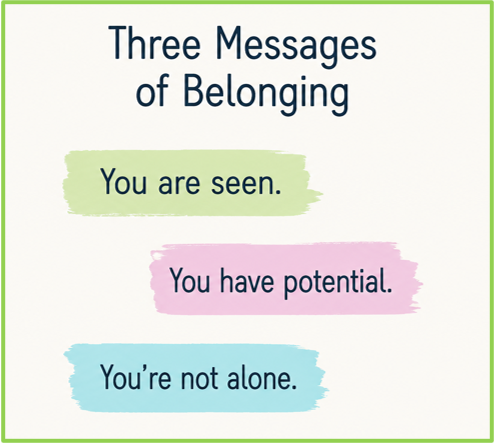
Geoffrey Cohen, “Understanding and Overcoming Belonging Uncertainty,” Behavioral Scientist. Design by Jan Swan, with Chat GPT
Strong Self-Identity as Survival Skills

A neurodivergent son watching his dad accept his party’s nomination for U.S. vice president reacted with great heaving emotion. The political opposition and extreme right media called the son’s display of raw emotion weird. This precipitated a beautiful New York Times‘ op-ed by Tina Brown, journalist/former editor of The New Yorker and Vanity Fair:
The sight…of Tim Walz’s 17-year-old son leaping to his feet, with streaming eyes, a hand to his chest with a cry of “That’s my dad” was heart piercing. As the mother of Georgie, a 38-year-old on the spectrum who still lives with me, I recognized him immediately as one of “ours,” a sweet, unfiltered, slightly bewildered-looking young man who wasn’t quite sure what was expected of him in this epic moment of political adulation.
Gus Walz has, according to his parents, a nonverbal learning disorder, ADHD, and an anxiety disorder, all of which they regard not as a setback but as his “secret power,” that makes him “brilliant” and “hyperaware.”
I know exactly what they mean…. for people who are different and have no support, the world can be bleak. Their loneliness can be agonizing. Some people assume the school days are the hardest, but it’s the years after that are the social desert.…
One of my son’s quirks is that he likes to wear bandannas and nail polish and tends to say so in the first five minutes of every job interview. Often he’s told that no, that would not be “appropriate.” Appropriate? Being inappropriate is the very definition of Georgie’s condition, and for his family, his most treasured trait. —Tina Brown, “My Son and Gus Walz Deserve a Champion Like Tim Walz,” The New York Times
No More Hiding Our Children
Responses to Brown show parental pride and young triumph. For example [edited for brevity]:
- “The most moving instant was when the family joined Tim on the stage, and his son reached to hold his hand…. I could see he took his hand with total care for his son…. It’s so evident he cared more about giving support and love than basking in his own ”
- “Words hurt, but they make one stronger. It’s not easy to be different, and there will always be pathetic bullies. Anyone trying to hurt that kind, sweet boy is beneath contempt.”
- “[I’m the] parent of an autism child, a daughter now in her mid-40s. Girls on the spectrum get identified less often than boys, since their childhood behaviors often conform to gender-stereotypical norms. In my daughter’s case, she was withdrawn, avoided eye contact, filled notebooks with intricate drawings of dogs, could not ride a bike, nor catch a ball. Asperger’s did not appear in the DSM until she was 7, and it was a savior, as we were then able to support her superpowers.”
- “I am one of those ‘offbeat’ people who cannot help but beat to my own drum. I am a black woman in my forties, and I saw myself in Gus. We need more real-life examples of atypical development in the wild, in real life, beyond the noise of ‘neurodivergent-tok.’ I appreciate you sharing your story, I appreciate having a kindred spirit in Gus.”
This last comment sent me searching. In “The Pros and Cons of Neurodivergent TikTok,” Alice Siberry, ND criminal justice consultant for Creased Puddle, writes about a tidal wave of written/video ND content appearing across TikTok. She notes #ADHD was viewed more than 11 billion times in 2022. This led to a surge in assessments and diagnoses in the U.S. and Europe, particularly for over 25-year-olds.
Self-Continuity: A Predictor of Future Wellbeing
How many of us look back at our younger selves and feel a surge of pride, appreciation, or gratitude for who we were?
I’m guessing a majority of us feel, Are you kidding? If not shame, then embarrassment about our younger selves. But this is no parlor game. It turns out that continuity of identity — past, present, future — is a component of a strong self-identity and is associated with future wellbeing.

Image: Shutterstock
Self-continuity is our subjective sense of connection between past/present selves (past–present self-continuity), between present/future selves (present–future self-continuity), or all three (global self-continuity), according to Constantine Sedikides, et al., “Self-Continuity,” Annual Review of Psychology, ResearchGate.
Sedikides and colleagues write self-continuity helps us interpret and organize information, generate positive emotional responses, and pursue goals while dealing with the pressures of daily life.
Research also finds people who feel more connected to their future selves procrastinate less. It makes sense. To believe in our future self means not disappointing that person later with poor choices now.
Future self-continuity may also help us cope more adaptively when life doesn’t go well. One study followed people coping with unemployment:

Image: Shutterstock
- Participants who lost their jobs showed lower self-continuity and less adaptive coping over time.
- Those who maintained a more continuous sense of self were more likely to seek social support and approach challenging tasks while unemployed.
- A stronger sense of continuity allowed people to connect the person they had been while employed with the person they might become, rather than allowing their present unemployment to become the sole reference point for identity.
This last finding seems particularly important. A circumstance can change dramatically without becoming the whole story of who we are. The unemployed person is still connected to the person who worked before — and to the person who may work again.
Research also links present–future self-continuity with lower stress and better coping, both important to physical wellbeing. Feeling connected to a future self is associated with healthier behaviors, including diet, exercise, and stress management — commonly referred to as modifiable risk factors for preventing illness.
Coming Up Next

In Post 34: Early Theories of Self-Identity Formation, I give an overview of historical theories of self-identity formation from the days of Carl Jung in the 1920s through Erik Erickson in the 1950s.
Copyright ©2026 Jan Swan
 English