On Anxiety and Panic Disorders
Show Table of Contents
INTRO
FEAR VS ANXIETY VS ANXIETY DISORDERS
- Emotional Health vs Mental Health
- Fear vs Anxiety
- Personal Journeys with Anxiety and Panic Disorder
- Fear, Anxiety, and Fight or Flight
- The Evolutionary Role of Anxiety
- When Anxiety Drifts to Disorder
- The Ancient Advantage and Current Anguish of SAD
PHOBIAS, ANXIETY / PANIC ATTACKS
- Phobias and the Rapid Onset of Fear
- Specific Phobia and Agoraphobia
- Anxiety Attacks vs Panic Attacks vs Panic Disorder
- Anxiety Disorder Risk Factors and Symptoms
- Why Anxiety Goes Undiagnosed — and Untreated
TREATING AND COPING WITH ANXIETY
1. On Anxiety and Panic Disorders: An Introduction
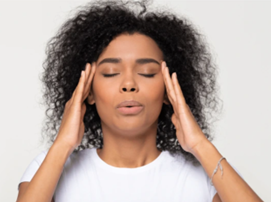
In understanding mental health issues, the most common, basic, AND complex of psychiatric conditions are anxiety disorders. While a degree of anxiety is experienced by most of us time to time, anxiety disorders aren’t a healthy response to everyday life. My anxiety disorder could be situational, as I’m worried about my sons, finances, lots of things — but that’s not owning it. An anxiety disorder isn’t just a series of worries.
This series is as much about self-scrutiny as it is about reporting on the mental disorders of others. Like many, I have not only anxiety but comorbid insomnia, tension headaches, and knotted gut. My sons’ anxiety disorders are expressed in extremely different ways.
As a deeply foundational emotion, anxiety is the wellspring of so many other mental health conditions that we’re simply unaware of the power and persistence of anxiety in our lives. We need to protect our nervous systems from where it begins (point of stimulus) to its mix with cognition (in the brain) to its final destination (muscles/glands), so we can move, react, act. Some of it voluntary and a lot involuntary. We nourish our brains through intellectual and artistic pursuits, building relationships, seeking our community, and treating our bodies well. We hurt ourselves by masking and maladapting behaviors that interrupt our natural processes. And many of us are born with built-in obstacles to natural processes that we have to first understand before we can overcome them. I’m too familiar with experiencing anxiety attacks at night, so I’d like to figure them out. And relatedly, explore panic attacks, which are even more debilitating and make you think you’re about to die — not to be too dramatic about it.
Transmission of Stimuli via Sensory Receptors
We need to understand anxiety before learning about anxiety attacks and panic attacks, what causes them, how they’re the same and different, and what to do about preventing them (best) or reducing their severity (next best). It is impossible to explain a slice of anxiety without the whole pie. In this series, I’ll focus on severe anxiety disorders and their evolutionary and biological role in making us who we are today — and what we can do about reducing pain and heightening joy.
Also, brain structure, brain chemistry, and neurotransmitters. I love neuroscience — even if I can’t understand most of what I read. Take this:
Every time I look something up, I have another three things to look up. I might have given up if I wasn’t so dedicated to pushing the limits of my brain function to understand brain function (probably an anxiety-riddled compulsion). I’ll judiciously share what I learn, because if anxiety is foundational to understanding our mental health, then brain function is foundational to understanding anxiety. This series covers generalized anxiety disorder (GAD), social anxiety disorder (SAD), anxiety attacks, panic attacks, phobic disorders, and agoraphobia. My focus is on those of us who have suffered from an anxiety or panic attack away from home — and are living a different life because of it.
The Greatest Impact on Human Behavior: Pure Emotion
Social science has defined the building-block emotions that make us human. Since the 1960s, primary and secondary emotions have grown from Eckman’s six to combinations of up to 30. Research suggests we’ve evolved from cave dwellers with a set of emotions that were key to our survival and propagation. It’s theoretical, of course, but what a way to be grounded in our essential selves — and humbled by our inheritances that go far back, beyond mom and dad.
In this post, I’ll compare primary and secondary emotions to basic psychological states that slide us along the anxiety spectrum — from “normal” to less normal to neuroatypical to someone hiding in their house terrified of what awaits them on the other side of the door.
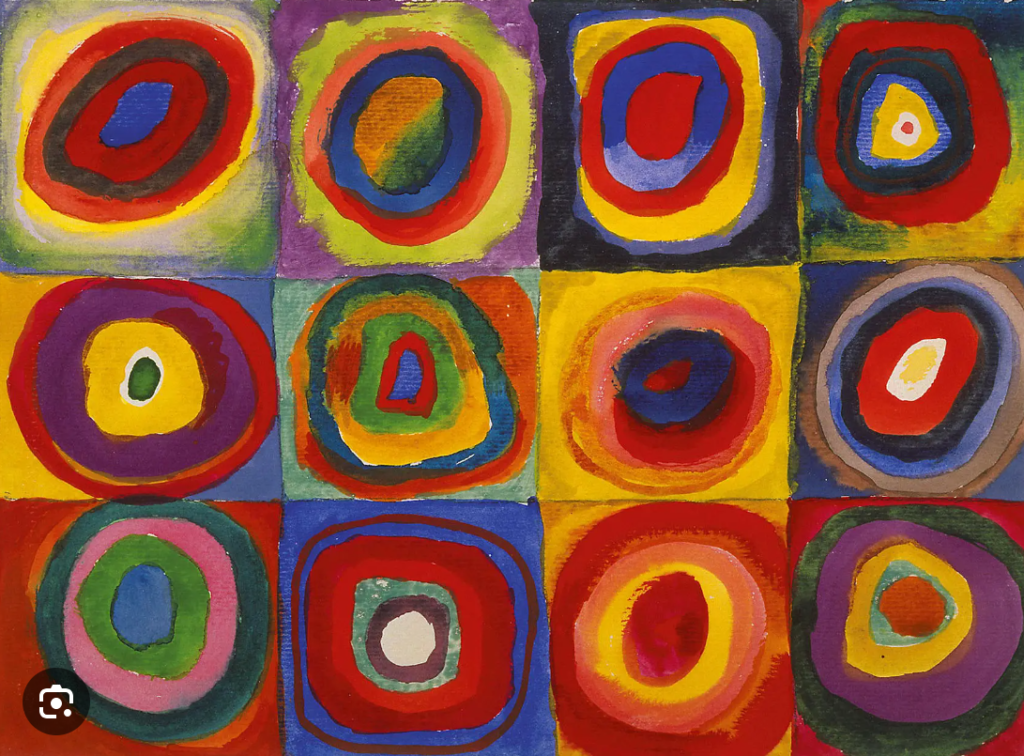
Vasily Kandinsky, Color Study. Squares with Concentric Circles, 1913, Städtische Galerie im Lenbachhaus, Munich
Questions to explore:
- What’s the relationship between fear (primary) and anxiety (secondary)?
- What causes emotions to wreak havoc on our bodily systems?
- What does emotional health look like?
- Is understanding the impact of our emotions on our behavior helpful to our wellbeing?
Emotional Building Blocks
FACS breaks down emotions into action units (AUs), identifying and assigning a code to specific facial muscle movements.
“Primary emotions are often very strong, which makes them easy to identify. They are thought to be instinctive, primal, and sensitive,” writes Olivia Guy-Evans, Simple Psychology. Primary emotions, she continues, are pre-cognitive and adaptive. They cause us to react instinctually and immediately, without cognitive interruption, to ensure our safety in a dangerous world.
Beginning in the 1970s, Paul Ekman, renowned psychologist and professor emeritus at the University of California, San Francisco, was a pioneer on researching primary emotions and their facial expressions.
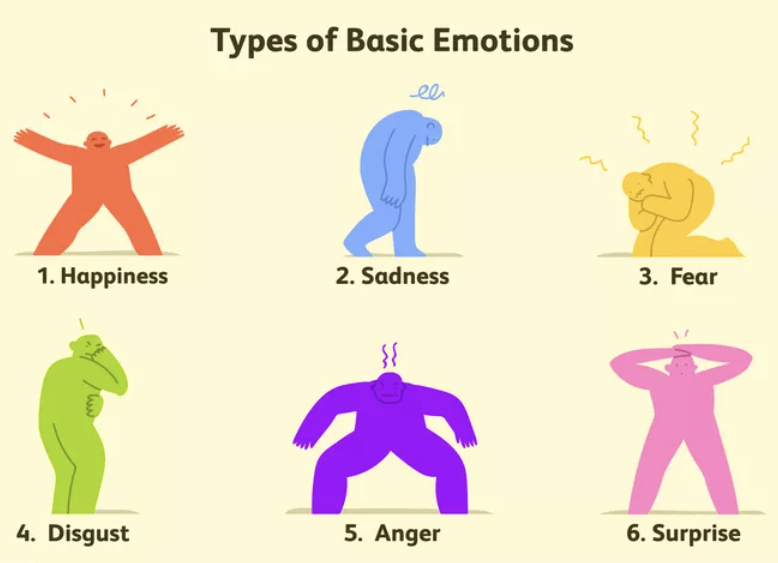
Graphic: Verywell/JR Bee
With Wallace Friesen, he developed the facial action coding system (FACS) to describe all visually discernible human facial movements.
AU6 is the “cheek raiser” (crow’s feet around the eyes) and AU12 is the “lip corner puller,” better known as a smile. FACS was used by researchers to study emotions, by animators to create realistic facial expressions, and computer scientists for facial recognition tasks. Ekman even consulted with Hollywood for his work on microexpressions and detecting deception.
Here’s a chart on Eckman’s groundbreaking research that was able to, for the first time, define and categorize highly distinctive emotions — easily recognized by facial expression, body language, and physical responses.
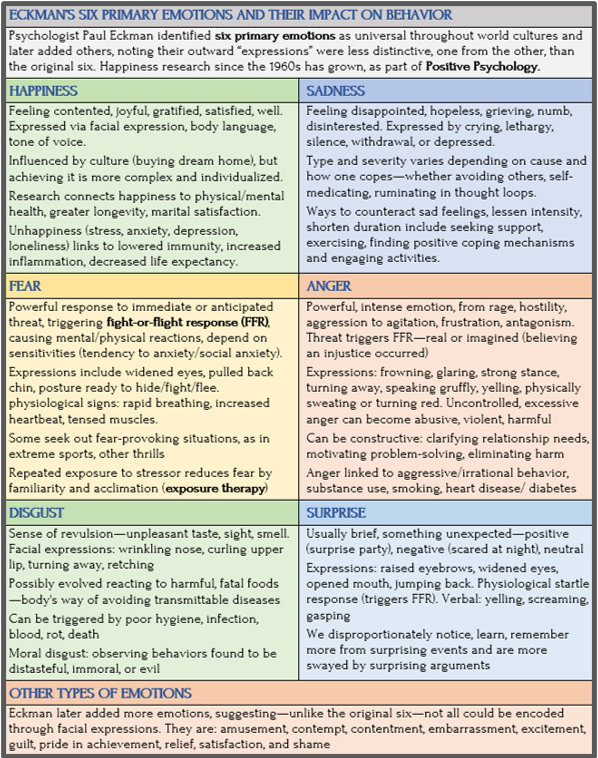
Source: Kendra Cherry, “Six Types of Basic Emotions and their Effect on Human Behavior,” Very Well Mind
Emotional Intensity in Combination
Psychologist Robert Plutchik developed wheels of eight building-block emotions — adding trust and anticipation to Ekman’s original six. In combination, these baseline emotions formed more complex and varied feelings — much like a color wheel mixes primary and secondary colors to create endless shades and tones. As red and yellow create orange, joy and trust create love.
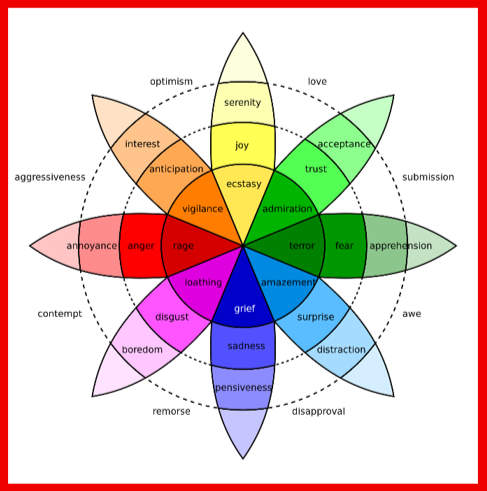
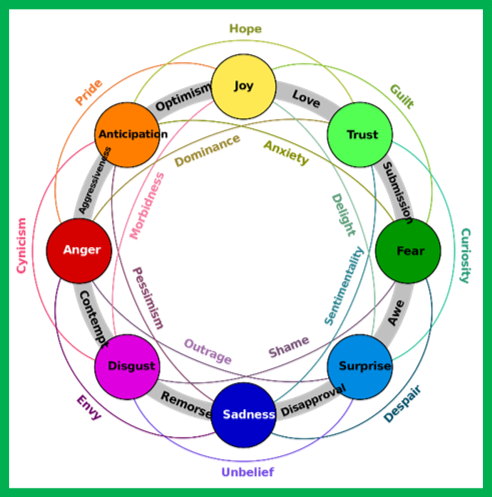
Robert Plutchik’s “petal” emotion intensity wheel and “emotion dyad” wheel. Source: Simon Whitely
In Plutchik’s “petal” emotion intensity wheel, basic emotions intensify toward the center or become milder toward the tip of the petal. Joy is serenity at its least intense and ecstasy at its most. If left unchecked, intense negative emotions can become destructive or lead to anxiety and depression.
His “emotion dyad” wheel with circles is best explained by these charts:
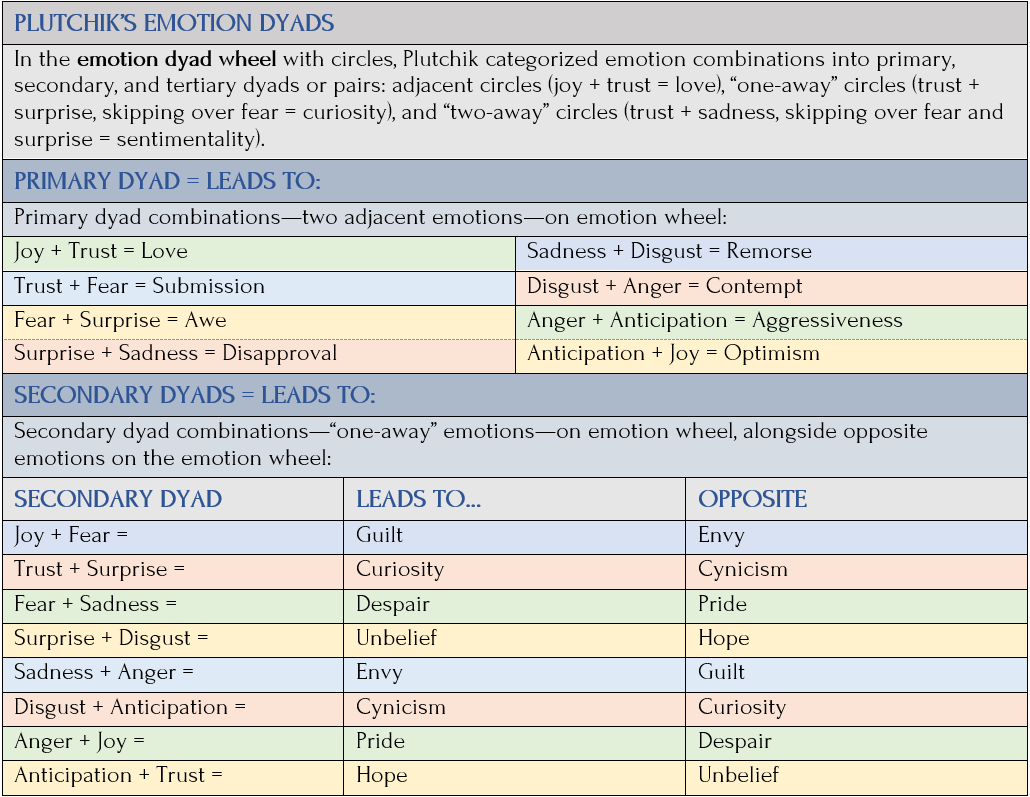
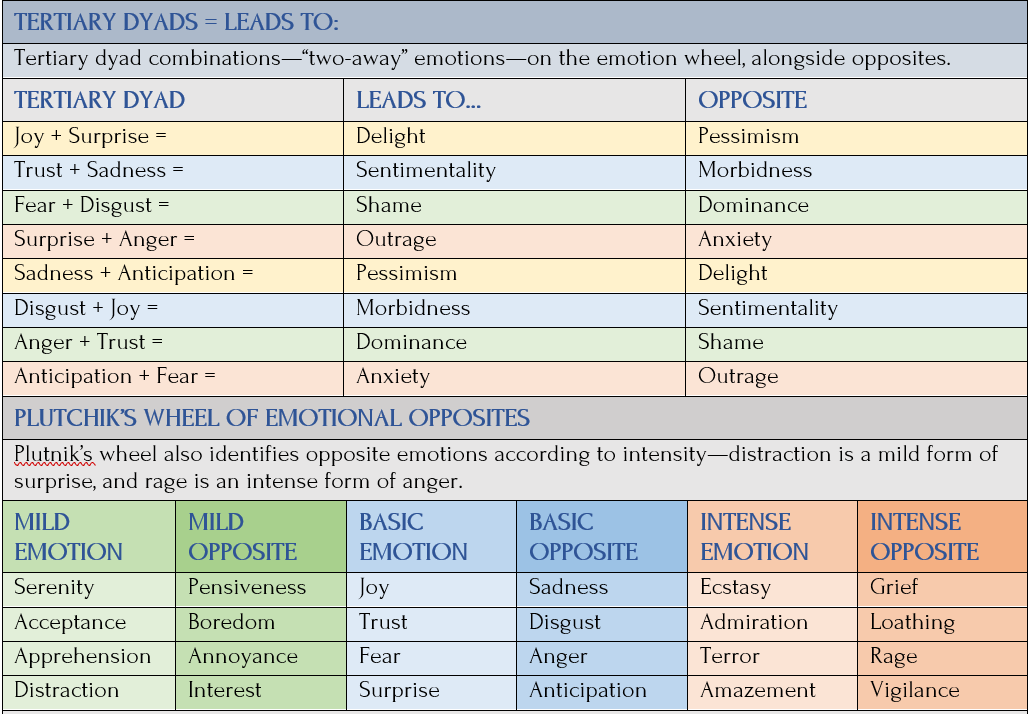
Source: Simon Whatley, “Plutchik’s Wheel of Emotion
More recent theories and research classified different types of emotions. According to VeryWellMind, a 2017 study identified 27 different categories of emotion — less distinctly unique than the original six and experienced more along a gradient.
Healthy Emotion vs Unhealthy Emotional Stress
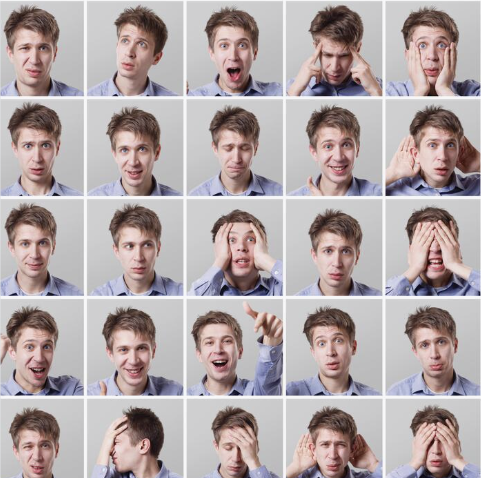
Photo: Vecteesy
A precarious ridge divides healthy emotion and unhealthy emotional stress or mental disorders. With better awareness and understanding of what side of the ridge we descend from, we might improve how we respond to people, situations, and ourselves in our daily interactions.
Mental disorders are less dots in time or space, less discrete stars in the sky, and more comets streaking across the universe, sliding along a spectrum: from good to bad to worse. Here are two kinds of anxiety spectra:
- From healthy (adaptive) to unhealthy (affecting daily life) to debilitating (phobic fear) to life turned upside down (panic disorders, agoraphobia)
- From single anxiety disorder (generalized anxiety disorder/GAD) to single comorbidity (GAD and major depressive disorder/MDD) to multiple, comorbid conditions (GAD, anxiety attacks, MDD, and trauma).
Common comorbidities with anxiety disorders include MDD, obsessive-compulsive disorder (OCD), PTSD, and substance abuse disorder (SUD) — though, there are many more.
Anxiety is what experts call an adaptive, affective emotion — it changes flexibly depending on the circumstance and is concerned with the experience of the feelings. Anxiety stays on the healthy side of the ridge as long as it motivates you to get to a place of physical, emotional, or psychological safety.
- Healthy anxiety: Let’s say you have a make-or-break, public presentation and, as time grows near, you find yourself increasingly anxious. After you give a successful presentation, your mood soars with gratitude that it went well and that it’s over. This is healthy anxiety.
- Unhealthy anxiety: Now let’s say, after your talk, you wonder whether you prepared enough or whether others thought you looked unprepared. You feel no relief it’s over and, instead, fret about what will be required of you next month. If you didn’t do so great this time, next time you’ll do worse. You retreat from volunteering for challenging opportunities, and someone else takes over the public speaking role. Meanwhile, you start having stomach aches and missing work, you snap at your spouse, and you start watching excessive TV.

Glossophobia, or fear of public speaking. Photo: Leaders Speaking
Anxiety crossed the ridge — your exaggerated emotional response has interfered with your ability to function. I plan to discuss what we can do for ourselves — starting with self-awareness and running through a lot of other “self-hyphenates,” like self-esteem, self-compassion, and even self-love. And what you can’t do for yourself, when you absolutely need professional intervention and guidance, if not medication, to get better.
Start by Committing to Your Health and Wellbeing
A lot of us slip off the ridge to the dark side when we don’t commit to our own health. We don’t take it seriously. If one drink is good, three is better. We’ll quit cigarettes next year. We deny a connection between our mental and physical health. We deny, suppress, or hide from what’s happening to us. We might retreat, or we might act out.
Depending on our choices, we’re moving in the right direction for future wellbeing or we’re not. Doing nothing makes it worse. In a lifetime, most of us, being human, do both. But at what cost? With how many wasted years and lost jobs and relationships?
Coming Up Next
In Post 2: Emotional Health vs Mental Health, I’ll talk about interrelated emotional mental health, but also independent aspects of who we are and how we relate to the world and ourselves.
Show Table of Contents
INTRO
FEAR VS ANXIETY VS ANXIETY DISORDERS
- Emotional Health vs Mental Health
- Fear vs Anxiety
- Personal Journeys with Anxiety and Panic Disorder
- Fear, Anxiety, and Fight or Flight
- The Evolutionary Role of Anxiety
- When Anxiety Drifts to Disorder
- The Ancient Advantage and Current Anguish of SAD
PHOBIAS, ANXIETY / PANIC ATTACKS
- Phobias and the Rapid Onset of Fear
- Specific Phobia and Agoraphobia
- Anxiety Attacks vs Panic Attacks vs Panic Disorder
- Anxiety Disorder Risk Factors and Symptoms
- Why Anxiety Goes Undiagnosed — and Untreated
TREATING AND COPING WITH ANXIETY
 English