Narcissism and the Rest of Us
Show Table of Contents
INTRODUCTION
NARCISSISM DEFINED
2. Is There a Narcissist in Your Life?
3. Narcissus and the Origins of Narcissistic Thought — Part I
4. Narcissus and the Origins of Narcissistic Thought — Part II
5. Narcissus and the Origins of Narcissistic Thought — Part III
NARCISSISTIC DEFENSES
6. A Narcissist’s Self-Defense — Part I
7. A Narcissist’s Self-Defense — Part II
8. A Narcissist’s Self-Defense — Part III
NARCISSIST PERSONALITY DISORDER VS TRAITS
9. When Narcissism is a Personality Disorder
10. Narcissism and the Maladaptive Umbrella
11. Malignant Narcissism and the Narcissism Spectrum
12. When Narcissism is Compounded by Comorbidity
NURTURE VS NATURE
15. Narcissism: Flipping Self-Esteem on its Head
16. The Double-Edged Sword of Grandiose Narcissism
NARCISSISM’S DARK SIDE
19. Narcissistic Rage and Narcissistic Self-Awareness
20. Trait Narcissism and the Illusion of Control
21. Beyond Narcissism: Dark Personality Traits — Part I
22. Narcissist Sociopaths: Dark Personality Traits — Part II
ROMANTIC LOVE AND BOUNDARY-SETTING WITH A NARCISSIST
23. Romantic Love with a Narcissist — Part I
24. Romantic Love with a Narcissist — Part II
25. The Narcissist’s Non-Apology Apology
26. Boundary-Setting with Narcissists — Part I
27. Boundary-Setting with Narcissists — Part II
28. Boundary-Setting with Narcissists — Part III
29. Shattering Narcissus’ Mirror… So They Can Live
CONCLUSION
30. On Narcissism: What About the Rest of Us?
25: The Narcissist’s Non-Apology Apology
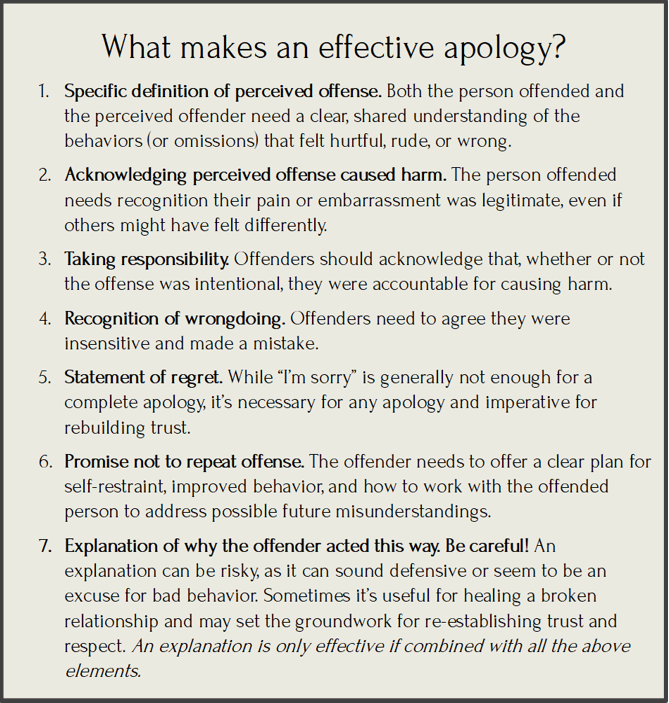
“The Power of Apologies,” adapted by Harvard Medical School from Apologies by Marsha Wagner, University of Colorado, Boulder. Graphic: Redesigned by Jan Swan
We apologize to others to acknowledge that we screwed up, hurt them, didn’t do what we promised to do, or let them down in some way. By apologizing we show them we care enough to invest in the relationship. We correct mistakes or poor treatment before bad behavior festers and erodes trust. Sincere apologizing shows our humanity, humility, and vulnerability, while validating their feelings. This is from my reading up on apologies. But why don’t we apologize more easily and freely, when it does so much good?
It’s not easy at any time, but especially in the heat of the moment. That’s when we probably felt justified in whatever we said or did — or didn’t do. Situations between us are rarely clearcut so that one of us is absolutely wrong (the offender) and the other right (the offended). And maybe the offender was wrong this time, but the offended had a pattern of wrongdoing and never apologized before. And if time elapses, we each get further entrenched in our version of events making it less likely that the offender will see their offense as the offended does.
There are also times when we know we owe someone a genuine, sincere apology but our heels are so dug in we can’t take a step. What’s that about? Pride? Wanting it to go away? Shame?
This simple act of contrition is so frequently unforthcoming that we have to wonder why. And question why we would be willing to jeopardize a relationship or cut ourselves off from deeper reflection, more self-awareness, and an ability to learn from mistakes and grow as a person.
Why We Need an Apology
An apology can be the first step to better understanding in a damaged relationship. It says you share values regarding appropriate behavior toward each other, you have regrets when you don’t behave according to those values (intentionally or unintentionally), and you will make greater efforts to live up to your shared standards of behavior. Timing can be crucial. An apology delayed may be an opportunity lost. —Marsha Wagner, University of Colorado, Boulder, excerpted in “The Power of Apologies,” Harvard Medical School
Yet, Wagner continues, it’s better not to apologize if we can’t be sincere (see her list of seven essential elements to an apology), which can actually do more damage. She writes, “Sincerity is expressed by what you say, how you say it, and what body language you use…. An inadequate or insincere apology can feel dismissive to the offended party and may heighten conflict.”
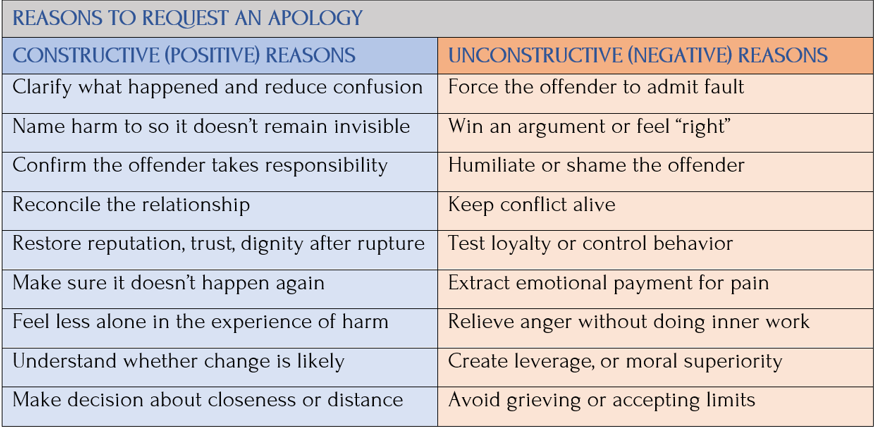
Only positive motivations are reasons to apologize. Negative reasons may provide short-term relief, but will absolutely perpetuate the hurt, damage the relationship, and destroy trust. Demanding rather than requesting an apology can also backfire — and provide more ammunition for the offender (in this case, the narcissist) to shift the blame around. In my experience, the narcissist always wins the blame game.
Without being able to apologize, it’s hard to have a healthy, stable, and secure relationship with anyone — it open lines of communication to move past conflict, toward healing. Forgiving and being forgiven are not new concepts. And it’s fairly simply expressed by two words: I’m sorry. Not I’m sorry I couldn’t meet your expectations. Just, I’m sorry.
Those Who Can’t or Won’t Apologize
Narcissists are notoriously unable to find their way through an apology, largely because they don’t see themselves as doing anything wrong. With that mindset, if they do apologize, it’s hedged and caveated until you can’t be sure whether you actually received an apology or have to apologize yourself.
Recently, my son Jaden became emotionally dysregulated during a conflict. The more I tried to explain my reaction, the more agitated he got — until he was shouting at me. We managed to restore calm, but I followed up with a text that I thought his behavior toward me was unacceptable. He texted back: “I’m sorry I was yelling on the phone instead of having the capacity to more calmly explain myself.”

Photo: Shutterstock
I heard “I’m sorry,” but what followed was a non-apology apology — his words were self-focused and not about the hurt I felt, as his mother, as the brunt of his outrage. Rightly or wrongly, I felt blamed for not understanding his struggle. In the end, I was unsatisfied by his apology, and he was left confused and irritated by my reaction to what he claimed was a “genuine” apology. He defensively accused me of “forcing” him to apologize. Of course, I could hardly force him, but I did prod him — I admit to that.
My son isn’t a narcissist but sometimes uses narcissistic defense mechanisms with the empathy meter’s turned down. No one can forgive without feeling selflessly for the other.
Forgiveness is a huge topic, bigger now in my mind than at any time in my life. Because now I can see the accumulated hurt it causes as years pass, and there’s no opportunity to clear the air, resolve repeating conflicts, and deepen connection. As I wrote earlier in this series, my mother never apologized for some bad behavior, and our relationship suffered because of it. I guess it’s also the difference between validation and judgement.
There must be unconscious forces that make apologies seem like recipes for disaster within the psyche. The words are simple, but the message to self is, if I apologize, then the world knows I’m not fit.
So I’ll take this book-length topic and bring it down to one post on why those with serious mental illness and possibly personality disorders, including narcissism, have a hard time apologizing for their clearly inappropriate, hurtful, or abusive behavior.
The Narcissist’s Non-Apology Apology
In her Psychology Today article, “The Narcissist’s ‘Not Really an Apology’ Apology,” clinical psychologist and narcissism expert Mary Ann Little describes a healthy apology as “neither an explanation nor an excuse.” In her book, Childhood Narcissism: Strategies to Raise Unselfish, Unentitled, and Empathetic Children, Little explains that a “secure, meaningful, and healthy relationship requires a capacity for empathy, understanding, and responsibility in both partners. These abilities ensure that the friendship or relationship provides the contentment and satisfaction that are the hallmarks of emotional health. Small and insignificant as it might seem, a person’s capacity to provide a meaningful apology offers powerful insight into those subtle but essential life skills.”
It requires owning up to the pain that one person caused another. It’s healthy to take responsibility for one’s actions and words, regardless of argumentation around what was said, what was meant, or what was heard.
Why is this the case? A healthy apology springs from empathy and requires equal concern for the other. Equality and reciprocity are the foundation of a friendship. They ensure health and allow forgiveness and repair, both of which can be relied upon throughout a long relationship. —Mary Ann Little, “The Narcissist’s ‘Not Really an Apology’ Apology: Four habits of mind compromise a narcissist’s apology,” Psychology Today
Little explains why narcissists seek to avoid responsibility and blame others, are reluctant (or unable) to admit they were wrong, and attend to their own wounds over another’s — what she calls the “‘not really an apology’ apology.” She also acknowledges many of us — narcissists and non-narcissists alike — engage in non-apology apologies. Here’s her example of a failed apology [paraphrased/abbreviated]:

Edgar and Charlotte were friends at work…for over two decades, they shared their successes and disappointments in both their work, personal lives, and events (both positive and negative) in the lives of their children.
At Charlotte’s daughter’s wedding reception, Edgar pulled Charlotte aside…to comment on her daughter’s…previous “lack of humility” and “overconfidence in her opinions,” stating he hoped those issues were behind her.
The next week at work, Charlotte confronted Edgar for bringing up her daughter’s difficulties with her at the wedding reception, which had hurt her feelings.
Edgar followed up with a written apology. His words were defensive. He quibbled over the specific phrasing he had used to describe the daughter’s issues [but] doubled down on his criticisms….
He attempted to whitewash the exchange by focusing on what he believed was the daughter’s improved behavior…and summarized their exchange as a “study in the difference between what was said, what was meant, and what was heard.” While Edgar paid lip service to an apology, Charlotte didn’t feel better. —Mary Ann Little, Psychology Today
Apologies that Fail to Heal
My experience with Jaden and Charlotte’s experience with Edgar are common and fairly predictable. People don’t like to apologize — and I include myself. But without heartfelt, agenda-free apologies, we’re stuck in place. Here’s Little’s list of narcissistic traits to explain what’s missing from most apologies [paraphrased/abbreviated]:
- Inability (or reluctance) to admit wrongdoing. When feeling criticized, narcissists resist taking responsibility for their behavior. Instead, they make excuses and blame others or external circumstances. They find fault in the facts, claiming others misperceived or misinterpreted their words or actions.
- Lack of adequate concern for the other or the capacity for a healthy, meaningful relationship (low empathy). Their fragile self-concept keeps them from fully connecting, which would require focus on the other person. They rely on explanations and rationalizations, rather than listening and understanding.
- Behavior based on self-protection and self-inflation, with high sensitivity to slights or criticisms. In conflict, narcissists protect themselves from threat to their self-esteem over expending emotional energy on someone else. Often thinking in extremes, they can’t easily integrate mistakes or flaws into their self-concept.
Little believes narcissistic non-apologies are a warning sign that non-narcissists shouldn’t ignore to protect themselves from emotionally painful interactions to come. In posts 26-28, I’ll cover boundary-setting as one way to assure self-protection, along with modifying expectations of what a narcissist is capable of. With my mother, I no longer expect apologies for unacceptable behavior and am therefore less disappointed the next time. Except that’s not really true — I am disappointed. All those memories of unresolved conflict stacked one on top of the other. It’s like a low-level trauma. Through all these decades, I’m in close touch with my mother, with no interest in severing ties and disrupting my family. But I pay a price for what’s missing between us. I’m sorry I didn’t have the capacity to deal my mother’s narcissism.
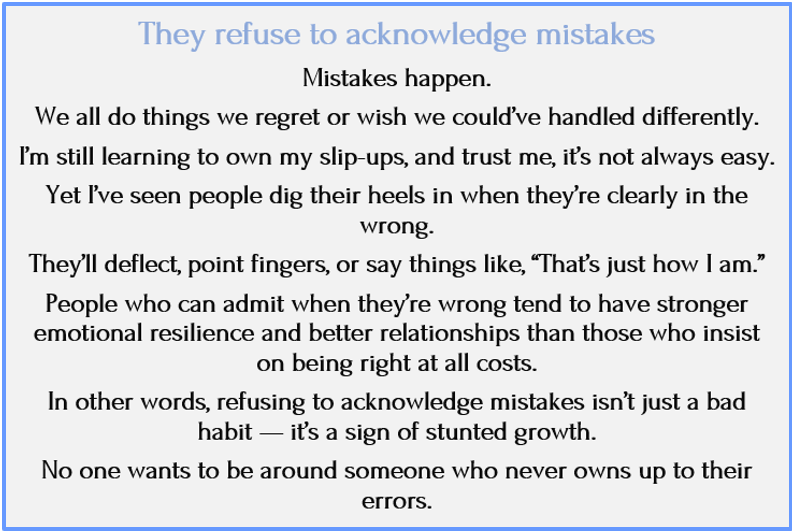
Olivia Reid, “9 small behaviors that reveal someone has never been humbled by life (and it shows).” Graphic: Jan Swan
Non-Apology (Narcissist) Apologies, as Reported by Non-Narcissists
In social media posts, people share personal experiences of how their spouses, partners, or close relatives “apologized.” I took the most illustrative of the hundreds of comments I found and grouped them by type.
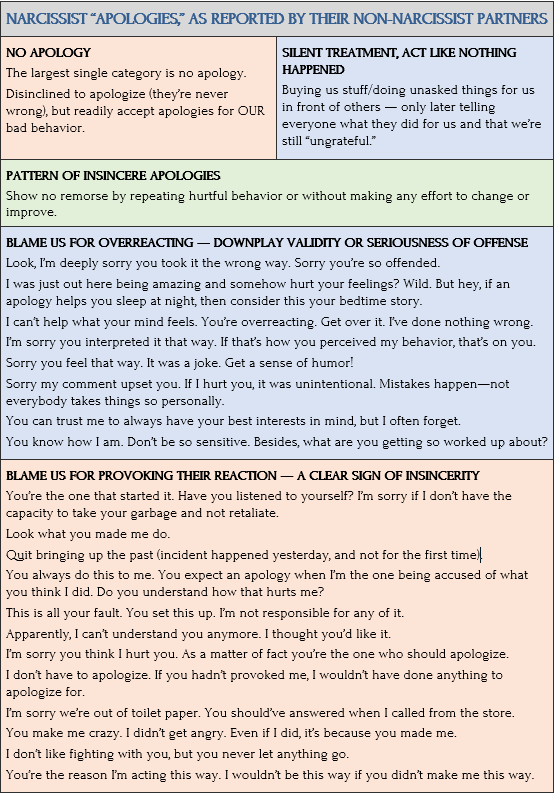
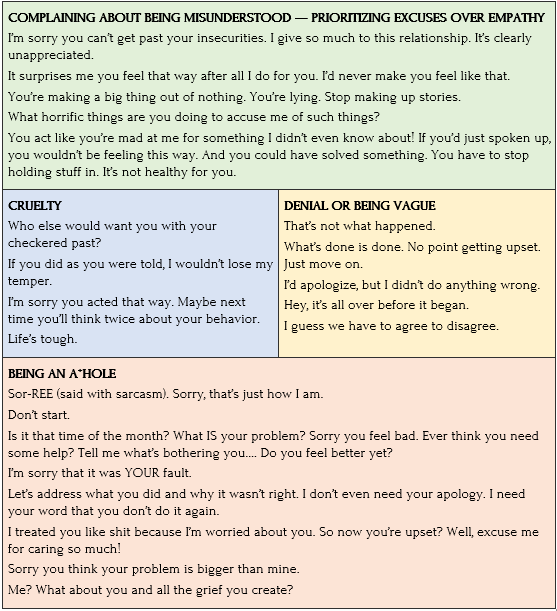
After reading these defensive, cruel, sarcastic, insulting put downs by narcissists, it makes sense their non-narcissist partners feel hurt, angry, betrayed. By the time we can muster a response, we’re so flustered and outraged we tend to respond in kind — thereby escalating the tension.
The website Calm offers this: “Encouraging someone to offer a more sincere apology can be done gently and constructively. Express your appreciation for their attempt to apologize and suggest ways to make the apology feel more genuine. For example, you might say, ‘I appreciate your apology. It would mean a lot to me if you could acknowledge exactly what happened and how it affected me, so I can feel understood and we can move forward.’ This approach builds a ,supportive environment that can facilitate a more heartfelt apology and strengthen the relationship.”
The trouble is staying Calm, which an entire website is helping us be. Now reread the apology statements above and come up with a response that will move the conversation in a productive direction. Not easy. I know I’ve failed at this numerous times.
Here are Calm’s suggestions [paraphrased/abbreviated]
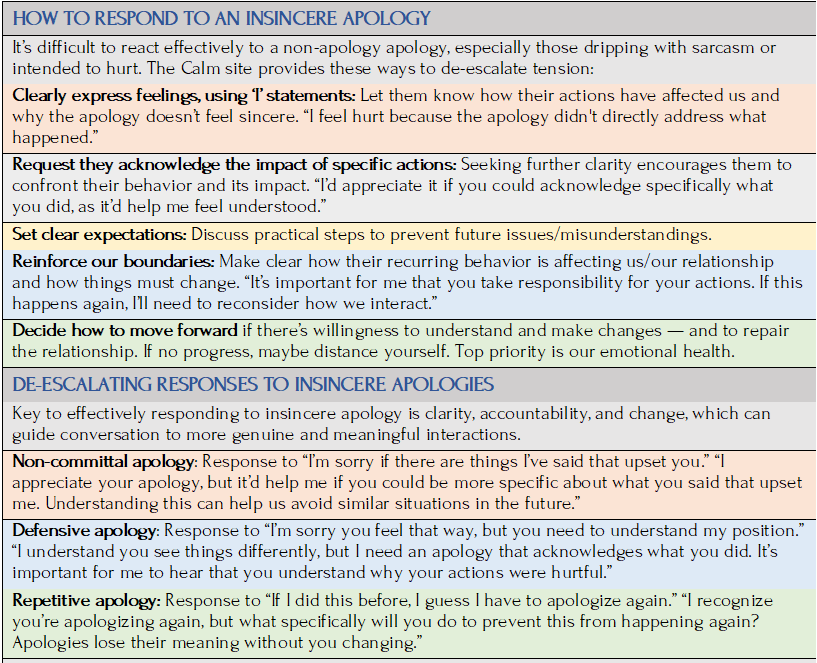
Clinician Chris Mosunic, “How to recognize an insincere apology: 5 signs to look out for,” Calm
Calm concludes its piece by responding to the question of whether to address insincere apologies in real time, let it go, and bring it up later. The answer pertains to how much the relationship matters to you. “By addressing the issue, you promote honesty and sincerity in your relationship, both of which are key to its long-term health.”
I agree with this. For those of us hurt by no apology, an insincere statement, or more hurt (gaslighting, silent treatment, stonewalling), not addressing it allows it to damage trust and lose connection. It’s no doubt unpleasant to do, but it also tests the mettle of the relationship. If the relationship can’t withstand calling out poor behavior, maybe it’s best to let it go.
Recovery from insincere apologies involves sincere effort from the apologizing party to understand and correct their behavior, coupled with forgiveness and a willingness to rebuild trust from the other. Open communication and a commitment to change are vital for mending the relationship. —”How to recognize an insincere apology: 5 signs to look out for,” reviewed by clinician Chris Mosunic, Calm
Forgiveness and Radical Acceptance
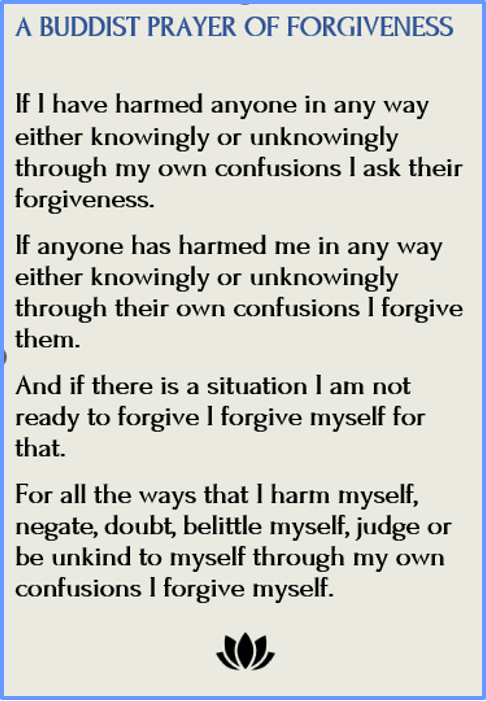
A few years ago, I went on a weekend retreat (with 100 or so comrades) with widely respected psychologist and meditation teacher Tara Brach, whose work on radical acceptance has deeply influenced my thinking about forgiveness, self-compassion, and emotional healing. I’ll be writing more about her in the future, so for now I’ll briefly share her message on forgiveness and acceptance — from her book Radical Acceptance. Also visit The Radical Compassion Institute.
For Brach, forgiveness isn’t an intellectual endeavor, something we can will ourselves to do. Rather, forgiveness arises from a compassionate presence from within our bodies, if we can be open to that presence. Here I’ll use her language without direct quoting. According to Brach, holding pain, resentment, and blame hardens and imprisons the heart, while forgiveness releases its grip and creates room for freedom, compassion, and genuine peace. The process begins with self-compassion letting ourselves be seen with kindness before extending that compassion to others. Brach emphasizes this in no way condones harmful behavior or erase boundaries — forgiving someone doesn’t allow further harm. Instead, it’s about releasing the “emotional imprisonment of anger or resentment” while still protecting ourselves.

Tara Brach and her dog, The Radical Compassion Institute
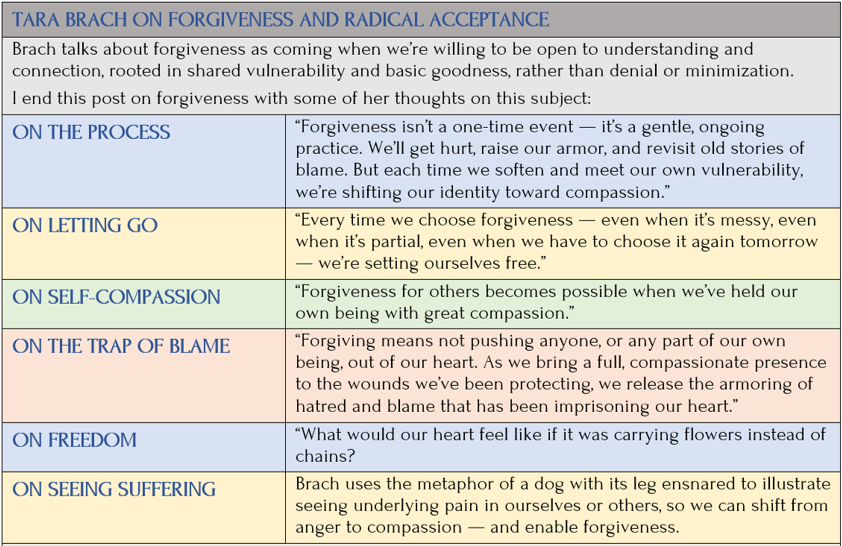
Tara Brach, “Resources on Forgiveness”
Coming Up Next

When I first heard the word boundary used in a context that wasn’t about geographical or civic borders, I figured it was psychospeak for protecting personal space. It turns out that’s true, but a too-narrow understanding, which is why I’ll devote the next three posts to boundaries. It turns out to be a crucial concept for self-preservation in a world that takes more than it gives. In Post 26: Boundary-Setting with Narcissists — Part I, I’ll start with boundary-setting as healthy for any relationship.
Sources
 English