Narcissism and the Rest of Us
Show Table of Contents
INTRODUCTION
NARCISSISM DEFINED
2. Is There a Narcissist in Your Life?
3. Narcissus and the Origins of Narcissistic Thought — Part I
4. Narcissus and the Origins of Narcissistic Thought — Part II
5. Narcissus and the Origins of Narcissistic Thought — Part III
NARCISSISTIC DEFENSES
6. A Narcissist’s Self-Defense — Part I
7. A Narcissist’s Self-Defense — Part II
8. A Narcissist’s Self-Defense — Part III
NARCISSIST PERSONALITY DISORDER VS TRAITS
9. When Narcissism is a Personality Disorder
10. Narcissism and the Maladaptive Umbrella
11. Malignant Narcissism and the Narcissism Spectrum
12. When Narcissism is Compounded by Comorbidity
NURTURE VS NATURE
15. Narcissism: Flipping Self-Esteem on its Head
16. The Double-Edged Sword of Grandiose Narcissism
NARCISSISM’S DARK SIDE
19. Narcissistic Rage and Narcissistic Self-Awareness
20. Trait Narcissism and the Illusion of Control
21. Beyond Narcissism: Dark Personality Traits — Part I
22. Narcissist Sociopaths: Dark Personality Traits — Part II
ROMANTIC LOVE AND BOUNDARY-SETTING WITH A NARCISSIST
23. Romantic Love with a Narcissist — Part I
24. Romantic Love with a Narcissist — Part II
25. The Narcissist’s Non-Apology Apology
26. Boundary-Setting with Narcissists — Part I
27. Boundary-Setting with Narcissists — Part II
28. Boundary-Setting with Narcissists — Part III
29. Shattering Narcissus’ Mirror… So They Can Live
CONCLUSION
30. On Narcissism: What About the Rest of Us?
23: Romantic Love with a Narcissist — Part I
We’ve finally arrived where the rubber meets the road. Whether or not it’s possible to have romance and marriage with a narcissist. Depending on the severity of narcissism, the answer is a qualified maybe. The relationship’s likely range is from difficult to impossible. Although it also depends on the narcissist’s self-awareness, degree of accountability for their behavior, and their commitment to therapy. We know this carries no guarantees but without taking a comprehensive approach to tamping down narcissistic proclivities, it probably tilts toward impossible.
In this post, I hope to survey some research findings, personal stories, and everyday wisdom about a topic that generates significant attention on social media and mental health websites. In fact, more turns up about narcissistic love relationships than any other narcissistic relationship (in my unscientific line of inquiry).
I will focus on moderate-level, “trait” narcissism (grandiose and vulnerable), since narcissistic personality disorder (NPD) is extreme, rare—and, by many-more-magnitudes, difficult to treat. Ditto for malignant varieties.
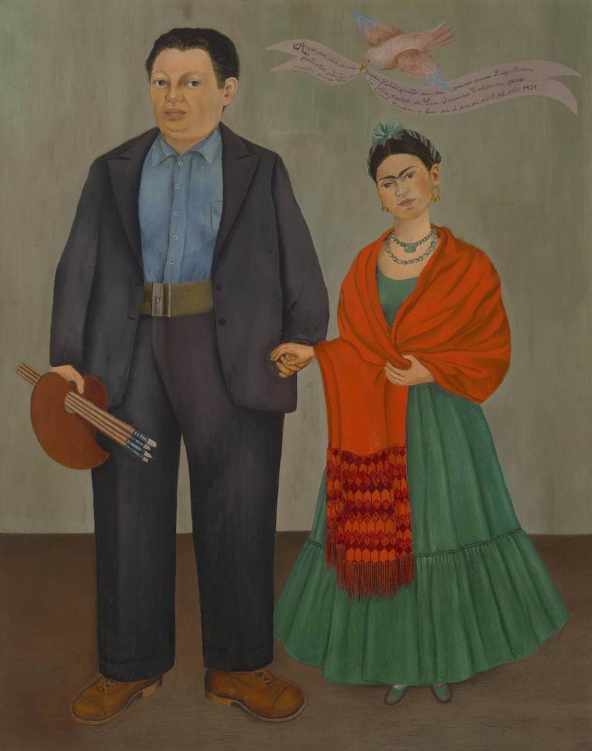
Frida Kahlo, Frieda and Diego Rivera, 1931, Banco de Mexico Rivera & Kahlo Museums Trust/Artist Rights Society, NY. Kahlo and Rivera had a famously destructive marriage, with infidelity on both sides — though Rivera was clearly abusive and narcissistic. Kahlo once said, “There have been two great accidents in my life. One was the streetcar, and the other was Diego. Diego was by far the worst.”
Transforming Narcissistic Relationships
In “What I Learned about Narcissism from Terry Real,” psychotherapist Claudia Behnke reports on fellow psychotherapist and author Terry Real’s seminar, “Treating the Untreatable: How to Transform Narcissistic Relationships.” Real is the founding director of Relational Life Therapy (RLT) and an internationally renowned relationship expert. I appreciate the way he distinguishes outcomes for trait narcissism vs NPD and for expressing his optimism that life, love, and relationships can improve with the right care — and outlook.
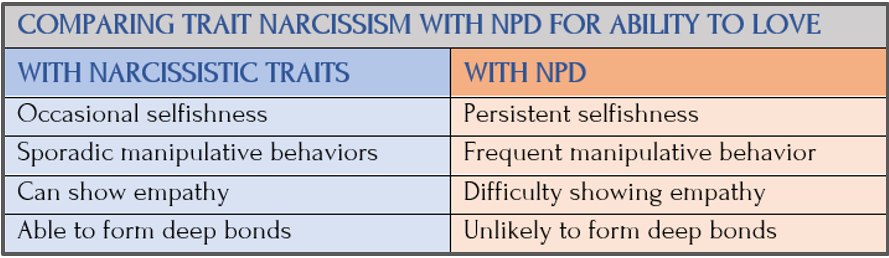
Source: Arlin Cuncic, “Can a Narcissist Love? It’s hard to love someone else when you lack empathy,” VeryWell Mind
People with narcissistic traits may learn to move beyond them, but those with NPD lack self-awareness and insight into their behaviors. People with NPD typically do not see themselves as the problem; instead, they blame others and are very difficult to work with in therapy. As Terry explains, “A diagnosis of a personality disorder usually means your therapist doesn’t like you very much.” People with NPD don’t think there’s anything wrong with them, which is why you would not typically come across them in therapy unless they are forced to for some reason. —Claudia Behnke, “What I Learned about Narcissism from Terry Real”
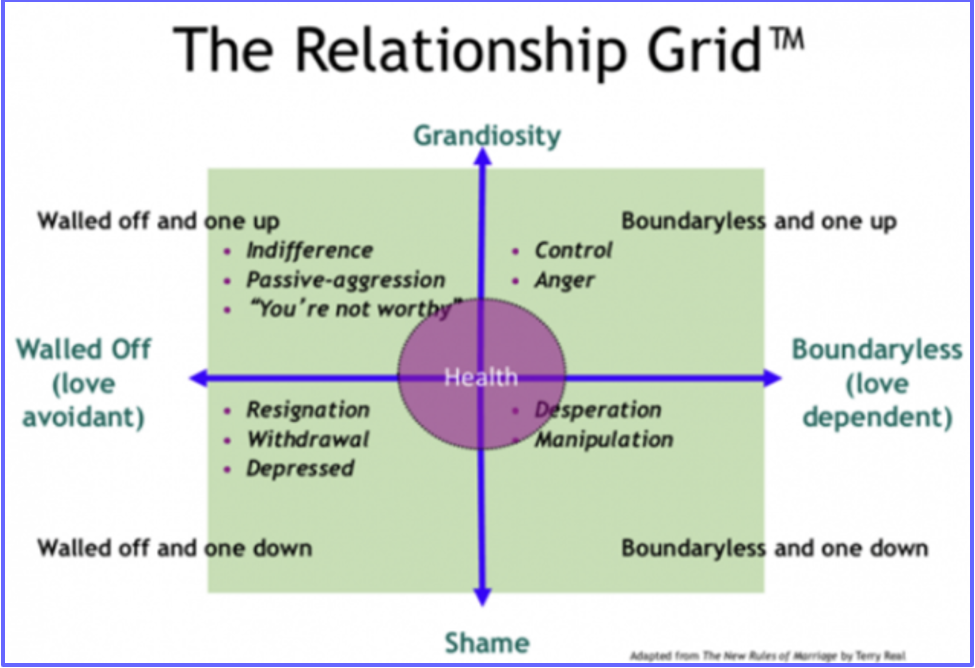
Real devised a relationship grid to help people first determine their most prominent proclivities and then make adjustments to improve their significant relationships. Thinking of my more difficult relationships, I took the free assessment online and wasn’t too happy with what I learned about myself. I discovered I’m boundaryless and love dependent — meaning, I cave and don’t create structure to protect myself. I will return to the relationship grid in a later post when discussing how to deal with a narcissist.
Source: Terry Real
Love Relationships and Empathy
The narcissist’s lack of empathy is most apparent in relationships that are supposed to be close and less obvious in relationships with acquaintances. A narcissist is often motivated to plump up their public image, so they easily extend sympathy to strangers. Feeling sorry for someone places the narcissist in a position of power and allows them the opportunity to be the “hero.”
Authentic empathy requires the narcissist to place themselves on an “even playing field” with a loved one to relate to that person as an equal human being — one who is entitled to their own emotions. Unfortunately, the narcissist may be too insecure to accomplish this. Manipulation and control are typically the ways a narcissist takes the power inappropriately in a relationship. —Erin Leonard, “Understand a Narcissist From an Object Relations Perspective: How a narcissist manipulates and controls by playing favorites,” Psychology Today
Experts agree one of the main reasons relationships with moderate narcissists go wrong is because empathy is essential to successful relationships and narcissists are severely empathy-challenged. If we think about what any one of us hopes to achieve in an honest, mutually loving, and trusting relationship, it may be a tall order to expect that with a narcissist.
What Does a Narcissist Think Love Is?
Narcissists often have a skewed idea of love and what it should look like. Ketan Parmar, MD, notes, “To a narcissist, love is an external source of validation used to boost their self-esteem. They do not understand that real love involves reciprocity. Instead, they believe that love is something they can obtain from a person or object and use to feel better about themselves.” —Arlin Cuncic, “Can a Narcissist Love? It’s hard to love someone else when you lack empathy,” VeryWell Mind
In their constant quest for validation, Arlin Cuncic writes, narcissists believe they’re entitled to unconditional love and admiration from their partner. They don’t realize or perhaps don’t care that authentic love involves mutuality of commitment, trust, and empathy. Not only is the relationship one-sided, it’s also typically superficial. “Rather than forming a deep emotional bond, narcissists become attached to the idea of love and attempt to recreate the feeling of admiration they had at the beginning of their relationship. They may belittle their partner as self-protection if they don’t feel that admiration,” Cuncic writes.
Photo: Adobe Stock

Experts say narcissists may believe they’re in love in the moment and also believe they’re showing affection by sudden and perhaps over-the-top attention. But this doesn’t equate with meaningful connection. At first, the non-narcissist partner may find the narcissist’s intense interest exciting, but it’s non-sustainable and increasingly meaningless as they progress.
Paying Attention to Warning Signs
Being aware of warning signs to address unhealthy dynamics before they escalate may help. Cuncic quotes Flora Sadri-Azarbayejani, medical director, Psyclarity Health: Boston, who counsels non-narcissists to find out whether their narcissist partner loves them. Not by word, but by action — over time.
This list of love behaviors sounds terrific for any relationship. But is it realistic? Cuncic cites results of a study published in the Journal of Personality and Social Psychology suggesting narcissists might succeed in short-term dating but fail in committed relationships. This bears out from social media chats, which tell love stories with unhappy endings. Perhaps the happy ones don’t post? For anyone, let alone a narcissist, to put their partner’s needs first would require the narcissist partner to be self-reflective and willing to change. Otherwise it’s much more likely the feelings they show will remain conditional and one-sided.
Narcissists Can and Do Love
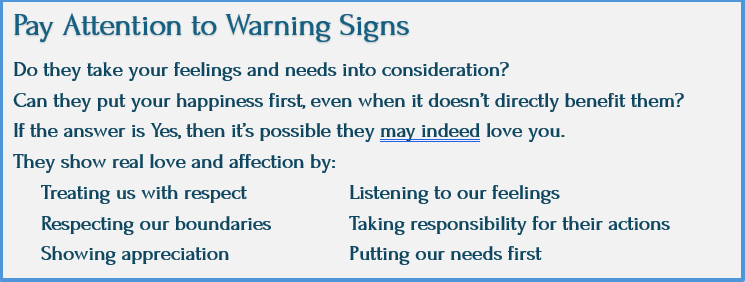
Photo: Adobe Stock
The answer seems to be they can and do love — but their love may never be the same as a healthy, unconditional bond. Rather, as Cuncic quotes psych counselor Holly Keller as saying, “’People with narcissistic tendencies tend to be the people in your life you think of as self-absorbed or emotionally immature. The depth of love may be on the shallower side or expressed immaturely. They may believe love looks like gift-giving, proximity, or physical intimacy.’” In contrast to NPD, someone with trait narcissism may still be capable of forming genuine connections with others and expressing love appropriately. They will likely display selfish behaviors on occasion, but these aren’t signs of a personality disorder.
And some experts believe encouraging empathy, to see things as their partner does, is the way to find happiness in a relationship.
Empathy Prompts
In his seminal book Rethinking Narcissism, clinical psychologist/Harvard Medical School lecturer Craig Malkin, PhD, reframes our thinking of narcissism as a hopeless case of detached, self-serving grandiosity. Rather, he places it on a “drive-to-feel-special” spectrum, arguing change is possible if we can reach the narcissist though sustained emotional connection. In other words, empathy. It’s a question of whether the narcissist in the relationship can prioritize connection over their need to feel special — because those two things are at odds.
Malkin suggests the non-narcissist help move their narcissist partner to the spectrum’s center (healthy narcissism), away from the two extreme ends (echoism at one end and NPD at the other) [see post 11]. The healthy narcissist should be, in fact, all of us. We all want to feel special enough to be confident and pursue our life and work goals, but remain warm and caring.
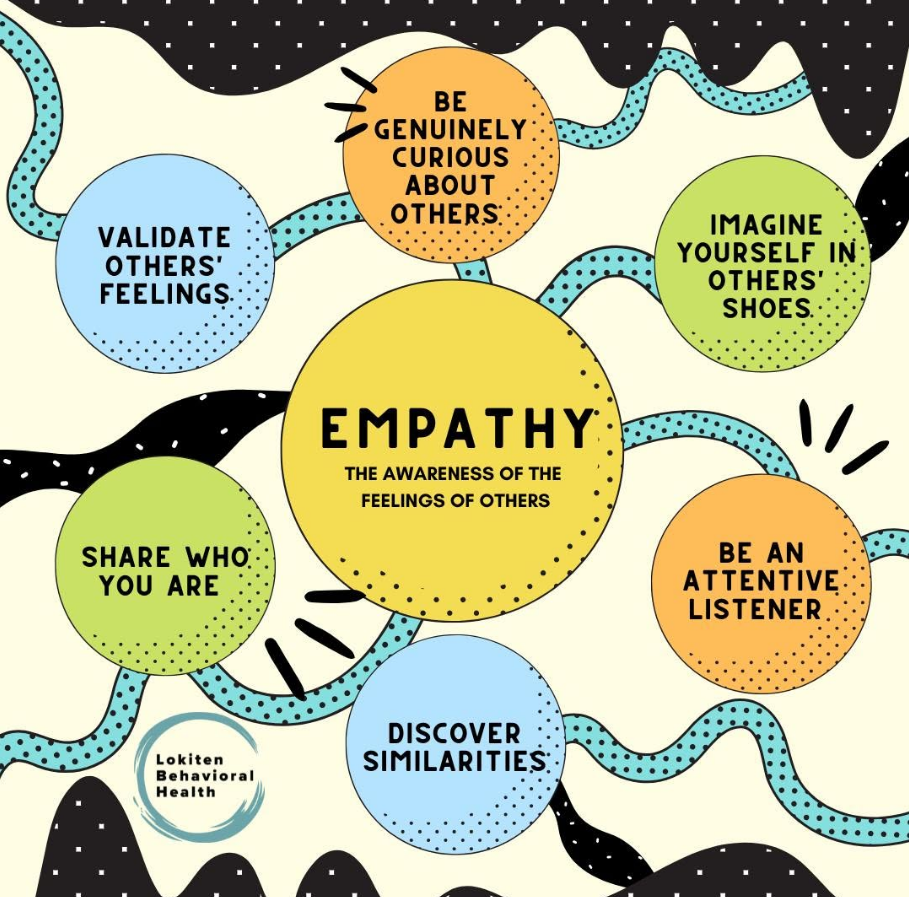
Empathy prompts are Malkin’s ingenious invention — a tool for testing and fostering a partner’s emotional capacity. That is, if the non-narcissist partner is up to the task against a probably recalcitrant narcissist. There are two important concepts behind empathy prompts. One is to address a common complaint of narcissists by demonstrating that we prioritize the relationship and, two, is to accomplish this by sharing a vulnerable feeling with them.
How They Work
Empathy prompts help shift narcissists toward healthier behavior by following a pattern, starting with voicing the importance of our relationship and revealing our own vulnerable feelings:
- Typical prompt: “[Name], you mean a lot to me. When [behavior occurs], I feel [vulnerable emotion].” For example: “Your opinion means the world to me. When I hear you talk to me like that, I feel worthless in your eyes.”
- Using we, us, our:First-person plural activates the communal part of the narcissist’s brain. Research suggests this can decrease self-obsession and increase helpfulness.
Assessing change potential: We can then observe their response.
- Positive responses include affirmation of the relationship’s importance (“I don’t want you to feel bad”), clarificationand curiosity about our feelings (“How long have you felt this way?”), validation or apologizing for our experience (“I know my sarcasm hurts you”), and demonstration, showing a willingness to change (“I’m willing to try therapy, if you think that will help us”).
- Rewarding warmth:Malkin advises specifically praising communal moments (concern or collaboration) rather than praising achievements or performance.
- Negative responses: If we do all this and our narcissist partner lashes out, demeans/blames us, or withdraws into silence, Malkin says, we should consider their response a failure—a sign they can’t/won’t leave their “addiction” (to bad behavior) behind and aren’t willing to change. This information can help us make the right decision about what we should do.
The idea is for the non-narcissist on the receiving end of narcissistic attacks and manipulations not to stay trapped in an unhealthy relationship. It either changes or ends — hopefully without more suffering and abuse. By addressing tendencies to self-blame/guilt or find excitement in all the wrong places, we can break free from unhealthy relationship patterns and build more fulfilling connections. In Malkin’s list, we should try to:
- Recognize self-blame or guilt as coping mechanisms for fear of loss. Self-blame may come in handy when a relationship no longer works and leaving feels too painful.
- Acknowledge our right to feel disappointed by our effort when it doesn’t work.
- Create and stick to healthy boundaries [see posts 25-26].
- Distinguish between empathy (understanding/feeling our partner’s pain) and responsibility (believing we’re accountable for fixing it).
- Avoid the excitement trap: Disassociate bad partners from excitement — without mistaking uncertainty for passion.
- Own and express our desires in safe relationships with supportive partners. Take emotional risks and create novelty and adventure in healthy relationships.
Evidence that Empathy Prompts Work
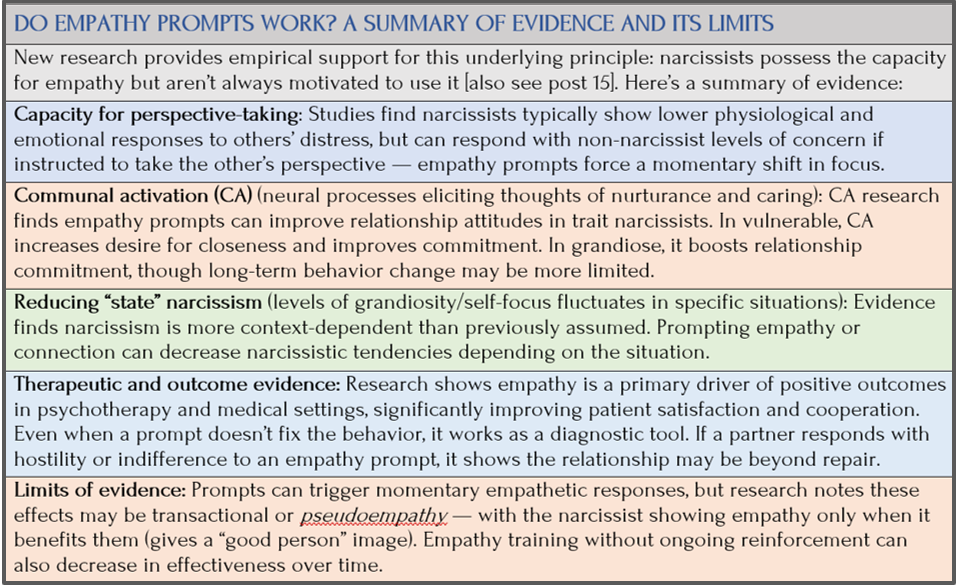
I’m all in on Malkin’s empathy prompts. But do they really work?
Source: Arlin Cuncic, “Can a Narcissist Love? It’s hard to love someone else when you lack empathy,” VeryWell Mind
Challenges in Placing Burden on Non-Narcissist Partners
While Malkin’s approach emphasizes the potential for change in narcissists through empathy prompts and sustained emotional connection, we do need to recognize non-narcissist partners may not be cut out for taking this role. This may be doubly true because narcissists tend to choose partners they more easily dominate. Does that person then have the moxie to guide their narcissist partner from a place of extreme self-involvement toward healthy narcissism?
This journey requires the non-narcissist to continuously prioritize the relationship, handle the push-pull of the relationship with calm aplomb, and initiate vulnerable conversations, which can be emotionally taxing and easily rejected. I don’t know the answer.
Nothing encourages me more than believing narcissists aren’t impervious to empathy, and we can even cajole them toward the spectrum’s center. But even Malkin knows there’s a point where it won’t work. If a partner isn’t willing to change, doesn’t “get” empathy or its prompts, or consistently uses coercive tactics (gaslighting or extreme control), the better choice is to leave the relationship.
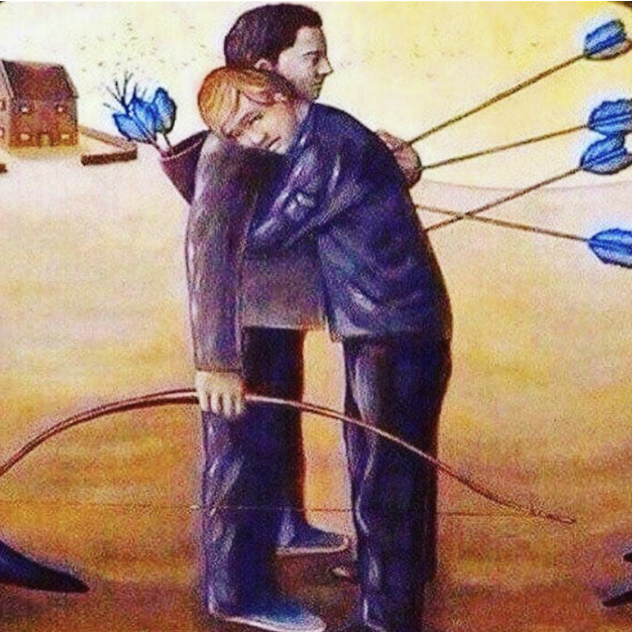
Katie Butler, “Close to You,” acrylic on canvas. From “The Harm of Partnering with a Person with Narcissistic Personality Disorder,” Grandi & Associates

Coming Up Next
Crazy to think I could cover love with a narcissist in a single post. In Post 24: Romantic Love with a Narcissist — Part II, I’ll press on and continue to see whether there’s a way to end the pain and suffering of being ensnared in a relationship where one of us wants to sap the life spirit out of the other.
 English