
Narcissism and the Rest of Us
Show Table of Contents
INTRODUCTION
NARCISSISM DEFINED
2. Is There a Narcissist in Your Life?
3. Narcissus and the Origins of Narcissistic Thought — Part I
4. Narcissus and the Origins of Narcissistic Thought — Part II
5. Narcissus and the Origins of Narcissistic Thought — Part III
NARCISSISTIC DEFENSES
6. A Narcissist’s Self-Defense — Part I
7. A Narcissist’s Self-Defense — Part II
8. A Narcissist’s Self-Defense — Part III
NARCISSIST PERSONALITY DISORDER VS TRAITS
9. When Narcissism is a Personality Disorder
10. Narcissism and the Maladaptive Umbrella
11. Malignant Narcissism and the Narcissism Spectrum
12. When Narcissism is Compounded by Comorbidity
NURTURE VS NATURE
15. Narcissism: Flipping Self-Esteem on its Head
16. The Double-Edged Sword of Grandiose Narcissism
NARCISSISM’S DARK SIDE
19. Narcissistic Rage and Narcissistic Self-Awareness
20. Trait Narcissism and the Illusion of Control
21. Beyond Narcissism: Dark Personality Traits — Part I
22. Narcissist Sociopaths: Dark Personality Traits — Part II
ROMANTIC LOVE AND BOUNDARY-SETTING WITH A NARCISSIST
23. Romantic Love with a Narcissist — Part I
24. Romantic Love with a Narcissist — Part II
25. The Narcissist’s Non-Apology Apology
26. Boundary-Setting with Narcissists — Part I
27. Boundary-Setting with Narcissists — Part II
28. Boundary-Setting with Narcissists — Part III
29. Shattering Narcissus’ Mirror… So They Can Live
CONCLUSION
30. On Narcissism: What About the Rest of Us?
3. Narcissus and the Origins of Narcissistic Thought — Part I

John William Waterhouse, Echo and Narcissus (detail), 1903, of Ovid’s Metamorphoses. Walker Art Gallery, Liverpool, UK
Most of us recognize the image from Greek mythology of Narcissus, a beautiful young man staring into a pool of water at his own reflection. As the myth goes, Narcissus was so obsessed with his reflected image he could not stop staring, neither eating nor drinking until he died. Yet, narcissism as a psychological term was only coined in the late 19th century. Between the ancient Greeks and Freud, however, writers and artists were riveted by the concept of a tragic flaw and probed the effect of self-love on others in their work.
In the Roman poet Ovid’s epic Metamorphoses, Narcissus was the beautiful son of the river god Cephissus and the nymph Liriope. The gods told his parents Narcissus would have a long life if he didn’t look at himself.
But Narcissus rejected all those who fell in love with him, including the nymph Echo, who could only repeat other’s words. Upset at being rejected, Echo withdrew from life and wasted away until only a whisper was left. Her prayers were heard by the goddess Nemesis, who doomed Narcissus to fall in love with his reflection. We know how that turned out. A narcissus flower grew where he died.
Echo clearly showed a deficit in self-regard, which weakened her self-identity and ability to express her needs and desires. Narcissus, with his overwhelming yearning for self-regard over all else, becomes completely isolated from his surroundings, as described by psychotherapist/ Harvard Medical School lecturer Craig Malkin, and author of Rethinking Narcissism (2015).
In the early 1800s, the English Romantic poet, Lord Byron (1788-1824), described how, “‘Self-love forever creeps out, like a snake, to sting anything which happens … to stumble on it.”
A generation later, French Symbolist poet/critic Charles Baudelaire (1821-1867) wrote, “‘as vigorous a growth in the heart of natural man

Portrait of Lord Byron, painting by Thomas Phillips
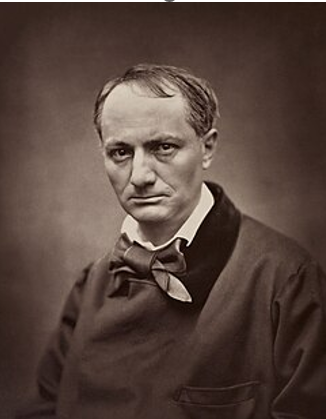
Charles Baudelaire, 1862, photograph by Étienne Carjat
as self-love,’” and “those who ‘like Narcissuses of fat-headedness … are contemplating the crowd, as though it were a river, offering them their own image.’”
By mid-19th-century, writers used egotism for narcissistic self-absorption. Nathaniel Hawthorne wrote, “‘Egotists … made acutely conscious of a self, by the torture in which it dwells.’”
A famous literary example of narcissism is captured in the 1890 novel, The Picture of Dorian Gray, by Irish poet, playwright, novelist, and critic Oscar Wilde (1854-1900). Under Lord Henry Wotton’s evil influence, Dorian Gray is obsessed by his beauty, youth, and pleasure-seeking. The plot twist is while Dorian remains youthful and innocent looking, his portrait “ages,” revealing a “grotesque reflection of his inner corruption.” Dorian hides the portrait in his attic, but it continues to torment him.
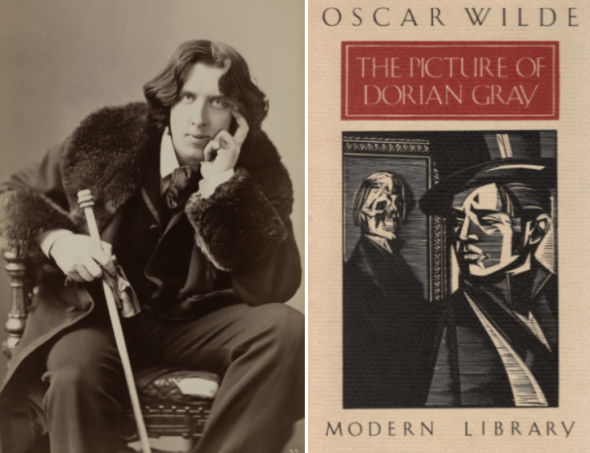
Oscar Wilde, photography by Napoleon Sarony, 1882, Wikipedia; a cover of The Picture of Dorian Gray
According to Wikipedia [the main source for this post], Wilde highlights the “dangers of unchecked vanity and the consequences of prioritizing appearance over morality.” Like Narcissus, Dorian Gray is:
- Obsessed with his beauty and youth at the cost of his humanity.
- Self-absorbed and lacking in empathy, without regard for his action’s impact on others.
- Superficial, lacking insight, valuing pleasure, judging others for appearance or status.
We still value Ovid’s Narcissus with its implications for balancing self-esteem and empathy — and for how a healthy childhood allows for deep and meaningful relationships later on.
Shattering Narcissus’ Mirror So He Can Live
Separating the narcissist from their mirror so they can live a richer, more fulfilling life is a riveting, relatively short history of narcissism theory and treatment. The story begins in 1889, when two physicians — independently of one another — refer to narcissism in comparing those treating their own bodies like a sexual object (“narcissism”) to how others treat a sexual partner’s body (“normal”). According to NCBI/NIH and Wikipedia, German psychiatrist Paul Näcke (1851-1913) saw narcissism as an all-consuming, lifelong perversion. English psychiatrist Henry Havelock Ellis (1859-1939) — described as a eugenicist, progressive intellectual, and social reformer who studied human sexuality — used the term to describe his patients’ behavior.
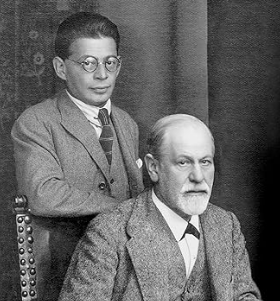
Otto Rank and Sigmund Freud. From Robert Kramer, Otto Rank and the Creation of Modern Psychotherapy.
In his 1905 book Three Essays on the Theory of Sexuality, Sigmund Freud coined narcissistic libido, “solidifying its place in psychoanalysis.” In 1911, Freud publisher, Austrian psychoanalyst/ philosopher Otto Rank (1884-1939), wrote the first clinical paper on narcissism as an explanation for excessive vanity and self-admiration.
Freud’s lifelong friend and official biographer, Welsh neurologist/psychoanalyst Ernest Jones (1879-1958), quoted Freud as saying in 1909 that “narcissism was a necessary intermediate stage between autoerotism and object-love.”[Object is psychology’s term for anyone or anything outside of oneself.] The next year, in Leonardo, Freud described how “the growing youngster…finds his love objects on the path of narcissism, since Greek myths call a youth Narcissus, whom nothing pleased so much as his own mirror image.” In 1914, Freud published his first major exploration, “On Narcissism: An Introduction.”
In 1911, Freud publisher, Austrian psychoanalyst/philosopher Otto Rank (1884-1939), wrote the first clinical paper on narcissism as an explanation for excessive vanity and self-admiration.
Freud’s lifelong friend and official biographer, Welsh neurologist/ psychoanalyst Ernest Jones (1879-1958), quoted Freud as saying in 1909 that “narcissism was a necessary intermediate stage between autoerotism and object-love.” [NOTE: Object is the psych term for anyone or anything outside of oneself.] The next year, in Leonardo, Freud described how “the growing youngster … finds his love objects on the path of narcissism, since Greek myths call a youth Narcissus, whom nothing pleased so much as his own mirror image.” In 1914, Freud published his first major exploration, “On Narcissism: An Introduction.”
The God Complex
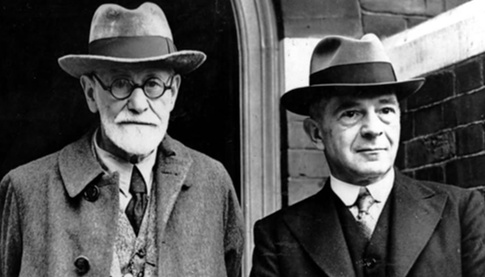
Sigmund Freud and Ernest Jones, England, 1938, Freud Museum, London
In his highly influential 1913 essay, “The God Complex,” Jones described narcissism as a character flaw. He coined the term to describe patients showing excessive self-admiration, belief in their superiority (while disregarding others’ feelings or needs), uniqueness (hating to be compared to others), and infallibility — traits aligned with later criteria for narcissistic personality disorder (NPD).
The First Documented Real-Life Narcissus
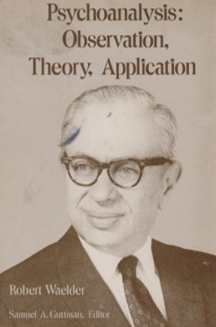
Robert Waelder. Photo: Biblio.com
In 1925, Austrian psychoanalyst Robert Waelder (1900-1967) — a noted member of the Vienna Psychoanalytic Society, who studied under Anna Freud and wrote on psychoanalysis and politics — published the first case report of pathological narcissism and described it as a narcissistic personality. The patient he wrote about, according to Wikipedia, was a “successful scientist with an attitude of superiority, an obsession with fostering self-respect, and a lack of normal feelings of guilt. The patient was aloof and independent from others and had an inability to empathize with others’ situations, and was selfish sexually. Waelder’s patient was also overly logical and analytical and valued abstract intellectual thought (‘thinking for thinking’ sake) over the practical application of scientific knowledge.” Waelder’s early work influenced how narcissism is defined today.
Freud’s Primary and Secondary Narcissism
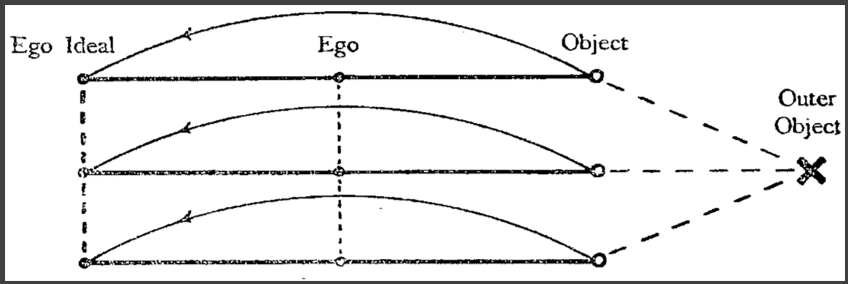
This original illustration shows a primay group of three individuals who have substituted the same object for their ego ideal and have consequently identified themselves with one another in their ego. Sigmund Freud, Group Psychology and the Analysis of the Ego, 1921, Wikipedia Commons
Freud saw “exclusive self-love” as part of the human psyche, calling narcissism “the libidinal complement to the egoism of the instinct of self-preservation.” His primary narcissism — later commonly called infantile narcissism — sees healthy ego formation as “interrupted” by parents socializing their child to the outside world. From that point on, the heathy ego evolves as it distances itself from primary narcissism, forming an ego-ideal (image of perfect self) and investing strong emotional energy in outside objects, ideas, others (Freud called this cathexis).
Freud’s work found ego-libido (self-love) to be nearly the same as object-libido (object-love).
What’s crucial here is sharing self-love with someone lessens ego -libido for protecting and nurturing self. This means we learn as young children our need for protection and nurturing doesn’t solely depend on self-love. Plus, when that someone returns our love and affection, they restore our libido and self-worth. We don’t lose libido by sharing love with someone, but instead gain a strong sense of ourselves (self-worth) and learn empathy.
Freud focused his attention on this pivotal moment in a child’s young life — when they transition from primary narcissism to a healthy form of narcissism — because it powers them through life. This also explains unhealthy narcissism, at least in Freud’s telling, because when love isn’t returned for myriad of reasons personality development is stunted.
Secondary narcissism occurs when libido is withdrawn from external objects (people), especially the mother, causing an unhealthy relationship with daily life and potential for megalomania (form of grandiose delusion). For Freud, while both primary and secondary narcissism emerge in normal human development, problems arise in transitioning from one to the other—potentially leading to pathological narcissistic disorders in adulthood. Disrupting or failing to achieve this balance disturbs the psyche. Now, instead of pursuing object-love and drawing psychic energy from others, the child withdraws object-love as a toxic defense strategy to restore primary narcissism/ego-libido.
Understanding Freud’s concepts is almost like understanding poetry. Impossible the first time through, but by the time the poem is nearly memorized its wisdom and heart are in full bloom.
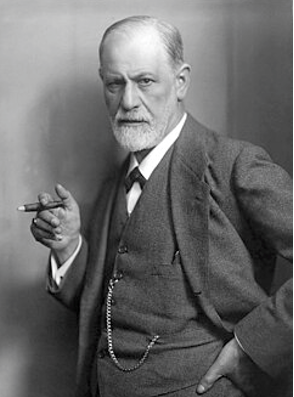
Sigmund Freud, photograph by Max Halberstadt, 1914. Wikipedia
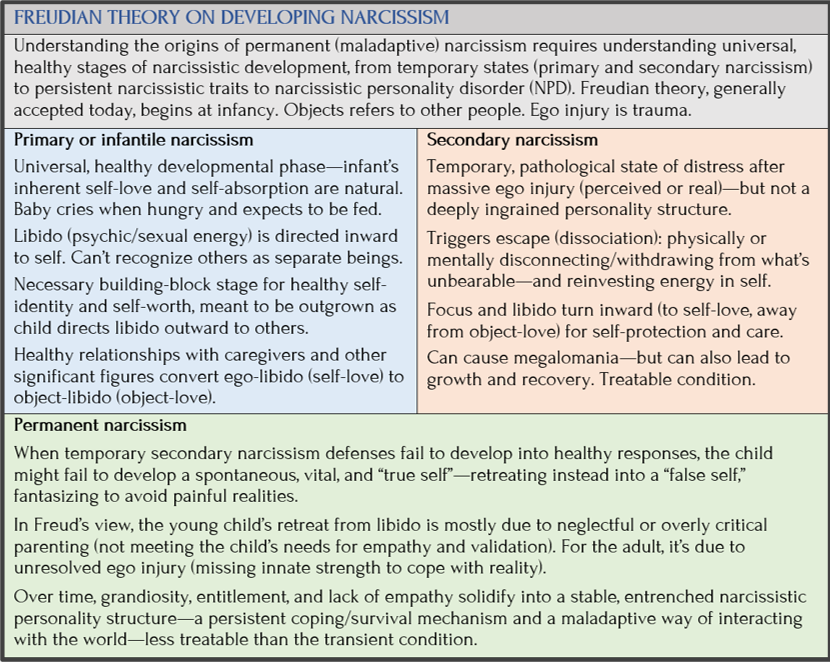
Sources: Courtney Telloian, “How to Identify Different Types of Narcissism,” PsychCentral; Carrie Barron, MD, “Secondary Narcissism as a Temporary State, Psychology Today; Wikipedia
Clarification on Secondary Narcissism
In contrast to primary, secondary narcissism can only develop once the young child can form attachments to external objects (people, places, or things) as a response to experiencing traumatic pain (ego injury), disappointment, harsh criticism, rejection, or envy (unconscious or conscious). In defensive mode, older children or teens might react to ego injury by withdrawing from all social interactions and relationships, becoming increasingly isolated, detached, and self-preoccupied (in Freud’s concept, the libido reverts to self, from outward-facing to internalized).
Outward grandiosity and superiority are some of the ways they cover over feeling vulnerable, ashamed, inadequate, or distressed. In more extreme and dysfunctional cases, this pattern of behavior can involve severe defensive strategies (denial, projection, excessive self-control, repression, or dysregulation), and relationship problems. When the traits become pervasive and inflexible, they may indicate NPD.
Indulgence vs Deprivation
In sum, Freud’s theory of pathological narcissism is rooted in a profound sense of deprivation — resulting in megalomania (grandiose delusion) — the narcissist’s defense mechanisms against constant criticism, abuse, neglect, or trauma as they seemingly face a cold, hostile world.
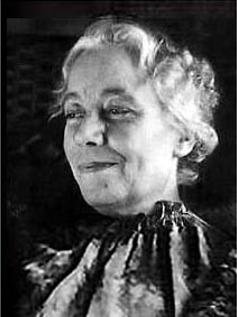
In contrast, German-American psychoanalyst Karen Horney (1885-1952) saw narcissism as self-idealization caused by indulgence, not deprivation. She rejected Freud’s idea of primary narcissism, with inherent narcissistic needs and tendencies. In her view, child narcissism is intensified by how their early environment affects their particular temperament and reinforces narcissistic behaviors. Their self-esteem is weak because excessive admiration doesn’t match actual achievement.
Photo: Karen Horney. Wikipedia
Who’s right?
As with many historical debates, elements of both theories stand up today. Deprivation and indulgence can each contribute to development of narcissistic traits and to different subtypes on the narcissism spectrum [see post 11]. Deprivation correlates with a more vulnerable subtype, marked by insecurity, hypersensitivity, deep sense of worthlessness, and need for constant external validation. Indulgence is more associated with a grandiose subtype, marked by entitlement, inflated ego, and a belief in one’s own superiority. Upcoming posts discuss more recent research indicating a complex interplay of genetic and environmental factors. Like all histories of psychiatric conditions, the story parallels the history of psychiatric thought itself—and the increasing reliance on modern neurobiology and clinical research for answers.
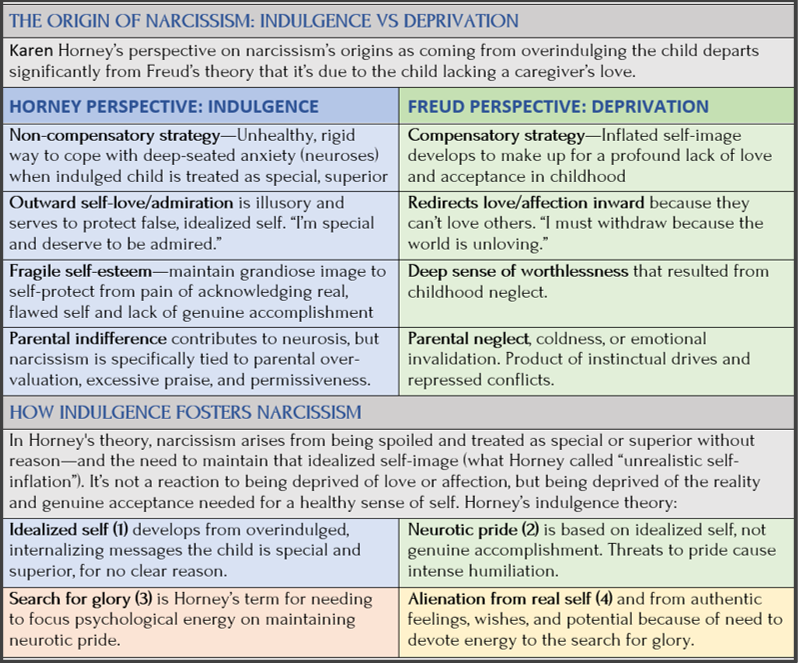
Sources: Clinical psychologist Helen, “A Comparative Analysis of Freud and Horney’s Theories,” Medium; Wikipedia
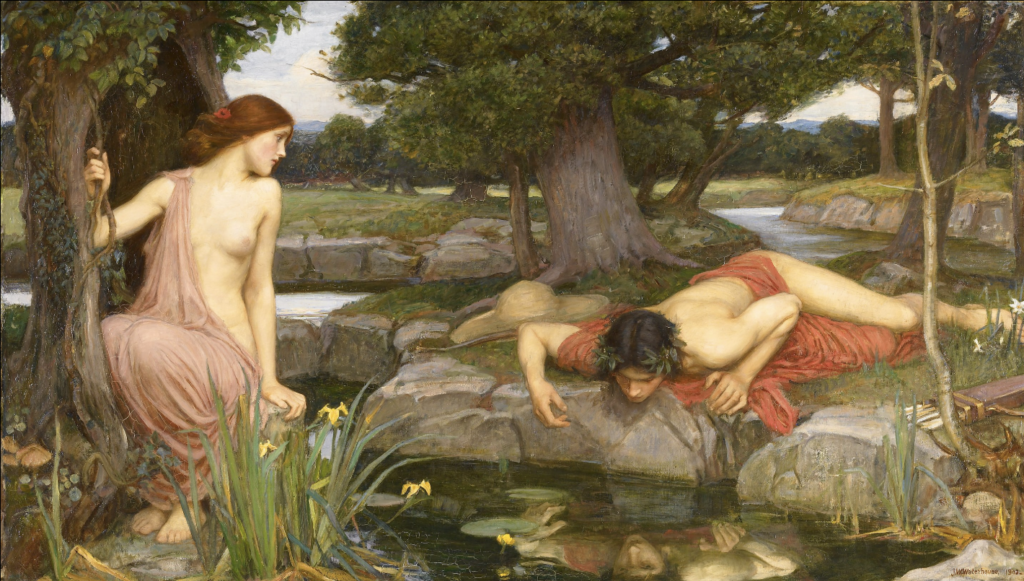
John William Watterhouse, Echo and Narcissus, 1903, oil painting. Walker Art Gallery, Liverpool
Coming Up Next
In all, I’m devoting three posts to this mini-history of narcissism. I find the century-plus attempts by exceptional thinkers to understand what formed us — the good, the bad, the ugly — furthers understanding of just how deeply rooted our personalities are. We’re no match for the freight heaped on our tiny infant shoulders: the genetic baggage, the environmental baggage, the emotional baggage. It’s no wonder we founder and pollute the air as our train chugs along the tracks — at least until we find more streamlined approaches to advancement.
Post 4: Narcissus and the Origins of Narcissistic Thought — Part II begins on the eve of narcissism’s formal recognition as a psychiatric disorder, published in the American Psychiatric Association’s 1980 Diagnostic and Statistical Manual of Mental Disorders, third edition (DSM-3). Freudian theory provided a foundation for everything that followed, whether by those building on his theories or breaking from them. I intend these posts to set the stage to think about what forms and affects us, specifically the whys and the wherefores of narcissism.
 English