Narcissism and the Rest of Us
Show Table of Contents
INTRODUCTION
NARCISSISM DEFINED
2. Is There a Narcissist in Your Life?
3. Narcissus and the Origins of Narcissistic Thought — Part I
4. Narcissus and the Origins of Narcissistic Thought — Part II
5. Narcissus and the Origins of Narcissistic Thought — Part III
NARCISSISTIC DEFENSES
6. A Narcissist’s Self-Defense — Part I
7. A Narcissist’s Self-Defense — Part II
8. A Narcissist’s Self-Defense — Part III
NARCISSIST PERSONALITY DISORDER VS TRAITS
9. When Narcissism is a Personality Disorder
10. Narcissism and the Maladaptive Umbrella
11. Malignant Narcissism and the Narcissism Spectrum
12. When Narcissism is Compounded by Comorbidity
NURTURE VS NATURE
15. Narcissism: Flipping Self-Esteem on its Head
16. The Double-Edged Sword of Grandiose Narcissism
NARCISSISM’S DARK SIDE
19. Narcissistic Rage and Narcissistic Self-Awareness
20. Trait Narcissism and the Illusion of Control
21. Beyond Narcissism: Dark Personality Traits — Part I
22. Narcissist Sociopaths: Dark Personality Traits — Part II
ROMANTIC LOVE AND BOUNDARY-SETTING WITH A NARCISSIST
23. Romantic Love with a Narcissist — Part I
24. Romantic Love with a Narcissist — Part II
25. The Narcissist’s Non-Apology Apology
26. Boundary-Setting with Narcissists — Part I
27. Boundary-Setting with Narcissists — Part II
28. Boundary-Setting with Narcissists — Part III
29. Shattering Narcissus’ Mirror… So They Can Live
CONCLUSION
30. On Narcissism: What About the Rest of Us?
14. The Nature of Narcissism

Photo: Shutterstock
Genetic and neurobiological research is ripe for exploration. Even though the research base is somewhat limited, more studies reveal the likelihood of inheritable genetic factors and differences in the structure and function of brains belonging to narcissists vs non-narcissists. We’re newly understanding how these factors influence personality traits and behavior, and the implications for treatment are wide open.
I’ll cite a lot of research studies. This is not intended to be a comprehensive meta-look, but a sampling. The findings should all be read as suggestive and promising for future research.
Genetics
International research over 15 years reveals a genetic component to narcissism in 37%-77% cases among study subjects. Researchers acknowledge the role of inherited personality traits, but also agree results are not yet definitive. In “Is Narcissism Genetic? Here’s What the Data Show,” Charlie Health, Rasna Kauer Neelam, MD, summarizes of three genetic “twins” studies:
- 1996 Canadian study, comparing personality traits in 500 sets of identical or fraternal twins, showed narcissism to have a “heritability score” of 53% in study subjects.
- 2007 twin study in U.S./Canada of the genetic component of the dark triad (narcissism, Machiavellianism, psychopathy) determined a 59% genetic effect on narcissism.
- 2008 study in Norway of 3,000 twins examined all 10 personality disorders listed in DSM-4, finding 33% of NPD had a genetic basis; the rest were caused by environmental influence.
In his Time article, Jeffrey Kluger cites:
- 2014 study in China, showing identical twins shared more grandiosity and entitlement than fraternal twins or other siblings.
- Other studies comparing adopted to biological children also pointed to heritability, with biological children sharing more of their parents’ narcissistic behavior than those adopted.
Though statistically significant given the large number of participants, the results are hard to interpret because they use different questionnaires and metrics to interpret the data.
Some narcissistic traits are more heritable than others. Wikipedia cites environmental and genetic factors associated with traits as largely unique and non-overlapping. In two studies:
- Grandiosity had a 23% heritability, compared to a 35% maladaptive entitlement score.
- Grandiosity/dominance was 37% heritable, compared to a 44% score for maladaptive/ antagonistic traits.
Neurobiology

Photo: Shutterstock
Through the lens of neurobiological research, science can look at the mind-brain-body connection in narcissism and gain a deeper understanding of how it contributes to narcissistic traits. Narcissism brain research is fairly new, advancing largely due to increasingly sophisticated brain-imaging technology.
Cleveland Clinic notes narcissists often have subtle brain differences, but experts aren’t sure if brain differences cause NPD or vice versa (NPD causes brain differences).
NPD often shows up in the teens or early adulthood. Research estimates .5%-5% of people in the U.S. may have it, with 50%-75% of these cases affecting males. These estimate are rough, since people hide their narcissism
Narcissism is a personality trait that in the extreme can be a psychological disorder. It involves an excessively positive focus on the self in combination with an extremely low regard for others…. This is consequential: narcissists have difficulties in maintaining healthy relationships, and they also tend to be hostile and aggressive. Despite a strong current understanding of behavioral characteristics associated with narcissism, little is known about the underlying neural mechanisms involved, especially with respect to responses to potential threats such as social exclusion. —Christopher Cascio, et al., “Narcissists’ social pain seen only in the brain,” PubMed/NIH
Through brain imaging, studies link narcissistic traits to structural and functional brain networks, but findings are inconsistent. A 2023 Scientific American article noted, despite promising findings, the neuroscience of narcissism is still in its early stages due to small sample sizes and sometimes contradictory results.
General neurocognitive studies show connectivity between brain regions to be as important as each specific region. In narcissism, certain brain regions in association with increased neural connectivity may reinforce narcissistic traits.
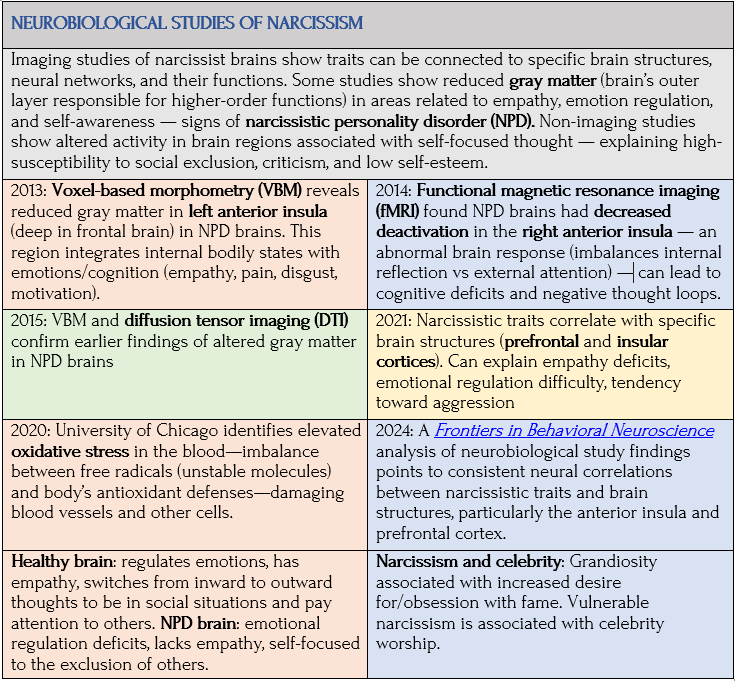
Sources: Wikipedia, Christopher Cascio, et al., “Narcissists’ social pain seen only in the brain,” PubMed/NIH; Igor Nenadić, et al., “Narcissistic personality traits and prefrontal brain structure,” Nature; Sidney Ash, et al., “Neural Correlates of Narcissism: Is There a Connection with Desire for Fame and Celebrity Worship? PubMed/NIH
Research comparing scans of NPD/non-narcissist brain structures and functional changes implies findings, but again the evidence is far from definitive.
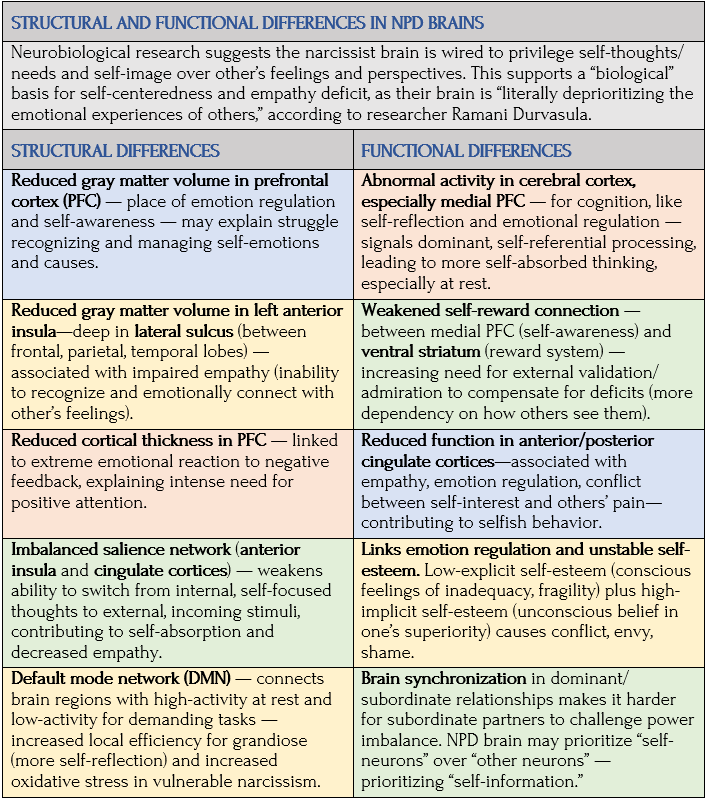
Sources: Wikipedia; Igor Nenadić, et al., “Narcissistic personality traits and prefrontal brain structure,” Nature; Emanuel Jauk and Philipp Kanske, “Can neuroscience help to understand narcissism? A systematic review of an emerging field,” PubMed/NIH
Coming Up Next

Post 13 and post 14 provided quick overviews of recent research on environmental (nurture) and genetic/neurobiological risk factors (nature) for narcissism. In Post 15: Narcissism: Flipping Self-Esteem on its Head, I’ll leave the nature-nurture research to discuss the latest research into narcissism’s thin relationship to healthy self-esteem.
 English