Narcissism and the Rest of Us
Show Table of Contents
INTRODUCTION
NARCISSISM DEFINED
2. Is There a Narcissist in Your Life?
3. Narcissus and the Origins of Narcissistic Thought — Part I
4. Narcissus and the Origins of Narcissistic Thought — Part II
5. Narcissus and the Origins of Narcissistic Thought — Part III
NARCISSISTIC DEFENSES
6. A Narcissist’s Self-Defense — Part I
7. A Narcissist’s Self-Defense — Part II
8. A Narcissist’s Self-Defense — Part III
NARCISSIST PERSONALITY DISORDER VS TRAITS
9. When Narcissism is a Personality Disorder
10. Narcissism and the Maladaptive Umbrella
11. Malignant Narcissism and the Narcissism Spectrum
12. When Narcissism is Compounded by Comorbidity
NURTURE VS NATURE
15. Narcissism: Flipping Self-Esteem on its Head
16. The Double-Edged Sword of Grandiose Narcissism
NARCISSISM’S DARK SIDE
19. Narcissistic Rage and Narcissistic Self-Awareness
20. Trait Narcissism and the Illusion of Control
21. Beyond Narcissism: Dark Personality Traits — Part I
22. Narcissist Sociopaths: Dark Personality Traits — Part II
ROMANTIC LOVE AND BOUNDARY-SETTING WITH A NARCISSIST
23. Romantic Love with a Narcissist — Part I
24. Romantic Love with a Narcissist — Part II
25. The Narcissist’s Non-Apology Apology
26. Boundary-Setting with Narcissists — Part I
27. Boundary-Setting with Narcissists — Part II
28. Boundary-Setting with Narcissists — Part III
29. Shattering Narcissus’ Mirror… So They Can Live
CONCLUSION
30. On Narcissism: What About the Rest of Us?
17. The Happy Narcissist

Photo: iStock
Early posts described how each of us passes through a healthy narcissistic state, from infancy through toddlerhood. Some of us advance from that self-absorbed state to one that’s balanced between our own needs and the needs of others, building a sense of self-worth, self-confidence, and empathy. But others of us get stuck in that state, which Freud called primary narcissism. Typically triggered by something big—mostly a dysfunctional relationship with our parent or caregiver — we enter into a temporary, secondary narcissistic state, which before long fixes into a permanent form of narcissism. The strength or severity of the narcissistic state is highly varied and individual, with most carrying traits for life and some smaller percentage developing a disorder.
That’s the theoretical fork in the road — the basis for thinking about the “nurture” side of the “nature-nurture” debate. Psychologist Craig Malkin advocates for a degree of narcissism as good for us. I’m curious not only about when healthy narcissism tips over to pathology, but also if pathology is treatable.
I started this blog with sharing the story of my relationship to a mother with narcissistic tendencies, though undiagnosed (I should add I’m in the minority in believing this assessment), and my fears my son with bipolar disorder has adopted some unhealthy narcissistic defenses as his coping mechanism. It’s not clear to what degree any of us can recognize these patterns, attempt to hold onto aspects that are healthy — and diminish behaviors of what is not.
Understanding healthy narcissism helps us look again at trait narcissism (grandiose and vulnerable comprising the majority). I quote Shortform’s summary of Craig Malken’s 2015 book, Rethinking Narcissism:
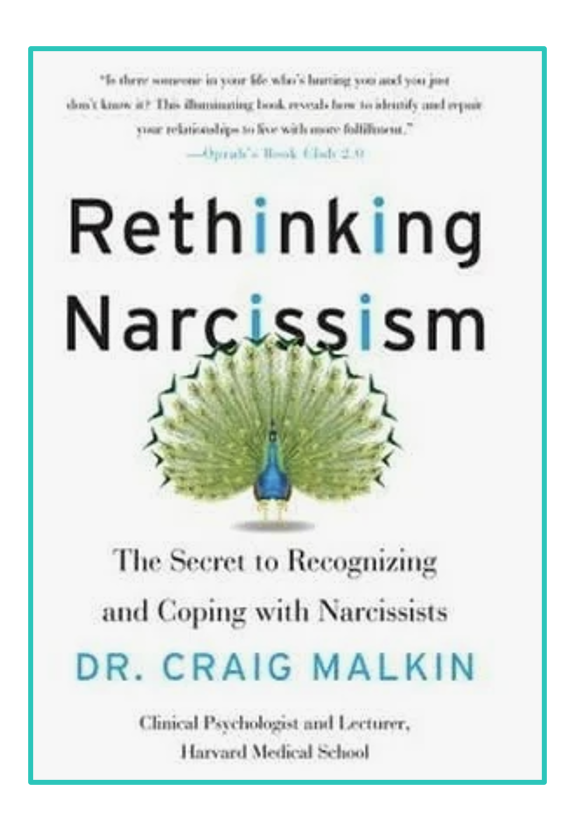
Malkin illustrates the spectrum of narcissistic behaviors, with its advantageous and harmful variations, by referencing the tale of Narcissus … alongside Echo … whose predicament exemplifies a pronounced deficit in self-regard, which leads to a profound weakening of her self-identity and a persistent struggle to express her personal desires and requirements. Narcissus symbolizes a point on the spectrum where an overwhelming yearning for distinctiveness overshadows everything else, culminating in a deep sense of isolation from his surroundings.
Malkin suggests an equilibrium within this spectrum, where a person’s self-awareness and their engagement with others harmonize, indicating a healthy form of self-regard. We can recognize our own abilities and aspirations while simultaneously being considerate of the emotions and requirements of others. The display of traits associated with narcissism is dynamic, varying throughout our lifetime, influenced by the stages we go through, significant occurrences, and specific situations. Recognizing that narcissism is not an immutable characteristic fosters hope for change and encourages us to approach ourselves and others with a greater sense of compassion and understanding. —Craig Malkin, Rethinking Narcissism, 2015, summarized by Shortform

I found inspiration in this quote. It made me hopeful for my son and every other person who hasn’t easily adjusted to life’s pressures. Some resort to narcissistic defense strategies to get their needs met and cover over self-loathing and low self-esteem. Others succumb to their resentments and anger — the abused becoming abusers, much like schoolyard bullies who were badly mistreated by their parents. Malkin’s take on narcissism gives me insight into the benefits of narcissistic tendencies when negative impulses are held in check.
Photo: Adobe
Some Positive Notes
“The concept of excessive selfishness has been recognized throughout history. Since then, narcissism has become a household word; in analytic literature, given the great preoccupation with the subject, the term is used more than almost any other.“ [Wikipedia]
The meaning of narcissism has changed over time. Today narcissism “refers to an interest in or concern with the self along a broad continuum, from healthy to pathological … including such concepts as self-esteem, self-system, and self-representation, and true or false self. Just like the myth of Narcissus, narcissism gets associated with physical vanity and self-absorption, with manipulation, insincerity, and poor empathy.” But it goes deeper than that. According to DSM-5 guidelines, narcissism can also be about traits and abilities like “intelligence, charisma, artistic skill, athletic ability, wealth, power, and success.”
It’s hard to know when narcissism on a spectrum crosses the line from healthy to pathological. But, since we all start out as baby narcissists, it’s clearly a healthy developmental milestone. With strong attachments and positive acculturation in our social environments, healthy narcissism guides us to achieve in relationships, education, and work. Individuals with healthy narcissistic traits have stronger relationships and reduced social anxiety. They tend to possess:
- Increased self-confidence, assertiveness, and a strong sense of self-worth gives rise to ambition and a strong drive for professional and financial success.
- Greater life satisfaction and reduced anxiety and depression, according to research
- Improved social skills and relationships, enhanced by narcissistic charm and charisma.
- Resilience, mental toughness, and the ability to cope with stress more effectively–crucial ingredients in life satisfaction and achievement.
The positive aspects of narcissism are most evident when present in healthy, moderate levels. When excessive, narcissism becomes unhealthy and then the problems begin — in relationships and in work and social interactions. It’s subjective to distinguish when that happens, before it’s detrimental to individuals and those around them. Narcissism’s impact varies significantly from person to person. Some individuals may benefit from certain narcissistic traits, while others may experience only the negative consequences
Our Drive to Feel Special
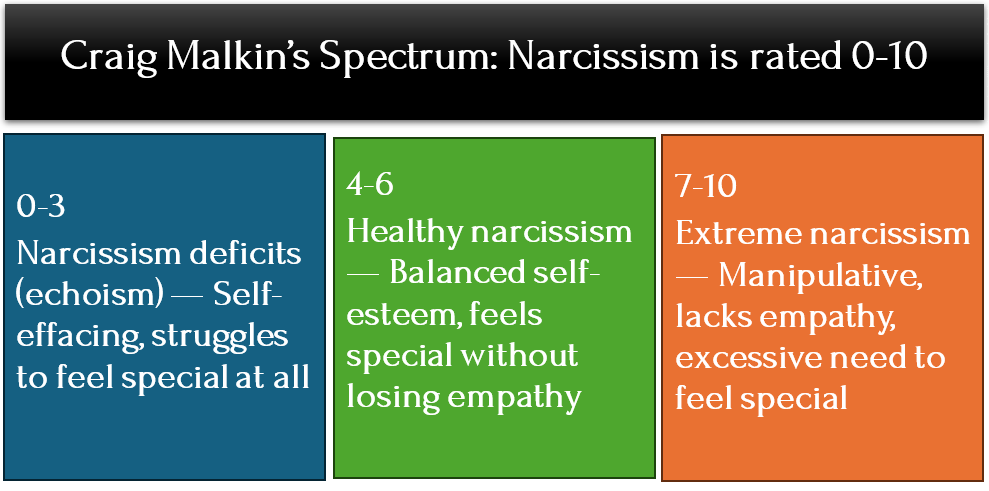
Picture the narcissism spectrum. Do you see healthy narcissism at one end and narcissistic personality disorder (NPD) at the other? Now picture echoism at one end of the spectrum, NPD at the other end — and, in the middle, healthy narcissism. This is Malkin’s work. He wrote, “Danger lurks toward the ends of the narcissism spectrum.” The main thesis of Rethinking Narcissism is much of narcissism isn’t “all bad” and what’s most important is balance. An individual can harness the positive aspects of narcissism to achieve personal success, deeper connections with others, and happiness.
Narcissism can be harmful, true, and the Web is rife with articles and blogs from people who’ve suffered at the hands of extremely narcissistic lovers, spouses, parents, siblings, friends, and colleagues. Their stories are as heartbreaking as they are frightening. But that’s just a small part of narcissism, not the whole picture. —Craig Malkin, Rethinking Narcissism, as summarized by Shortform
Graphic: Jan Swan
Malkin believes healthy or “slightly elevated” narcissism is a normal drive to feel special. He writes, “People who live in the center of the spectrum don’t always take to the stage, but when they do, they often lift others up with them.” He calls healthy narcissism “the sweet spot where self-love and love for others coexist harmoniously” and describes such narcissists as:
- Happier, more creative, more sociable, more physically healthy
- Self-confident without arrogance, able to accept criticism and admit mistakes, more resilient in the face of adversity
- Able to make genuine, reciprocal connections, have empathy, and be interested in others’ success and wellbeing
- Dream big and pursue ambitious goals, achieve great things, be better leaders, enjoy being in the spotlight occasionally
This is more than a happy narcissist. This is a happy person.
The Unhappy Narcissist
I’m not sure how someone exhibiting narcissistic traits maintains this healthy balance without crossing over to pathological narcissism. Malkin identifies the following warning signs of what he calls “subtle narcissists,” who are harder to spot than extreme narcissists:
- Emotion phobia, when narcissists avoid acknowledging their own vulnerabilities, tamping down their empathy for others, acting defensively to emotional topics.
- Emotional hot potato is projecting their feelings onto others (throwing them the hot potato), hurting relationships by turning the victim into the one with the problem.
- Stealth control exerts dominance without making a big show of it, manipulating circumstances to get what they want, causing frustration and resentment in others.
- Pedestal placement: Idealizing others to feel special by association.
- Twin fantasy: Insisting on excessive similarities with others.
Insecure Love
Malkin builds on the theoretic foundation of narcissism as percolating in infancy (based on primary caretaker relations). He writes, “The key childhood experience that pushes children too high or too low on the spectrum is always the same: insecure love.”
By providing secure, loving environments for children and addressing our own narcissistic tendencies, Malkin writes, we promote healthier development across the spectrum. If environmental pressures, abuses, or trauma punish or threaten a child, those children learn to cope in unhealthy ways. Echoists suppress their needs by avoiding burdening others. Extreme narcissists inflate their ego to compensate for feeling unlovable. He cites three key environment factors that make it likely these children will grow into narcissistic adults:
- Parenting styles that are inconsistent/unpredictable, overly permissive/indulgent, or authoritarian/controlling
- Childhood trauma or neglect
- Cultural influences emphasizing individualism or fame
Coming Up Next

As in my other series, I’ll indulge my fantasy in exploring who among the rich, famous, and powerful have or are perceived to have the mental health condition I’m writing about. With narcissism, however, it’s not an altogether positive framing of a person. So, in Post 18: Famous Narcissist Leader, I’ll keep my examples to a few famous leaders who’ve been perennial media subjects and couldn’t possibly be affected by a bit more unflattering attention.
Sources
 English