Narcissism and the Rest of Us
Show Table of Contents
INTRODUCTION
NARCISSISM DEFINED
2. Is There a Narcissist in Your Life?
3. Narcissus and the Origins of Narcissistic Thought — Part I
4. Narcissus and the Origins of Narcissistic Thought — Part II
5. Narcissus and the Origins of Narcissistic Thought — Part III
NARCISSISTIC DEFENSES
6. A Narcissist’s Self-Defense — Part I
7. A Narcissist’s Self-Defense — Part II
8. A Narcissist’s Self-Defense — Part III
NARCISSIST PERSONALITY DISORDER VS TRAITS
9. When Narcissism is a Personality Disorder
10. Narcissism and the Maladaptive Umbrella
11. Malignant Narcissism and the Narcissism Spectrum
12. When Narcissism is Compounded by Comorbidity
NURTURE VS NATURE
15. Narcissism: Flipping Self-Esteem on its Head
16. The Double-Edged Sword of Grandiose Narcissism
NARCISSISM’S DARK SIDE
19. Narcissistic Rage and Narcissistic Self-Awareness
20. Trait Narcissism and the Illusion of Control
21. Beyond Narcissism: Dark Personality Traits — Part I
22. Narcissist Sociopaths: Dark Personality Traits — Part II
ROMANTIC LOVE AND BOUNDARY-SETTING WITH A NARCISSIST
23. Romantic Love with a Narcissist — Part I
24. Romantic Love with a Narcissist — Part II
25. The Narcissist’s Non-Apology Apology
26. Boundary-Setting with Narcissists — Part I
27. Boundary-Setting with Narcissists — Part II
28. Boundary-Setting with Narcissists — Part III
29. Shattering Narcissus’ Mirror… So They Can Live
CONCLUSION
30. On Narcissism: What About the Rest of Us?
4. Narcissus and the Origins of Narcissistic Thought — Part II
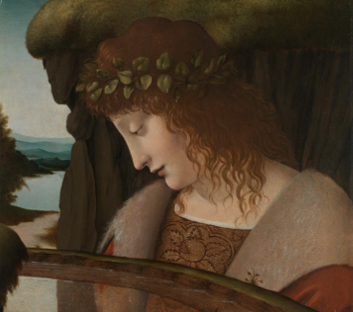
Follower of Giovanni Antonio Boltraffio, Narcissus, ca. 1500, National Gallery UK
Narcissism as a psychiatric condition was recognized by some of the 20th century’s greatest thinkers and theorists for some 80 years before being formally inducted into the psychiatric hall of fame. That happened in 1980, when narcissistic personality disorder (NPD) was included in the American Psychiatric Association’s third edition of the Diagnostic and Statistical Manual of Mental Disorders (DSM-3). The current edition is DSM-5.
During the 1930s-1940s, narcissism slowed down as a course of inquiry. But interest rebounded within the psychoanalytic community in the 1950s — with 1952 an especially banner year:
- French thinker, writer, feminist Simone de Beauvoir (1908-1986), in her 1952 seminal work The Second Sex, discussed how a person’s desire to be viewed as a fixed, objective self is a consequence of consciousness. This idea is rooted in narcissistic behavior, where a person wishes to be recognized by others as having a fixed identity.
- Austrian-American psychiatrist/psychoanalyst Heinz Hartmann (1894-1970), one of the founders of ego psychology, led a team to focus on the ego’s function, including how narcissism helps maintain self-esteem and develop an ego-ideal [see below].
- French psychiatrist, psychoanalyst Pierre Marty (1918-1993), president of the Société Psychanalytique de Paris, presented a paper on the “Narcissistic difficulties presented to the observer by the psychosomatic problem,” published in Revue Française de Psychanalyse.
With the 1952 publication of DSM-1, however, the omission of NPD indicated decades of research and clinical work on narcissism didn’t yet count for a formal diagnosis. In 1968, in preparation for DSM’s second edition (DSM-2), Heinz Kohut termed narcissism and narcissism personality disorder (NPD), though not officially recognized until DSM-3.
Revisiting Freud: Kohut and Kernberg
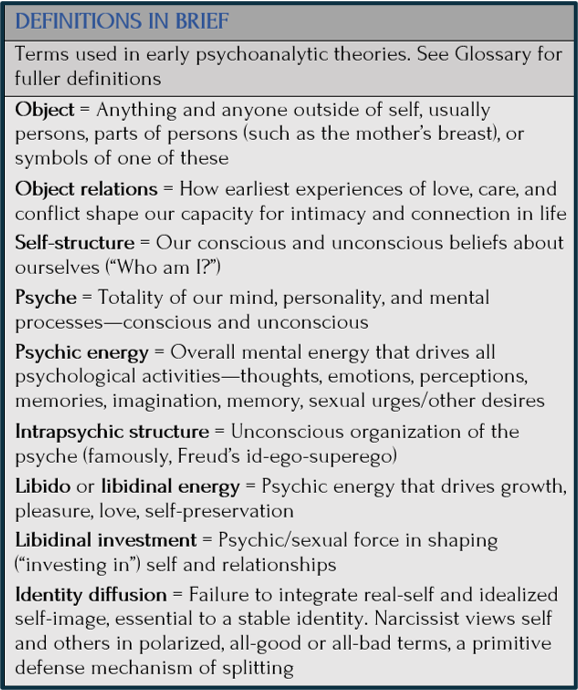
While the psychiatric world was in conflict about narcissism as a disorder, two psychoanalysts revisited and expanded on Freudian theories.
In addition to NPD, Kohut made many enduring contributions to modern understanding. He agreed with Freud that a child fantasizes about having a grandiose self and ideal parents. Kohut wrote that deep down, people believe in the perfection of their self and their environment. As they mature, this grandiosity becomes self-esteem, and parent idealization becomes core values. When trauma disrupts this process, the most primitive, narcissistic version of self remains unchanged — which, as with Freud’s primary and secondary narcissism, can become permanent.
Kohut's self-psychology
Kohut’s expansion of Freudian thinking was a theory and treatment approach called self-psychology. Kohut saw narcissism as developmentally normal, essential to the child’s ability to develop resilience, ideals, and ambition. He revolutionized the understanding of narcissistic development by highlighting the caregiver’s crucial role in providing protection and empathy (healthy) or failing to do so (pathological). Protective caregivers reinforce the child’s positive qualities by acting as empathic role models (Kohut called this empathic attunement). Caregivers need to satisfy the child’s three basic self-object needs — what their developing self requires from others (objects):
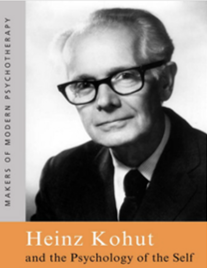
Heinz Kohut, Cobo.com
Otto Kernberg, Wikipedia
- Mirroring: Caregiver affirms child’s worth by reflecting their talents and feelings.
- Idealization: Child regulates their emotions by idealizing the calm, comforting caregiver.
- Twinship/alter ego: Child gains security and feeling they belong by sensing their similarity to their caregiver or other significant figures in their life.
Without caregivers providing this consistent, empathetic feedback, the child grows up with “‘a brittle and flawed sense of self,’” possibly leading to narcissistic pathology. As teens and adults, they may over-rely on others for self-esteem and struggle with insecurity, according to Kohut.
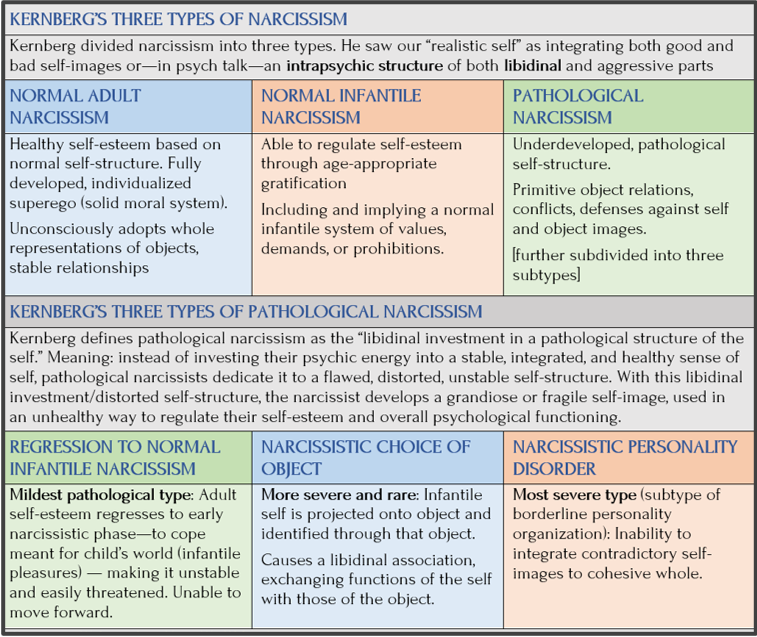
kernberg's typing of narcissism
Austrian-American psychoanalyst/professor at Weill Cornell Medicine, Otto Kernberg (b. 1928) is renowned for theories on pathological narcissism and borderline personality organization (a structural-level description of severe personality disorders). Like Kohut, Kernberg expanded on Freudian theory in seeing primary narcissism as a temporary state that develops the infant’s sense of self and their self-esteem. The caregiver gives the child positive feedback, reinforcing the child’s self-worth and acquiring of positive mental pictures. Infantile narcissism becomes pathological when it fails to develop into a healthy adult form.
Gustave Klimt, Mother and Child, 1905, National Gallery of Modern and Contemporary Art, Rome
Ideal-Ego vs Ego-Ideal
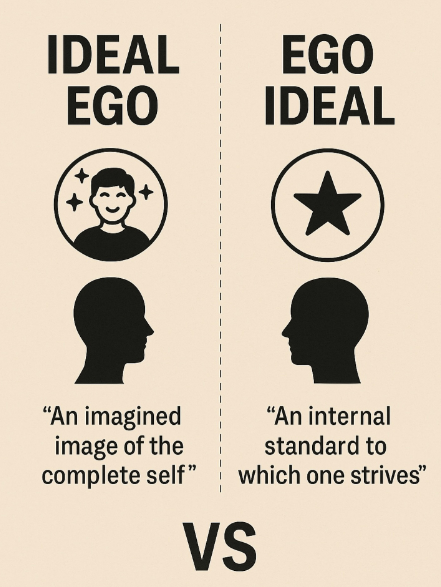
We can’t go further without clarifying a mind-numbing distinction in historical psychoanalytic theory between two seemingly interchangeable terms: ideal-ego and ego-ideal. Freud, who originated ego-ideal (image of the perfect self), used the terms interchangeably. But Kernberg made distinguishing the two essential for understanding his theory on how personality develops — in particular, narcissism.
Here’s a chart comparing terms to help make the distinction memorable:
Source: Instagram
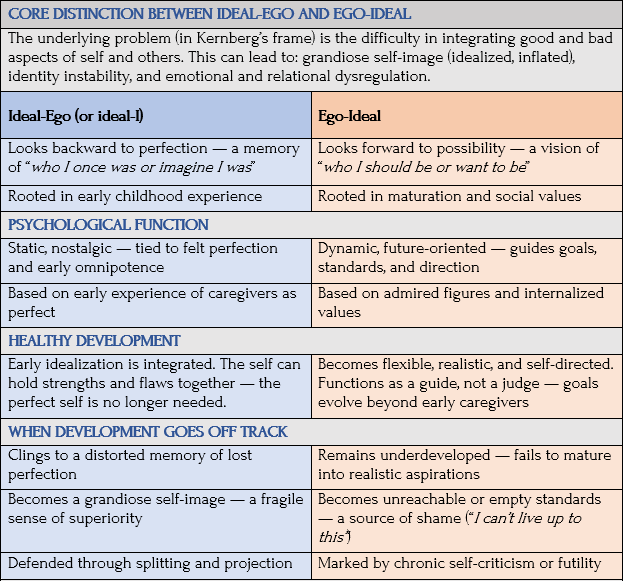
Sources: VeryWellMind, Wikipedia
In Narcissism, the System is Pathologically Altered
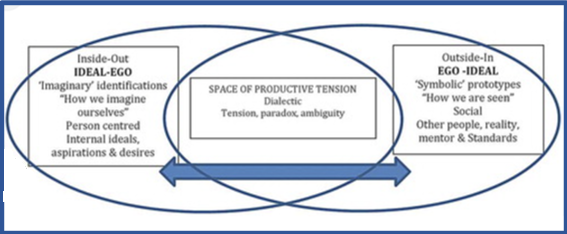
Drawn from teacher development research, but broadly applicable. M. Clarke, et al., “Dialectics of Development: Teacher Identity Formation in the Interplay of Ideal Ego and Ego Ideal,” Teaching Education, Taylor & Francis
This illustration shows how these two ways of organizing the self diverge. These distinctions weren’t always understood in the same way. Kernberg saw the persistence of an idealized, grandiose self as a developmental failure — something that interferes with forming a stable, integrated identity. Kohut, by contrast, viewed early grandiosity as a normal phase, one that could be transformed rather than eliminated. What becomes clearer, especially in light of more recent thinking, is that both were describing different parts of the same process. We don’t live entirely in the past or the future. A stable sense of self develops over time, in the tension between early ideals and the person we are still becoming.
Later Theories
In 1971, Hungarian-French psychoanalyst and narcissism authority Béla Grunberger (1903-2005, living 102 years) focused on the double orientation of narcissism — the need for self-affirmation and for permanent dependency. Because, as Grunberger noted, narcissism is active throughout life, it needs to be treated as an “autonomous factor.”
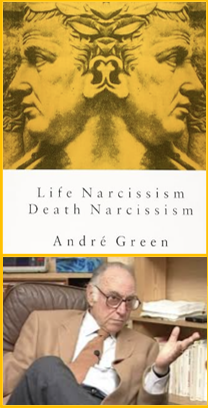
In his 1983 book, Narcissisme de Vie, Narcissisme de Mort, French psychoanalyst André Green (1927- 2012) expanded on Freud’s final theory on narcissistic drives. Green discussed both narcissism’s positive life drives (positive narcissism) and negative, death-giving narcissism (negative narcissism). He clarified the conflict surrounding the object of narcissism (whether real or fantasy) in its relationship to ego. Since narcissism gives the ego a degree of independence, a “‘lethal kind of narcissism must be considered, for the object is destroyed at the beginning of this process.’” In further analysis, “‘Green evokes physical narcissism, intellectual narcissism, and moral narcissism’ — a set of divisions sometimes simplified into that between somatic narcissists (obsessed with the body) and cerebral narcissists (those with an innate feeling of intellectual superiority).
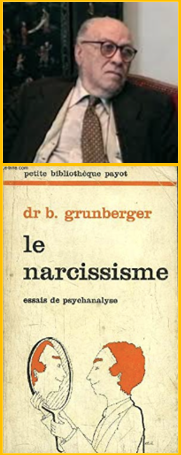
Béla Grunberger, Société psychanalytique de Paris
André Green, Freud Museum, London
Coming Up Next
Post 4: Narcissus and the Origins of Narcissistic Thought — Part III advances the narcissism story as a disruptive twist of personality and character from its origins in our pre-memory childhoods. This is the story of object relations theory and “Unconscious Phantasy,” which still have relevance today.
 English