Narcissism and the Rest of Us
Show Table of Contents
INTRODUCTION
NARCISSISM DEFINED
2. Is There a Narcissist in Your Life?
3. Narcissus and the Origins of Narcissistic Thought — Part I
4. Narcissus and the Origins of Narcissistic Thought — Part II
5. Narcissus and the Origins of Narcissistic Thought — Part III
NARCISSISTIC DEFENSES
6. A Narcissist’s Self-Defense — Part I
7. A Narcissist’s Self-Defense — Part II
8. A Narcissist’s Self-Defense — Part III
NARCISSIST PERSONALITY DISORDER VS TRAITS
9. When Narcissism is a Personality Disorder
10. Narcissism and the Maladaptive Umbrella
11. Malignant Narcissism and the Narcissism Spectrum
12. When Narcissism is Compounded by Comorbidity
NURTURE VS NATURE
15. Narcissism: Flipping Self-Esteem on its Head
16. The Double-Edged Sword of Grandiose Narcissism
NARCISSISM’S DARK SIDE
19. Narcissistic Rage and Narcissistic Self-Awareness
20. Trait Narcissism and the Illusion of Control
21. Beyond Narcissism: Dark Personality Traits — Part I
22. Narcissist Sociopaths: Dark Personality Traits — Part II
ROMANTIC LOVE AND BOUNDARY-SETTING WITH A NARCISSIST
23. Romantic Love with a Narcissist — Part I
24. Romantic Love with a Narcissist — Part II
25. The Narcissist’s Non-Apology Apology
26. Boundary-Setting with Narcissists — Part I
27. Boundary-Setting with Narcissists — Part II
28. Boundary-Setting with Narcissists — Part III
29. Shattering Narcissus’ Mirror… So They Can Live
CONCLUSION
30. On Narcissism: What About the Rest of Us?
6: A Narcissist’s Self-Defense — Part I

Photo: Pixabay
Willful or repressed, narcissists will do most anything to escape detection for not being the strong, superior person they “project” themselves to be. Defensive strategies “mask” their vulnerabilities, fears, failures, or feelings of shame or inadequacy. They may test any number of defenses until finding what works for them.
Experts say narcissistic defenses provide temporary relief but can have extreme negative consequences for narcissists themselves and their family and friends. We know they’re empathy-challenged and often lack genuine connections, but narcissists do a lot of damage to those around them because of their outsized reactions to the normal course of events.
They’re terrors in conflict, they’re mistrusting at best and paranoid at worst, and they blow hot (raging) and cold (emotional distance) hour by hour.
Narcissists make little progress by healthy standards due to their avoidance of self-reflection, “owning” and learning from mistakes, and taking on responsibility.
As we saw in the prior post devoted to object relations theory, through projection and masking, they don’t get needed help or support when experiencing emotional pain or having other difficulties.
Freud-acolyte Otto Kernberg [see post 4] is best known for how narcissism acts as a defensive maneuver to mask a borderline personality.
[Narcissists] have managed to construct a pathological grandiose self that is constituted by the combination of ideal aspects of the self, ideal aspects of others incorporated as if one possessed them, and ideal aspirations of self as if one has achieved them. While at the same time, one’s need of others is denied and devalued, and others are devalued. “… I’m fine. I’m just great by myself, I don’t need anyone else.”
There is an ideal internal world of grandiosity and self-sufficiency, and the rest of the world is constituted by depreciated worthless people. Those who are great and one has to still admire in order to incorporate everything there, and others who are potential enemies that one has to fight off…. They have a tremendous need to be admired but without any mutuality to the relationship. Instead, there’s an abnormal love of self, an incapacity to love others, and an internal sense of grandiosity and emptiness at the same time. —Interview with Otto Kernberg, You Tube
Narcissistic Flight
Psychotherapist Joseph Burgo writes in Psychology Today that narcissistic flight is a primary defense against shame, along with two secondary defenses of blaming and contempt. He discusses how the pairing of shame and blame (what he calls indignant rage — more typically called narcissistic rage) is extremely common.
When people suffer from an unbearable sense of shame, they often seek to elicit admiration from the outside, as if to deny the internal damage. Beautiful outside versus ugly inside. We’ve all known such narcissistic types. As friends or acquaintances, they tax our patience and drain us emotionally because of their constant need to draw attention to themselves; their narcissistic behavior makes social interactions dull and one-sided. Recognizing that these people suffer from unbearable shame may help us to feel some compassion, but it doesn’t make the relationships any more satisfying. —Joseph Burgo, “Narcissism and Other Defenses Against Shame,” Psychology Today,
Burgo’s therapeutic case is worth quoting at length [lightly edited for brevity]:
A short, slightly overweight, and physically unexceptionable gay man in his mid-30s, David suffered from extremely low self-esteem. His … sister had committed suicide in her late teens …. David dropped out of college, never managed to find and apply himself to any meaningful career, and spent most of his adult life either supported by his parents or working in low-level retail jobs. Despite a deep longing for one, he’d never had a relationship … and tended to become fixated upon unattainable men, extremely attractive and successful members of the idealized gay social world, as he called it. Often he developed subservient relationships with these people …. Invariably, they’d take advantage of him, giving rise to …resentment. Eventually there’d be an explosive confrontation that usually ended the friendship.
When David discovered Internet chat rooms, he found a way to become in fantasy the person he’d always longed to be…and he completely misrepresented himself. The online David was younger, taller, and thinner than the real one; he had a dynamic career and drove a different car, owned his own home …. Often these relationships moved … to the telephone; he took great pleasure in “meeting” these strangers and getting to know them through hours-long conversations. They’d make plans to get together, he’d reschedule at the last moment…. Eventually he’d either disappear without warning from the other man’s life or make a shamed confession and beg off.
David was burdened with intolerable toxic shame. Because he couldn’t face that shame and how he felt about his own damage, avoidance of authentic relationships was inevitable. The internal damage felt so hopeless he longed to escape himself entirely.
[In therapy with Joseph Burgo:] Whenever I tried to put him in touch with the damaged David hiding behind his narcissistic Internet encounters, he’d often begin to scream, accusing me of purposefully humiliating him. It felt to me as if the shame were so excruciating that he had to “scream it out” to rid himself of that searing pain and project it onto me. As his therapist, I found the experience deeply painful but, at the same time, it helped me understand the degree of his suffering, the intense pain he was constantly warding off. —Joseph Burgo, from his blog, After Psychotherapy, and Psychology Today
Mirroring
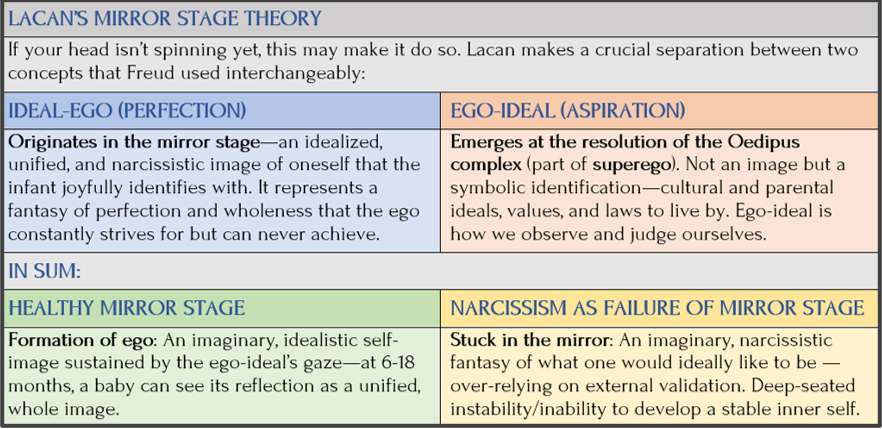
Unlike a pet dog or cat, the 6-18 month old can see its image for the first time and think, “This is me.” But this developmental milestone in a child’s life can also feel unsettling, because the mirror image might not conform with how the pre-verbal child feels. Such is the theory reinterpreting Freud by French psychoanalyst/intellectual/author Jacques Lacan (1901-1981), published in a 1949 paper, Mirror Stages. Freud, who said “all narcissistic impulses operate from the ego and have their permanent seat in the ego,” gave us the concept of the ego-ideal, a temporary form of narcissism transitioning us from infant primary narcissism to healthy or unhealthy narcissism.

Puppy practices faces in the mirror, Sunny Skyz

Source: Narullah Mambrol, “Lacan’s Concept of Mirror Stage,” Literary Theory and Criticism
Lacan proposes a mirror stage that comes after the first half-year of life when infants, driven by their needs, don’t distinguish themselves from mom. When the child sees their reflection in the mirror for the first time, they realize they’re actually not fused with mom and may in fact be a separate little being.
Lacan believed this stage to be crucial to ego formation, beginning a lifelong process of identifying self vs other. His mirror stage theory sets a baseline ego-ideal (healthy) that contrasts with narcissism (unhealthy) — when the child develops a pathological relationship to the mirror stage.
In a word, the tiny narcissist is stuck, unable to move forward. They need constant external validation and develop a “grandiose but unstable self-identity that relies on the ‘reflection’ of others to have an illusion of wholeness,” Nasrullah Mambrol writes in “Lacan’s Concept of Mirror Stage,” Literary Theory and Criticism.
Source: Nasrullah Mambrol, “Lacan’s Concept of Mirror Stage,” Literary Theory and Criticism
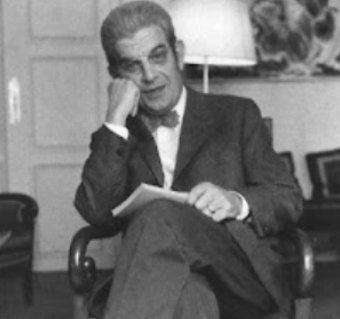
We’re understandably reluctant to accept this loneliness—and are, consequently, very concerned to control the external appearances that we present. That’s what fashion trades on. We hope that if we could tinker sufficiently with what other people see externally of us (perhaps our hair or design of collar), we may eventually be properly understood. Lacan suggests a more difficult, mature move: that we accept that other people simply won’t ever experience us the way we experience ourselves; that we will be almost entirely misunderstood—and will in turn deeply misunderstand. —Greek psychotherapist Nikos Marinos
Jacques Lacan, 1974
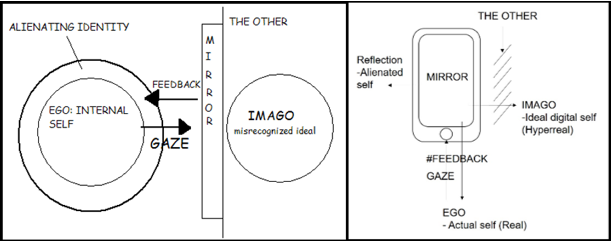
Jacques Lacan’s Mirror Phase. Left: Lacan’s original diagram, Scarlar, Chapman University. Right: “Mirror stage as applied to the iPhone,” A.N Media
Compliance
Related to Lacan’s mirror stage is the defensive behavior of compliance, first described by British pediatrician and psychoanalyst Donald Winnicott (1896-1971), who we met for his concept of “good-enough mother.” [post 5]. Because of an uncomfortable relationship with the primary caregiver, the very young child becomes more motivated by a desire to please others than to be themselves. Winnicott gives the example of an infant’s reaction to a depressed caregiver who neglects the infant’s cries. The infant becomes anxious from the lack of responsiveness, which diminishes their illusion of omnipotence. They are not the center of the world; their needs are not magically met. Instead, the infant finds ways to get the distracted, unhappy caregiver’s positive response by being a “good baby.” Unfortunately, this is not healthy. According to Winnicott, compliance leads to developing a false-self as a defense of always anticipating others’ demands and complying with them—to protect their true-self from an unsafe world.
Lacan’s Symbolic Order
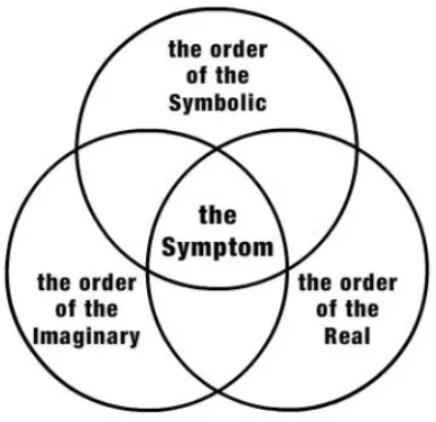
Lacan’s most famous theory is the Symbolic Order — a system of language, social roles, and cultural norms that structures our subjectivity and experience. I give a fuller definition of the symbolic order in the Glossary. I’ll briefly summarize here how it pertains to narcissism.
The Lacanian perspective understands narcissism not simply as excessive self-love, but as a fragile attempt to stabilize identity within the symbolic order. Signifiers (words representing our place in the world — like admired, desired, important) give us meaning and identity rather than a unified inner self. The narcissist needs to anchor themselves in fixed symbolic positions (successful, exceptional, or admired), treating these signifiers as if they could guarantee a coherent self. Yet the symbolic order cannot provide such wholeness: signifiers derive meaning only through their relation to other signifiers (we’re a father because we’re NOT a mother, son/ daughter, or brother/sister), with recognition always mediated by others.
For a narcissist, signifiers don’t just describe them — they hold them together. Without constant affirmation from others, there is no solid inner core to fall back on — only a frightening emptiness. When praise fades or attention shifts away, it can feel to the narcissist like disappearing, which is why they react with desperation, rage, or sudden detachment.
This is a plausible explanation for why narcissists remain deeply unhappy even at moments of success. Their sense of self depends on external recognition that can never resolve the structural lack introduced by the symbolic order (i.e., language and social identity). Admiration, status, or achievement may briefly soothe this lack, but because recognition must be continually renewed and is governed by shifting social standards, it never provides lasting fulfillment. Narcissists subconsciously treat recognition as if it could finally secure identity and restore a sense of wholeness, but desire does not settle or end in this way. It moves from one source of validation to another. As a result, even being “on top of the world” often intensifies anxiety and emptiness rather than alleviating it.
In sum: narcissistic identity depends heavily on external validation and is haunted by a persistent sense of lack. Law and prohibition — embodied in social limits, failure, rejection — threaten this fragile construction, producing shame, rage, or withdrawal when the desired image collapses. Narcissistic symptoms thus function as defensive strategies that manage the tension between an underlying structural incompleteness and the demand to appear whole within society. In this view, narcissism is not a moral failing or a surplus of ego, but a symptom of the symbolic order itself: an effort to deny lack by turning identity into a rigid, performative sign.
Developmental Deficits and Defensive Compensations

British artist Roger De Grey, Interior Exterior. Linda Berman, “How Can We Understand the Secret Connections Between Our Inner and Outer Worlds?” Ways of Thinking
In her article, “Anatomy of a Narcissist: These are the inner workings of the narcissistic personality,” Psychology Today, Julie Hall notes narcissism is more than an adult-onset condition of obnoxious but otherwise not serious traits. It’s a potentially severe “mental illness” causing the narcissist great suffering and “traumatically affects family members, social groups, and society at large.” Because narcissists mask their true selves, often seek out positions of authority, and wield power abusively, other people in their lives often don’t recognize the signs. By calling them out on their behavior, family and friends can better protect and support the narcissist’s victims (including themselves).
Hall refers to the narcissist’s “developmental deficits and defensive compensations” — a bewildering list of how we can be mistreated, manipulated, and abused by the narcissists we know. Object relations theory proposes narcissists relate to loved ones as either good or bad “objects,” playing one against the other to manipulate and control. Hall writes, narcissists objectify love objects by stripping them of their right to have different feelings from the narcissist’s — which don’t reflect their delusions about who they present themselves to be.
The chart below gives an overview of common defenses, followed by a more in-depth look at some of the most common and difficult ones we may encounter with our narcissist.
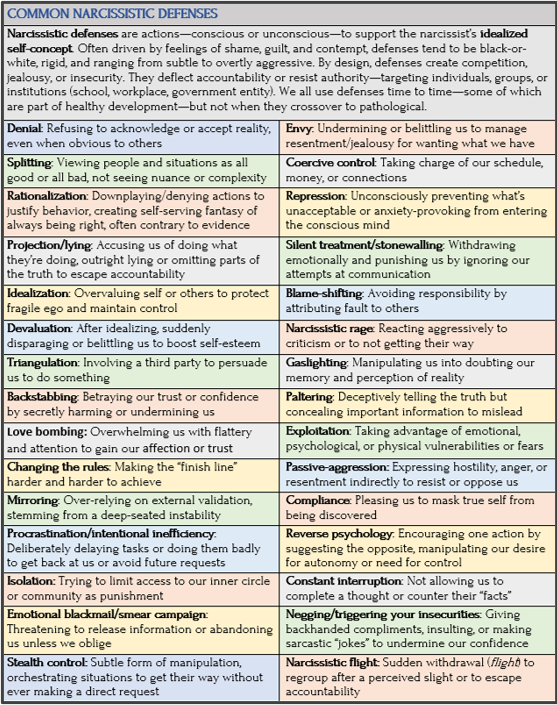
Sources: Wikipedia; Joseph Burgo, “Narcissism and Other Defenses Against Shame,” Psychology Today; Nancy Lovering, “How Narcissists Blame and Accuse Others for their Own Shortcomings,” PsychCentral; and psychoanalyst Otto Kernberg, You Tube
Narcissistic Defenses in Brief
Envy, Jealousy, and Victimization
Narcissists rarely get enough of what they deserve, which makes them envious of what others have and achieve, jealous of the attention others get, and victimized by how unfair everything is. Hall writes, “They need to feed their high ego because of these deep insecurities that have become fused with their self-identity, particularly vulnerable narcissists. This propels them to correct the power imbalance with others by making demands without concern for others’ feelings, often resorting to gaslighting, ghosting, and manipulation.”
Internalized Inferiority vs Externalized Self-Esteem
As Hall describes it, narcissists lack the ego strength to sustain high self-esteem, so they exaggerate self-importance.

Winslow Homer, Two Are Company, Three are None, 1872, wood engraving, Wikipedia
As Hall describes it, narcissists lack the ego strength to sustain high self-esteem, so they exaggerate self-importance. To feel good about themselves, they become highly dependent on “status-enhancing externalities” (excessive demands for attention, admiration, special privileges, caretaking, and control in their relationships). In addition to self-aggrandizement, narcissists are prone to cognitive distortions, such as catastrophizing, minimizing, personalizing, and magical thinking [see post 15].
Immorality
Hall writes, “Narcissists’ fragile sense of self is a house of cards built precariously on inner splitting, delusional self-beliefs, and primitive defenses.” To keep the card house from collapsing, they avoid self-reflection and accountability. Hall considers narcissists to be lacking “all but a rudimentary corrective observing ego (conscience),” meaning they function outside the norm of fairness, ethics, and morality.
Stealth Control
In relationships, stealth control by a narcissist is when they use the art of subtle manipulation to get their way without ever having to ask directly, thereby sidestepping conflict and acting like they aren’t controlling — even though they are.
Malkin describes the narcissist’s “stealth control” as one red flag. In the early stages of a relationship, he may simply change up plans you’ve already made, substituting something else which he bills as “better” or more fun or glamorous. Unlike the controlling type who makes it clear that it’s his way or the highway, stealth control permits the narcissist to get what he wants without ever articulating his needs; it’s got the added benefit of putting you in a place where you start forgetting your own needs and wants. —Peg Streep, “6 Ways a Narcissist Can Hide in Plain Sight: Why it can be so hard to see what makes him (or her) tick,” Psychology Today
Triangulation and Relational Antagonism
In this three-person “charade,” the narcissist aligns with one person against the third. The excluded person often clamors to be accepted again, and the aligned person fights to remain in the privileged position. In triangulation, the narcissist emotionally controls two people.
Related to triangulation, relational antagonism is narcissists not seeing their relationships as equals on a level playing field — they’re more competitive and exploitative than cooperative and responsible. With their feelings of entitlement and lacking the “inhibiting influence of emotional empathy,” narcissists exploit others for physical and emotional resources and devalue, humiliate, and violate others to boost their self-esteem.

Masking

I discussed masking in my On Neurodivergence and Otherness series. Being different from the mainstream is often the reason individuals wouldn’t allow their real selves out in public. But narcissists also use the defense of masking. Their compulsive need for attention and validation drives them to cultivate a socially winning public persona, to be seen as the wonderful people they believe they are. Or, as in the compelling post by a high school student, a desire to hide, lest their inner fears and insecurities and shame be seen.
Photo: Daniela Arida, “My Mask,” We Are Two Lips Blog
Masks for me are like an armor before going into battle, which is what going to school is like for me, I fear for the attention to be on me. I always use masks at school , it seems I have a reputation of being quiet and not getting involved. This is just an observing mask, I prefer to be quiet and unnoticed than the center of attention. I do not like opening up to people and making myself vulnerable. I almost do not feel the need to, I am happy not wanting to wear the mask that others wear (the sheep mask). But a small part of me is still insecure, feeling maybe I’m different — I’m the one wearing the wrong mask. I’m often confused by my feelings. Sometimes I want to change myself for others and wear the mask of fitting in and other times, I say “Hell no.” I just want to be me! But then, who is “me”? Who is Daniela? I want others not to judge me because I am not like them. I want to live in a world where we are who we are and not who others want us to be. —Daniela Arida, “My Mask,” We Are Two Lips Blog
Coming Up Next
Post 7: Narcissist’s Self-Defense — Part II begins with the popularized concept of narcissistic supply and continues to explore specific narcissistic defense strategies. When we consider these methods, some unconscious and some highly intentional, we can use them as a check on our own behavior. Afterall, we don’t have to be a narcissist to be passive-aggressive, deny responsibility, brag about exploits at a family gathering, or talk incessantly without listening. If we’re the brunt of narcissistic defenses, it’s also good to understand just how we’re being manipulated into allowing the narcissist to disguise their failings and seem the victor.
 English