
Narcissism and the Rest of Us
Show Table of Contents
INTRODUCTION
NARCISSISM DEFINED
2. Is There a Narcissist in Your Life?
3. Narcissus and the Origins of Narcissistic Thought — Part I
4. Narcissus and the Origins of Narcissistic Thought — Part II
5. Narcissus and the Origins of Narcissistic Thought — Part III
NARCISSISTIC DEFENSES
6. A Narcissist’s Self-Defense — Part I
7. A Narcissist’s Self-Defense — Part II
8. A Narcissist’s Self-Defense — Part III
NARCISSIST PERSONALITY DISORDER VS TRAITS
9. When Narcissism is a Personality Disorder
10. Narcissism and the Maladaptive Umbrella
11. Malignant Narcissism and the Narcissism Spectrum
12. When Narcissism is Compounded by Comorbidity
NURTURE VS NATURE
15. Narcissism: Flipping Self-Esteem on its Head
16. The Double-Edged Sword of Grandiose Narcissism
NARCISSISM’S DARK SIDE
19. Narcissistic Rage and Narcissistic Self-Awareness
20. Trait Narcissism and the Illusion of Control
21. Beyond Narcissism: Dark Personality Traits — Part I
22. Narcissist Sociopaths: Dark Personality Traits — Part II
ROMANTIC LOVE AND BOUNDARY-SETTING WITH A NARCISSIST
23. Romantic Love with a Narcissist — Part I
24. Romantic Love with a Narcissist — Part II
25. The Narcissist’s Non-Apology Apology
26. Boundary-Setting with Narcissists — Part I
27. Boundary-Setting with Narcissists — Part II
28. Boundary-Setting with Narcissists — Part III
29. Shattering Narcissus’ Mirror… So They Can Live
CONCLUSION
30. On Narcissism: What About the Rest of Us?
11. Maladaptive Umbrella and the Narcissism Spectrum
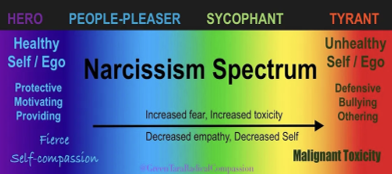
Illustration: Tara Lee, Medium
Before I discuss the narcissism spectrum and how every one of us can locate ourselves on it, I’ll tackle the maladaptive umbrella’s other three narcissist subtypes — what the research world calls trait narcissism. In post 10, we saw that grandiose and vulnerable subtypes are the most prevalent of narcissistic profiles that fall short of disabling personality disorders, like NPD. We saw they have a common core of traits, but these traits are expressed differently: grandiosity is more extroverted and externally focused; vulnerability more introverted and inwardly focused.
Since Freud, we have continued to understand narcissism is much more complex than we might’ve expected [see posts 3-5]. Early theories of what turns a baby into a narcissistic child and what determines the severity of the child’s symptoms have formed our present-day picture. Freudian theory begins with this: all of us start life as infant narcissists. Adult-onset narcissism is usually in reaction to a shattering, traumatic event. By understanding our own narcissism, we can better appreciate the full range of who we are and why we behave as we do.
When enough healthy narcissism (hero end of the spectrum) is nurtured and modeled in childhood, children behave in healthy ways (respectful, kind, assertive) and mature into healthy adults. When the tyrant end of the spectrum is modeled and conditioned in childhood, children behave in unhealthy ways (deferential, defiant, defensive) and are prevented from maturing into healthy adults.
For children without enough positive role models, it’s an easy slide from people-pleaser to sycophant to tyrant. Without intervention by caring adults and competent professionals, unhealthy neural pathways become ingrained, and it becomes harder and harder to change (heal) as adults. —Tara Lee, Medium
The three other “subclinical” subtypes likewise show up with common traits expressed differently. The core, unifying trait is desperately wanting and needing to be seen as unique and special, but always on guard. Narcissists selectively show us their superiority, brilliance, and talent — expecting us to give them what they need and deserve. In this post, I’ll cover the variants antagonistic, communal, and malignant narcissism — more in common with grandiosity, but not consistently so.
Antagonistic Narcissism

Photo: iStock
Securely attached humans approach relationships cooperatively. They work together to achieve shared goals, seek and give empathetic validation, share accurate and truthful information, and express affection and vulnerability to build trust and intimacy in their relationships. There may be conflict, there may be disagreement, but mutual support is the foundation of the relationship and respect and love are not at stake.
By contrast, for the narcissistic personality attachment with others is antagonistic, a concept in biology that refers to a relationship in which one organism benefits at the expense of another. Common forms of antagonism in nature are predation, competition, and parasitism. —Julie Hall, “Understanding the Narcissist’s Antagonistic Attachment Style,” Psychology Today
Antagonistic narcissism shares destructive traits with malignant narcissism. When threatened, they can be self-centered, highly competitive, argumentative, vengeful, rude, hostile, intrusive, or aggressive. Unlike the rest of us with more or less healthy self-esteem and capable of loving relationships, antagonistic narcissists undermine the wellbeing of those close to them and take pleasure in seeing them suffer.
Predation: They’re mostly known for exploiting and dominating others for personal gain or punishing them for not giving into excessive demands for compliance and attention. They seek out chaos and create conflict with others, constantly belittling and criticizing. They’re less likely to forgive and have lower trust than other subtypes. Their behavior not only damages close relationships, it decimates them, leaving partners feeling emotionally drained or hurt.
Competition: Their focus is on competition and winning at all costs. Hall writes: “Seeing life as a zero-sum game in which they can only win if someone else loses,

Photo: Hey Sigmund
antagonistic narcissists continually work to undermine and one-up those around them, while asserting their superiority and greater entitlement.” They’re driven to dominate others in every aspect of life.
Parasitism: Here I defer to Hall’s chilling words.
Parasitism shows up as exploitation in relationships, usually with the antagonistic narcissist manipulating or coercing the other person into providing ongoing resources, such as money, housing, privilege, social standing, sex, or caretaking.
To render the “host” easier to exploit, they typically use tactics such as isolation, guilt, seduction, fawning, and gaslighting, while using forms of intermittent reinforcement to create the illusion of reciprocity in the relationship. This not only drains the host of physical and emotional resources, but it also alienates that person from his or her own self-preserving instincts and ability to maintain safe personal boundaries. —Julie Hall, “Understanding the Narcissist’s Antagonistic Attachment Style,” Psychology Today
It’s terrifying to think a person can be so damaged by their life circumstances they become so irredeemably dark and capable of evil. In some instances, a relationship might be possible with a narcissist, even if limited. But here, there’s only one direction to move in. And that’s away.
Communal Narcissism
When I heard the term communal narcissism, I thought, it was an oxymoron. But, in fact, it’s another narcissistic scam on genuinely good people who act in good faith. Unlike antagonistic narcissism, those with communal narcissism believe they are highly moral and caring people. Yet their behavior is inconsistent with their expressed values. They may donate time and money to a good cause, but their motivation is for praise, not for a genuine desire to help. Now I’m wondering, was my two-faced boss a communal narcissist?

Photo: Shutterstock
Initially, when you first meet a communal narcissist, it’s unlikely you will realize they are one. It can take time to see their personality traits and to realize their intentions aren’t as genuine as you believed.
When someone does something nice for you, they should be doing so because they want to. However, if they immediately demand recognition, that may be a sign of communal narcissism.
If you see someone behaving in a way that makes them look like the “good guy” in public, but act quite differently behind closed doors, there’s a chance they’re a communal narcissist. —Author Ariane Resnick, “Communal Narcissism — Understanding Collective Self-Centeredness,” VeryWellMind

Lucas Graham, “Eight subtle behaviors of a communal narcissist (that most people overlook),” Global Editing
In addition to sharing traits with grandiose narcissists — constantly seeking praise, bragging and exaggerating talents or accomplishments, emotional manipulation, a sense of superiority and entitlement — the following are signs specific to communal narcissism:
- Excessive volunteering, using their generosity to exploit community bonds, dominate conversations, and steer attention to their contributions. Donate money for bragging rights — shaming others to also donate.
- Virtue signaling and using altruism for public attention, displaying false humility to downplay achievements while subtly drawing attention to them, sometimes using their own sacrifices for sympathy and attention to be seen as heroic.
- Overplaying their empathy, seeming to be kindhearted and caring, not to offer genuine support but to appear morally superior. They talk about the importance of fairness, while behaving unfairly to others.
- Insisting on admiration or praise for their contributions and achievements, using social media to highlight their efforts, and often taking credit for the work of others. Without constant validation, they become uncomfortable and restless.

Lucas Graham, Global Editing
- Lack of genuine interest in others, unless in a public setting where they can gain recognition for their concern. Often reveals itself over time since they rarely ask about others.
Communal narcissists pay a price for their public acts of generosity but private anger and resentment for perceived unfair treatment. They may burn out as they overextend themselves, revealing the moral outrage and ungenerous motives they try to hide.
While it may seem the communal narcissist is fairly benign to the rest of us, that’s far from the reality, according to Julie Hall. What they do has a great impact on the lives of the people around them, because their circle of influence can affect an entire community, a city, a country. I’ll stop here before the political realm takes over, which I’m committed to avoid, like anyone setting up a charitable foundation that’s not charitable but a scam.
Malignant Narcissism

Photo: Getty Images
The fifth and most severe maladaptive subtype is malignant narcissism — best understood as a fusing of antagonistic narcissism and antisocial personality disorder (ASPD). ASPD is an extreme personality type that goes against social norms and laws. Sharing the same traits as narcissistic personality disorder (NPD), the malignant narcissist is more willing to use extreme measures to get what they want. They’re more devious and crueler in their manipulative behavior and more extreme to the point of legal trouble or substance abuse. Picture the stalker, the physical abuser, the person who drains their spouses savings account — we hear of these terrible acts and know these things happen. But we may not know the perpetrator has a compound form of narcissism + ASPD.
Malignant narcissism is also, by far, the most controversial of the five subtypes. It’s clinically (but not officially) recognized but with a vague set of conditions making it difficult to diagnose. Many terms we accept today — like sociopath or psychopath — are made popular on TV series but are difficult to define and diagnose, according to an article in Medical News Today. It doesn’t mean the harmful behaviors aren’t real and the effect on others isn’t devastating.
Some people describe malignant narcissism as a form of psychopathy, which the DSM-5 also does not list. Psychopathy is an unofficial term for people with antisocial personality disorder.
As there is not a well-validated scale to measure malignant narcissism, its characteristics are not clearly defined. It may serve as a moral judgment rather than a diagnosis, especially in online abuse recovery and self-help spaces. Whether malignant narcissism is a real diagnosis remains controversial.
The notion of malignant narcissism originates in the self-help and law enforcement communities, not in psychiatry. These communities have focused on malignant narcissism as a behavioral judgment and a specific form of abuse rather than a mental health diagnosis.
In the popular conception, malignant narcissism is a form of narcissistic personality disorder that is highly abusive. People with this personality supposedly get a sense of satisfaction from hurting others and may manipulate people or lie to gain money, acclaim, and other things they desire.
The need for attention and love is also present for people with malignant narcissism. However, their strategies for getting this attention tend to be more aggressive, and they show less regard for the rights of others. They may have antisocial personality traits that cause them to abuse others willingly, and sometimes happily, for their own pleasure and personal gain. —Zawn Villiness, “What to know about malignant narcissism,” Medical News Today
Treatment outcomes for malignant narcissists are poor. Yet, as Villiness writes, despite common understanding, there’s no scientific proof that malignant narcissists are beyond help. There’s also no evidence that third parties can compel them to change. It has to come from within. Here’s what two researchers have to say:
Malignant narcissism is a severe personality disorder that has devastating consequences for the family and society. It requires attention within the discipline of psychiatry and the social science community. We recommend treatment in a therapeutic community and a program of prevention that is focused on psychoeducation, not only in mental health professionals, but in the wider social community. —Mila Goldner-Vukov and Laurie Jo Moore, “Malignant Narcissism: from fairy tales to harsh reality,” PubMed/NIH
The Malignant Narcissism of a President
I keep promising myself not to discuss Trump in my narcissism blog, but he said something the other day that made me laugh. He claimed he helped build New York City. Not just Trump Tower, an ugly monstrosity on Fifth Avenue, but the entire city. The hubris in that one statement, among the thousands of other incredulous self-aggrandizements, epitomize his narcissistic personality disorder (NPD), but his cruel and relentless pursuit of his “enemies” and the treatment of immigration families in prison-like detention centers boosts his narcissism into malignancy.
Graphic: Stop the Spin Cycle
The Narcissism Spectrum
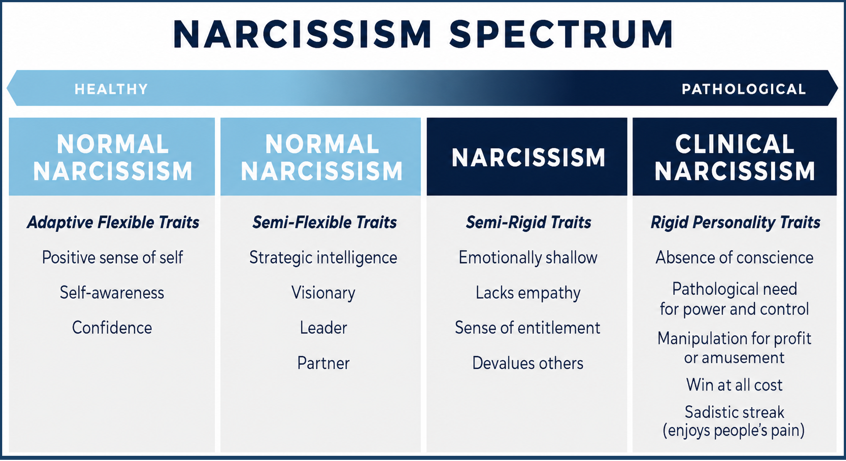
All forms of narcissism can be arrayed on a spectrum — from healthy narcissism (self-love) to narcissistic personality disorder/NPD (pervasive) to malignant narcissism (toxic). The narcissism spectrum ranges from low to high severity — and from inward to outward expression. While DSM-5 only recognizes NPD, research and clinical experts recognize a complex constellation of subtypes along a continuum, calling its north and south poles:
- Adaptive narcissism — productive, healthy aspects, including self-confidence, self-reliance, and an ability to celebrate ourselves (healthy self-love).
- Maladaptive narcissism — nonproductive, unhealthy traits with a negative impact on oneself and others (pervasive, toxic, persistent)
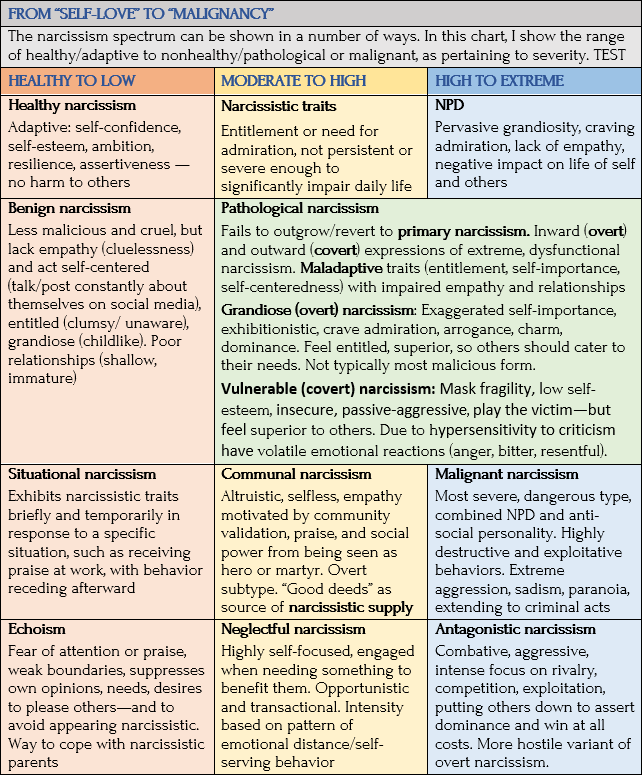
Sources: Melissa Prusko, “The Eight Types of Narcissists,” Family Institute; Courtney Telloian, “How to Identify Different Types of Narcissism,” PsychCentral; Tara Lee, “The Narcissism Spectrum — Destigmatizing Narcissism, Medium; Wikipedia; Craig Malkin, Rethinking Narcissism, Shortform
Narcissism Isn’t All Bad: the Narcissism Spectrum Scale (NSS)

Craig Malkin
Psychotherapist/Harvard Medical School lecturer Craig Malkin was an early advocate for seeing narcissism not as a binary but as a spectrum, encompassing a range of destructive behaviors and positive ones necessary for personal success and happiness. He wrote, “Danger lurks toward the ends of the narcissism spectrum,” as a cautionary reminder that both extreme narcissism and no narcissism can lead to unhealthy dynamics, emphasizing the importance of balance. [Also see post 23: Is Romance with a Narcissist Possible?]
More recently, Malkin and colleagues created the Narcissism Spectrum Scale (NSS). This assessment tool adds reliability to measuring narcissism across the “Malkin” spectrum, from deficits (echoism) to healthy (positive self-enhancement) to unhealthy (extreme). NSS was designed to help people understand and reflect on their own position on the spectrum toward a healthier balance. Three key factors predict different patterns of behaviors:
- Narcissism deficitsare related to an inability to feel special and a lack of self-worth. One example is the self-effacing condition of
- Healthy narcissism encompasses positive self-regard and self-enhancement, with benefits like happiness and resilience. Possess confidence and ambition without harming others.
- Extreme narcissism is characterized by grandiose fantasies and a need for excessive admiration. Captures the Triple E: exploitation, entitlement, and empathy impairment.
Coming Up Next

In Post 12: When Narcissism is Compounded by Comorbidity, we discover the truth about narcissism is the strong likelihood of co-occurring (comorbid) mental health conditions, which intensifies symptoms, inclinations, and behaviors. This is especially true with comorbid NPD and antisocial personality disorder, which heighten aggressive proclivities.
 English