Narcissism and the Rest of Us
Show Table of Contents
INTRODUCTION
NARCISSISM DEFINED
2. Is There a Narcissist in Your Life?
3. Narcissus and the Origins of Narcissistic Thought — Part I
4. Narcissus and the Origins of Narcissistic Thought — Part II
5. Narcissus and the Origins of Narcissistic Thought — Part III
NARCISSISTIC DEFENSES
6. A Narcissist’s Self-Defense — Part I
7. A Narcissist’s Self-Defense — Part II
8. A Narcissist’s Self-Defense — Part III
NARCISSIST PERSONALITY DISORDER VS TRAITS
9. When Narcissism is a Personality Disorder
10. Narcissism and the Maladaptive Umbrella
11. Malignant Narcissism and the Narcissism Spectrum
12. When Narcissism is Compounded by Comorbidity
NURTURE VS NATURE
15. Narcissism: Flipping Self-Esteem on its Head
16. The Double-Edged Sword of Grandiose Narcissism
NARCISSISM’S DARK SIDE
19. Narcissistic Rage and Narcissistic Self-Awareness
20. Trait Narcissism and the Illusion of Control
21. Beyond Narcissism: Dark Personality Traits — Part I
22. Narcissist Sociopaths: Dark Personality Traits — Part II
ROMANTIC LOVE AND BOUNDARY-SETTING WITH A NARCISSIST
23. Romantic Love with a Narcissist — Part I
24. Romantic Love with a Narcissist — Part II
25. The Narcissist’s Non-Apology Apology
26. Boundary-Setting with Narcissists — Part I
27. Boundary-Setting with Narcissists — Part II
28. Boundary-Setting with Narcissists — Part III
29. Shattering Narcissus’ Mirror… So They Can Live
CONCLUSION
30. On Narcissism: What About the Rest of Us?
16. The Double-Edged Sword of Grandiose Narcissism

Photo: iStock
By now, we should be well-versed in the characteristics of grandiose narcissism, a pathological subtype — which can become a deeply entrenched personality disorder. One of its most prominent features is an abnormal fixation on social status. To be perceived as the superior being they want to project, the narcissist must appear more powerful, popular, brilliant, and accomplished than others. One good way to do this is to bask in the glow of the rich and famous. It’s called status pursuit.
The flip side of status pursuit is feeling challenged or not accepted by others, in which case the narcissist can become hostile and act defensively toward the individual or entity they believe has denigrated
and shamed them. Their worst nightmare is being discovered as a non-superior person — like Oz revealed behind the curtain, turning the dials to seem fearsome and all-powerful, but in fact being an ordinary man. Instead of acting resigned, they rise up in rage and aggression. This is existential for them.
Elevate their Status or Reduce the Status of Others
In “The Why and How of Narcissism: A Process Model of Narcissistic Status Pursuit,” PubMed Central/NIH, researchers Stathis Grapsas and colleagues find grandiose narcissists self-regulate thoughts and emotions “through interconnected processes in pursuing status in their moment-by-moment transactions with their environments.” Narcissists “vigilantly attend to perceived cues that connect to high status, so they can appraise whether they can elevate their status or reduce the status of others.”
The narcissist’s perception of others — those they want to be among vs those they want to denigrate — has a great impact on how they behave, with equally great consequences for shaping their social status. Grapsas’ research uses the Narcissistic Admiration and Rivalry Concept (NARC) — devised in 2013 by German psychologist Mitja Back and colleagues — to reveal how narcissism “becomes a stable and consistent cluster of behaviors in pursuit of social status — and how it develops and maintains itself over time.”
The Double-Edged Sword of Grandiosity

Graphic: Jan Swan
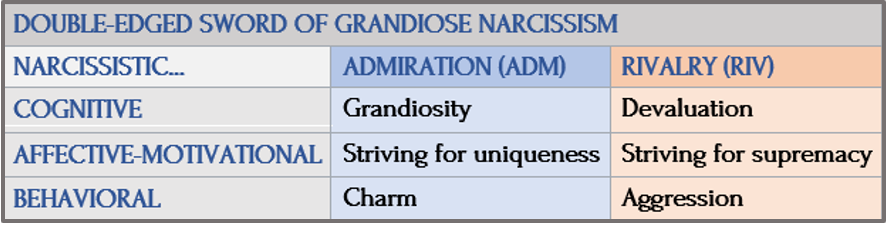
The psychiatric community calls grandiose narcissism a “double-edged sword,” because of its distinct, contrasting dimensions. Grandiosity is both adaptive (high self-esteem, assertive, popular) and maladaptive (aggressive, antisocial, risk-taking). The NARC pathways model offers a relatively new understanding of how narcissists use these contrasting tendencies — admiration and rivalry — to regulate self-esteem:
- Adaptive = ADMIRATION = self-enhancement: Advancing themselves or promoting positive self-views
- Maladaptive = RIVALRY = self-protection: Fending off negative or harmful self-views
In NARC, both admiration and rivalry encompass three aspects: cognitive (thought), affective-motivational (a mix of emotional reactions and internal drives), and behavioral (actions taken). Narcissists are clinically assessed according to these perimeters using an accompanying NARC questionnaire — or NARQ.
Self-Regulation: Critical to a Well-Adjusted Life

Photo: Nature
The Back team based their narcissism studies on self-regulation theories. In neuropsychology, self-regulation is how our brain (cognition) controls emotions, thoughts, and behaviors to handle frustration and stress, manage impulses (or impulsive acts), and keep focus (make smart decisions, manage relationships, achieve goals).
Theorists suggest narcissists regulate self-esteem, both consciously and unconsciously, to get the constant external validation they need to uphold their pretense of superiority. According to Wikipedia, the Back team reasons because narcissistic self-views are inflated, their ways of self-regulating must also be inflated to compensate for their extreme behavior.
Welcome to the fascinating realm of the Narcissistic Admiration and Rivalry Concept! This fresh take on narcissism breaks the mold by showing us that the drive for grandiosity isn’t one-dimensional; it’s actually a tale of two very different strategies.
On one side, we have narcissistic admiration — that charming, self-promoting flair that turns heads, wins hearts, and makes for a dazzling first impression. Think of it as the party starter: confident, outgoing, and ready to bask in social adulation. But hold on — the story gets more interesting.
On the flip side, there’s narcissistic rivalry, a less glamorous yet equally potent force where the focus shifts from winning applause to warding off any threat to one’s self-image. This is the defensive, sometimes combative side that isn’t afraid to ruffle feathers in the name of self-preservation.
Adding another twist to this narrative is the idea that grandiosity itself can serve as a coping mechanism for deep-seated shame. In this view, the extravagant self-image isn’t just about basking in adoration or outshining others — it’s also a strategy for perspective-building and attaining a more secure sense of self, ultimately counterbalancing internal vulnerabilities. —Bryan Garcia, “Narcissistic Admiration and Rivalry Concept: The Double-Edged Sword of Grandiosity,” SubStack
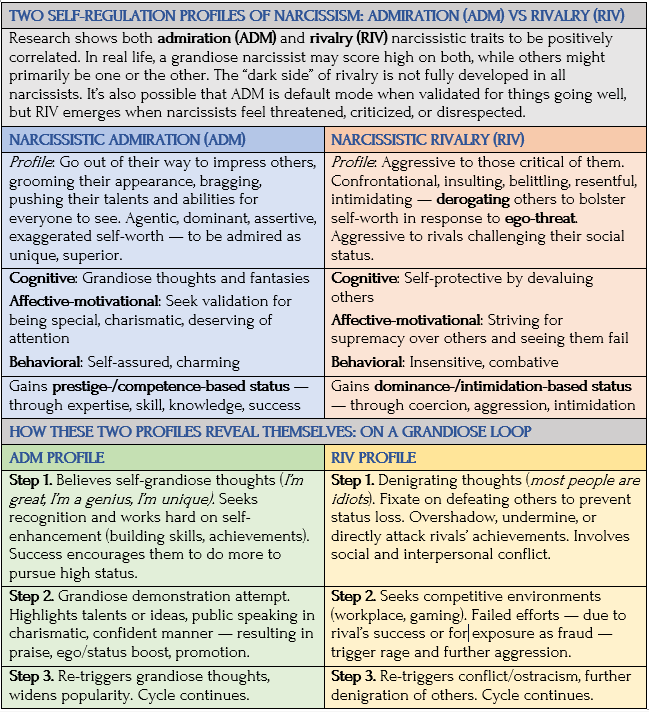
The Grandiose Loop of Admiration vs Rivalry
This chart is my appreciation of NARC’s contribution to understanding narcissism. Again, in Garcia’s own words:
While a person high in narcissistic admiration (and extraversion) might simply be very self-assured and charismatic, it’s typically those who also score high on narcissistic rivalry — exhibiting aggressive or antagonistic behaviors — who are more likely to display the severe interpersonal dysfunction characteristic of narcissistic personality disorder (NPD). In essence, high narcissistic admiration alone is not as indicative of NPD as when it’s combined with high levels of rivalry or antagonism. —Bryan Garcia SubStack
authentic vs hubristic Pride
Source: ScienceDirect
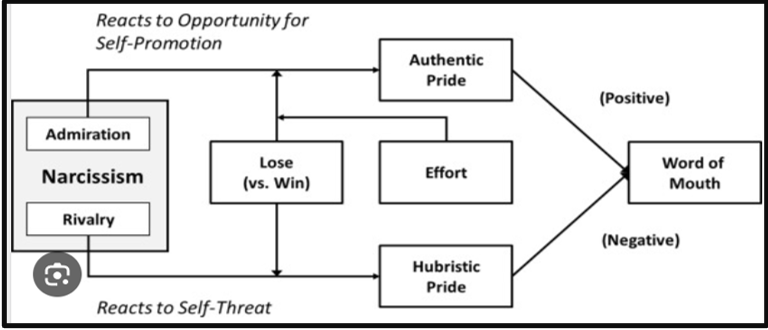
This graphic take on ADM vs RIV adds the variable of pride — authentic vs hubristic — to an opportunity for self-promotion.
Mitja Back and colleagues believe a narcissist’s inflated self-view is fragile and unstable, requiring constant self-regulation processes to maintain and protect it from threats. “These processes are not about building healthy self-esteem, but about managing a precarious internal state that vacillates between grandiosity and vulnerability.”
Along with ADM-RIV pathways, Back indicates the following as key to the NARC model:
- Contingent self-esteem: A narcissist’s self-esteem is not stable but dependent on external factors — social validation, praise, achievement.
- Hypersensitivity to ego-threat: Their precarious self-esteem causes hypersensitivity to any real or perceived criticism, failure, or reduction in social regard. These ego-threats can cause their inflated self-view to collapse, revealing underlying feelings of inferiority.
- Compensatory strategies: Narcissists use self-regulation strategies to deal with ego-threats and “upregulate” their self-esteem. Not always healthy, these include: intrapsychic strategies (fantasizing about fame or success) and interpersonal strategies (bragging, seeking excessive admiration, competing with/devaluing others to elevate their status).
- Rejection of “insecure” narcissist myth: Unlike older theories, Back’s work sees narcissism as a “stable orientation toward maintaining status that involves regulating a highly conditional self-esteem.”
In Bryan Garcia’s summary, Back’s description of “compensation” is the “underlying psychological dynamic” to prop up their inflated, but fragile, sense of self and manage the intense emotional distress that follows any perceived threat. Getting the constant external validation they need to maintain this unrealistic façade creates constant internal tension between their grandiose self-image and their deeper feelings of shame or inadequacy.
Threatened Egotism Theory
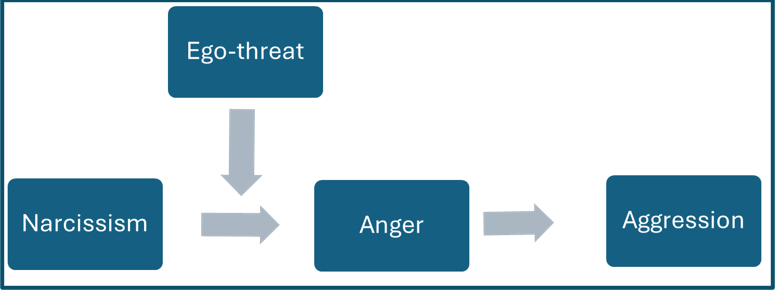
Abbreviated model of Threatened Egotism Theory, based on graphic by Lisa Penney, ResearchGate
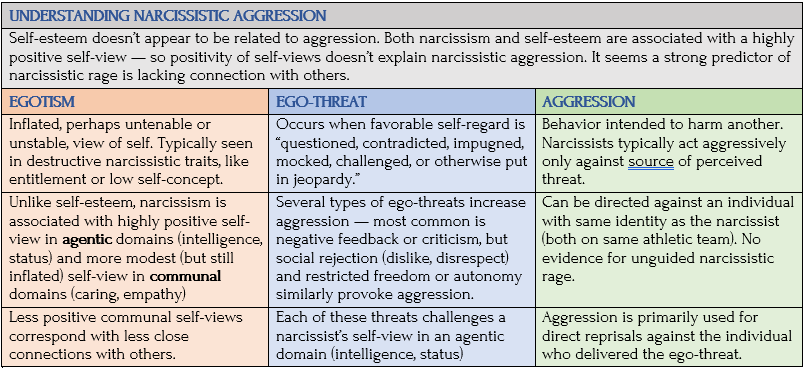
In 1996, social psychologists Roy Baumeister, Laura Smart, and Joseph Boden developed an influential social psychology framework they called threatened egotism theory. To this day it has significant and wide-ranging implications for how we understand and mitigate violent tendencies among specific communities of people. For our purposes, I will report on findings relevant to narcissism. The following is from a psychology.iresearch paper (without author credit), adding new research [paraphrased and edited].
Threatened egotism theory’s first principle suggests violence arises from unstable, inflated self-esteem combined with ego-threatening feedback — ranging from personal criticism or disrespect to social exclusion — upending common wisdom that low self-esteem fuels aggression. This explains why narcissists perceive ego-threats as challenges to their superiority.
The second principle reframes aggression as a defensive reaction to ego-threats to reject the challenge and the challenger and restore self-worth. This principle explains why specific provocations elicit disproportionate aggression or violence.
A Personal Detour

This research resonates for me. Recently I experienced texted accusations and insults from family members who I triggered with some tough comments. (Texting is a poor way to communicate difficult conversations.) At one point, I tried to clarify something misinterpreted as an insult — but failed. The rocket was launched and entered the stratosphere before I could cry “abort.” I didn’t handle this exchange well, but also didn’t anticipate or deserve the hostility levied at me.
Photo: Getty Images
Threatened egotism theory — supported by empirical evidence — explains behaviors from bullying to genocide. By reframing the self-esteem/aggression relationship, the theory focuses on how narcissists with grandiose self-views “respond with hostility to challenges that undermine their inflated self-conceptions. It also suggests that fostering unstable high self-esteem without achievement can exacerbate violent tendencies.”
On this last point that self-esteem not built from real-world achievement can inflame violent reactions: One of narcissism’s origin theories concerns overindulgent and overprotective parenting, which gives a child a false sense of their superiority based on little else than a parent’s say-so. This has the unintended consequence of sending the budding narcissist into the world searching after something they may never find. This research now adds to this conundrum — the search for validation/ status when not forthcoming elicits aggressive acts. This is making so much sense in explaining things to me, in dealing with the narcissists in my life. So many unnecessary battles.
A Nuanced Explanation of Aggression

Following a CrowdStrike software update outage in 2024, hackers capitalized on the chaos. Andrey Rudakov/Bloomberg/Getty Images, CNN
As the authors note, the theory’s significance lies in its nuanced explanation of aggression, ranging from interpersonal violence to societal conflict. Their research contributes to this understanding by extending to:
- Digital aggression: Online criticism triggers hostility among high-egotism/narcissistic users
- Cross-cultural contexts: Cultural norms shape self-esteem instability/stability. Like narcissism risk factors, individualist cultures (like the U.S.) amplify egotism-driven violence, while collectivist cultures (like in Asia or the Middle East) show “buffered threat responses.”

Demonstrators outside the US Capitol in Washington on January 6, 2021. Graeme Sloan/Getty Images, CNN
Other new evidence supporting the theory:
- High school studies show negative essay feedback prompts aggression in narcissistic participants.
- Recent bullying studies show high-egotism students become aggressive after disrespect, and school interventions reducing narcissistic tendencies decrease bullying. Criminological data confirm violent offenders react to perceived insults.
- Workplace studies link ego-threat to conflict escalation.
- Historical analyses link perceived national insults to warfare, validated by archival data
- Neuroscientific studies link ego-threat responses to hyperactivation of the brain’s amygdala (plays crucial role in processing/regulating emotions, particularly fear and anxiety).
By distinguishing self-esteem types, this principle ensures the theory’s relevance in promoting non-violent outcomes. As social psychology advances, according to the paper’s authors, “threatened egotism theory’s ability to bridge psychological, technological, and cultural domains positions it as a vital framework for addressing contemporary challenges.”
Mitigating Threat
One more study, by a team from an Amsterdam university, who define the three main variables in the Baumeister and colleagues’ threatened egotism model, in which egotism, in response to ego threat, leads to aggression
Source: S. Konrath, et al., “Attenuating the link between threatened egotism and aggression,” Psychological Science 2006, VU Research Portal, Amsterdam
Graphic: Vrije University (VU), Amsterdam
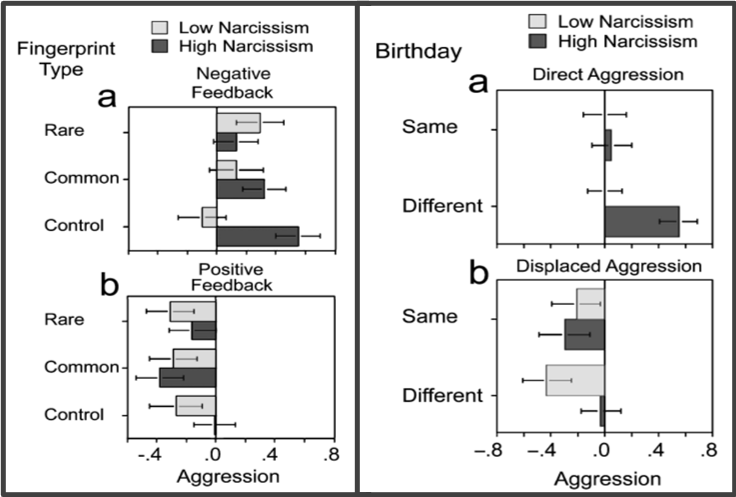
A research study from Vrije University (VU), Amsterdam, examined whether narcissistic aggression could be reduced by manipulating a modest commonality — the same fingerprint type or birthday — between the target of aggression (“participant”) and a “threatener” partner. The threatener criticized essays written by the participants. Aggression was measured by allowing participants to give the partner blasts of noise through headphones. The fingerprint study compared positive and negative feedback. The birthday study compared direct aggression (aimed at the source, i.e., the partner) and displaced aggression (redirected to the “experimenter” — the participant was told their threatener partner was running behind).
In control groups, narcissists were especially aggressive to their partners. However, narcissistic aggression was completely decreased, even under ego-threat, when participants believed they shared a key similarity with their partner.
Coming Up Next

I’ve introduced the work of Craig Malkin throughout this blog. As the author of Rethinking Narcissism, I’ve found cheer in the notion that a balanced diet of narcissism is good for us and boosts our success in life and work. In Post 17: The Happy Narcissist, I’ll rely on Malkin’s more positive outlook to understand when and why healthy, “happy” narcissism crosses the Rubicon to unhealthy, never to return. After the happy narcissist, I’ll return the grandiose and vulnerable narcissist — and see what today’s researchers are finding.
 English