Narcissism and the Rest of Us
Show Table of Contents
INTRODUCTION
NARCISSISM DEFINED
2. Is There a Narcissist in Your Life?
3. Narcissus and the Origins of Narcissistic Thought — Part I
4. Narcissus and the Origins of Narcissistic Thought — Part II
5. Narcissus and the Origins of Narcissistic Thought — Part III
NARCISSISTIC DEFENSES
6. A Narcissist’s Self-Defense — Part I
7. A Narcissist’s Self-Defense — Part II
8. A Narcissist’s Self-Defense — Part III
NARCISSIST PERSONALITY DISORDER VS TRAITS
9. When Narcissism is a Personality Disorder
10. Narcissism and the Maladaptive Umbrella
11. Malignant Narcissism and the Narcissism Spectrum
12. When Narcissism is Compounded by Comorbidity
NURTURE VS NATURE
15. Narcissism: Flipping Self-Esteem on its Head
16. The Double-Edged Sword of Grandiose Narcissism
NARCISSISM’S DARK SIDE
19. Narcissistic Rage and Narcissistic Self-Awareness
20. Trait Narcissism and the Illusion of Control
21. Beyond Narcissism: Dark Personality Traits — Part I
22. Narcissist Sociopaths: Dark Personality Traits — Part II
ROMANTIC LOVE AND BOUNDARY-SETTING WITH A NARCISSIST
23. Romantic Love with a Narcissist — Part I
24. Romantic Love with a Narcissist — Part II
25. The Narcissist’s Non-Apology Apology
26. Boundary-Setting with Narcissists — Part I
27. Boundary-Setting with Narcissists — Part II
28. Boundary-Setting with Narcissists — Part III
29. Shattering Narcissus’ Mirror… So They Can Live
CONCLUSION
30. On Narcissism: What About the Rest of Us?
9: When Narcissism is a Personality Disorder

Photo: Betsie Van dee Meer. Getty Images
By now, we’ve learned many maladaptive responses stem from childhood experiences of abuse, so the narcissist deals with their internalized trauma by projecting abuse onto us. This is the prevailing wisdom of the great psychiatric pioneers of the 20th century. But only in the last few decades of the 21st century has serious research into narcissism accelerated. Researchers believe this renewed interest is due to a realization of the damage narcissists cause to the lives of others surrounding them — and how common it is in all aspects of life.
Narcissistic personality disorder (NPD) can mean a person experiences extreme levels of grandiose narcissism, vulnerable narcissism, or both — sequentially (mood swings) or at the same time.
The Mayo Clinic says the essential dilemma of NPD is a paradox of outward confidence and inside suffering, affecting self-esteem, self-identity, and behavior. Those diagnosed express unreasonable levels of self-importance, uniqueness, and an excessive need to impress others in ways that harm them, as well as themselves. In post 14, I’ll discuss the relationship between grandiosity and aggression.
Severe narcissists with this disorder neither understand nor care about others, but are so unsure of their self-worth that they’re rattled by the slightest criticism, real or perceived. Often, they have no idea why they struggle, which intensifies their blame of others.
Here’s what a team of psychologists from the University of Virginia found in their research [paraphrased, edited for brevity]:
“NPD is a pervasive pattern of grandiosity, need for excessive admiration, lack of empathy, exaggerated sense of self-importance, and arrogant, haughty behaviors or attitudes.”
They continue:
Graphic: Cleveland Clinic
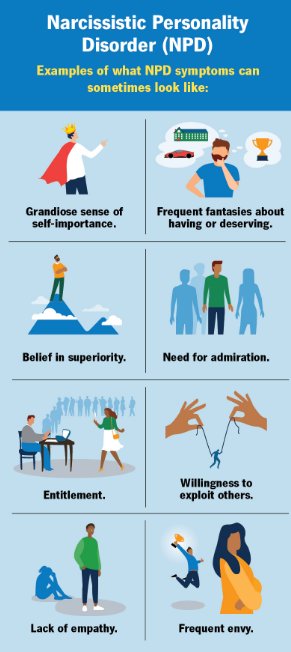
Their grandiose self-experience is an unrealistic overvaluation of their own talents, invulnerability, uniqueness, and superiority. Some researchers believe NPD involves an unhealthy method of self-esteem regulation that stems from efforts to maintain an unrealistically positive self-image.
Research finds narcissists possess a heightened sensitivity to threat and finds a positive relationship between narcissism and hostility. This suggests…they react with anger and aggression when those feelings of self-worth are threatened by others. Narcissists may dismiss the threat, while disparaging message and messenger. They also may turn on those they see as competitors that outperformed them. —Susan South, et al., “Personality and the derogation of others: Descriptions based on self- and peer report,” Journal of Research in Personality, UVA/Open Scholar
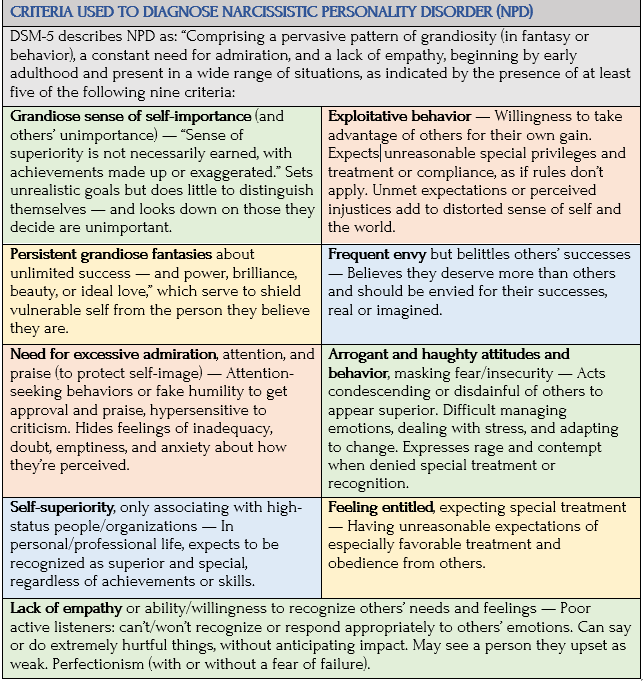
Sources: Cleveland Clinic, Psychiatry Online
Recognizing the Signs of NPD
Most narcissists in psychiatric care were led there by someone who recognized the signs — but the signs are contradictory. We may not, for example, think we can hurt a narcissist’s feelings. But we can. They react differently largely due to a poor understanding of appropriate and proportional emotional responses. They might react more defensively, with more hostility and anger, and hold onto grudges longer.
As a family member, we may unwittingly provoke a hair-trigger reaction to the mildest of comments — as if anything less than 100% support means we intended to offend, accuse, or judge. Or a joke is misheard. There’s no pulling back, at least not in the moment. If we’re lucky, we might be able to clear the air later, when calm.
Research shows the narcissist’s thought-processing is different — and new research helps explain the inner mechanisms at work when hurting others. Like avoiding direct confrontation, which surfaces underlying fears and insecurities about losing control or being abandoned.
Insecurity and unstable self-esteem give rise to exaggerated jealousy and possessiveness — emotions they can’t manage so turn to acting abusive to partners, friends, or coworkers. Everything the narcissist feels we do as well, time to time, but not to the degree of mistreating others. That’s when it crosses the line. Many of us fear being “found out” for not measuring up to our own expectations, but we tend to get over it without obsessively ruminating about what we want others to think about us—a common feature of NPD.
Another feature is emotional withdrawal after experiencing a major setback. Since narcissists crave and feel entitled to external validation, a crushing disappointment (losing a job or partner) can cause intense frustration and rage — one of many reasons for going silent. Another reason is solidifying their hold over a partner.
These uneasy ways of processing thoughts and feelings — whether from threats to self-esteem or from not getting needs met for attention and deference — helps explain NPD symptoms of common mood swings and erratic, often cruel behavior.
In this next chart, I group characteristics — formal and informal — according to patterns of behavior:
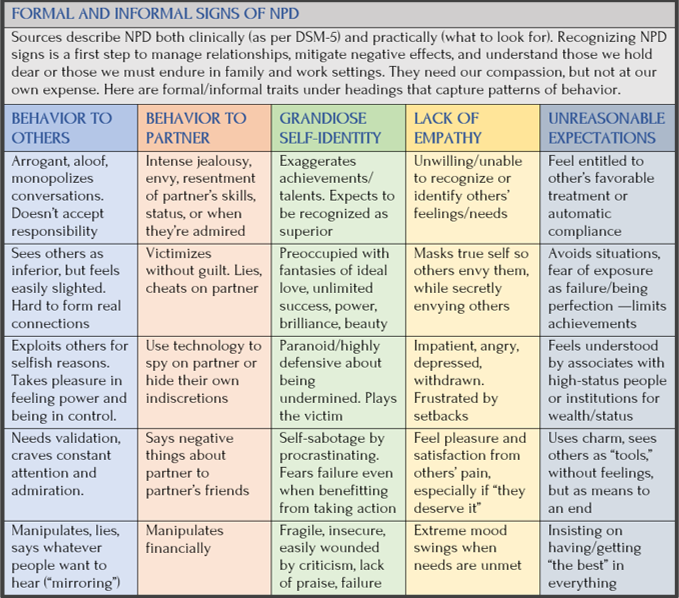
Sources: DSM-5-TR; “Living with Someone Who Has Narcissistic Personality Disorder,” Medscape; blog by Dr. Phil Chanin; Anna Mason, “What is a Covert Narcissist? Understanding the Signs and Symptoms, All Points North; Very Well Health; psychiatric nurse, Jason Hetrick, Quora
Narcissist Vignettes: In Their Own Voice
In web searches, not surprisingly, most personal stories I found were by victims of narcissism, not by narcissist themselves. But I did find two and included excerpts from their writing voices [edited for grammar/brevity]:

Photo: Shutterstock
I am diagnosed with narcissistic personality disorder. I understood my life didn’t work the way it should. I couldn’t achieve any of my actual goals. I kept damaging and driving away people I “loved” and needed. I kept feeling worthless and anxious no matter what I did. I decided to try and understand what was going on and how to “fix it.” It’s been a 13-year journey so far. I keep getting more insights. The following is a recent discovery that really did blow me away.
For the longest time I was aware of lacking empathy, which was undefined, loaded with moral judgement, hard to pin down — until I found this description.
Esch’thon continues their explanation:
Empathy is observing another living being. Mirror-neurons trigger an imitation of that person’s emotional state. If they’re hurt, empathy will cause a degree of perceived physical pain in the same area of the body. If they’re sad, empathy will cause sadness as well. Same for joy, satisfaction, wonder, surprise, et cetera.
I don’t have that.
Most people seem to take this “sense” for granted, never being able to imagine someone lacking it. One reason why we’re judged to be cold, emotionless, cruel, or manipulative is the assumption we’re actively ignoring others’ feelings. Shocker—we can’t sense them. I got oh so many explanations and pleas to recognize and accept others’ feelings, instead of an explanation of what they keep ranting on about.
My NPD diagnosis became manifest through my own research and eventually a competent therapist who did not just send me away. I was confronted with assumptions —autism, psychopathy, etc.—all dead wrong. So I was just being an asshole it seemed.
Turns out, emotional and bodily empathy is located mainly in a certain region of the brain—right insular cortex—and works through a neuron that creates long, associative connections in the brain. Seems this thing is defective in my brain. Those cells are either too few, absent, or misplaced somewhere else. Studies aren’t conclusive—the sample size of narcs willing to get brain-imaged for defects is pretty small (surprise!), but the description of what this is supposed to do fits. —Esch’thon, “Narcissism and Empathy,” Medium
They see the consequences of their empathy “defect” as massive and their hold on self-worth and identity as tenuous.
My entire life I’ve been trying to get validation of my identity boundaries, some valid feedback on who I am. Good? Bad? Existing? Total silence. No affirmation. Only the destructive feeling of having failed when another interaction detonated.
While a region in my brain seems to have adapted quite well to the repressive climate of my childhood, the rest of me is still programed by evolution to wait for social validation as an indicator of how well I am doing. Of my place in society. An orientation on whether I’m on the right track or dead wrong. My brain waits for a signal on this channel where my antenna is broken. While I can hear the words spoken to me and note my achievements — I never believe them. I keep trying to prove my worth, by hard work and sacrifice or through good old dominance and control. But the answer I am programed to seek never comes. —Esch’thon, “Narcissism and Empathy,” Medium
Anonymous’ Story

On another Medium page, psychologist Ayaz Ali shares an anonymous narcissist’s story, “I am a Narcissist, and I am Learning to Feel Safe: A Journey Beyond the Stigma.”
My name is not important, but my story is. I have two personality disorders: borderline (BPD), in remission, and NPD, which I actively manage in therapy. Trauma forged my disorders, primarily medical trauma. When I was 14, I developed severe, debilitating visual conditions of constant flashing lights and flickering vision. Doctors told me it was anxiety. For years, the very people who were supposed to help me gaslit me.
That experience made me distrust myself. “Maybe I’m just crazy” or “No one will believe what’s happening to me.” My sense of reality and safety broke before I became a teen.
BPD and NPD can both involve low empathy during emotional dysregulation, a fragile sense of self, and chronic emptiness. The key difference for me lies in expression. As a covert narcissist, I don’t walk around thinking I’m better than everyone else. I use airs of superiority to mask deep feelings of inferiority and worthlessness. The grandiosity is a persona, a mask that hides who I am underneath.
Anon narcissist writes how he didn’t act like a good person, but was manipulative, cold, and cruel — the emotionally abusive one in relationships.
I saw people as pawns. Everything felt like a competition or a threat. I played the victim to gain sympathy and used cruelty and fear to feel power and control. I took pride in emotionally hurting people. That felt like a twisted achievement.
A pivotal moment came when he became involved with another narcissist, who he describes as “Machiavellian, vindictive, and intelligent.”
They tore me down until I felt like a shell, broken and empty. Afterward, I fell into despair crying, nightmares, and flashbacks. I had to admit that I had treated others in similarly damaging ways. That relationship catalyzed change. It made me say, “I need help.” In a strange way, I feel grateful for it. Without that collapse, I might still act in cruel, manipulative ways.
He then describes years of treatment and efforts to build a healthy relationship with someone supportive. He ends his story with this:
The work never ends. I still struggle with jealousy, entitlement, and viewing the world as a competition. When I start to see my partner as a transaction, I stop and reframe. My mind tries to enter defense mode, and I tell myself, “You are safe. You do not have to think that way.” I also live with extreme hypervigilance and anxiety. On the outside, I mask well. Inside, I feel jittery and rarely at ease. My main goal for the future is simple: I want to feel safe. —Anonymous author, “I am a Narcissist, and I am Learning to Feel Safe: A Journey Beyond the Stigma,” posted by psychologist Ayaz Ali, Medium
Coming Up Next

 English