Narcissism and the Rest of Us
Show Table of Contents
INTRODUCTION
NARCISSISM DEFINED
2. Is There a Narcissist in Your Life?
3. Narcissus and the Origins of Narcissistic Thought — Part I
4. Narcissus and the Origins of Narcissistic Thought — Part II
5. Narcissus and the Origins of Narcissistic Thought — Part III
NARCISSISTIC DEFENSES
6. A Narcissist’s Self-Defense — Part I
7. A Narcissist’s Self-Defense — Part II
8. A Narcissist’s Self-Defense — Part III
NARCISSIST PERSONALITY DISORDER VS TRAITS
9. When Narcissism is a Personality Disorder
10. Narcissism and the Maladaptive Umbrella
11. Malignant Narcissism and the Narcissism Spectrum
12. When Narcissism is Compounded by Comorbidity
NURTURE VS NATURE
15. Narcissism: Flipping Self-Esteem on its Head
16. The Double-Edged Sword of Grandiose Narcissism
NARCISSISM’S DARK SIDE
19. Narcissistic Rage and Narcissistic Self-Awareness
20. Trait Narcissism and the Illusion of Control
21. Beyond Narcissism: Dark Personality Traits — Part I
22. Narcissist Sociopaths: Dark Personality Traits — Part II
ROMANTIC LOVE AND BOUNDARY-SETTING WITH A NARCISSIST
23. Romantic Love with a Narcissist — Part I
24. Romantic Love with a Narcissist — Part II
25. The Narcissist’s Non-Apology Apology
26. Boundary-Setting with Narcissists — Part I
27. Boundary-Setting with Narcissists — Part II
28. Boundary-Setting with Narcissists — Part III
29. Shattering Narcissus’ Mirror… So They Can Live
CONCLUSION
30. On Narcissism: What About the Rest of Us?
15. Narcissism: Flipping Self-Esteem on its Head

Photo: iStock
Narcissism’s relationship to self-esteem isn’t what it was once thought to be, according to new research. Narcissism isn’t just a mask for underlying shame or low self-esteem. In the past, self-esteem in narcissists was measured by self-reports, but the nature of narcissism is that self-reporting is unreliable. In fact, research finds narcissistic self-esteem fluctuates widely based on complex factors having to do with different origins, different types of narcissism, and varied circumstances. It’s as different from healthy self-esteem as other narcissistic traits are from healthy behavior. It’s important to explore this distinction.
We know narcissism is strongly linked to flattering self-evaluations. In reading Mary Trump’s book about her famous uncle, Too Much and Never Enough: How My Family Created the World’s Most Dangerous Man, we learn that lying and self-aggrandizement were the way to get along with her grandfather, Donald Trump’s father (confirmed by Trump’s sister). The Park/Colvin research team, as cited below, confirm narcissism as related to “an overestimation of intelligence and physical attractiveness, performance, and personality.” And, on a social media site, one poster wrote, “The narcissist’s biggest weakness is that they overestimate their intelligence and power, and underestimate yours.”
Narcissists are preoccupied with managing their esteem, image, appearance, and social rank. They see the world and themselves in a hierarchy status, where they’re superior and others are inferior. In their mind, their superiority entitles them to special privileges others don’t deserve. Their needs, opinions, and feelings count, while those of others don’t or only do to a lesser degree. They have grandiose fantasies of greatness, where they’re the most attractive, talented, powerful, smartest, strongest, and wealthiest. —Darlene Lancer, “Narcissists’ Tactics to Gain Power and Self-Esteem,” Codependency
Another thing we know from research is a strong association between narcissism and aggression, when the narcissist is ego-threatened. After receiving negative performance feedback, for example, narcissists are more likely than others to express anger and verbal aggression — especially when ego-threat comes from social rejection.
It is an aggressive act to belittle or “derogate” another person, and research has demonstrated a positive link between narcissism and other-derogation, especially when ego threat was present. People high in narcissism rated peers’ personality traits more negatively…even when the peer exhibited superior task performance. Similarly, after receiving negative performance feedback, narcissists retaliated by rating the evaluator low on competence. — Sun Park (Korea University) and C. Colvin (Northeastern University), “Narcissism and Other-Derogation in the Absence of Ego Threat,” Journal of Personality, People/UNCW
But what’s the evidentiary link between narcissism and self-esteem? Do narcissists have high or low self-esteem — and how do they compare to non-narcissists with high self-esteem, especially when faced with anything threatening their public persona?
Debunked Theories

The most prominent debunked theory is the “mask model” of narcissism, which believes narcissistic grandiosity and arrogance are façades to hide a shattered sense of self and low self-esteem. A second overly simplified view is that narcissism is synonymous with inflated self-esteem, when research suggests narcissism and high self-esteem are distinct.
In her Codependency article, “Narcissists’ Tactics to Gain Power and Self-Esteem,” therapist and attorney Darlene Lancer writes, “Narcissists have been shown to lie on tests. However, when researchers subjected them to a polygraph test where being found out would reflect poorly on them, they didn’t lie, and their self-esteem scores declined markedly.” She cites DSM-5 indicating narcissists’ “self-appraisal fluctuates between extreme inflation and deflation.”
Other-Esteem
Lancer adds, narcissistic self-esteem doesn’t come from within, but requires external validation.
People usually think “high self-esteem” is optimal. However, esteem that relies on others’ opinions is not self-esteem, but “other-esteem.” I believe unrealistic and other-dependent self-esteem is unhealthy and prefer to describe self-esteem as either healthy or impaired. Ranking their self-esteem high is misleading, due to the fact it’s generally inflated and unrelated to objective reality. Additionally, it’s fragile and easily deflated.
Healthy self-esteem is stable and not so reactive to the environment. It’s non-hierarchical and not based on feeling superior to others. Nor is it associated with aggression and relationship problems, but the reverse. People with healthy self-esteem aren’t aggressive and have fewer relationship conflicts. They’re able to compromise and get along. —Darlene Lancer, Codependency
In this post, I’ll share insights about narcissism and self-esteem that distinguishes healthy from “impaired,” using Lancer’s distinction. Along the way, I’ll define some unwieldy terms — like other-derogation (devaluing others to boost narcissistic ego) and ego-threat (challenging the narcissist’s inflated, but fragile self-esteem, triggering an aggressive reaction).
Narcissistic individuals create psychological breakwaters to keep threatening information from reaching their highly favorable self-concept. Research suggests they use defensive strategies in response to ego threat… They also use self-serving attributions more than people low in narcissism. In one study, participants downplayed the importance of a test they just failed. People high in narcissism attributed failures to collaborators and successes to themselves more than those low in narcissism. —Park/Colvin, People/UNCW
Two Portraits of Self-Love: Narcissism and Self-Esteem

Photo: Nature
Whether in research or in life, we compare ourselves to others to self-evaluate, regardless if it’s about our creative or work performance, personal relationships, appearance, or personality. In the absence of other measures, we might rate our “agreeable” quotient or our artistic talent in comparison to those around us.
Park/Colvin’s research compared high narcissists to non-narcissists with high self-esteem to see differences in how they think about and behave toward others. The study confirmed why severe forms of narcissism are pathological and not “normal.” And why narcissism is not another word for self-esteem.
Research Terms used in the following chart
Ego-threat = A challenge or attack on a narcissist’s sense of self, competence, or superiority, such as being criticized for a failure, being outperformed by a rival, or having their status challenged. Ego-threats trigger aggression as a defensive mechanism to protect their inflated, unstable self-esteem and self-worth.
Other-derogation = Narcissists demean others to bolster their fragile self-esteem, whether ego-threatened or not. They belittle competitors, dismiss criticism, project their poor performance or insecurities onto others, or lash out aggressively at anyone who outperforms them. This can include groups they’re not a part of — possibly a form of racism/prejudice.
Agency/agentic = A healthy individual’s ability, will, or capacity to get ahead, live independently, and achieve life goals through self-directed, autonomous action. An agentic narcissist, however, involves an inflated sense of power, status, and success.
Communion/communal = A healthy individual’s desire to form bonds with others by being warm, compassionate, and cooperative and find fulfillment through relationships. A communal narcissist, however, wants to be seen as helpful, selfless, or giving—often to the detriment of genuine concern for others.
Better-than-average effect = A research term for a common tendency to rate one’s traits more positively than rating the average person’s traits.
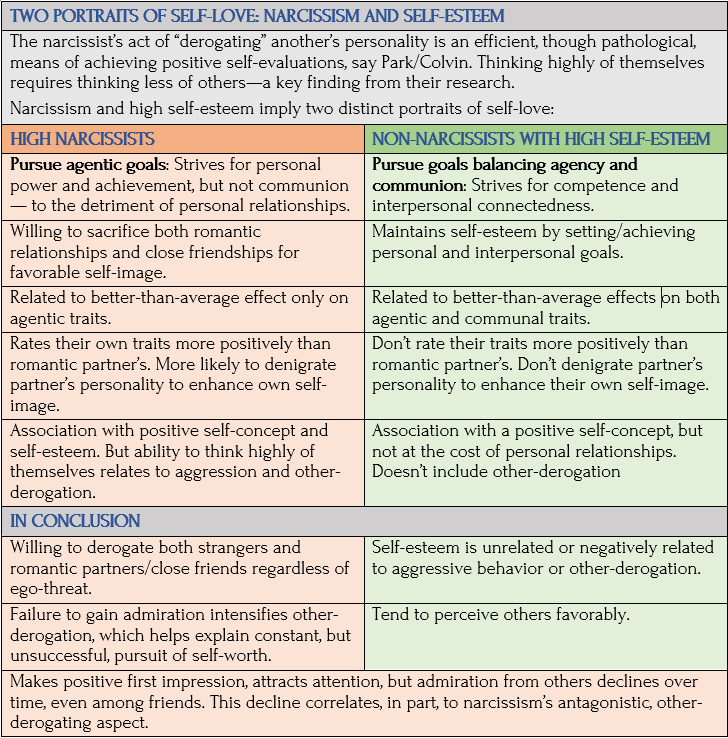
Source: Sun W. Park (Korea University) and C. Randall Colvin (Northeastern University), “Narcissism and Other-Derogation in the Absence of Ego Threat,” published in the Journal of Personality, People/UNCW
Narcissistic Personality Disorder (NPD) and Self-Esteem
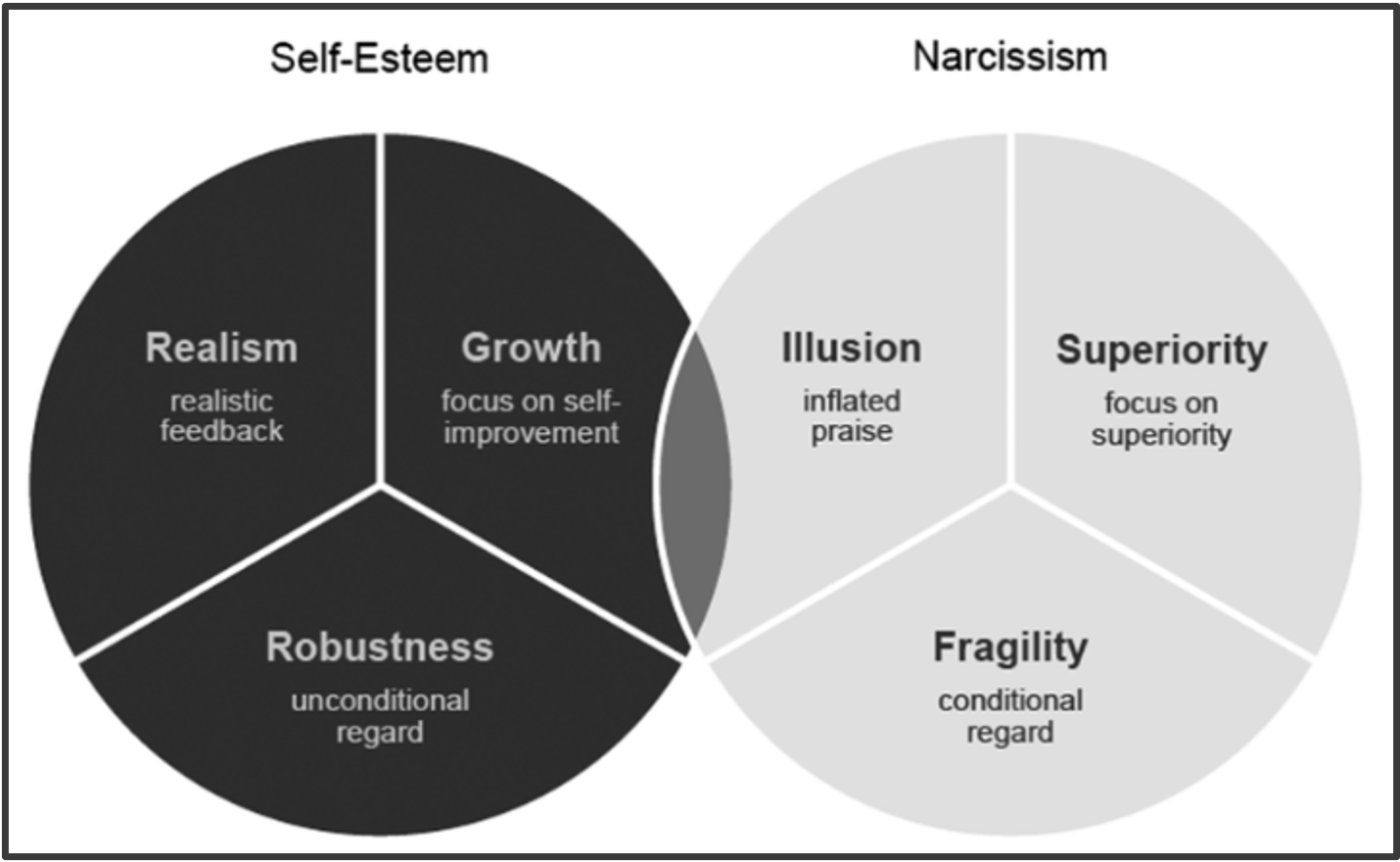
Susan South and her University of Virginia research team — in their study, “Personality and the derogation of others: Descriptions based on self- and peer report,” Journal of Research in Personality, UVA/Open Scholar — had this to say about NPD and self-esteem [paraphrased, edited for brevity]:
Hypothesized pillars of self‐esteem and narcissism, and the socialization experiences to cultivate them. Overlap between the circles reflects the weak correlation between self‐esteem and narcissism. Research Gate
Some researchers believe narcissistic personality disorder involves an unhealthy method of self-esteem regulation that stems from efforts to maintain an unrealistically positive self-image. It’s likely the narcissist thinks and perceives the world free of helplessness and low self-esteem — to establish control over their own experiences.
They force attention on themselves to undo feelings of inadequacy, but then project their feelings of inferiority on those they strive to impress.
Research finds narcissists possess a heightened sensitivity to threat, with a positive relationship between narcissism and hostility. This suggests — whether showing grandiose feelings of superiority because of true self-worth or to protect damaged self-esteem — they react with anger and aggression when those feelings of self-worth are threatened by others. Narcissists may dismiss the threat, while disparaging message and messenger. They also may turn on those they see as competitors that outperformed them. —Susan South, et al., “Personality and the derogation of others: Descriptions based on self- and peer report,” Journal of Research in Personality, UVA/Open Scholar
Narcissism, Aggression, and Self-Esteem
South and team cite two studies worth giving a quick summary overview:
Social psychology researchers/professors Brad Bushman (Ohio State University) and Roy Baumeister (Florida State University) measured narcissistic aggression in a study of controlled successes/failures. Narcissists had the highest levels of aggression, regardless of whether the evaluation was negative or positive. A less surprising result is having the highest aggression when receiving negative (“threatening”) evaluations. But the authors, who note narcissists aren’t aggressive toward a neutral third person, targeting aggression at the specific ego-threat, write, “They merely wish to strike back at direct threats to their self-esteem.”
In another study of self-esteem, threat, and aggression, the team of Carolyn Morf (University of Bern) and Frederick Rhodewalt (University of Utah) found narcissists experience extreme fluctuations in mood in response to failure (also in a research setting of controlled successes/ failures). Narcissists who initially succeed and then fail at the same task react with the most anxiety, anger, and changes in self-esteem. They self-aggrandize by attributing success to their own ability, while externalizing failure (displaying hostility and blaming others).
In the opposite failure-to-success sequence, narcissists showed the happiest response. The authors conclude, narcissists attribute their entire sense of self-worth to feedback from others. Narcissists react to feedback, whether negative or positive, in a manner that safeguards and maintains their self-regard.
In citing these two studies, South’s team concludes narcissists strike out at a person who threatens their self-concept. However, their results also suggest “other-derogation” is more than a narcissistic defensive or self-regulation strategy. It’s a character trait, as they come off to their peers as “cold, aloof, and unusual.”
We believe other-derogation is a type of self-regulatory process, and we can now distinguish differences in how persons with pathological defenses, like other-derogation, view themselves as opposed to how they are viewed by their friends. —Susan South, Thomas Oltmanns, and Eric Turkheimer, “Personality and the derogation of others,” Journal of Research in Personality, UVA/Open Scholar
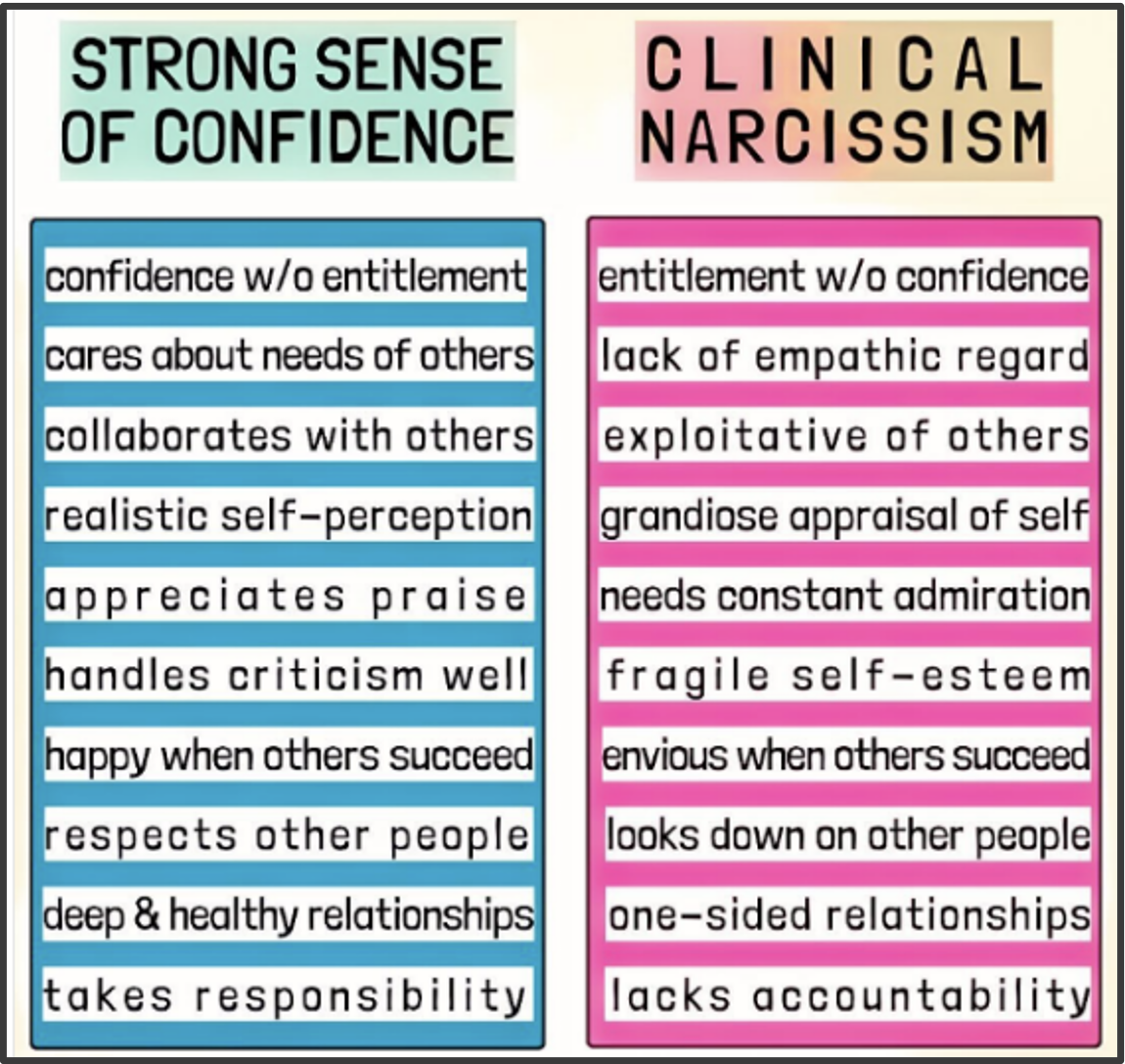
What research says in thousands of words, psychologist Josh Mirmelli says succinctly in his graphic. I especially love comparing “confidence without entitlement” (high self-esteem) vs “entitlement without confidence (high narcissism).
The key difference between clinical narcissism and high self-esteem lies in the way individuals perceive themselves and interact with others. —Psychologist Josh Mirmelli, Instagram
Graphic: Josh Mirmelli, Instagram
Here’s another psychologist’s take on the question of narcissism’s impaired self-esteem.
According to research, narcissism is not an “extreme manifestation of high self-esteem.” The person high in self-esteem sees themselves as worthy; the narcissist sees themselves as superior. Despite both traits being connected with favorable views of the self, they differ qualitatively. Self-esteem is more of a measure of adequacy rather than an inflated sense of self-importance. And they are not codependent. A narcissist may even see themselves as low in self-esteem. I may be better than everyone else, but I am still not happy with who I am. —Psychologist Jeremy Sutton, PhD, “Self-Esteem Research: 20 Most Fascinating Findings,” Positive Psychology
Words Referring to Self
Ever feel confused by the difference between self-esteem, self-efficacy, and many more compound versions of same? I end this post with a chart drawn from an amalgam of psychologists’ understandings of how these terms relate — whether or not we’re narcissists.
Self-esteem is a reflection on how we see ourselves and our sense of worth. It is not binary — very high or extremely low — it’s on a scale. Like self-efficacy, self-esteem is based on our judgment.
People strive to feel good about themselves or seek to maintain their self-esteem, and this is fundamental to human nature. Self-esteem is a judgment or self-evaluation of our work or goodness and how well we feel we’re doing in areas of our life that we rate as important. —Cognitive scientist Juan Yang
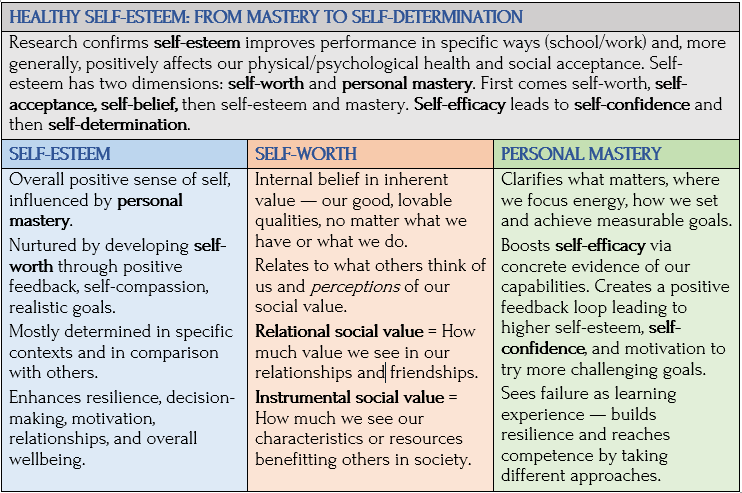
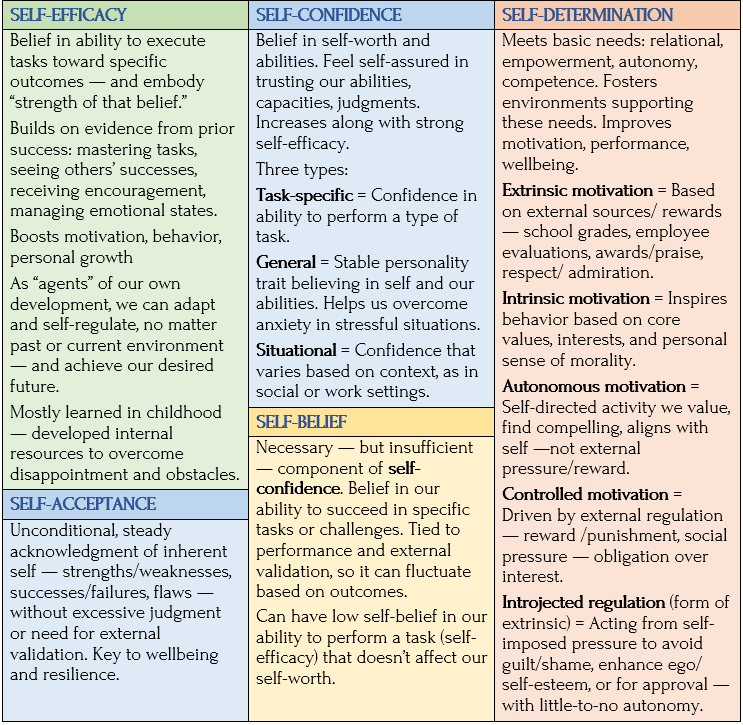
Sources (from psychologists with PhDs): Jeremy Sutton, “Self-Esteem Research: 20 Most Fascinating Findings,” Positive Psychology; Pylin Chuapetcharasopon, “Is It High Self-Esteem or Narcissism?” Dr. Pylin Coaching; Reena Sandhu, “How to Reduce Anxiety and Enhance Self-Esteem through Personal Mastery,” Canadian Counseling and Psychotherapy Association (CCPA). Also: Psychology Dictionary Online
Coming Up Next
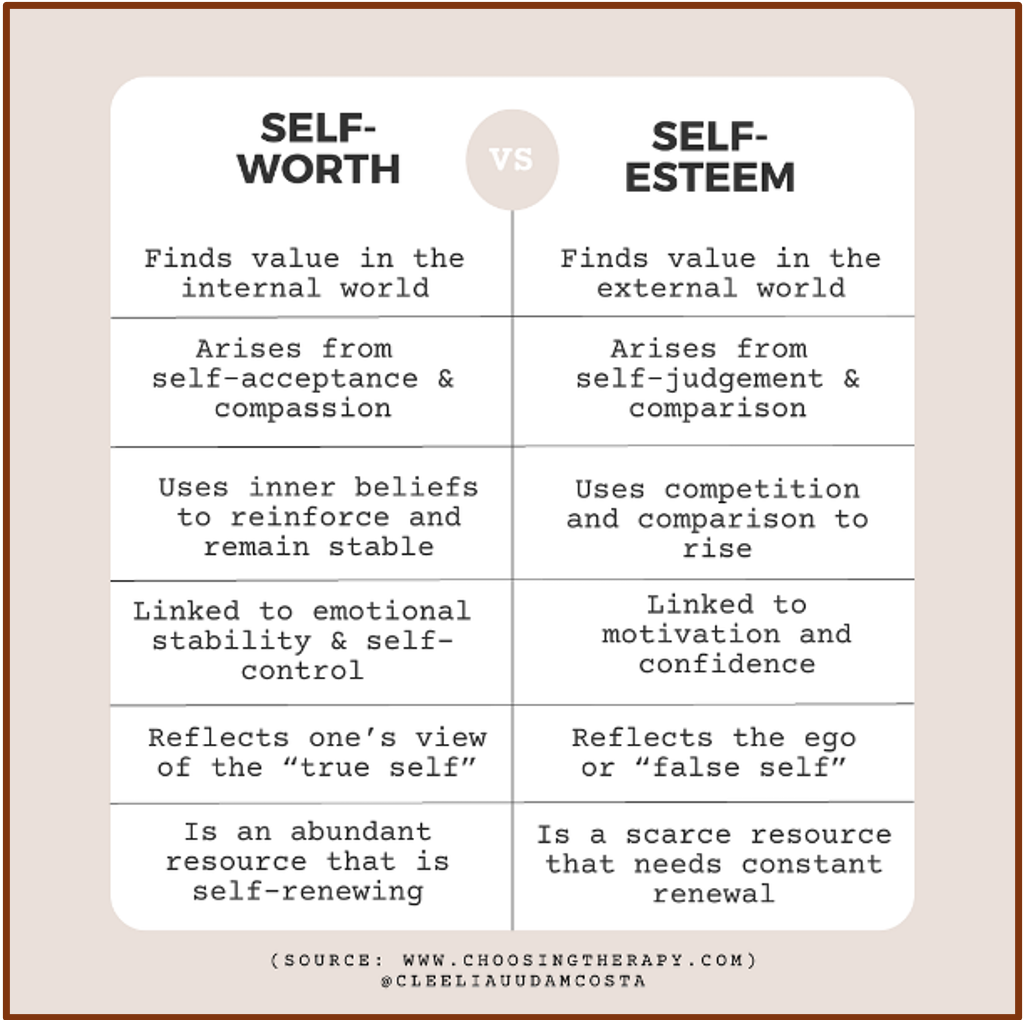
“Self-“ terms describe what most of us strive for, in varying degrees and changing circumstances. In Post 16: The Double-Edged Sword of Grandiose Narcissism, I describe narcissists’ endless pursuit of status (money, social standing, fame) and their rage when thwarted or threatened — all based on recent research. In somewhat controversial findings, I’ll show a new framework for the “double-edged sword” of grandiosity: admiration and rivalry, as it applies to more severe cases of narcissism. What we now know about the distinction between narcissism and healthy self-esteem, even when self-esteen is considered “high,” is a fitting segue to understanding narcissism’s darker nature.
 English