
Narcissism and the Rest of Us
Show Table of Contents
INTRODUCTION
NARCISSISM DEFINED
2. Is There a Narcissist in Your Life?
3. Narcissus and the Origins of Narcissistic Thought — Part I
4. Narcissus and the Origins of Narcissistic Thought — Part II
5. Narcissus and the Origins of Narcissistic Thought — Part III
NARCISSISTIC DEFENSES
6. A Narcissist’s Self-Defense — Part I
7. A Narcissist’s Self-Defense — Part II
8. A Narcissist’s Self-Defense — Part III
NARCISSIST PERSONALITY DISORDER VS TRAITS
9. When Narcissism is a Personality Disorder
10. Narcissism and the Maladaptive Umbrella
11. Malignant Narcissism and the Narcissism Spectrum
12. When Narcissism is Compounded by Comorbidity
NURTURE VS NATURE
15. Narcissism: Flipping Self-Esteem on its Head
16. The Double-Edged Sword of Grandiose Narcissism
NARCISSISM’S DARK SIDE
19. Narcissistic Rage and Narcissistic Self-Awareness
20. Trait Narcissism and the Illusion of Control
21. Beyond Narcissism: Dark Personality Traits — Part I
22. Narcissist Sociopaths: Dark Personality Traits — Part II
ROMANTIC LOVE AND BOUNDARY-SETTING WITH A NARCISSIST
23. Romantic Love with a Narcissist — Part I
24. Romantic Love with a Narcissist — Part II
25. The Narcissist’s Non-Apology Apology
26. Boundary-Setting with Narcissists — Part I
27. Boundary-Setting with Narcissists — Part II
28. Boundary-Setting with Narcissists — Part III
29. Shattering Narcissus’ Mirror… So They Can Live
CONCLUSION
30. On Narcissism: What About the Rest of Us?
13. The Nurture of Narcissism

Photo: iStock
In the 20th century, theories proposed narcissism originated in infancy and extended to adult trauma. Research didn’t have the tools, know how, nor motivation, it seems, to explore further. So narcissism became a back-burner issue for several decades. That all changed in the 2000s, when understanding narcissism kicked up new scientific and public interest. This was possibly due, in part, to the explosion of the self-help industry, the “me” generation, and popular culture: books, TV, and movies exploring the inner motivations of complex people, whether creative or criminal. Another possibility was growing understanding of the prevalence of narcissism and its negative impact on people around them and on society.
This renewed interest also fueled a thorough research program on what exactly constitutes narcissism as a personality trait and as a clinical disorder, what are its antecedents, and its personal and interpersonal consequences. To this end, only a few personality constructs have received attention from so many different perspectives as is the case for narcissism. Different but overlapping theories have been put forward from social/personality psychology, clinical psychology, and psychiatry. —Researchers Emanuel Jauk and Philipp Kanske, “Can neuroscience help to understand narcissism? A systematic review of an emerging field,” PubMed/NIH
Environmental and Biological Research of the 21st Century
Large-scale studies of narcissistic traits and reliable, validated personality questionnaires score individuals on their type of narcissism and its degree of intensity. According to sites like Charlie Health, Mayo Clinic, Cleveland Clinic, and Wikipedia, the causes of narcissistic personality disorder (NPD) are as complex as the disorder itself. “Genetic factors create susceptibility, while environmental factors, like parenting and traumatic experiences, can alter the likelihood of that susceptibility developing into a personality disorder.”
“There’s evidence that narcissism is genetic, though it’s small. Within families, you’re looking at shared genes, but you’re also looking at behaviors that are learned from generation to generation.” Most researchers lean toward nurture rather than nature. “It’s pretty easy to answer from the perspective of grandiose narcissism that parents kind of create these little narcissists.” —Amy Brunell, professor of psychology and narcissism researcher at Ohio State University, quoted by Jeffrey Kluger, “How to Deal With a Narcissist,” Time
The Environment
Many environmental factors — in addition to child-caregiver relationships — contribute to narcissism.
Almost every study concludes with the caveat of “preliminary” evidence with small-to-moderate effect sizes. “Correlation not causation.” “We believe our study sheds further light on sociological trends and justifies further investigation…” With that in mind, here’s examples of correlation:
- Negative childhood experiences, with early or persistent trauma, emotional (rejection, neglect) or physical abuse.
- Dysfunctional parent-child relationships that swing from too much adoration to too much criticism—neither matching the child’s actual efforts or achievements–causing adult narcissists to struggle when things don’t go their way.
- Cultures that encourage individualism and independence are riskier for NPD than those encouraging community and collective action. According to Aline Vater’s research, PubMed Central, “Individualistic cultures encourage a stronger focus on the self, whereas collectivistic cultures emphasize the importance of social values …. Members of individualistic cultures may be more narcissistic than individuals from collectivistic cultures.”
- Excessive social media use that’s associated with narcissistic traits in younger generations.
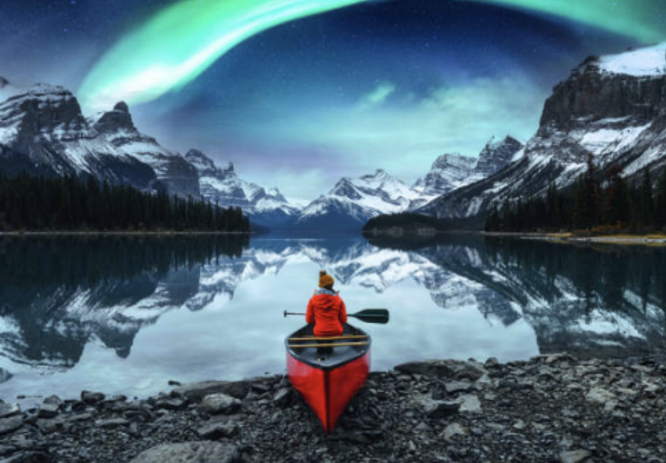
Whether shopping in a busy mall or outdoor market, raising a child, or pursuing the aurora borealis, people live in cultures around the world that are both more and less inclined to give rise to narcissism:




Photos: Adobe, Shutterstock, iStock
The chart below shows some findings from recent research studies that looked into environmental causes of narcissism:
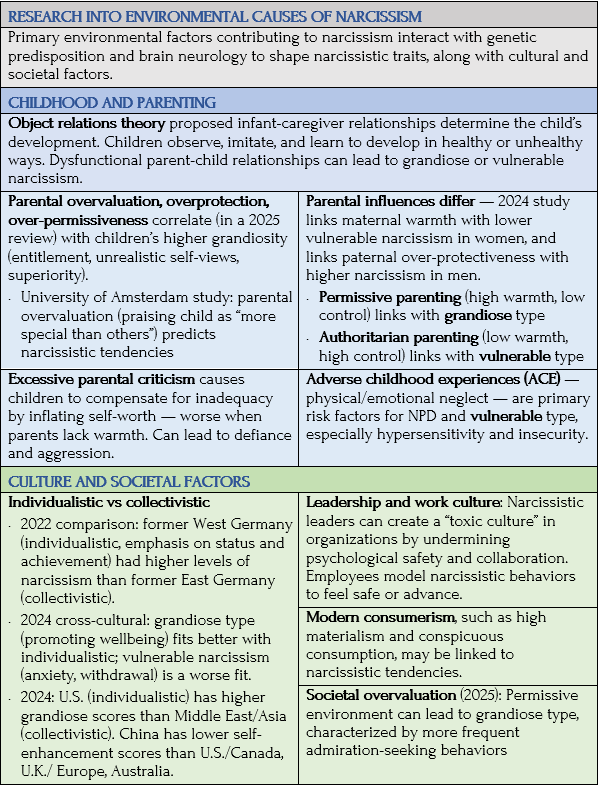
Sources: Mircea Cătălin Dîrțu and Oara Prundeanu, “Narcissism and Pro-Environmental Behaviors: Mediating Role of Self-Monitoring, Environmental Control and Attitudes,” MDPI; Aline Vater, “Does a narcissism epidemic exist in modern western societies? Comparing narcissism and self-esteem in East and West Germany,” PubMed Central; David Kealy, et al., “On overvaluing parental overvaluation as the origins of narcissism,” PNAS
This chart summarizes Jauk and Kanske’s psychological and behavioral studies, including self-ratings by grandiose and vulnerable narcissists:
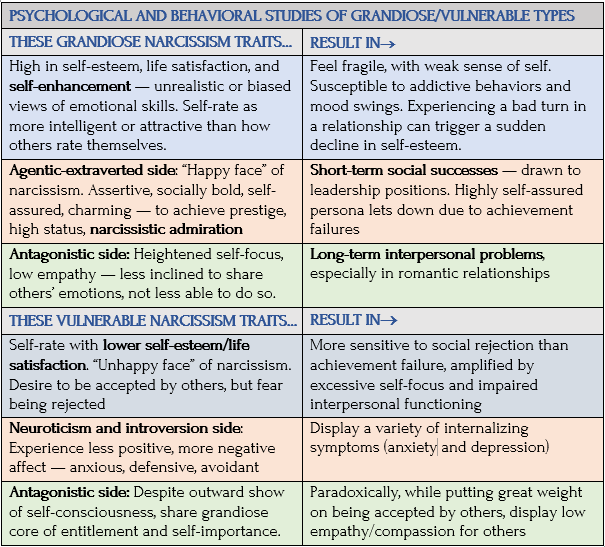
Source: Emanuel Jauk and Philipp Kanske, “Can neuroscience help to understand narcissism? A systematic review of an emerging field,” PubMed/NIH
Social Media Use and Narcissism

According to psychologist Craig Malkin, author of Rethinking Narcissism, social media can foster healthy or unhealthy narcissism depending on use: “We never feel genuinely self-confident when we bury our true nature. We assume that whatever we’re concealing is somehow shameful and that we’re wise to keep it secret if we want to be liked and loved.”
Photo: Magnific
By approaching social media (SM) mindfully and prioritizing genuine connection, users can engage productively while avoiding its pitfalls. Keeping balance, users can expand social support networks and foster a sense of purpose within a larger community. Malkin suggests also having real friends, being open about both successes and struggles, joining purpose-driven communities, using SM intentionally, and following positive role models. However, most research points to an unhealthy alliance between grandiose narcissism and SM use.
As social media sites have blossomed so too has the interest in social media and narcissism. Still, this field of research is only seven years [first paper published in 2008]. We now have relatively robust evidence that grandiose narcissism is associated with social networking behavior across many — but not all — conditions. —JL McCain and WK Campbell, University of North Carolina Wilmington
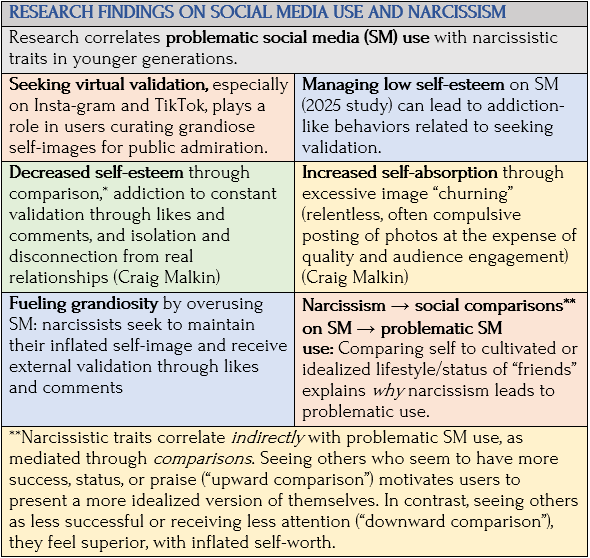
Sources: AI Xiangling Hou, et al., “Longitudinal association between narcissism and problematic social networking sites use, PubMed/NIH; Alessandro Musetti, “Vulnerable Narcissism and Problematic Social Networking Sites Use,” PubMedCentral/NIH; JL McCain and WK Campbell, “Narcissism and Social Media Use: A Meta-Analytic Review,” University of North Carolina Wilmington.; Craig Malkin, Rethinking Narcissism, 2015, as summarized by Shortform
Coming Up Next

In this post, we covered environmental (nurture) risk factors for narcissism. In Post 14: The Nature of Narcissism, I’ll focus on genetic and neurobiological (nature) risk factors for narcissism.
Sources
See end of Post 14
 English