Narcissism and the Rest of Us
Show Table of Contents
INTRODUCTION
NARCISSISM DEFINED
2. Is There a Narcissist in Your Life?
3. Narcissus and the Origins of Narcissistic Thought — Part I
4. Narcissus and the Origins of Narcissistic Thought — Part II
5. Narcissus and the Origins of Narcissistic Thought — Part III
NARCISSISTIC DEFENSES
6. A Narcissist’s Self-Defense — Part I
7. A Narcissist’s Self-Defense — Part II
8. A Narcissist’s Self-Defense — Part III
NARCISSIST PERSONALITY DISORDER VS TRAITS
9. When Narcissism is a Personality Disorder
10. Narcissism and the Maladaptive Umbrella
11. Malignant Narcissism and the Narcissism Spectrum
12. When Narcissism is Compounded by Comorbidity
NURTURE VS NATURE
15. Narcissism: Flipping Self-Esteem on its Head
16. The Double-Edged Sword of Grandiose Narcissism
NARCISSISM’S DARK SIDE
19. Narcissistic Rage and Narcissistic Self-Awareness
20. Trait Narcissism and the Illusion of Control
21. Beyond Narcissism: Dark Personality Traits — Part I
22. Narcissist Sociopaths: Dark Personality Traits — Part II
ROMANTIC LOVE AND BOUNDARY-SETTING WITH A NARCISSIST
23. Romantic Love with a Narcissist — Part I
24. Romantic Love with a Narcissist — Part II
25. The Narcissist’s Non-Apology Apology
26. Boundary-Setting with Narcissists — Part I
27. Boundary-Setting with Narcissists — Part II
28. Boundary-Setting with Narcissists — Part III
29. Shattering Narcissus’ Mirror… So They Can Live
CONCLUSION
30. On Narcissism: What About the Rest of Us?
7: A Narcissist’s Self-Defense — Part II
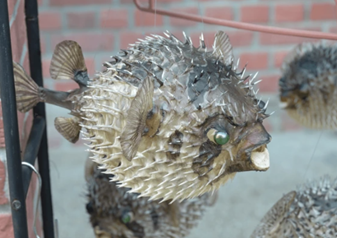
Most narcissistic defense strategies have a dual purpose. One is to protect the ego from being overwhelmed, unmasked, or hurt. And the other is to “offend” by ensnaring, controlling, manipulating, and demeaning those surrounding them. A narcissist’s target can be limited to a single household, a romantic relationship, a classroom, or workplace, or it can encompass an entire nation. In the socio-political realm, narcissists oversee world wars, genocide, and other atrocities. There are no boundaries to the reach and harm they can cause when unexamined and unchecked. We need to guard and organize against it.
In the personal realm, we must limit exposure to those willing to do us harm to fulfil their needs, whatever they are in the moment.
First we must recognize the signs, because they’re infuriatingly hard to detect. If a parent or adult child, we might try to match their behavior tit-for-tat, with similar defensive tactics, making it harder to discern what is and isn’t “narcissistic fire.” Plus, we’ve been pushed to behave in a way we’re not proud of and, in some cases, are deeply ashamed of.
In this post, I continue to add defensive arrows to the narcissist quiver. Taken together — whether defenses formed in the earliest years of life (mirroring, compliance), seeking love relationships (idealization and devaluation or “love-bombing”), seeking friendships (triangulation), or a place in society (masking) — a picture emerges of the narcissist as a lonely, insecure person with a lot of bluster but no roadmap for forming genuine, caring relationships.
But first, we need to understand the concept of narcissistic supply, fundamental to our understanding of why narcissists must sling their arrows to begin with.
Narcissistic Supply
“Narcissists hunger to have their needs met. If you’re in a close relationship with a narcissist, they expect you to ‘supply’ them,” writes therapist/author Darlene Lancer, “What is Narcissistic Supply?” Medium
Babies and toddlers — nature’s purest, most innocent narcissists — need narcissistic supply to give them confidence in their ability to take a step or trust their parents to comfort them when they cry. As healthy children grow and develop, they need narcissistic supply less and independence more.
Photo: Shutterstock

But a lot gets in the way of healthy attachment and development. According to PsychCentral, for those well past childhood, narcissistic supply is a pathological or excessive need for attention or admiration from others, especially codependents — without consideration for the feelings, thoughts, or preferences of others.
Those of us close to a narcissist must act before it’s too late — lest we get caught in a downward spiral of feeding their supply as we hollow out our own. See how you react to these scenarios:

- Your unemployed husband sits for hours each day in front of the TV watching violent, graphic shows. He doesn’t recognize your extreme discomfort. When you complain, he gets furious and storms out the door. The next night, you go to your bedroom to read, closing the door to muffle the noise. He complains bitterly about you not spending time with him but offers no compromise. Quite miserably, you stop confronting him and settle on the couch, your back to the TV and headset on, wondering whether you can afford to leave him.
- Your boss asks you to do something without being clear about what she wants. You follow her to her office to get that clarity. She looks at you like you just spilled hot coffee on her original edition of Shakespeare. While you mumble an
apology, she loudly sighs and explains slowly and deliberately what she’s asking for, to “penetrate your thick skull,” using those words. You retreat with eyes tearing, not noticing her secret satisfaction of having the upper hand. The next morning your anxiety pitches upward as you commute to work.
- Your mother has a major birthday the entire family is celebrating on Saturday, three days from her actual birthday. You intend to call her on her birthday, knowing she expects it. However, you’re distracted by a crisis that consumes the entire morning and forget to call until evening when it’s too late. Instead, you call the next morning, only to be whiplashed by her

Vanity, after photo of Victorian cat by Landor, 1897, The Mall, Ealing. Credit: Duncan GettyImages
anger and name-calling for being insensitive, thoughtless, and “only thinking about yourself, never about someone else.” At the birthday party, she greets you sarcastically. You avoid her until you can leave. You don’t expect an apology for this treatment, just as there’s never been an apology before.
In truth, I made up all but the last scenario. It happened to me. The following birthday, I called on the day. As PsychCentral notes, narcissism is insidious because the same traits that make narcissists intolerable to have in your life cause them to want to be in your life. They have no desire to leave you alone. In fact, they insist on not leaving you alone. Because of their all-consuming need for narcissistic supply.
Let’s hear from a self-described narcissist [edited for brevity]:
In narcissistic personality disorder (NPD), supply refers to the attention, admiration, or validation we seek from others to bolster our self-esteem and self-worth. We often require this external validation to regulate our self-image and maintain a sense of superiority and grandiosity. This is our food, our fuel. Without it, we perish.
Supply can be divided in two categories:
Social interaction-driven supply includes seeking admiration and attention through social relationships, garnering praise and recognition for achievements or abilities, and manipulating others to gain validation and a sense of control. This type of supply heavily relies on external interactions and comparisons with others to reinforce our self-worth.
Non-social interaction-driven supply: I know it seems contradictory, but this type of supply focuses on personal growth and acknowledging our qualities and strengths without needing constant validation. This includes establishing and managing a successful entrepreneurial venture to attain financial independence and being dedicated to becoming an expert in a specific field.
The catch here is social interaction-driven supply gives the most “high,” but depletes faster. So we become dependent on this type of supply. Learning a new skill stops being something for personal growth and becomes a tool for comparison with others and grandiosity-seeking. Our hobbies become a burden because we need to be the best in everything.
The key to balance is understanding these social driven supplies can NEVER be gone. If we are running low on supply, we will subconsciously seek ways to harvest it and may go to our local sources to gorge on it.
I particularly like to balance my social-driven supply days with days not manipulating and controlling people for the sake of validation. —childofeos, posting on Reddit
Most Common Defensive Behaviors
The following supplements Julie Hall’s list from other sources [edited/paraphrased]:
DENIAL AND PROJECTION
Perhaps the most common narcissistic defenses, denial and projection have a devastating impact on relationships. Denying the uncomfortable reality of a situation and projecting unacceptable thoughts or feelings onto others are normal childhood emotional defenses that narcissists continue into adulthood.
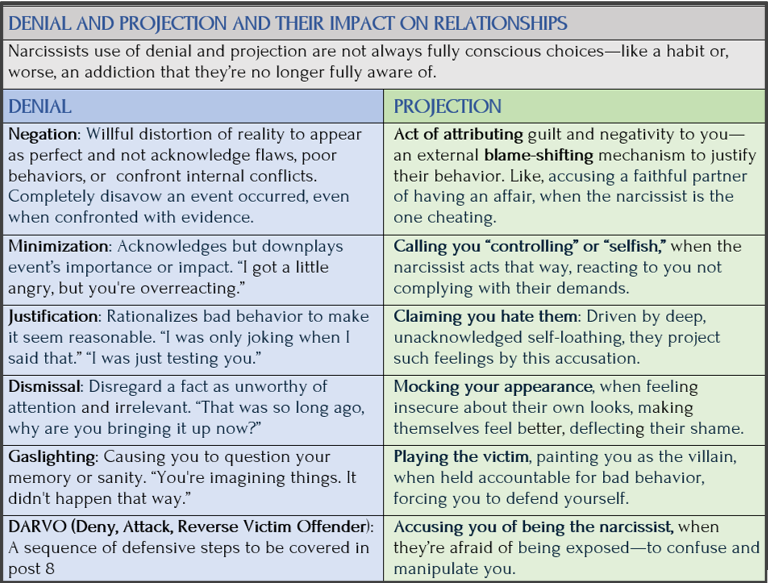
Sources: Julie Hall, “Anatomy of a Narcissist: These are the inner workings of the narcissistic personality,” and Joseph Burgo, “Narcissism and Other Defenses Against Shame,” Psychology Today
INTROJECTION
In contrast with projection, introjection absorbs others’ thoughts and feelings. As children, we internalized our caregivers’ “introjects” of reality (their values, their teaching). As adults, we may still struggle with introjected negative beliefs stemming from our childhoods. Vulnerable narcissists especially tend to internalize dialogue that reinforces negative self-perceptions and self-doubt. They lack clarity about their emotional needs. Instead, they rely on introjected external validation, which can sabotage personal growth and self-esteem and lead to self-fulfilling cycles of failure.
NARCISSISTIC SPLITTING
Splitting happens when the narcissist tries to cope with conflicting feelings between two distorted extremes. One is the repression of any awareness of their worthless and inferior self. The other, a grandiose, superior self. Hall writes, “…narcissism is an inferiority complex managed through a compensatory superiority complex.” They suffer from this internal seesawing, particularly when stressed, leading to compartmentalization of these polarizing traits, while projecting them onto others (the idealizing/ devaluing cycle).
- Unrealistic, unintegrated object (other) relations is the encumbered term for narcissistic children who get “stuck” in emotional splitting (a key feature of healthy child development) and don’t progress to a more integrated, nuanced understanding of people and situations. [See object relations theory, post 5]
EMOTIONAL EMPTINESS AND LACK OF EMPATHY
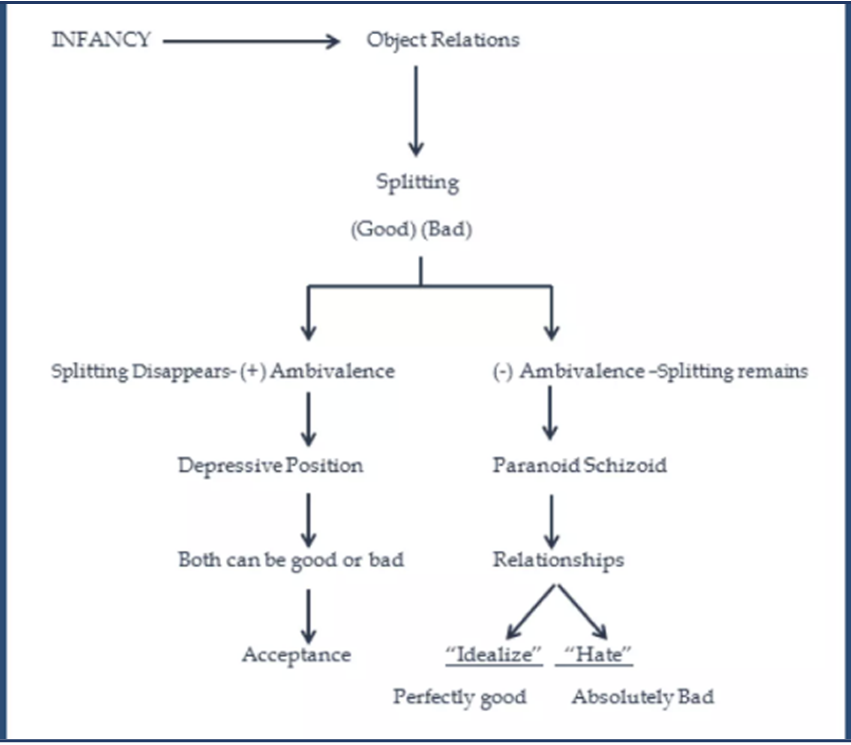
Graphic: Rollin Jay Libo-on, “Object Relation Theory — Melanie Klein,” Slideshare
Artwork: Cartoon Stock
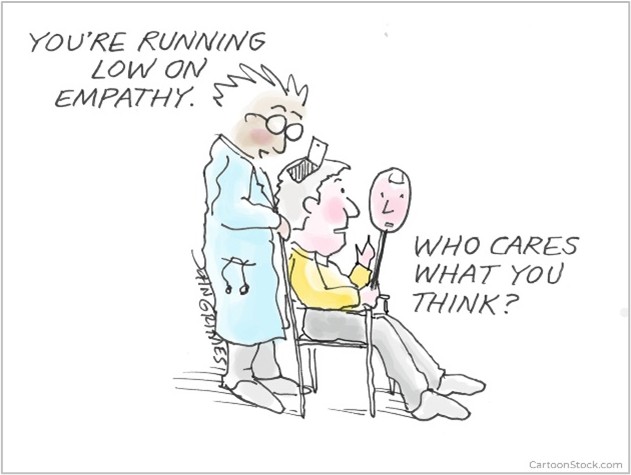
Most everyone who thinks about a narcissist recognizes their low empathy. Lacking self-confidence and empathetic connection with others is a recipe for emotional alienation, according to Hall. “Their basic distrust leads them to avoid vulnerability, which they regard as weakness, and view relationships as struggles for dominance and control rather than opportunities” for personal growth and intimacy. Emotionally detached from others and constantly struggling to shore up their self-esteem, narcissistic people are hyper-fixated on self in interpreting their experiences and relationships. A vicious circle. Empathy is a theme I’ll revisit throughout this blog, especially in how it affects romantic relationships [see post 23].
NARCISSISTIC RAGE
In more severe disorders, narcissists — particularly more overt, grandiose types — can react to major or minor setbacks with intense frustration, triggering rage, passive-aggressiveness, or withdrawal and silence. As Hall notes, these extreme reactions might be to threats to self-esteem or to not receiving enough attention or validation — caused by poor understanding of their own emotional needs and thought processing. For all their bravado, narcissists tend to hate confrontation, reacting to challenges by lashing out in anger. Hall writes this possibly stems from experiencing abuse, so they project their internalized trauma onto others. “Narcissists’ vulnerable self-esteem and delusional grandiosity are a perfect storm for emotional dysregulation and reactivity to disappointments, losses, slights, and conflicts.” [See post 19]
IDEALIZATION VS DEVALUATION CYCLE OF ABUSE
Time with a narcissist is a roller-coaster of happy, angry, loving, and hurtful sensations. The narcissist manipulates their victim in positive-to-negative emotional loops, with the net result the victim is left confused, betrayed, devastated, and even traumatized. At its worse, the victim self-doubts and loses control of how to think and feel.
That’s the end game of a cycle of abusive defense strategies the psych world calls idealization and devaluation (I&D). One moment you’re on a pedestal, the next lying on the floor amid the shards, knees bruised, with no idea of what just happened. Transitions between these extremes can be sudden or gradual and might not stop until the narcissist either moves on to another victim or returns for another cycle, with promises of love and a sparkle in their eyes. We can only hope the victim wakes up and doesn’t fall for it a second go-round.
More recently and more popularly, this I&D process of getting someone close and dependent before maliciously sending them adrift, is referred to as love-bombing. It’s certainly a more memorable term, and that also makes it more valuable — so more people can be alert to its possibility and relate to our understanding of good and bad objects, when object = person.

Photo: Westend61/Getty Images

Photo: Shutterstock
The idealized object remains the good object as long as they gratify the narcissist’s ego. If the narcissist is unhappy with this person, the narcissist immediately switches to idealizing the individual in the devalued position. As the original idealized object “falls from grace,” extreme panic may set in regarding the emotional abandonment. In order to avoid rejection and replacement, the “good object” may be tempted to immediately make a personal sacrifice to please the narcissist and prove their loyalty. This provides the narcissist with an inordinate amount of control in the relationship. —Psychologist Erin Leonard, “Understanding a Narcissist From an Object Relations Perspective, How a narcissist manipulates and controls by playing favorites,” Psychology Today
In I&D, the narcissist is gratified by the ability to gain control of the relationship, keep us off-balance, and weaken us emotionally so we’re incapable of taking decisive action. Two examples of how I&D work to undermine and unsettle us:
- I worked for a nonprofit, where the president had a knack for keeping us off-balance. Just when we thought things were going well, especially after a particular success, she’d pull the rug out from under us — maybe say something belittling in a meeting — lest we become over-confident or too secure. It was unsettling. I wasn’t the only one riding a rollercoaster — we all felt that way time to time. I didn’t think of her as narcissist, though I do now. Her I&D actions belied her insecurities — her underhanded way to gain control to cover up psychic holes. I planned to leave, but she left instead. My remaining years on the job were…sane.
- A romantic relationship with a narcissist is typically a damaging I&D cycle of intense affection (love-bombing) and withdrawal (constantly criticized, belittled) — with us, the narcissist’s foil for validation and control. It ends when they leave us for someone else, or we wake up and dump them, hopefully before we’re emotionally drained and our self-esteem hits the basement floor. If we’re walking on eggshells, feeling confused, guilty, or isolated, caught in this push-pull dynamic, it may be a strong signal to make a quick exit.
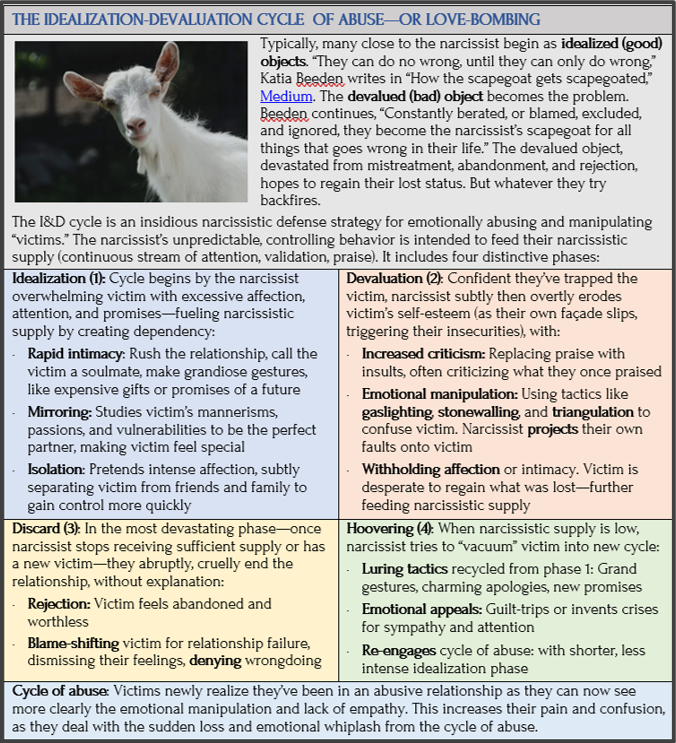
Sources: Psychoanalyst Emily Mayfield, MindSetTherapy; psychoanalyst Kristalyn Salters-Pedneault, “Idealization and Devaluation: When excessive admiration turns to rejection,” VeryWellMind; critical care nurse Ethan Cohen, “dealization and Devaluation: What You Need to Know, Charlie Health. Photo by Sergiu Valenas, Unsplash, used by Katta Beeden, Medium.
Coming Up Next
In Post 8: A Narcissist’s Self-Defense — Part III, I start with the powerlessness of a young person to guard against the narcissistic behaviors and actions of a parent or older sibling, and how that becomes life-defining.
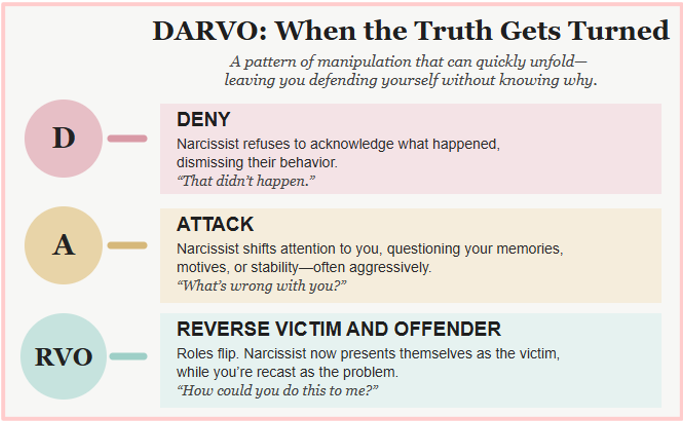
Then I’ll discuss the concept of DARVO, an acronym for deny, attack, and reverse victim and offender. This is a memorable way to check those around you to see whether they qualify as abusive, even if at many other times they’re not. Only in this way, can those of us “victims” of narcissism protect ourselves — by calling out the behavior, avoiding the person as often as we can, or ending the relationship.
 English