Narcissism and the Rest of Us
Show Table of Contents
INTRODUCTION
NARCISSISM DEFINED
2. Is There a Narcissist in Your Life?
3. Narcissus and the Origins of Narcissistic Thought — Part I
4. Narcissus and the Origins of Narcissistic Thought — Part II
5. Narcissus and the Origins of Narcissistic Thought — Part III
NARCISSISTIC DEFENSES
6. A Narcissist’s Self-Defense — Part I
7. A Narcissist’s Self-Defense — Part II
8. A Narcissist’s Self-Defense — Part III
NARCISSIST PERSONALITY DISORDER VS TRAITS
9. When Narcissism is a Personality Disorder
10. Narcissism and the Maladaptive Umbrella
11. Malignant Narcissism and the Narcissism Spectrum
12. When Narcissism is Compounded by Comorbidity
NURTURE VS NATURE
15. Narcissism: Flipping Self-Esteem on its Head
16. The Double-Edged Sword of Grandiose Narcissism
NARCISSISM’S DARK SIDE
19. Narcissistic Rage and Narcissistic Self-Awareness
20. Trait Narcissism and the Illusion of Control
21. Beyond Narcissism: Dark Personality Traits — Part I
22. Narcissist Sociopaths: Dark Personality Traits — Part II
ROMANTIC LOVE AND BOUNDARY-SETTING WITH A NARCISSIST
23. Romantic Love with a Narcissist — Part I
24. Romantic Love with a Narcissist — Part II
25. The Narcissist’s Non-Apology Apology
26. Boundary-Setting with Narcissists — Part I
27. Boundary-Setting with Narcissists — Part II
28. Boundary-Setting with Narcissists — Part III
29. Shattering Narcissus’ Mirror… So They Can Live
CONCLUSION
30. On Narcissism: What About the Rest of Us?
8: A Narcissist’s Self-Defense — Part III
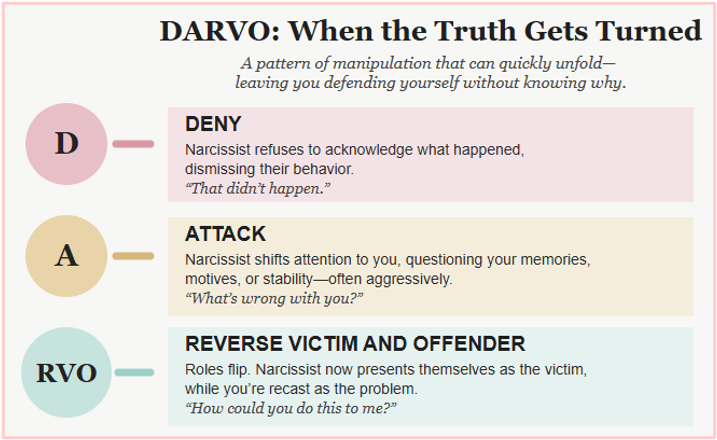
Adapted from Eric Patterson, “DARVO,” Choosing Therapy
Understanding narcissistic defense strategies helps us sidestep full impact, like ducking a punch. To me, that’s what we must do when otherwise we have no control over the relationship AND we have our reasons for not walking away. The fact that these defense mechanisms have names and are studied by psychiatric researchers should tell us something. They are patterns of abuse not unique to any single narcissist or experienced by any single “victim.” There’s a universality to these tactics of keeping us under the thumb and taking us down a peg or two or three. Afterall, if the narcissist is feeling good, it’s in part because they’ve made us feel bad. And if the leader is a narcissist, they’ve made a lot of people feel bad.
Two caveats. One, not all a narcissist’s defenses are conscious and intentionally cruel — even if their actions cause others harm. Second, the narcissist is often an engaging person, with a keen intellect and charismatic personality. They can be funny, charming, generous, and loving — mostly it’s not an act, except in extreme, more rare cases of narcissistic personality disorder (NPD) or malignant narcissism.
With these caveats in mind, we must confront the tragedy of the narcissist. With a personality hellbent on controlling others for personal gratification and to protect their ego from collapse under scrutiny, they’re often in great personal pain and unable or unwilling to seek help. Without their narcissistic tendences, they might’ve been more loved and in less need of masking underlying pain.
Before making sense of the concept of DARVO (Deny, Attack, and Reverse Victim and Offender), we need to understand narcissistic injury and the reason for the emotional intensity behind all these defensive strategies.
Narcissistic Injury
In describing narcissistic injury, psychologist Karyl McBride, PhD, “Understanding Narcissistic Injury: Narcissists do not forgive or forget,” Psychology Today, cites DSM-5: “Vulnerability in self-esteem makes individuals with narcissistic personality disorder very sensitive to ‘injury’ from criticism or defeat. Although they may not show it outwardly, criticism may haunt these individuals and leave them feeling humiliated, degraded, hollow, and empty. They may react with disdain, rage, or defiant counterattack.” McBride continues [slightly edited for brevity]:
Narcissists with this kind of injury reaction take a long time to get over it. They hold grudges and want to get back at the person they perceived harmed them. They seek revenge, try to cause problems for their attacker, and seem never to forgive or forget.
Most of us move on from hurt feelings, but the narcissist doesn’t. They’re not enough in touch with their feelings to move on. They think, “It’s all your fault,” or “How could you do this to me?”…. When the narcissists’ façade of charm and deception gets cracked, their world bursts apart. They blame others for their feelings of inadequacy, self-loathing, lack of happiness, success, or love. —Karyl McBride, PhD, “Understanding Narcissistic Injury: Narcissists do not forgive or forget,” Psychology Today
If we stand our ground, say, the narcissist openly shows their disdain and desire for revenge. We see this at work, with friends, with particular family members. Or more broadly, we see this in politics. The charm or the promises we may’ve thought were real transform into a vicious battle of abusive behavior. Narcissists are envious of others, fiercely competitive, and always must come out on top no matter the issue. This is traumatic to realize, especially if we’re close, rely on, or can’t easily walk away from.
Narcissistic injury or ego injury as it was first defined in the 1920s by Sigmund Freud include “losses in love” and “losses associated with failure.” It’s a real or perceived threat and emotional trauma that overwhelms an individual’s defense mechanisms and devastates their pride and self-worth. The shame or disgrace can be significant, creating permanent damage to their self-identity and self-esteem. Not always noticed, narcissistic injuries likely result from criticism, loss, envy, or sense of abandonment.
A poster on a Reddit community for narcissists, writes:

“Narcissistic injury isn’t about the event — it’s about the threat.” Professor of counseling Russ Curtis, “What is Narcissistic Injury?” YouTube
Scenario: someone very close to you, your supply maybe, causes narcissistic injury. Instantly you are devastated, demoralized, and most of all angry and vengeful.
As a self-aware narcissist, what’s your strategy for stepping back and stopping the rage? How do you turn off the lust for revenge? How do you heal? —From a poster on a Reddit community for narcissists.
Here’s the response the poster receives from another self-described narcissist:
For me, I usually get in touch with my senses first and then shut up my inner voice, as my therapist explained it:
We have three parts that make us up: our executive self (decides courses of action and, to some degree, what we believe is true), our emotional self (where the feelings of shame and anger and narcissistic rage are), and the inner voice (simply what we hear in your head when you talk to yourself).
From my experience, we can “level up” our executive self by practicing critical thinking skills and our emotional self by doing awareness and compassion meditations. The inner voice is relatively easy to control and level up compared to the others.
The reason we turn it off is that narcs tend to have f**king horrible inner voices that essentially fan the flames of self-loathing. By turning it off and getting grounding in our emotional state, we experience negative emotions without escalating them. The natural tendency is for emotions to fade. The longer we feel without arguing internally, the easier it is to not take revenge and not suffer emotionally in the long term.
I’ve also noticed that this practice strengthens our emotional self. —wanttobebetter12345, Reddit
DARVO (Deny, Attack, and Reverse Victim and Offender)
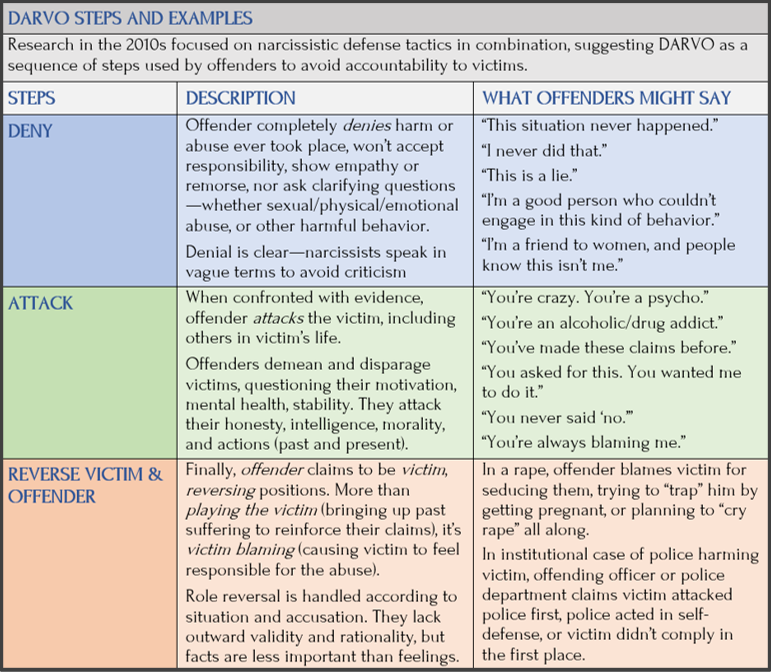
DARVO (deny, attack, and reverse victim and offender) is actually more a scenario of defenses, with separate acts of bossiness or touchiness or petulance, things we’ve all done, becoming lethal behaviors when staged by the narcissist. The pattern of ordinary behaviors take on a different meaning when they are repeated, sequenced, and used to control. DARVO fits with unsettling precision in the lives of people we know. Calling a spouse — even a narcissistic one — an abuser is not an easy place to begin. But neither is living on the receiving end of ongoing verbal, sexual, or physical abuse. Over time, it becomes traumatic.
DARVO was conceptualized in 1997 by Jennifer Freyd, an American psychologist and founding director of Harvard’s Center for Institutional Courage.
I have observed that actual abusers threaten, bully, and make a nightmare for anyone who holds them accountable or asks them to change their abusive behavior. This attack, intended to chill and terrify…will often take the form of focusing on ridiculing the person who attempts to hold the offender accountable…. The offender rapidly creates the impression that the abuser is the wronged one, while the victim or concerned observer is the offender. Figure and ground are completely reversed…. The offender is on the offense, and the person attempting to hold the offender accountable is put on the defense. —Jennifer Freyd, “Violations of Power, Adaptive Blindness, and Betrayal Trauma Theory,” Feminism & Psychology, 2020, quoted in Wikipedia
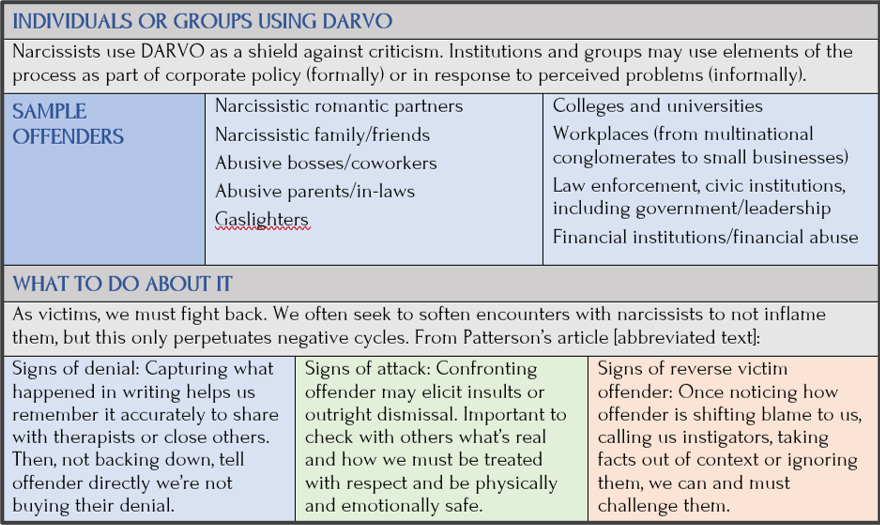
DARVO is highly effective in using common manipulative defenses, like denial and blame-shifting, against the unsuspecting non-narcissist (victim). The narcissist (offender) is thus able to avoid accountability for the harm they’re causing the victim.
Research on interpersonal violence finds correlations between offenders who minimized or denied any wrongdoing and those who reverse-engineered victim-offender positions. They also found DARVO to be common to all psychological abusers — not just narcissists — including those with dark personality traits (antisocial, Machiavellian, or sadistic behaviors).
Protecting Against DARVO
According to Freyd’s collaborator Sarah Harsey, Freyd first saw DARVO as a technique used by sex offenders to deflect blame. Eric Patterson quotes Harsey in Choosing Therapy: “You can see examples of this in the media when high-profile sex offenders like R. Kelly and Harvey Weinstein use DARVO. But it’s not just a tactic used by perpetrators of sexual abuse — research finds DARVO is also used by people who commit wrongdoings that encompass a broad spectrum of severity, ranging from cases of sexual assault to more minor transgressions.”
Sources: Wikipedia; Eric Patterson, “Darvo,” Choosing Therapy
Gaslighting and Other Effects of DARVO
“DARVO takes a terrible, uncomfortable, or traumatizing event and continues the cycle of abuse. Now, the person has to deal with the original event and the damaging effects of DARVO on their mental and physical health,” writes Patterson.

Image: Psychoanalyst Robin Stern, “Gaslighting: Turning Off the Gas on Your Gaslighter,” HelpGuide
According to Dr. [Sarah] Harsey, “The intent of DARVO is to silence victims, either through confusion, invalidation, or even intimidation. By denying any mistreatment occurred (or downplaying the harm it caused), attacking victims’ credibility, and then playing the victim, perpetrators attempt to instill doubt among their victims — did the abuse really happen in the way that I remember it? Am I just overreacting? Is it actually my fault? Data indicates that people exposed to DARVO during confrontations with perpetrators report feeling greater self-blame for the wrongdoings they experience. Ultimately, DARVO tries to distort the way victims think about themselves and the abuse they experience.” —Eric Patterson, “DARVO,” Choosing Therapy
A particularly devastating effect of DARVO is when we doubt our memory and get confused about what actually happened. This is popularly called gaslighting. Patterson writes, “With doubt comes shame, embarrassment, and guilt. [Victims] may withdraw from their original claims, or authorities may encourage them to rethink action.” He cites a study documenting the frequency of DARVO tactics when victims confront offenders:
- 44% of offenders denied events
- 22% said the whole situation is a misunderstanding
- 44% said the victims were crazy
- 22% of victims heard a temporary admission of guilt, with offenders returning to DARVO and denying/minimizing events.
Effects of Public Opinion
While I promise not to get political or spend too much time on the “macro” impact of DARVO at the hands of self-dealing leadership, it’s worth mentioning how it can be weaponized through the media and social media to discredit abuse survivors — an over-large percentage of whom are women. Offenders use public platforms to deny wrongdoing, attack the survivor’s credibility, and portray themselves as the victim — a strategy that can sway public opinion and create a hostile environment for survivors. Intense backlash against survivors of abuse causes long-range damage to society:
- Erosion of public trust of victims and survivors.
- Public victim-blaming, a finding supported by research, shows DARVO makes observers more likely to doubt a victim’s credibility.
- Self-silencing about abuse, which discourages others from coming forward.
- Legal implications, with research suggesting swayed public perception contribute to negative, harmful outcomes for victims, such as low-reporting rates and decreased prosecution of perpetrators.
As with mitigating the effects of a narcissist using DARVO on a particular person, there are ways to help counter the effect in the public spotlight. As with any societal, workplace, or political issue, the first step is raising awareness of the phenomenon of DAVRO, so people can identify it for what it is and learn to resist its manipulative tactics, ultimately reducing its power. This also includes learning about media/social media/podcasts that are credible vs those that aren’t — to become an informed consumer of credible sources. There are also lawsuits to strengthen legal protections, which are often extremely expensive and time-consuming.
The short- and long-term effects of a more public-facing use of DARVO are many:
- Victims feel alone and ashamed, especially in high-profile cases.
- They hesitate in reporting abuse because of the toxic environment.
- Violence, threats, and other attacks against the victim.
- A general sense that victims are lying.
- Belief that victims somehow invited the abuse.
Here’s a high-profile case of DARVO’s impact on a victim:
In celebrity cases, DARVO plays out on a massive scale. It becomes a public relations strategy. The abuser’s team weaponizes media narratives to disorient and silence the survivor, framing her as vindictive, unstable, or attention-seeking.
Amber Heard’s trial is one of the clearest examples. Despite credible evidence that she experienced domestic violence, the public overwhelmingly rallied around Johnny Depp, convinced he was the real victim. While the legal outcome was mixed, many interpreted it as a full vindication of Depp — and used it to justify relentless attacks on Heard. But the damage didn’t stop at the courtroom. The online backlash was brutal, far-reaching, and deeply discouraging. It sent a clear message to survivors everywhere: if you speak out, you’ll be mocked, maligned, and punished. —Julie Tervala, “Silencing Survivors: DARVO, Misogyny, and the Myth of the Perfect Victim,” Sanctuary for Families
Coming Up Next

I decided to start my narcissism series on its intellectual history, and the myriad defenses narcissists use before actually describing narcissism, so the descriptive information carries more weight. We now know narcissism is not a few arrogant, obnoxious people we can easily avoid, but, in its worst form, an insidious and deep-seated personality disorder. In Post 9: When Narcissism is a Personality Disorder (NPD), I’ll write about narcissism as a full-blown disorder, which I’ll follow with posts on less debilitating forms of narcissism as a series of traits and characteristics that exist on a spectrum.
NPD afflicts only .05-1.5% of the population but exacts a terrible toll on its victims. The reality of all personality disorders is how difficult they are to treat because the afflicted person is largely disinclined to seek treatment. Without a concerted effort over years, it will simply be impossible to change. And their capacity for deceit, manipulation, and abuse will continue.
 English