Narcissism and the Rest of Us
Show Table of Contents
INTRODUCTION
NARCISSISM DEFINED
2. Is There a Narcissist in Your Life?
3. Narcissus and the Origins of Narcissistic Thought — Part I
4. Narcissus and the Origins of Narcissistic Thought — Part II
5. Narcissus and the Origins of Narcissistic Thought — Part III
NARCISSISTIC DEFENSES
6. A Narcissist’s Self-Defense — Part I
7. A Narcissist’s Self-Defense — Part II
8. A Narcissist’s Self-Defense — Part III
NARCISSIST PERSONALITY DISORDER VS TRAITS
9. When Narcissism is a Personality Disorder
10. Narcissism and the Maladaptive Umbrella
11. Malignant Narcissism and the Narcissism Spectrum
12. When Narcissism is Compounded by Comorbidity
NURTURE VS NATURE
15. Narcissism: Flipping Self-Esteem on its Head
16. The Double-Edged Sword of Grandiose Narcissism
NARCISSISM’S DARK SIDE
19. Narcissistic Rage and Narcissistic Self-Awareness
20. Trait Narcissism and the Illusion of Control
21. Beyond Narcissism: Dark Personality Traits — Part I
22. Narcissist Sociopaths: Dark Personality Traits — Part II
ROMANTIC LOVE AND BOUNDARY-SETTING WITH A NARCISSIST
23. Romantic Love with a Narcissist — Part I
24. Romantic Love with a Narcissist — Part II
25. The Narcissist’s Non-Apology Apology
26. Boundary-Setting with Narcissists — Part I
27. Boundary-Setting with Narcissists — Part II
28. Boundary-Setting with Narcissists — Part III
29. Shattering Narcissus’ Mirror… So They Can Live
CONCLUSION
30. On Narcissism: What About the Rest of Us?
21: Beyond Narcissism: Dark Personality Traits — Part I
Cynthia Wagner, “The Narcissist Collage,” Saatchi Art
Narcissism is a harsh label to apply to anyone. It’s not a flattering term and gets tossed around way too much in casual description of someone selfish or obnoxious. At the same time, narcissism is insufficient as an all-encompassing term to capture all the darker qualities attributed to it. Terms that better describe the “dark side” are antisocial, malevolent, psychopathic, or sociopathic. Or older, more “literary” labels like Machiavellian or sadistic. Today, scientists and clinicians are moving away from diagnostic labels and toward clusters of specific traits that explain an individual’s troubling personality.
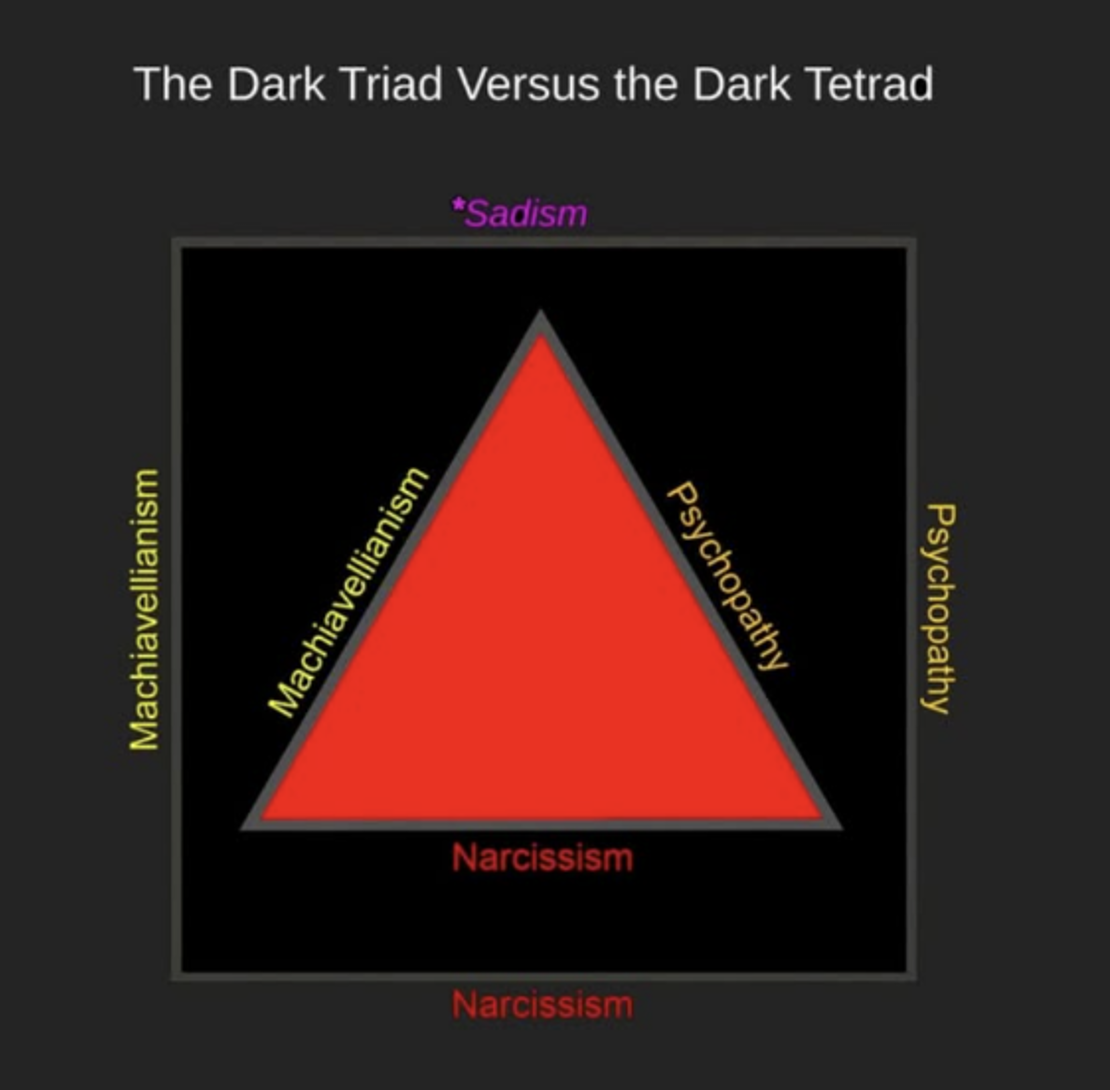
Dark personality traits was first coined by Canadian psychologists Delroy Paulhus and Kevin Williams in their 2002 research on the dark triad, a term to describe malevolent tendencies common to:
- Machiavellianism (manipulative, immoral)
- Maladaptive narcissism (lack of empathy, pride, self-centered)
- Nonclinical psychopathy (continuous antisocial behavior, impulsivity, remorselessness)
Later, Paulhus and colleagues included sadism (pleasure from others’ suffering) — forming the dark tetrad.
The dark triad/tetrad are psychological theories of personality describing personality types considered subclinical. They don’t necessarily appear in DSM-5 so aren’t readily diagnosable conditions.
Empirical evidence shows, though conceptually distinct, such traits overlap and relate to a “callous–manipulative interpersonal style.”
It’s an evolutionary adaptation that motivated our forebears to explore and pursue challenging goals needed for survival — and why we’re still challenging common sense today.
In modern times, researchers recognize illusion of control has a cognitive bias for overestimating individual influence in specific, objectively uncontrollable situations — like gambling, extreme sports, praying, bargaining with the devil, conspiracy theories, and other nonscientific thoughts, like being positive prevents cancer. We think we’ll never have a car accident because of our good driving skills — a related research concept known as the “better-than-average” effect.
Researchers found people with high scores on these traits have an increased likelihood of committing crimes, causing social distress, and creating major problems for organizations, especially if they’re in leadership positions.
They also tend to be less compassionate, agreeable, empathetic, and satisfied with their lives, as well as less likely to believe they and others are good. A “factor analysis” (statistical method for identifying underlying patterns in complex datasets) found that among the big five personality traits, low agreeableness is the strongest correlate of the dark triad, followed by neuroticism and a lack of conscientiousness.
However, there are some positive associations with dark personality traits: they have mental toughness, leadership skills, and a greater likelihood of embracing challenges, notes Jon Druda, PhD, in Psychology Today.
Druda suggests an evolutionary advantage:
The persistence of these traits … suggests an evolutionary basis. In balanced amounts, they may have offered survival advantages in our ancestral environments. For instance: Machiavellianism could have been useful in complex social hierarchies, enabling individuals to navigate and influence social structures. Aspects of narcissism (confidence and assertiveness) may have been crucial in leadership roles and mate selection. Risk-taking and emotional detachment associated with psychopathy might have been advantageous in high-stakes situations like hunting or territorial conflicts. —Jon Druda, PhD, “The Dark Triad: Not All Gloom and Doom,” Psychology Today.
The D-Factor of Personality
Both world history and everyday life are full of examples of people acting ruthlessly, maliciously, or selfishly. In psychology as well as in everyday language, we have diverse names for the various dark tendencies humans may have, most prominently psychopathy (lack of empathy), narcissism (excessive self-absorption), and Machiavellianism (belief the ends justify the means), the so-called “dark triad,” along with many others such as egoism, sadism, or spitefulness. —Ingo Zettler, professor of Personality and Social Behavior, University of Copenhagen, and key developer of Dark Factor of Personality (D) theory.

Madison Burgess, “I’ve been ‘diagnosed as a psychopath’ — this is what it’s like,” Daily Mail. Photo: Shutterstock
D is for dark. As the psychiatric profession moves away from discrete mental health labels and toward assessing clusters of symptoms per each individual, researchers and clinicians know — from decades of research — that someone with one malevolent trait tends to have one or several more. So says mental health coach/writer Darius Cikanavicius in “Dangerous Dark Traits Among Narcissists, Abusers, and Toxic People,” PsychCentral.
- Narcissist A has a tendency to self-aggrandize but isn’t inclined to hurt anyone.
- Narcissist B self-aggrandizes AND seeks to inflict pain on others — indicating the D-factor. That doesn’t mean their narcissism caused a dark trait, but it made dark traits more readily positioned.
Dark traits often transcend narcissism when narcissism is comorbid with antisocial behavior or other forms of psychopathy. Once a person has a “dark personality,” it seems, they have proclivities for many other dark traits, as in this description:
People with strong narcissistic tendencies operate by playing victim and twisting the story. They heavily project, hate seeing others happy, use verbal abuse, manipulate others, use various toxic arguing techniques, regulate their self-esteem by hurting others, and act poorly when upset or threatened. —Darius Cikanavicius, “Dangerous Dark Traits Among Narcissists, Abusers, and Toxic People,” PsychCentral
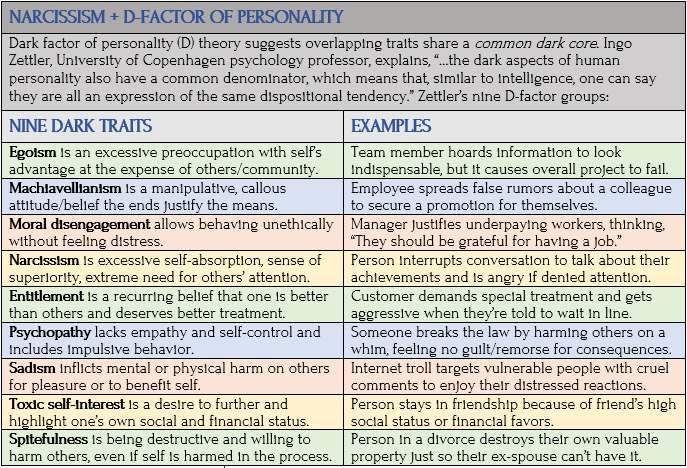
Sources: Darius Cikanavicius, “Dangerous Dark Traits Among Narcissists, Abusers, and Toxic People,” PsychCentral; Ingo Zettler, University of Copenhagen, “Psychologists define the ‘dark core of personality,’” Science Daily; and researchers Morten Moshagen, Ulm University, and Benjamin Hilbig, University of Koblenz-Landau, Germany
The D-factor mostly manifests itself as narcissism, psychopathy, one of the other dark traits, or a combination. Mapping the common denominator, in Zettler’s formulation, can determine whether a person has a high D-factor and how likely they are to engage in behavior associated with one or more dark traits. Someone with higher D-factor wanting to humiliate others is also highly likely to engage in other malevolent activities, like lying, cheating, or stealing.
Utility Maximization in the Dark Core of Personality
The Copenhagen research team defines the D-factor in terms of utility/disutility. The tendency is to maximize the self’s individual utility (utility maximization) — disregarding, accepting, or malevolently provoking disutility for others — accompanied by beliefs that justify their behavior.
All dark traits can be traced back to the tendency of placing one’s own goals and interests over those of others even to the extent of taking pleasure in hurting others — along with a host of beliefs that serve as justifications and thus prevent feelings of guilt, shame, or the like. The research shows dark traits can be understood as instances of this common core — though they may differ in which aspects are predominant (the justifications-aspect is very strong in narcissism whereas the aspect of malevolently provoking disutility is the main feature of sadism) . —Ingo Zettler, University of Copenhagen,, “Psychologists define the ‘dark core of personality,’” Science Daily
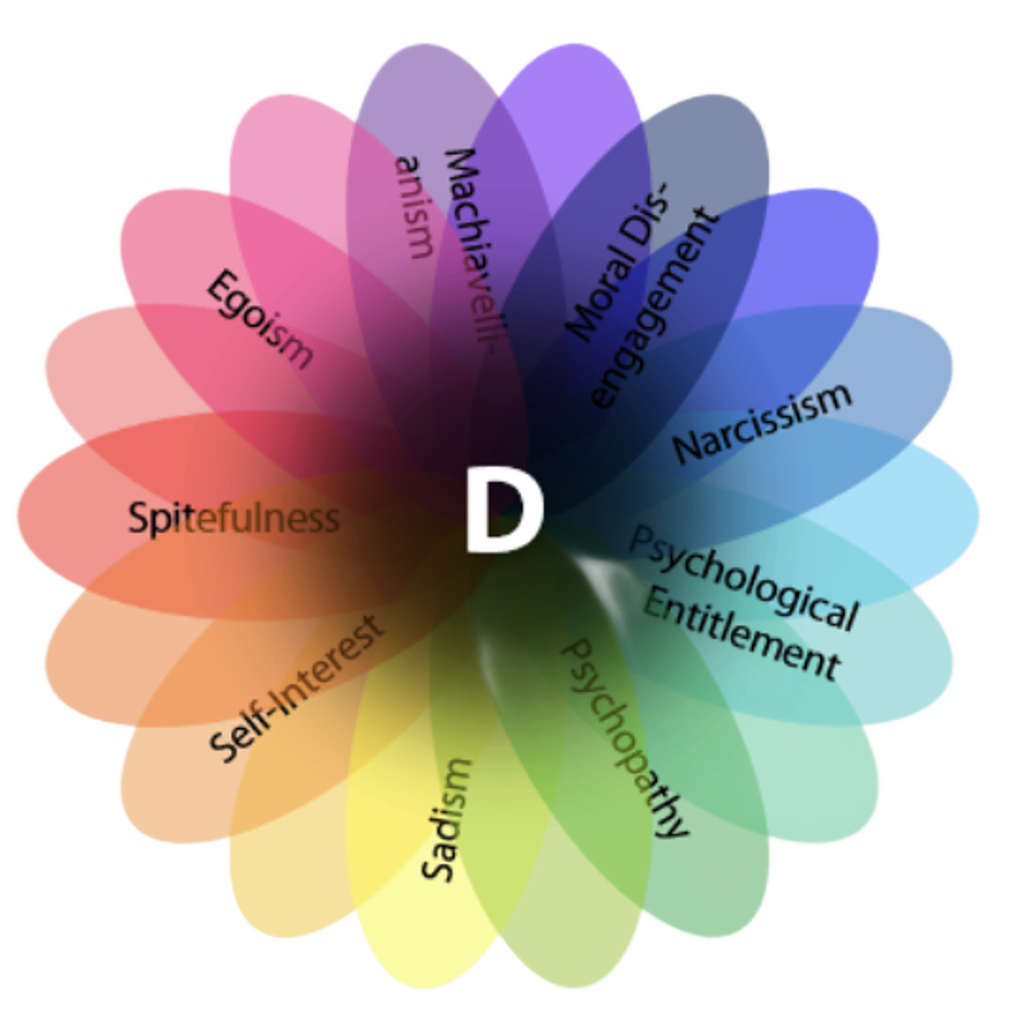
Graphic: “The Dark Factor of Personality: A Theory of the Common Core of Socially and Ethically Aversive Personality Traits,” Darkfactor
According to Professor Zettler, University of Copenhagen, the dark personality isn’t motivated toward another’s utility (helping someone) nor do they derive utility from others’ utility (being happy for someone). For example [from Wikipedia]: “Stealing something causes financial disutility, bullying someone causes psychological disutility, and hurting someone causes physiological disutility. Individuals high in D might even experience self-utility (excitement) from disutility inflicted on others (pain).”

Photo: Katherine Hignett, “Psychopathy, Sadism, Narcissism: These Personality Traits Reveal Your Underlying ‘Dark Core,’” Newsweek
Those with high D-factor hold onto a positive self-image despite malevolent behavior. “They feel justified in seeing themselves/their group as superior, seeing others/other groups as inferior, endorsing ideologies favoring dominance, adopting a cynical world view, and considering the world as a competitive jungle.” When we think of world autocrats and tyrants, we now know they have significant personality disturbance with severe D-factor pathology.
The specific label “matters less than the understanding of how callous, malicious, malevolent, evil, or unempathetic people hurt others — as well as how you refer to such people (narcissists, psychopaths, sociopaths, Machs (Machiavellian personality),” writes Zettler.
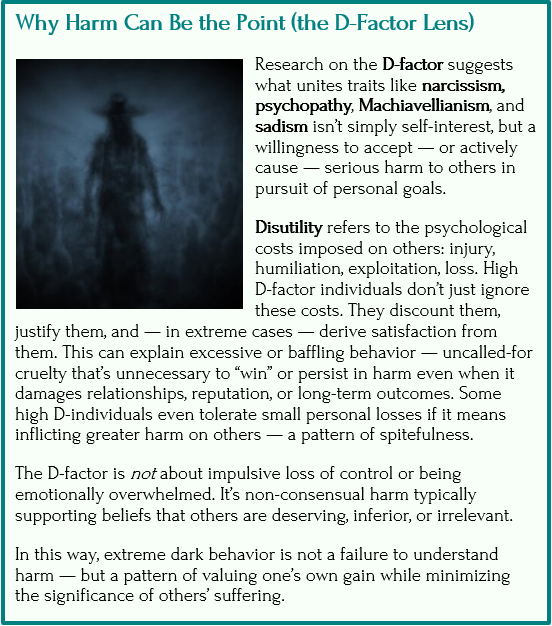
Source: Katherine Hignett, “Psychopathy, Sadism, Narcissism: These Personality Traits Reveal Your Underlying ‘Dark Core,’” Newsweek. Graphic: Jan Swan
Each dark trait is distinctive and can result in specific behaviors — but they have more in common than what sets them apart. For example, in cases of extreme violence, rule-breaking, lying, and deception in corporate or public sectors. Knowledge about a person’s D-factor may be useful way to assess the likelihood of more offensive or harmful behavior. My paraphrase of Kaufman’s summary of Zettler’s, et al., main findings:
- All dark traits are substantially positively related — the strongest correlations are: egoism, Machiavellianism, moral disengagement, psychopathy, sadism, and spitefulness.
- The strongest D-factor patterns fit with theoretical models: utility maximization (“I’ll say anything to get what I want”), inflicting disutility on others (“I’m willing to suffer small harm so I can punish someone who deserves it”), and justifying malevolent beliefs (“I honestly feel I’m just more deserving than others”).
- High D-factor people are more likely to keep money for themselves when given the opportunity and display unethical behavior (cheating to maximize gain).
- D-factor is positively associated with self-centeredness, dominance, impulsivity, power, insensitivity, and aggression. And negatively associated with nurturance, internalized moral identity, perspective-taking, sincerity, fairness, greed avoidance, and modesty.
Dark personality theory suggests people who hurt people for personal gain might be labeled under different conditions, but all share the D-factor. Understanding this can help the rest of us take notice and protect ourselves. When it comes to leadership in a toxic workplace, we might find it best to vote with our feet. In our country, we must fight injustice, vote, get others to vote, and do everything we can to curb dangerous inclinations and racist policies.
In Sum
Dark personality theory suggests people who hurt people for personal gain might be labeled under different conditions, but all share the D-factor. Understanding this can help the rest of us take notice and protect ourselves. When it comes to leadership in a toxic workplace, we might find it best to vote with our feet. In our country, we must fight injustice, vote, get others to vote, and do everything we can to curb dangerous inclinations and racist policies.
Ditching the Dark Triad
Having introduced the dark triad, I give equal time to those who think the term has overstayed its welcome. In “4 Reasons to Ditch the ‘Dark Triad’ Label,” Psychology Today, Susan Krauss Whitbourne, PhD — professor emerita of Psychological and Brain Sciences, University of Massachusetts Amherst — cites the work of a research team from universities around the country who argue for removing the dark triad label from psych literature. Their reasons:
- Stigma: Within the dark triad, psychopathy and narcissism are central to two personality disorders. As diagnosable conditions, applying an evil-sounding term isn’t appropriate language, just like myriad terms have been dropped for their inhumane associations. People struggle with lifelong symptoms, even ones that seem They’re imprisoned, rejected in relationships, and unable to find employment. Psychology shouldn’t add more challenges.
- Sensationalism: Though people are drawn to seemingly charismatic leaders who seem convinced of their own greatness while advancing selfish agendas, this isn’t a reason to dignify the dark triad concept with an attention-grabbing label.
- Imprecision: The term dark is inherently vague. Added to other synonyms for evil “creates a metaphoric thundercloud above the heads of those” diagnosed. Another problem is how to define a cutoff for when a person goes from light to dark. Dark triad measures don’t have clear-cut criteria, calling up stereotypes rather than actual qualities.
The Alternative
Whitbourne gives the researchers’ solution, writing there’s solid research on the personality trait of antagonism, and its opposite, agreeableness, both of which can be seen on a continuum rather than as a category (light vs dark). “These terms are well-established in describing an aspect of personality, being precise, non-sensationalistic, and non-stigmatized.”
No one is the sum of one trait, the authors state, but rather a “complex collection of multiple attributes.” Someone can be high on antagonism but also high on other qualities such as “openness to experience and even conscientiousness.” An antagonistic person might have a number of agreeable qualities.
The two most significant and common narcissistic subtypes — grandiose and vulnerable — are together called trait narcissism by researchers. The chart below compares traits, proposed by psychology professor Nikhila Mahadevan, University of Essex, UK, “Conceptualizing grandiose and vulnerable narcissism as alternative status-seeking strategies,” Compass Journal. Mahadevan’s research is about differences in status-pursuit by subtype, but his findings are useful (and similar) when applied to the illusion of control.
Antagonism, the Low Pole of Agreeableness
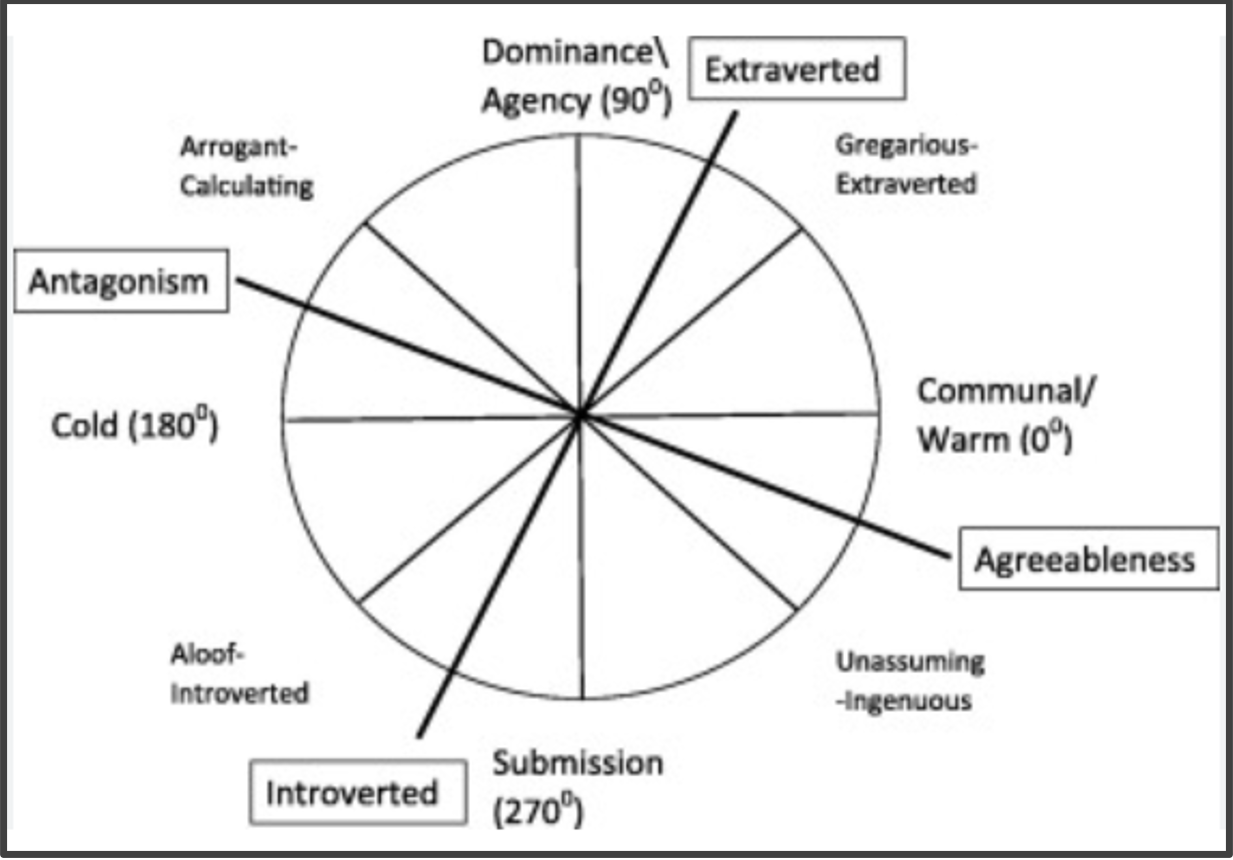
Graphic: Donald Lynam and Joshua Miller, “The basic trait of Antagonism: An unfortunately underappreciated construct,” Science Direct
Those with high D-factor hold onto a positive self-image despite malevolent behavior. “They feel justified in seeing themselves/their group as superior, seeing others/other groups as inferior, endorsing ideologies favoring dominance, adopting a cynical world view, and considering the world as a competitive jungle.” When we think of world autocrats and tyrants, we now know they have significant personality disturbance with severe D-factor pathology.
The specific label “matters less than the understanding of how callous, malicious, malevolent, evil, or unempathetic people hurt others — as well as how you refer to such people (narcissists, psychopaths, sociopaths, Machs (Machiavellian personality)),” writes Zettler.
Antagonism, the low pole of Agreeableness, shows traits related to immorality, combativeness, grandiosity, callousness, and distrustfulness. These traits strongly correlate to “externalizing” behaviors, such as antisocial behavior, aggression, and substance use. Antagonism is the core trait of many important psychopathological conditions (psychopathy, antisocial and narcissistic personality disorders).
Antagonism is also a feature of general and disordered personality, psychopathology, and interpersonal behavior. As Neuroticism is core to understanding the intense distress and suffering that comes with “internalizing” disorders, Antagonism is core to understanding the impairment and suffering — to the individual and society at large—that comes with externalizing disorders. —Donald Lynam and Joshua Miller, “The basic trait of Antagonism: An unfortunately underappreciated construct,” Science Direct
Lynam and Miller conclude with: “Antagonism, like neuroticism, has tremendous public health significance — not only for the harm it does to the individual but for the harm it does to others.”
Coming Up Next

I will continue to talk about the shadow side of narcissism in Post 22: Narcissist Sociopaths: Dark Personality Traits — Part II, especially the narcissistic sociopath with borrowed dark traits from perhaps comorbid personality disorders.
 English