Narcissism and the Rest of Us
Show Table of Contents
INTRODUCTION
NARCISSISM DEFINED
2. Is There a Narcissist in Your Life?
3. Narcissus and the Origins of Narcissistic Thought — Part I
4. Narcissus and the Origins of Narcissistic Thought — Part II
5. Narcissus and the Origins of Narcissistic Thought — Part III
NARCISSISTIC DEFENSES
6. A Narcissist’s Self-Defense — Part I
7. A Narcissist’s Self-Defense — Part II
8. A Narcissist’s Self-Defense — Part III
NARCISSIST PERSONALITY DISORDER VS TRAITS
9. When Narcissism is a Personality Disorder
10. Narcissism and the Maladaptive Umbrella
11. Malignant Narcissism and the Narcissism Spectrum
12. When Narcissism is Compounded by Comorbidity
NURTURE VS NATURE
15. Narcissism: Flipping Self-Esteem on its Head
16. The Double-Edged Sword of Grandiose Narcissism
NARCISSISM’S DARK SIDE
19. Narcissistic Rage and Narcissistic Self-Awareness
20. Trait Narcissism and the Illusion of Control
21. Beyond Narcissism: Dark Personality Traits — Part I
22. Narcissist Sociopaths: Dark Personality Traits — Part II
ROMANTIC LOVE AND BOUNDARY-SETTING WITH A NARCISSIST
23. Romantic Love with a Narcissist — Part I
24. Romantic Love with a Narcissist — Part II
25. The Narcissist’s Non-Apology Apology
26. Boundary-Setting with Narcissists — Part I
27. Boundary-Setting with Narcissists — Part II
28. Boundary-Setting with Narcissists — Part III
29. Shattering Narcissus’ Mirror… So They Can Live
CONCLUSION
30. On Narcissism: What About the Rest of Us?
24: Romantic Love with a Narcissist — Part II
Source: Facebook
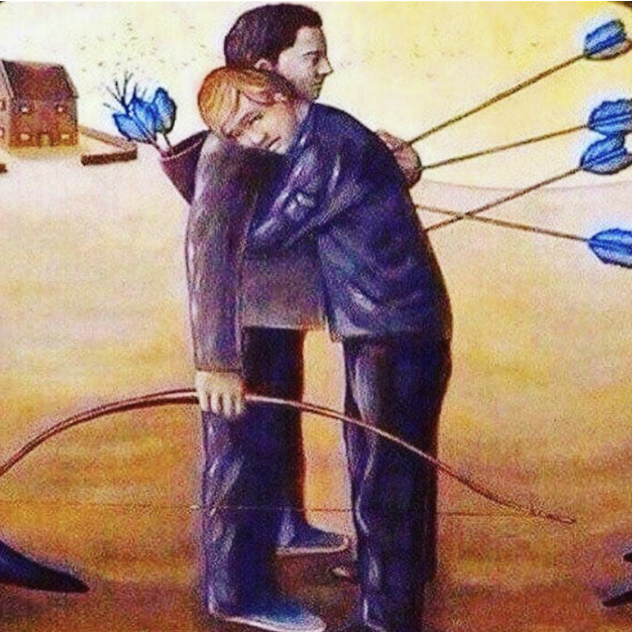
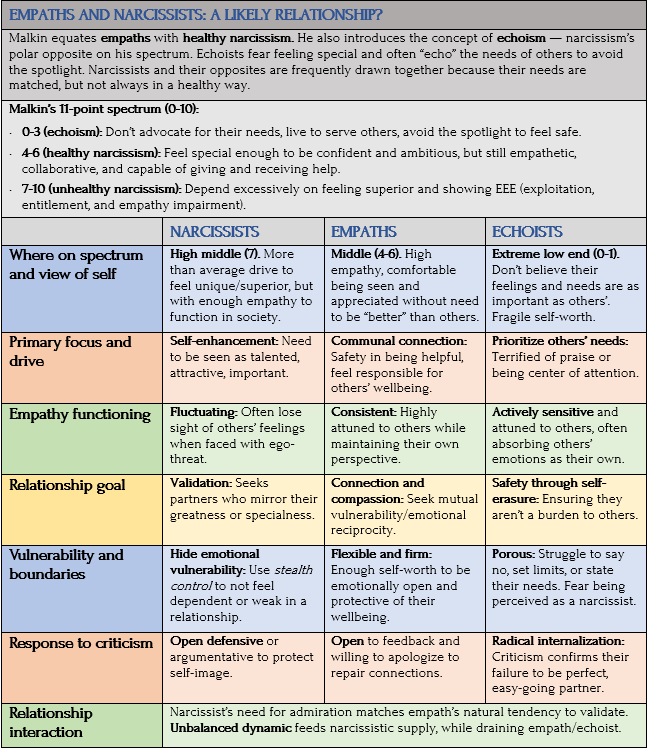
In scanning the long list of ways a narcissist can mistreat someone [see post 6, post 7, and post 8 ], especially a romantic partner, it makes sense that narcissists seek or even target empaths as their partners. While there’s no empirical evidence to support this phenomenon, there are plenty of clinical observations and personal testimonies via social media. Craig Malkin, author of Rethinking Narcissism, calls this a complementary dynamic: two opposing personality types creating a strong mutual attraction.
In this post, I’ll look into complementary pairings and include some of the social postings I found.
The Narcissist and the Empath
Malkin gives these reasons for the complementary dynamism of the narcissist and the empath [paraphrased]:
- Fulfilling the need for narcissistic supply: Narcissists have an addictive need for validation, admiration, and attention. Empaths, who are naturally nurturing and focused on others’ feelings, are a reliable source of this supply.
- High forgiveness and low boundaries: Narcissists, lacking accountability and empathy, are drawn to empaths who forgive easily, take responsibility for mistakes (allowing narcissists to deflect blame), and tend to stay in relationship longer than others might.
- Reflecting a false self: In the beginning, narcissists idealize their partners to reassure themselves of their own worth. They seek out intelligent, respected empaths because winning over someone like that boosts their own ego and confirms their “specialness.”
- Mirroring and vulnerability: Subconsciously, a narcissist may see in an empath the very traits they’ve suppressed in themselves (vulnerability, connection). Conversely, narcissists may “mirror” the empath (using a mask of vulnerability) to reel in their caretaking impulse.
- Stealth control: Narcissists fear dependence on others because it makes them feel weak, so they use indirect manipulation to get their needs met. Empaths, who prioritize harmony and others’ needs, are not likely to pushback on these subtle manipulations.
Sources: Peg Streep, “You, Me, and the Narcissist Next Door,” Psychology Today; Sabrina Writes, “Why do Narcissists and Empaths Attract Each Other? Revealing the complex dance of connection,” Medium; Craig Malkin, Rethinking Narcissism, Shortform
Narcissists and Non-Narcissist Voices
Narcissists and empaths are drawn to each other because of deep mental needs, unspoken wounds, and complicated unconscious drives. At the same time it may cause ache and imbalance, it also offers a reflection for self-knowledge and growth. Spotting these styles can be a powerful step closer to cultivating relationships based on real empathy, mutual appreciation, and emotional fitness.
In the end, awareness is the key. While both people apprehend their personal needs and wounds, they could select connections that nurture rather than drain. With the aid of remodeling this knowledge into aware alternatives, we pave the way for more healthy, actual relationships in which empathy and authenticity genuinely thrive. —Sabrina Writes, “Why do Narcissists and Empaths Attract Each Other? Revealing the complex dance of connection,” Medium
What to Think?
Reading through social media posts about or by narcissists commenting on genuinely painful experiences with their intimate partners gives me pause. How disconnected are researchers and psych professionals from those living the reality? Are Malkin and others over-promising on empathy prompts, therapy, and other hopeful ways to turn a one-sided love relationship with a narcissist into something reciprocal and healthy? And last question: Are those who seek therapeutic interventions or are recruited into research studies different from those who air grievances on social media?
Because wherever I go — Quora, Reddit, Facebook — I see a world of hurt and bitterness from non-narcissists who stayed too long, tried too long, and felt trapped before finally escaping.

Photo: Getty Images
And from the narcissists themselves? Strangely powerful insights, more than we’re led to believe they’re capable of having, but so disturbing about the demands they make or their need to strike back — with such intensity. I found myself at the same time fascinated, appalled, sympathetic, and frightened for anyone in their sightlines.
Hence, I’m not sure how to conclude this post on romantic love and/or marriage with a narcissist. It’s all a jumble in my mind. So, with all the clarity of a gnat in a windstorm, here are some passages I randomly selected
The first is from a thread about whether a non-narcissist should give the silent treatment back to the narcissist [all edited for grammar and brevity, but I try to keep their voice]:
How do I respond to silent treatment?
I have been through so many silent treatments, and I responded in every which way. I ignored him back, I messaged him incessantly like a crazy woman, I professed my undying love, I got angry and released my inner demon, and I apologized while not even knowing what, if anything, I did wrong.
The end result was 100% always the same. They come back when they want to come back. Here’s the really fun part, too. With each silent treatment, the time spent being kind to you between silent treatments decreases, while the time you spend in silent treatment increases.
What begins as a 1 or 2 day punishment for your offenses every few weeks gradually becomes 1–2 weeks of silence every few days. Their eventual return that once came with heartfelt apologies (albeit, probably buried in plausible excuses), soon enough come with accusations, blame, and projection. It’s your fault they left.
The apologies you give for their silence — oh yes, if you’re not there yet, that’s coming — will be deemed suspicious, inadequate, too late. You’re just lucky they’re giving you another chance. Don’t you feel lucky? —Bree Lynn, Moved on from a Narcissist; out of the fog, into the light, Quora
And from a narcissist:

What does a narcissist think when you go completely silent and don’t chase after them?
We don’t like that. We want you to chase after us and keep trying at us, since this is a huge ego boost for us. And we feel we have control over you. When you stop doing this, we lose our sense of control, and we hate that. We will want you to pay for doing that to us and trust me, we will make you pay for it. Unless you make us unable to by going no-contact with us. This is the only way to cut off a narcissist. You have to make sure we’re never able to contact you again. Don’t play games with us or try to get us back, because more than likely, you’ll regret it in the end because we are ruthless. —From the narcissist Lily-Rose
This is bone-chilling. Does anyone want a relationship with Lily-Rose?
Imagine this next texted conversation between a dating couple (who don’t live together) starts when the partner is still asleep. Imagine they’re accustomed to outbursts of profanity and rage that stress the narcissist and make no sense. The partner tries to mitigate the rage, but finds it impossible to navigate the circular reasoning [edited for brevity]:

Edvard Munch, Separation, 1896, painting
What does a typical conversation with a narcissist look/sound like?
Narcissist starting at 7am with no provocation or prompting whatsoever: “Hey. You better call me as soon as you get this. We need to talk.”
Partner: “What’s up?”
Narc: “I am not telling you what the issue is just so you can decide whether or not my problem is significant enough for you to be concerned about. I am not telling you …. Forget it.”
Partner: “You just said there was a problem. I am getting ready for work. Is this an emergency?? Are you okay? What’s going on?”
Narc: “Oh, it’s nothing. But call me immediately. As soon as you get on the road.”
Partner: “What?? Is there a problem or isn’t there? Can’t you just say what the issue is? If it’s important, just say so.”
Narc: “You’re not really getting ready for work, are you? Why are you texting me if you are so busy?? You’re not busy. You’re just avoiding me! I don’t have to take your abuse. You make me feel like a piece of garbage, like nothing I have to say is important. You don’t care about me at all!”
Partner: “I just asked you what the issue is, but you won’t tell me! What am I supposed to do?”
Narc: “NOTHING! FORGET I ASKED! IT’S ALWAYS ALL ABOUT YOU AND WHAT YOU WANT. YOU COULD CARE LESS IF I WAS DYING!!!”
Partner: “Come ON! You know that’s not true. Talk to me.”
Narc: “I CAN’T TALK TO YOU! YOU NEVER LISTEN TO ANYTHING I SAY!”
Partner: “I’m trying, but …. “
Narc: “It’s been 30 minutes, and you still haven’t called. What is taking so long? I bet you are texting someone else. Probably one of your many admirers…I am surprised you have any time for anything else. Must feel great having all those people to talk to who stroke your ego any time you want. You know they only talk to you because they want to sleep with you, right? They are all the same, and you love it, just admit it. You love the attention. JUST SAY IT!”
Partner: “I can’t deal with this craziness today. I have a big day ahead. Can you knock it off? If you’re still upset at lunch, let’s chat.”
Narc: “I must talk to you NOW, and your day is NOT going to dictate what I get from you. You WILL CALL or you will see a very different side of me real soon.”
Partner: “You mean a more fun side than this? Can’t wait.”
Narc: “THAT’S IT!! YOU HAVE PISSED ME OFF FOR THE LAST TIME! MARK MY WORDS YOU WILL BE SORRY. I HAVE A MEETING NOW. GO AWAY.”
Partner: “OK :/”
Narc: “OK?!?!?!? is that all you have to say? Just okay? God, what kind of horrible worthless piece of garbage must you think I am in order to treat me like this?”
… and on and on for an hour or more. This interaction leaves them both feeling stressed and drained, but the partner is particularly frustrated and just wants to disappear or stay home. Later, after work:
Narc: “Hey, let’s get a drink.”
Partner: “I don’t want to. No.”
Narc: “So you hate me now? Should I just not contact you ever again? Is that how it is? Tell me, so I won’t have to waste another minute of my life talking to you.”
You: *sigh* —Deirdre Rose, Quora
From an older woman, posting in a Facebook women’s group:

Please help me. I’ve been in a relationship that has been a roller coaster for 5 years. I think we were probably a mismatch from the start but there was enough real good to hold us together. As I got more unhappy I became very, awfully critical of everything he said and did. I’ve been no cupcake. But the painful truth is he has a temper, says horrible things (which of course he’s sorry for), never takes real accountability, isn’t trustworthy and is a pathological liar (tough childhood, I tried to overlook it. I can’t.) I think he’s probably a narcissist.
We’ve been trying to hold on but a few days ago I caught him with “a friend” who was intimately touching him.
I know it’s over. In my heart I know he’s a cad. I know it’s my trauma that tells me I can’t find/don’t deserve better. But it’s still so painful. I know he’s on a date tonight and all I can think about is he will end up happy with someone else, she’ll get the best of him, and I’ll be alone.
I have a very small circle and really no support. They just can’t see why I feel so bad over someone like him. I understand that but I also know I’m hurting so badly. It’s physical. No observer would ever guess this — I come across as together, well-spoken, and wise. But really I’m just a pathetic heartbroken 62-year-old woman who’s all alone.
I’d really appreciate hearing from anyone who recognizes this feeling — hurting so bad silently you think you’ll almost die — and how they survived and any commentary on how I might. Thank you. —Anonymous, Facebook
I end this post with words of wisdom from an attorney and expert narcissist negotiator:
The Only Type of Relationship That Will Work for Narcissists
[It’s important] to shift the dynamic with narcissists so you can become the more powerful one, finally break free, and live the life you were meant to live. First, you have to understand narcissists have no sense of inner value and are empty shells inside. The only relationship that works for a narcissist is one catering to their needs, affirming their sense of superiority, and not challenging their self-absorbed world view.
Something happened to narcissists as children making them feel like the world is a scary and untrustworthy place and one they have to survive, like they’re gasping for air. To survive, narcissists grasp onto things that no one else can have. Narcissism is a black hole. Empaths can’t save narcissists or love them back to health without being sucked in.
Narcissists are highly sensitive and easily slighted. They hear tones like dogs hear whistles, so you have to be careful about how you say things. You might say something innocuous, and they misinterpret it as being sarcastic.
Narcissists don’t like being told what to do, but they expect others to follow their orders. They may ghost you at times. But if you’re not immediately available, they blow up your phone, show up at your house or office, and demand to know where you were and why you didn’t respond right away.
Narcissists don’t want a relationship where their partner is more successful than they are or gets more attention than they do. Their jealousy won’t allow you to be more popular. They will devalue you and put you down.
It’s very one-sided in that sense. They must have full access to everything you’re doing, but you don’t have that with them. They don’t want you to catch on to whom they actually are because that could be highly damaging.
The non-narcissist partner needs to make sure the narcissist feels special and in charge, even going to extraordinary lengths to do so. The narcissist has to feel they’re always right, and they’re the only one that matters, including sexually.
The three deadly sins of a relationship — abuse, addiction, and adultery — erode the fundamental integrity of a relationship. In a narcissistic relationship, you often don’t get to express your feelings because they don’t matter. You don’t feel like you can be yourself. Your soul feels crushed. —Attorney Rebecca Zung, Medium
Coming Up Next

Yes, we can have a relationship with a moderate narcissist, but it’s extremely challenging with potential to compromise our mental health. As the non-narcissist, we need to be the “adult in the room,” the one who stays calm and doesn’t react to crazy words and actions of our inevitably triggered narcissist partners. It requires immense self-awareness, strong boundaries, and resiliency to be with them. At the same time, we must prioritize our own wellbeing. Can you imagine being such a saintly person? Success also depends heavily on our narcissist’s willingness to acknowledge their behavior and work on it, often with professional help.
Otherwise, sustaining the connection becomes a psychologically damaging task of rolling the boulder up the hill, until out of exhaustion, it comes crashing down, destroying everything in its path. In Post 25: The Narcissist’s Non-Apology Apology, I tackle the narcissistic non-apology apology, followed by posts devoted to boundary-setting.
Sources
Social media and blogging sites
 English