On Anxiety and Panic Disorders
Show Table of Contents
INTRO
FEAR VS ANXIETY VS ANXIETY DISORDERS
- Emotional Health vs Mental Health
- Fear vs Anxiety
- Personal Journeys with Anxiety and Panic Disorder
- Fear, Anxiety, and Fight or Flight
- The Evolutionary Role of Anxiety
- When Anxiety Drifts to Disorder
- The Ancient Advantage and Current Anguish of SAD
PHOBIAS, ANXIETY / PANIC ATTACKS
- Phobias and the Rapid Onset of Fear
- Specific Phobia and Agoraphobia
- Anxiety Attacks vs Panic Attacks vs Panic Disorder
- Anxiety Disorder Risk Factors and Symptoms
- Why Anxiety Goes Undiagnosed — and Untreated
TREATING AND COPING WITH ANXIETY
5. Fear, Anxiety, and Fight-or-Flight

Emma Webster, The Rehearsal (Harvest Moon), 2023, Autre.Love
“Anxiety reacts to our emotions. Anxiety is a stop-reaction to the impulses that fear and other core emotions create inside the body,” writes Hilary Hendel in NAMI. Even if subconsciously, why would we (evolutionarily speaking) want to suppress our core emotions? Hendel gives some reasons why we might want to. Maybe we believe:
- Being afraid means we’re bad or weak.
- No one wants to deal with our fears, especially those we rely on.
- Our fear is way too unmanageable and overwhelming.
- We feel too many emotions and just can’t make sense of all the emotional turmoil.
- Our fear conflicts with other things we’re feeling and with what others ask of us.
We experience anxiety due to upsetting things in the present and from the past that still influence us — making it confusing to sort out.
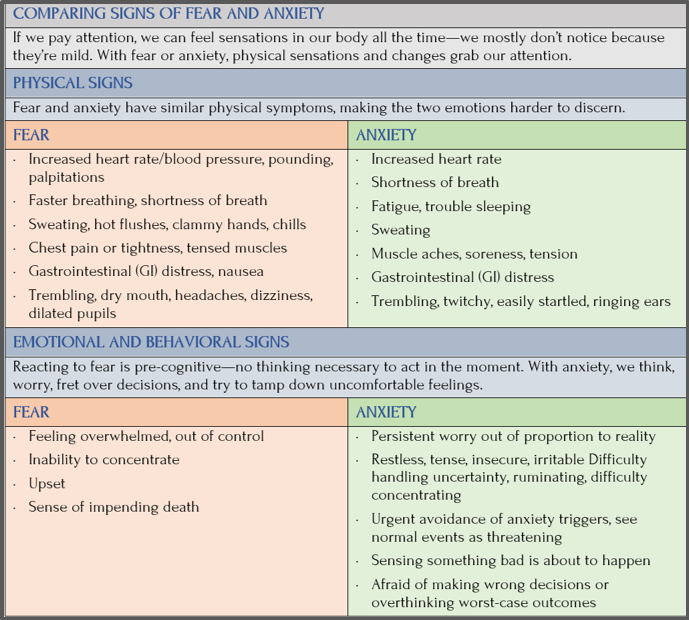
In this post, I will talk about our body’s reactions to fear and anxiety. They cause us to act in healthy and unhealthy ways — many of which are automatic, on the brink of consciousness. This next chart compares fear and anxiety reactions, physically, psychologically, and emotionally:
The Fight-or-Flight Response (FFR)
We’ve learned about the roles of primary (fear, sadness, anger, joy) and secondary (anxiety, shame) emotions in our lives. We see how they elicit responses and provide a roadmap for what we need or want to do. Basic emotions are direct and actionable — helping us understand ourselves in relation to life. More complex “secondary” emotions — especially to highly stressful life events — call for different responses. Like fear and anxiety, these are building-block emotions that keep us safe, if we take care to protect ourselves from their overuse.
The body’s fight-or-flight response (FFR) may be one of the most significant wonders of our evolutionary path. Since the beginning of human life, FFR survival mechanisms and the physiology of our bodily response systems protect us and, through prolonged anxiety, hurt us.
FFR is fittingly also known as the acute stress response — a set of changes that seems to bypass decisionmaking (pre-cognitive) and that jumpstarts the body to react to a stress trigger (stressor). Whether physical or psychological, FFR means to stay and deal with the threat or run to safety. Key points to remember:
- We feel emotions in our body.
- Our brain sends (neuro)chemical messages across the brain regions and releases hormones out to the body.
- Past and current experiences and states of mind contribute to the intensity and duration of our reactions.
- Chronic activation of FFR impairs health.
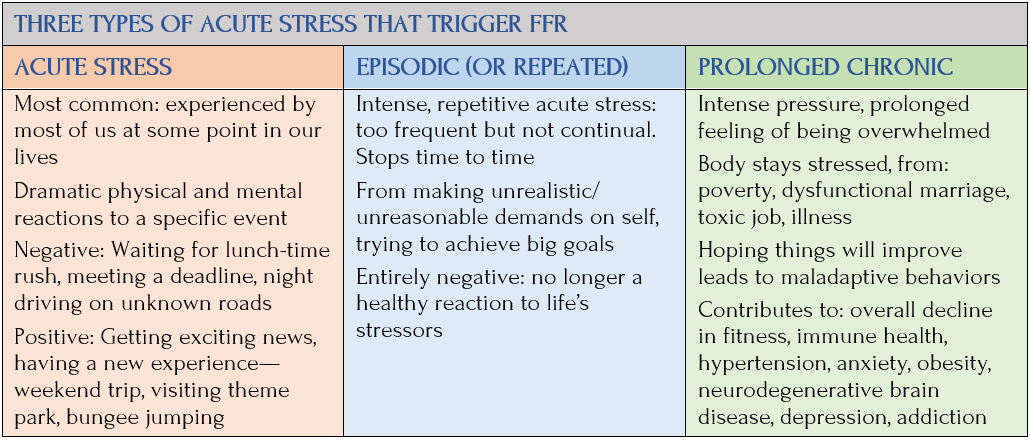
This chart compares three type of FFR-triggering stress:
General Adaptation Syndrome (GAS) and the Three FFR Stages
According to Medical News Today and Harvard Health Publishing, FFR was first described in the 1920s by American physiologist Walter Cannon, who noted how a chain of rapidly occurring reactions helped the body mobilize resources to deal with threat.
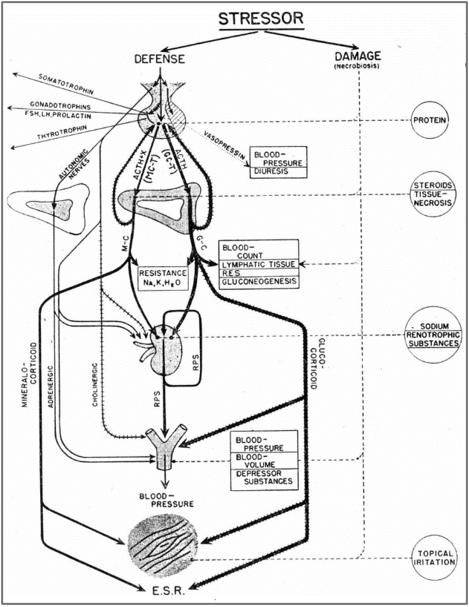
In 1936, Viennese-born, American-Canadian scientist Hans Selye was the first to propose the general adaptation syndrome (GAS) model of stress. Called the “father of stress” for his groundbreaking work, Selye found rats showed similar physical responses to different stressors, including cold temperatures, excessive physical efforts, and injection with toxins.
The GAS theory describes stress-induced, physiological changes through three stages. The last two stages show the pathological changes of episodic or chronic stress.
Diagram first published in the British Medical Journal in 1950, according to NIH
Alarm Stage
After you see or hear a stressor, a signal is sent to the amygdala region of the brain, becoming command and control. It interprets the images and/or sounds, perceives danger, and instantly sends a distress signal through the nervous system to the hypothalamus, another command center.
The hypothalamus communicates with the body through the autonomic nervous system (ANS), which controls involuntary functions (breathing, blood pressure, heartbeat, dilation or constriction of key blood vessels and lung airways).
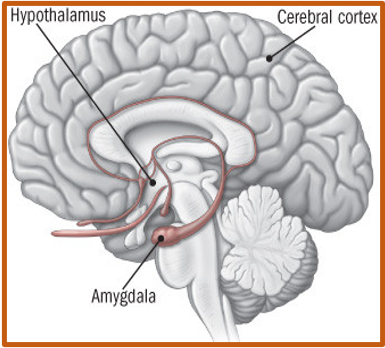
The hypothalamus activates the sympathetic nervous system (SNS), which Harvard Medical’s Dr. Howard LeWine describes as the “gas pedal.” It triggers a sudden onrush of stress hormone epinephrine (better known as adrenaline) into the bloodstream, providing the body with a burst of energy in well-orchestrated, near-instantaneous physical changes:
- More rapid breathing. Small airways open wide in the lungs to take in more oxygen. Extra oxygen is sent to the brain, increasing alertness.
- Sight, hearing, and other senses become sharper.
- Fast release of blood sugar (glucose) and fats from temporary storage into bloodstream, supplying energy to the body.
All of these changes happen so quickly that people aren’t aware of them. In fact, the wiring is so efficient that the amygdala and hypothalamus start this cascade even before the brain’s visual centers…fully process what is happening. That’s why people are able to jump out of the path of an oncoming car even before they think about what they are doing. —Dr. Howard LeWine, Harvard Health Publishing
As the initial surge of adrenaline subsides, the hypothalamus activates the second component of the stress response system — known as the hypothalamus-pituitary–adrenal (HPA) axis.
The HPA axis relies on a series of hormonal signals to keep the “gas pedal” pressed down. Your body is now primed to fight or flee to safety.
If the brain still perceives danger, the hypothalamus and pituitary gland release other hormones, prompting adrenal glands to release cortisol. The body stays revved up and on high alert.
Healthy chain reaction: The adrenaline boost to energy benefited our forebears in facing extreme threats. Today, whether threats are physical and/or psychological, the stress response prepares the body to react to actual or perceived danger and deal with stressful situations.
After the initial shock, the body’s parasympathetic nervous system (PNS) acts like a brake to calm the body down. It promotes repair by lowering cortisol levels and normalizing other responses, like lowering blood pressure and reducing heartrate.
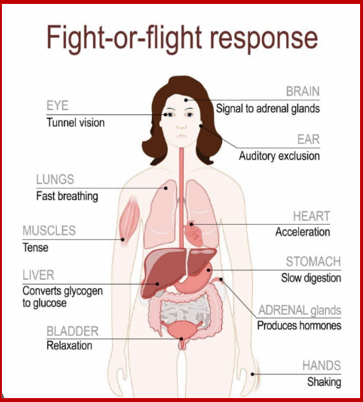
Amrendra Kumar, MD, “How Stress Affects the Body,” MD First Healthcare
During recovery, the body remains on alert until the danger has passed, which usually takes 20-60 minutes.
Resistance Stage: If, however, the stressful event persists for extended periods of time, the body adapts to cope with the higher level of stress. The body continues to secrete stress hormones, which keep the physical response to stress elevated. This induces the resistance stage and includes symptoms of poor concentration, irritability, and frustration.
Exhaustion Stage: If the stressful event continues to persist, the body enters the exhaustion stage and starts to break down. Symptoms of this stage include burnout, fatigue, depression, anxiety, and reduced stress tolerance. As stress persists, the body’s immune system continues to weaken, due to the suppressive effects of stress hormones on cells of the immune system. The exhaustion stage is a casualty of modern life. The body tends to overreact to stressors that are not life-threatening but chronic: work pressures, family difficulties, money problems.
Unhealthy Chain Reaction: Repeated, longer-term activation of the stress response contributes to damaging physical and psychiatric conditions, including addiction and obesity. Research suggests chronic stress contributes to obesity by causing people to eat more and decreasing sleep and exercise.
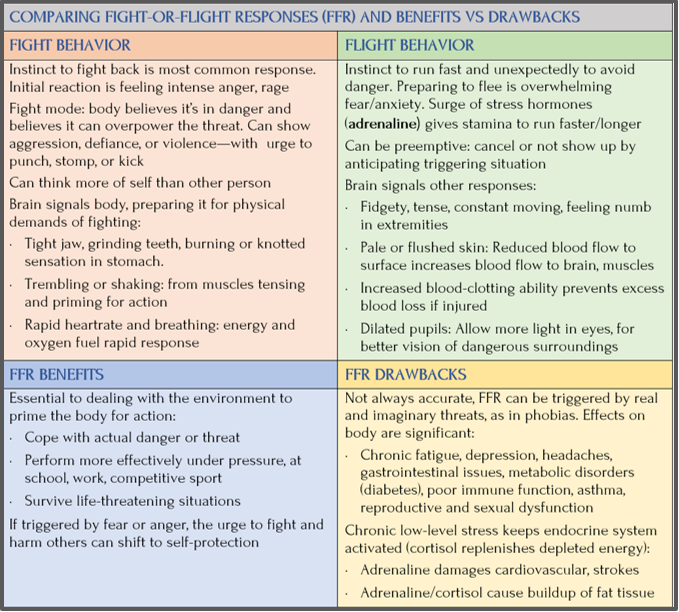
Sources: Harvard Health, Medical News Today, WedMD
Freeze or Fawn… or Flop?
When FFR doesn’t work, the body’s other stress responses are freeze and fawn, which mostly have poor results. Some sources mention a fifth “F” stress response: Flop.
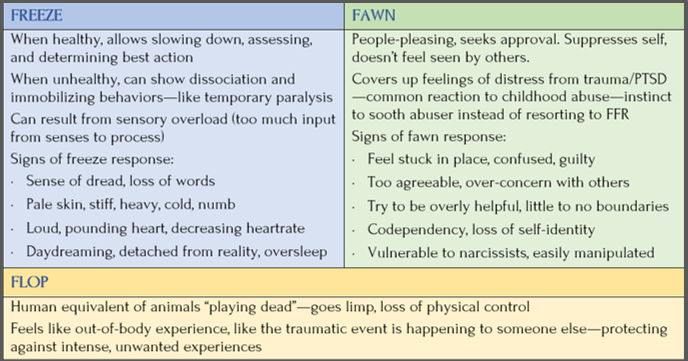
Sources: Harvard Health, Medical News Today, WedMD
Cortisol’s Many Physiological Stress Reaction Jobs
Chronic stress floods our body with hormones, like cortisol, damaging nearly every system by causing inflammation, weakening immunity, disrupting sleep, and increasing risks for heart disease (hypertension, heart attack, stroke), mental health issues (anxiety, depression, burnout), digestive problems (IBS, ulcers), memory/concentration issues, and weight changes. This is because it keeps FFR permanently activated. Cortisol plays a crucial role in FFR’s healthy and unhealthy sides, as seen in this next chart.
Body systems involved in prolonged stress
Fight or flight is a significant full-body experience. It’s humbling to see how our bodies go to war for us — our aligned brain-mind-body systems in strategic formation, prepared and ready to do their parts. None of us wants to suffer a breakdown of any one of these systems. But how many of us thought health erosion was due to a psychological condition? Especially a treatable condition. When we see all the ways our bodily systems are affected by stressful events, we should be awestruck by our resiliency and do more to protect ourselves from long-term, ill-health effects.
We know so much more today about damage from chronic stress on our bodies and how stress begets more stress. I get butterflies in my gut from anxiety — actually, the image of butterflies is too pretty. More like moths. Understanding that prolonged stress can cause so much damage to our health makes me want to do more about it. It’s time to love and protect our bodies.
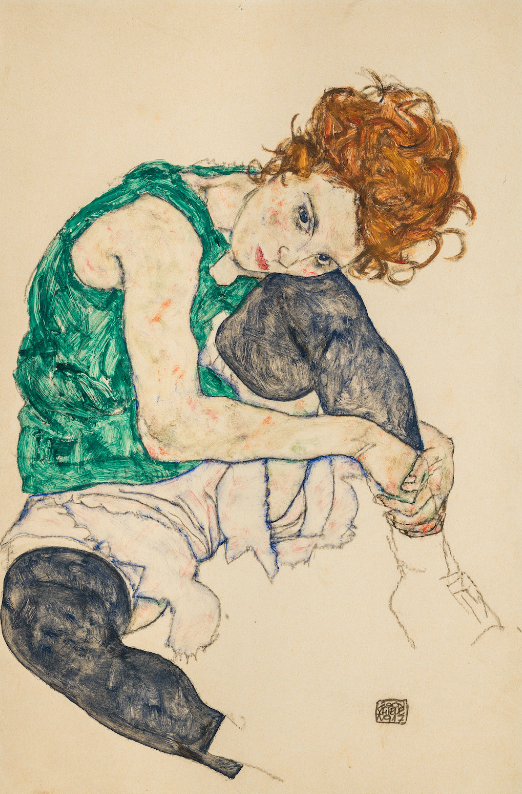
Egon Schiele, Seated Woman with Bent Knees, 1917, National Gallery, Prague
Coming Up Next
In Post 6: The Evolutionay Role of Anxiety, I’ll talk about when anxiety becomes an anxiety disorder and is no longer a mere reaction to stress.
Sources
 English