
On Anxiety and Panic Disorders
Show Table of Contents
INTRO
FEAR VS ANXIETY VS ANXIETY DISORDERS
- Emotional Health vs Mental Health
- Fear vs Anxiety
- Personal Journeys with Anxiety and Panic Disorder
- Fear, Anxiety, and Fight or Flight
- The Evolutionary Role of Anxiety
- When Anxiety Drifts to Disorder
- The Ancient Advantage and Current Anguish of SAD
PHOBIAS, ANXIETY / PANIC ATTACKS
- Phobias and the Rapid Onset of Fear
- Specific Phobia and Agoraphobia
- Anxiety Attacks vs Panic Attacks vs Panic Disorder
- Anxiety Disorder Risk Factors and Symptoms
- Why Anxiety Goes Undiagnosed — and Untreated
TREATING AND COPING WITH ANXIETY
3. Fear vs Anxiety
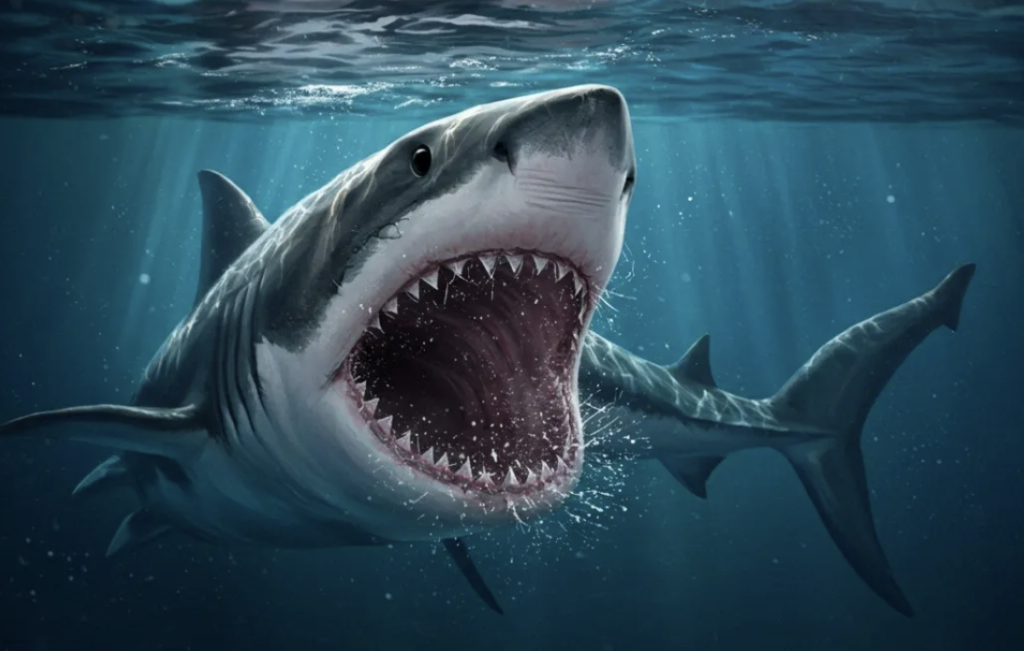
Great white shark, New South Wales, Australia. Big Fish
In terms of evolution, what came first: fear or anxiety? If you were taking a nice swim and this toothy shark approached you, what would you be experiencing? The answer is raw, unmitigated terror — that is, adaptive, affective fear. Your fight-or-flight response (FFR) would be triggered before you could say, uh-oh. You’d be fighting or fleeing before your inner voice told you, Do something now!
Most of us get that fear isn’t an outdated instinct, but the triggers have modernized. Most of us don’t fear for our lives in the wild, but we’re scared of walking alone on city streets late at night. This survival-promoting, rational fear protects us as much now as it did when lions and tigers and bears roamed free as our neighbors.
The Evolution of Fear
In her article, Julia Layton talks of the great evolutionist Charles Darwin, who experimented with his own fear response. At the zoo, “trying to remain perfectly calm, he stood as close to the glass as possible while a puff adder lunged toward him on the other side. Every time it happened, he grimaced and jumped back. In his diary, Darwin wrote, ‘My will and reason were powerless against the imagination of a danger which had never been experienced.’ He concluded that the entire fear response is an ancient instinct that has been untouched by the nuances of modern civilization.”
Other factors involved in fear go beyond instinct, and here we are unique within the animal kingdom. Layton writes:
Human beings have the sometimes unfortunate gift of anticipation, and we anticipate terrible things that might happen — things we have heard about, read about, or seen on TV. Most of us have never experienced a plane crash, but that doesn’t stop us from sitting on a plane with white-knuckle grips on the armrests.
Anticipating a fearful stimulus can provoke the same response as actually experiencing it. This also is an evolutionary benefit: Those humans who felt rain, anticipated lightning, and remained in the cave until the storm passed had a better chance of not getting struck with thousands of volts of electricity. —Julia Layton
The Evolution of Anxiety

Source: Anthropology
Core emotions — sadness, fear, anger, joy — serve biological and evolutionary purposes to help us survive. Fear specifically makes us respond ASAP to danger. It mobilizes the energy in our body for movement — blood flow neglects all but our most essential body parts to make us stronger and faster in the moment.
In contrast to fear, anxiety pushes energy back down, so we stop and react more slowly, with more consideration of options. Anxiety has a different purpose from fear so how we — how our bodies — respond to it is different.
Throughout the millennia, anxiety has guided humans (and animals) to adapt to the environment and anticipate threats to safety and propagation. Julia Layton writes, our forebears stayed one step ahead of thunderstorms by making their homes in caves to have a place of retreat at first rumble.
If fear is the body’s immediate response to danger, anxiety is feeling nervous and stressed out to the idea of danger. What triggers anxiety varies widely. Some people may feel anxious about an event or a trip coming up. Others to an intrusive thought. Or it could just be uneasiness in the face of general uncertainty. Evolutionary psychologist Mermelstein says:
- Fear is an instinctive reaction to external dangers.
- Anxiety is a more complex, psychological reaction involving more advanced cognition.
Psychotherapist Hilary Jacobs Hendel writes in her NAMI blog, anxiety’s an “inhibitory emotion” that results from avoiding fear and other core emotions and needs.
More specifically, anxiety results from the physical effort to push down emotions. If we know we are not in physical danger in a moment, yet we are experiencing something akin to fear, we can assume we are experiencing anxiety…. It’s important to understand the difference between fear and anxiety because the way we work through these two emotions is different.” —Hilary Hendel, NAMI
She explains the amount of anxiety we experience is linked to early experiences with emotions: A child learns their sadness leads to their mother’s withdrawal or impatience. So, the child unconsciously suppresses the sadness and, instead, feels anxious.
As an anxiety sufferer, I can use Hendel’s example of the anxious child to understand why core emotions (fear, sadness) don’t fill my gut with dread, but anxiety does. Anxiety results from a combination of fear, another emotion or two, something else not good — like intrusive thoughts or worry about tomorrow’s presentation — and conscious thought. Since I don’t want to feel this way, I unconsciously suppress, avoid, distract, tamp down, or drink anxiety under the table.
How about this (fictional) example?
A guy is kept waiting for close to an hour on a blustery street corner for his friends to pick him up. When they finally arrive, he gets no apology for their lateness. They go on to have a nice day together.
Despite this, he feels increasingly anxious as the day wears on. After a few drinks, he feels better. Later that night, the anxiety returns, making our guy feel doubly bad. Now he has a headache — from drinking on an empty stomach.
He takes some Tylenol and reflects on the day. He’s able to recognize his anxiety started once he got in the car, cold and tired from waiting. He realizes he was angrier than he thought at the time — he was just about to go home when the friends arrived, all smiles. Our guy also realizes thoughts of his inconsiderate friends had morphed into thoughts of how inconsiderate all people were, including his boss — who had dumped a last-minute project on him that’d mean weekend work.

Photo: Vecteezy
Our guy now understands his anxiety. A starter-kit emotion (anger) mixed with negative thoughts (his friends, all people, his boss, his ruined weekend) and with more emotions (resentment, fear, self-pity) unconsciously elicited anxiety. Now, with a clearer head and new clarity about the day, he can ease his anxiety. He takes some deep breaths and decides what to do about his main friend:
- Forget about it — after all, he feels okay now.
- Address it calmly with his friend, the next time they see one another.
- Call his friend now and express how angry he was — with the risk it won’t go well.
- Decide to never meet his friend on a street corner again.
At the same time, he also decides to wrestle with his feelings about work, his boss, and how to tackle the work just heaped on him:
- Maybe it’s possible to push the work to early Monday.
- If not, work for a few hours tomorrow morning to get a head start.
- Either make peace with a boss who doesn’t respect his time or talk it out with his boss.
- Start looking for a new position.
The point of this tale is anxiety is a normal emotion, but it’s also what Hendel calls an inhibitory emotion. We need to deal with the emotions and intrusive thoughts that lie beneath the anxiety. Otherwise, anxiety (healthy) can become an anxiety disorder (unhealthy) and distress us more.
One more time from Hendel, talking about herself:
Sometimes the core emotion I’m experiencing is obvious. Other times, it’s hard to figure out. In the challenging moments, I literally “try on” each core emotion, one by one. Here’s how:
My attention is still on my body — below my neck. I ask myself, “Is there sadness there? Is there anger? Excitement? Joy? Is there fear? Or disgust?” There is usually a sense of recognition when I find the right core emotion — and there may be more than one! I find and name them all. Then I tend to each emotion, one by one.
I discover that under my anxiety is the core emotion of fear. —Hilary Hendel, NAMI
So, underneath anxiety is ALWAYS fear, plus other stuff. Fear of being attacked, caught, found out, left alone, dying, missing out, losing out. Who thinks so much about fear? Now we can understand how fear is motivating or demotivating — giving rise to anxiety in its aftermath.
A Clear Distinction Between Fear and Anxiety
The story about fear blossoming into an almost universal human experience is no longer simply a reaction to immediate physical danger…. Fear morphed into a multifaceted anxiety that was moldable, flexible, interpersonal, and capable of shaping cognition. This anxiety contributed to group cohesion, group loyalty, and a deep commitment to the group’s narrative. —Jeffrey Mermelstein, “The Evolutionary Roots of Anxiety and its Implications for Socialization and Group Cohesion,” Journal of Psychiatry and Psychiatric Disorders
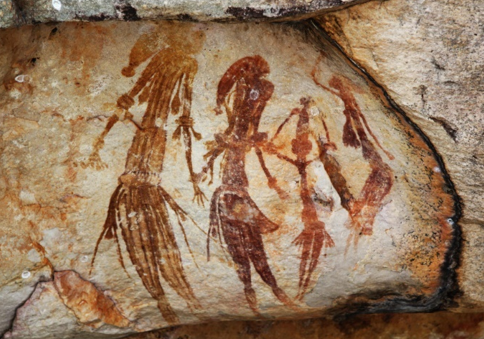
Gwion Gwion rock painting: Tassel figures wearing ornate costumes, Australia. Source: Wikipedia
Mermelstein surmises a mere 30,000-70,000 years ago, human consciousness expanded to include complex social groups — and with that, a more socially based anxiety with more complex cognition.
Accordingly, fear came first, anxiety second. And anxiety was useful for socialization.
Fear remained a primal reaction to actual physical dangers, but now our forebears also experienced this “multifaceted anxiety.” It had adaptive value in humankind’s survival AND played a role in the group’s expansion to include those not related to one another.
Groups Provided Physical and Psychological Security
Anxiety heightened a sense of whether an individual was secure in their group — since exile meant sure death. Pumping up anxiety evolved to foster group cohesion beyond kinship. The group then expanded its narrative to explain who it was — reducing individual anxiety helped bind the grateful individual to the group.
Heightened overall anxiety was adaptive in providing more motivation for individuals to become loyal members of larger cohesive groups. Mermelstein notes the highly speculative nature of these surmises, since cave paintings and tools carved from bone don’t tell anxiety’s story.
Current Evolutionary Theory
Scientists agree being wired to recognize danger was a powerful evolutionary benefit for humans, BUT:
Scientists view anxiety’s prevalence as an unintended consequence of a critically needed readiness to react quickly to actual physical dangers. Even if the reaction is too intense or too frequent, having people wired to react quickly and intensely to danger is seen as a valuable adaptive contribution to the survival of the individual and their kinship group. —Jeffrey Mermelstein
So, in Mermelstein’s view, common adaptive anxiety is necessary to anticipate threats before they happen, even if “too intense or too frequent” anxiety is an unintended consequence of the individual’s and clan’s survival.
To rephrase: pathological anxiety is collateral damage (my words) in the evolutionary boon of being anxious about future danger and anxious about fitting in with a clan larger than kin — two elements necessary for survival.
Mermelstein adds, fear, anxiety and other secondary inhibitory emotions (guilt, shame) are vital survival mechanisms for humans with “conflicting self-interest.” This means:
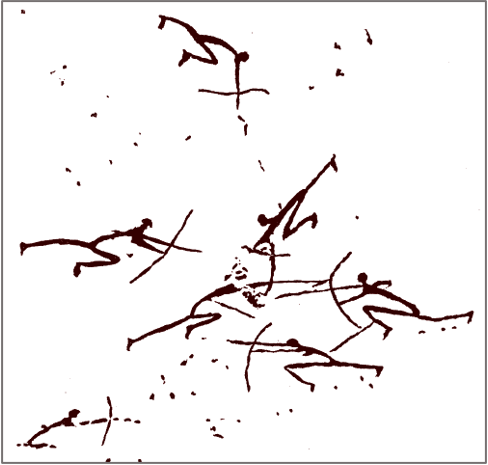
Anxiety plus guilt and shame provides a valuable check on aggression, enabling humans to live within larger non-family groups without killing one another.
Oldest depiction of combat (Mesolithic period), showing three archers encircled by a group of four. Iberian cave art (detail), Valencia. Source: Wildfire Games
Anxiety is About Socialization. Anxiety Disorders Are Not
Humankind has needed anxiety (plus guilt and shame) to keep itself cohesive and alive (at least not killing one another) across the millennia. If our forebears developed an anxiety disorder, oops! The larger benefit to survival of the species (that is, us) crowds out the individuals who suffer for the larger good.
Anxiety, yes, anxiety disorders, no. They’re neither adaptive, nor in our self-interest — because we have laws against killing one another. We owe it to ourselves and the larger groups we’re members of (family, workplace, sports team, friendships, community and religious groups, ethnic and racial groups) to keep ourselves fit and ready.
Yet, these evolutionary truths complicate our pursuit of a mentally fit life. It’s not always in our power to shed anxiety unnecessary to our survival, for our wellbeing. There are complex genetic predispositions, neurochemical wiring abnormalities, early childhood trauma, war, poverty, crime. There are other forces at play that foment anxiety disorders, phobias, and panic attacks.
Coming Up Next
Post 4: Personal Journeys with Anxiety and Panic Disorder returns to the modern era: what are anxiety disorders and phobic disorders? How does the brain process fear and anxiety? In subsequent posts, we’ll deal with symptoms and risk factors. By now, we know how fear, anxiety, emotional health, and mental health are connected. This should help us stop blaming ourselves for what we’re going through.
 English