On Anxiety and Panic Disorders
Show Table of Contents
INTRO
FEAR VS ANXIETY VS ANXIETY DISORDERS
- Emotional Health vs Mental Health
- Fear vs Anxiety
- Personal Journeys with Anxiety and Panic Disorder
- Fear, Anxiety, and Fight or Flight
- The Evolutionary Role of Anxiety
- When Anxiety Drifts to Disorder
- The Ancient Advantage and Current Anguish of SAD
PHOBIAS, ANXIETY / PANIC ATTACKS
- Phobias and the Rapid Onset of Fear
- Specific Phobia and Agoraphobia
- Anxiety Attacks vs Panic Attacks vs Panic Disorder
- Anxiety Disorder Risk Factors and Symptoms
- Why Anxiety Goes Undiagnosed — and Untreated
TREATING AND COPING WITH ANXIETY
8. The Ancient Advantage and Modern Anguish of SAD

Anxiety and its many forms of expression, like social anxiety disorder (SAD), have thousands of years of adaptive benefits to help us understand our current predicament. Experts say there’s no difference — from an evolutionary perspective — of various anxieties. Yet not all anxieties protecting our forebears remain useful today. By linking to our distant past, we can be motivated to claim our future.
In his PubMed/NIH paper, “The biology of fear- and anxiety-related behaviors,” Swiss scientist Thierry Steimer makes many compelling points, which I paraphrase (minus some neuroscience terms) here:
- Anxiety is based in biology.
- The brain processes emotional information and behavior. Anxiety may make us sick to our stomach, but it’s the brain’s fault.
- Contrary to 20th-century thought, the brain is not neatly split between emotional and cognitive processes — rather, they’re interrelated, cooperating, and codependent.
- Cognitive understanding of what’s going on is involved in emotional experiences.
- Fear doesn’t involve thinking — we react instinctually and thinking comes later.
- Anxiety involves feeling AND thinking.
- Cognitive understanding influences coping strategies or defense mechanisms:
How we think about our life experiences, values, and commitments — to ourselves, our personal health and growth, our families, our social and community circles — affects our responses to what life throws at us. Healthily or not. The point is, we have more agency to affect our health outcomes than we might’ve thought possible. Science proves fighting for ourselves makes a difference. —Jan Swan, interpreting Thierry Steimer
Anxiety’s Adaptive Advantages in the Service of Socialization
In response to my query to ChatGPT: “Socialization is the biological process by which an individual acquires the behaviors, norms, and cognitive skills necessary to function within a group to enhance their own survival and reproductive success.”
In evolutionary terms, socialization was essential to survival and reproduction. According to Jeffrey Mermelstein, writing in the Journal of Psychiatry and Psychiatric Disorders, anxiety was a psychological weapon to keep the group intact [paraphrased]:
- Modern day anxiety is an ideal aspect of socialization. It helps us detect and respond to social threats and continues to provide us with a societal advantage.
- Socializing the child in the family begins in infancy, with parents and older siblings as the main socializers. The family is already socialized within their larger community.
- Parents and the community cooperate in teaching children the importance of becoming a loyal community member, which reinforces group cohesion.
Innate vs Learned Anxiety
As children we’re socialized into the family and community by design, but are also born with the capacity for anxiety, mostly without any particular triggers. It turns out the list of innate fears is short: reaction to loud noises, falling from heights, and strangers. More is learned. Mermelstein notes that anxiety:
- Is pliable: Parents, anxious for their child’s safety, transmit their lifetime learning about anxiety to their child — needing their child to be anxious and cautious like they are.
- Is somewhat visible: Children’s dependency provides a prolonged opportunity to be molded to absorb family/community values, beliefs, and loyalties.
- Exists at every stage of life: Molding and reconditioning individuals are ongoing.
- Is malleable as it solidifies group unity: Group members may have the illusion of independent thought, but are guided by the group’s beliefs and thoughts. Their loyalty to the group helps them avoid anxiety’s psychic pain.
Belonging is a Powerful Human Motivation
- The need to belong to a group larger than one’s extended family grew in importance over millennia. As groups increased and diversified with non-kin, reciprocity and loyalty within kinship weakened. Keeping the larger group cohesive was motivated by fear that, without the group, survival was impossible. Here’s a conundrum:
- Some of us are more vulnerable than others to emotions that can become disabling conditions.
- We’re social creatures and rely on others for safety, security, love, and belonging — and to serve a larger purpose in life beyond our own immediate needs.
- Points 1 and 2 can be on a collision course.
Illustration: iStock/caraman
We look around and see this for ourselves. A student sits apart from everyone else, while friends surround the team captain. College friends experiment with drugs, but one among them has an “addictive personality” and soon, an unmanageable life. Young parents with the gene for death-defying adventure-seeking gamble their lives and their family’s future. We want to be independent lights, but we need the group. Our lives feel more precarious once we’ve left the nest. We’re never fully equipped for where our lives take us.
We’ve been instinctively socialized in ways that protect and hurt us. Now I have an appreciation for how deeply this struggle is embedded in our bones. The most vulnerable among us need to stand up to the millennia or to our own families or to ourselves — and not blame ourselves for our disabling disorders. To love ourselves for our struggle.
Introversion vs Extreme Shyness vs Social Anxiety Disorder (SAD)
Some extroverted types welcome new experiences and new people. They look forward to socializing and easily introduce themselves and join conversations.
Some introverts don’t enjoy socializing but are not bothered by this — they gain energy from being by themself or socializing with a few people they know well.
Some shy people want to socialize, but fear holds them back — leading to problems in relationships and at work.
Photo: iStock

The American Psychological Association (APA) defines shyness as the tendency to feel awkward, self-conscious, bashful, worried, or tense during social encounters. Shyness is a personality trait affecting how a person feels and behaves around others, especially unfamiliar people. Shy people can experience physical sensations like blushing or feeling speechless, shaky, or breathless.
Most people — at times in their lives, 80% of all people — have experienced shyness. And 40% of them consider themselves shy. Typically, shy people get along reasonably well, find situations tolerable, and feel some satisfaction once a feared situation is handled.
Problems exist only if someone shy wants to socialize, but can’t. Psychology professor Jonathan Cheek, Wellesley College, notes four types of shyness:
- Shy-Secure don’t need to interact socially. When asked in a lab setting to converse with new people, shy-secure types were low-key — but weren’t interested or excited.
- Shy-Withdrawn are more anxious about socializing, fearing rejection, judgment, or saying or doing the wrong thing. They’re prone to loneliness.
- Shy-Dependent overcompensate to fit in, rarely putting their needs first. They adapt better to short-term social situations. Long term, they don’t develop strong, mutual relationships.
- Shy-Conflicted need social contact, but are anxious. Cheek describes their behavior as “approach-avoid.” They’re in conflict between withdrawing/seeking autonomy vs moving toward others. They also experience “anticipatory anxiety” before socializing even begins. Of all types, the shy-conflicted have the most problems.
Many confuse shyness with introversion and social anxiety. In an interview by The Verge, psychologist Ellen Hendriksen, Boston University, said, “Introversion is how you’re wired, whereas [shyness and] social anxiety get in your way.”
Comparing Introversion, Shyness, and SAD
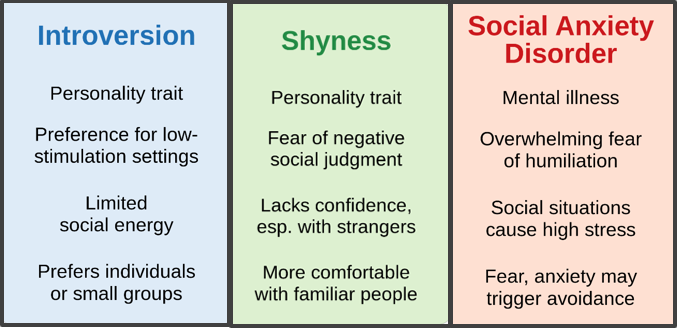
Here's a chart extending the Wikipedia graphic:
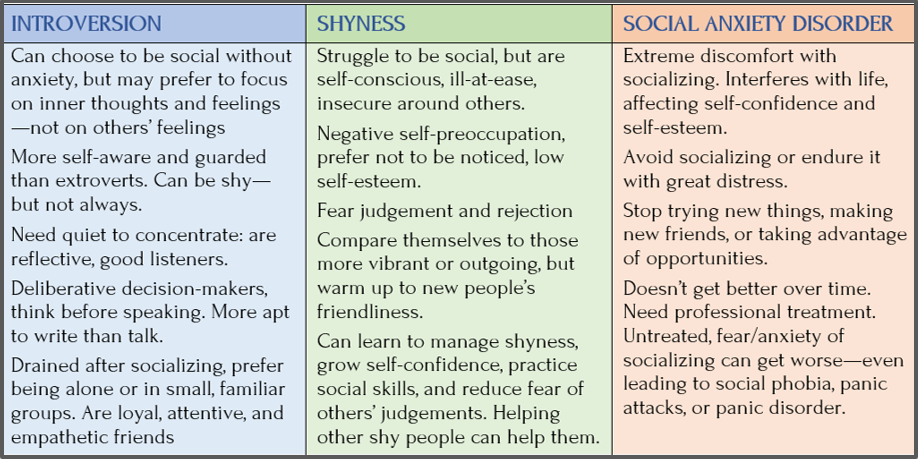
Sources: Interview with Boston University psychologist Ellen Hendriksen, The Verge, American Psychological Association (APA); Wikipedia; Hannah Owens, LMSW, “Are There Other Types of Social Anxiety? It goes beyond shyness or introversion,” Very Well Mind
Social Anxiety Disorder (SAD) is Different

Photo: iStock
Social anxiety disorder (SAD) is a relatively new term to describe a serious mental health condition. It was originally called social phobia, extending back to 1903, when French psychiatrist Pierre Janet used it to describe patients with an intense fear of being observed while talking or playing the piano. Another name is performance anxiety that emphasizes the underlying anxiety.
But SAD’s not just social unease, common in shy or withdrawn children and adolescents. All of our comfort levels in social settings vary — a spectrum from the naturally reserved to the naturally outgoing
And most of us know where we’d place ourselves on this spectrum.
Instead, SAD’s diagnosed once anxiety causes significant distress or functional impairment—when shy feelings become severe enough to disrupt daily life. Hendriksen says social anxiety is not a deficit of social skills and points out positive attributes.
The one thing I always like to add is that social anxiety is a package deal, and it often comes bundled with strengths, like high standards and empathy and being helpful and altruistic. People who have social anxiety are often good listeners and conscientious, and they work hard to get along with fellow humans. And those are all really amazing strengths that won’t go away even as people work on their social anxiety. —Psychologist Ellen Hendriksen, Boston, University, in an interview, The Verge
SAD is a common condition, yet wasn’t added to the American Psychological Association’s Diagnostic and Statistical Manual of Mental Disorders or DSM-4 until 1994. Social phobia was only mentioned for the first time in DSM-3 (1980). Scientists don’t agree on the causes, but here’s what is known. SAD:
- Affects 15 million or about 7% of the U.S. adult population.
- Also affects millions of children and adolescents — typically beginning in the teens, with 13 as average onset age
- Occurs more frequently in women than men, though men are more likely to seek treatment
- Appears to run in families or one parent, or in families that don’t socialize or encourage their children to have friends
- Is perhaps caused more by the environment in which one grows up
SAD’s Evolutionary Advantages
People with SAD over worry their social status and fear being observed and judged by others. They’re often triggered by their fear their own words, actions, or appearance will go against the image they’d like others to see. Does this affliction help humankind?
In Science Direct, author Tara Karasewich and psychologist Valerie Kuhlmeier, Queen’s University, Ontario, discuss SAD’s evolutionary advantages, even if social anxiety feels bad. They use the term, trait social anxiety, which underscores SAD as an inherited predisposition.
[T]rait social anxiety [should] be considered a conditional adaptation; that is, the trait should develop as a response to cues in the early childhood environment to prepare individuals to face social threat in adulthood. [We] can provide new insights into how trait social anxiety has persisted in our species and how it functions in the modern world. —Tara Karasewich and Valerie Kuhlmeier, Science Direct
Here are their new insights. Social anxiety:
- Probably evolved to protect our ancestors from social threat.
- First develops in infancy, resulting from genes interacting with the environment.
- Tells a conditional adaptation story for being beneficial to ancient humans surviving danger and adapting to their environment.
- Predisposes individuals to avoid social threat by being wary of others — warning of potential danger among other group members to prevent conflict or limit its damage.
Effects of SAD
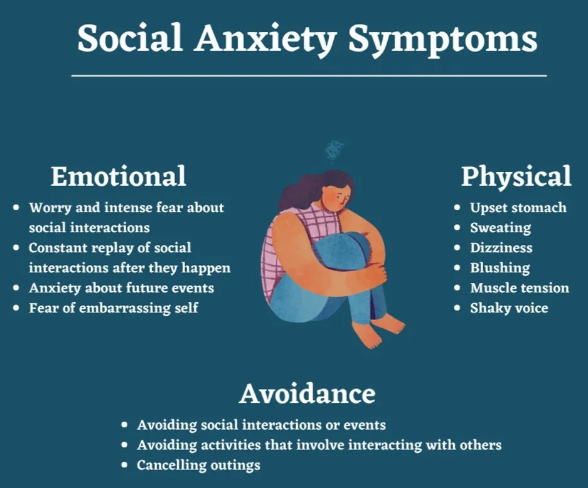
People with SAD suffer in many ways since everyday life involves other people. As a result, SAD may:
- Cause bright, talented, and sensitive people to be lonely and isolated.
- Compromise their education or work goals, due to social demands or public requirements.
- Be comorbid with depression or substance abuse.
Mental health specialists either see SAD and social phobia [post 7] as synonymous or see social phobia as a more extreme and persistent SAD variant.
Graphic: based on chart by K. Trudeau. From Maya Hsu, “Impact of Nervous System Attunement on Social Anxiety,” Seattle Anxiety
Profile In Courage
Australian writer Tobias Atkins, who wrote a book, How I Overcame Social Anxiety, also shared his “story of healing” on the Anxiety & Depression Association of America (ADAA) blog. I’ve edited to the third-person and for brevity:
For most of his life, Tobias struggled with social anxiety disorder (SAD), along with generalized anxiety disorder (GAD), obsessive-pulsive disorder (OCD), and depression. Due to his fear of job interviews, he took medical disability benefits, along with medication. Tobias felt uncomfortable or awkward in public 90% of the time, not being able to relax and be himself around people, even old friends.
MEET TOBIAS

Photo: Adobe
Tobias was always shy and sensitive, but gave up thinking he could fix it. He also gave up on himself, convinced he didn’t win the genetic lottery — so, “better luck next lifetime.” He only found out about SAD when he saw his first psychologist.
For years, Tobias suffered in silence. He felt embarrassed and ashamed so didn’t tell anyone or seek help. He was raised to believe it was weak to talk about feelings. When he finally did open up, his friends didn’t understand him or what he was going through. They said, “harden up” and “who cares what others think?” He now realizes seeking help and talking about your feelings are the bravest things you can do.
The first step to change is asking for help: If you act like everything’s all right when it’s not, you can’t expect anyone to help you. Statistics show most people suffer with SAD in silence for around 10 years before seeking help—which makes no sense because this condition is treatable.
How Everything Changed
Tobias’ life changed when he sought help and met a former SAD sufferer who managed to persuade him SAD’s not a life sentence. Once Tobias believed this, everything changed.
His psychologists taught him to stop calling himself hurtful names, like loser, ugly, and weird — and to accept himself, for good and bad. He doesn’t need to be perfect or never appear awkward for others to like and accept him.
Instead of looking to others for validation, his therapists taught him to value and validate himself. What others thought of him started to matter less. Tobias became more concerned with how he felt about himself.
Tobias encourages others to get professional help. Psychologists have tools and knowledge to help people overcome SAD.

Tobias’ therapist used a technique called emotion-focused therapy (EFT) to help him gain awareness of his emotions — and to face them. EFT helped Tobias get over his social anxiety. He hopes his story will tell other SAD sufferers their conditions aren’t life sentences.
My Analysis of Tobias
Bravo to Tobias for his courage to change his life by committing to the therapeutic process. I’d be curious to know how long the entire process took before he felt free of SAD. And whether he was treated for OCD and depression — or did those conditions resolve once his social anxiety lifted.
It’s upsetting news a decade of suffering goes by before someone decides to seek treatment and change their life. Tobias delivers a powerful message. It takes resolve and commitment to getting better for treatment to work. You can’t just show up. You have to believe and trust. It’s hard to go through, but the effort pays off. It’s life-saving advice.
When asked by The Verge what people with SAD should do, Hendriksen had this to say:
Go forth and do. I often talk to clients who say, “I wish I could hit pause on the world, and I could retreat and work on myself and gain confidence and reemerge confident and be ready to live my life.”
That’s backward. A nice analogy is that of mood and action. We often think we have to “feel” like doing something before doing it. We have to feel like going to the gym before going to work out. But if we lace up our shoes and go to the gym, often our mood catches up — and we’re glad we went. With confidence, it’s the same thing. We have to put action before feeling confidence. Because when we see ourselves doing challenging things, we start to believe we can. —Ellen
Social Phobia

Photo: Adobe
The field of mental health changes constantly, as research and clinical knowledge about a disorder’s symptoms changes and updates former classifications. This is true when it comes to the historical diagnosis of social phobia, which is now called SAD in DSM-5.
Social phobia was formally recognized as a disorder when included in DSM-3 in 1980 (refined in 1987). When SAD was entered into DSM-4 in 1994, the two disorders remained distinct. But eventually SAD became the primary name by the time DSM-5 appeared in 2013.
It’s only worth discussing here to note one difference between the comprehensive SAD and the highly specific phobic reaction to an event or circumstance. Some sources say there remains a difference in scope and intensity.
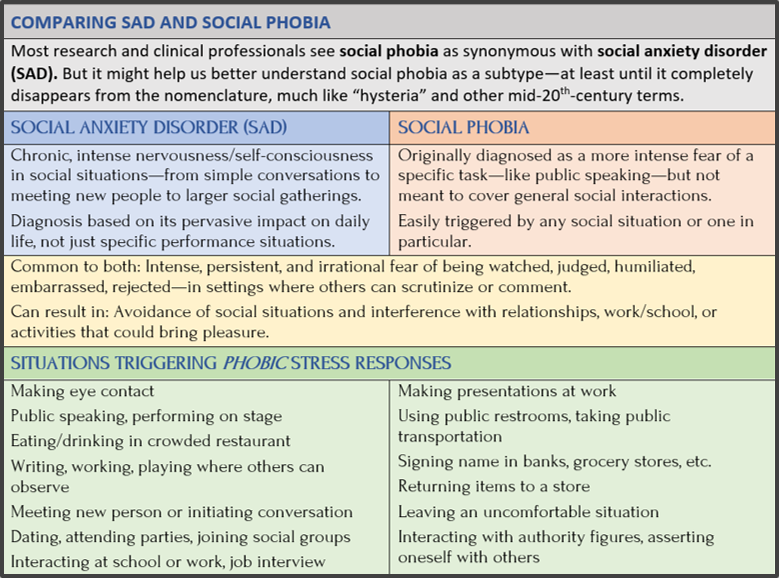
Sources: Hannah Owens, LMSW, “Are There Other Types of Social Anxiety? It goes beyond shyness of introversion,” Very Well Mind; Hope Gillette, “What is the Difference between Social Anxiety and Social Phobia?” Medical News Today
Related But Different: Avoidant Personality Disorder (AVPD)
It’s worth mentioning avoidant personality disorder (AVPD), which involves many similar characteristics of SAD — like chronic feelings of inadequacy and extreme sensitivity to criticism — but some clear distinctions as well. According to the Cleveland Clinic, those with AVPD want to interact with others, but their fear of rejection holds them back.
People with SAD have an intense and ongoing fear of being judged and watched by others, leading them to avoid social situations. But those with AVPD, also avoiding social situations and relationships, has more to do with their low self-esteem than with anxiety.
Researchers once thought that AVPD was a severe form of SAD. But studies show most people with AVPD don’t meet SAD criteria. Individuals can have both AVPD and SAD, with more severe symptoms than either condition alone.
Researchers estimate 1.5%–2.5% of the U.S. population has AVPD. It begins in late teens or early 20s and is typically likely to affect people with the following:
Coming Up Next

AI generated
In Post 9: Phobias and the Rapid Onset of Fear, we’ll move from anxiety disorders to anxiety-based phobias.
 English