On Anxiety and Panic Disorder
Show Table of Contents
INTRO
FEAR VS ANXIETY VS ANXIETY DISORDERS
- Emotional Health vs Mental Health
- Fear vs Anxiety
- Personal Journeys with Anxiety and Panic Disorder
- Fear, Anxiety, and Fight or Flight
- The Evolutionary Role of Anxiety
- When Anxiety Drifts to Disorder
- The Ancient Advantage and Current Anguish of SAD
PHOBIAS, ANXIETY / PANIC ATTACKS
- Phobias and the Rapid Onset of Fear
- Specific Phobia and Agoraphobia
- Anxiety Attacks vs Panic Attacks vs Panic Disorder
- Anxiety Disorder Risk Factors and Symptoms
- Why Anxiety Goes Undiagnosed — and Untreated
TREATING AND COPING WITH ANXIETY
18. Coping with Anxiety at Home
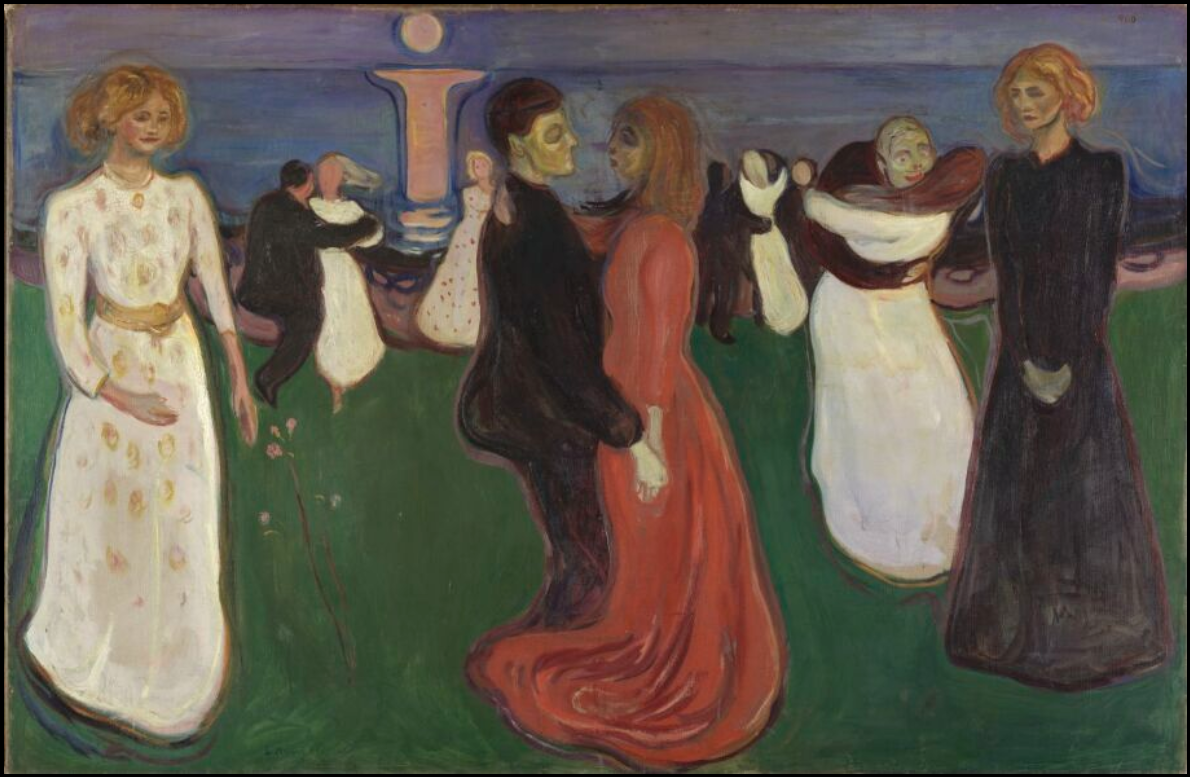
Edvard Munch, The Dance of Life, National Museum of Norway
I conclude my anxiety series with what we can do at home to augment the benefits of psychotherapy and/or medication. What I describe here isn’t meant to be comprehensive, but give an idea of how any of us with anxiety-disrupted sleep, relationships, work, and life can take matters into our own hands. We can become aware of when we start climbing the anxiety bell curve that peaks at full-blown panic attack and cut it off at the pass — moving across from rising to descending arcs well short of the peak. And save us from crippling moments when we can’t catch our breath or feel like we’re headed to oblivion. No one but us can commit to our health, growth, sense of optimism, ability to feel joy, belief in ourselves and what we can accomplish, and sense of overall wellbeing.
Maybe we believe the stressor is short lived and so out of our control we feel there’s nothing we can do. Research, however, finds avoidance strategies have extremely poor outcomes long term. They tend to worsen the problem and lead to more distress, anxiety disorders, and PTSD. This in turn can indirectly affect physical health, especially if avoidance includes smoking, drinking, poor eating habits, or lack of exercise and sleep.
Adaptive Coping Mechanisms
Think about what to do in this scenario. It’s 5:30 p.m., we’re feeling hungry, but all we see in our empty fridge is a head of broccoli and not much else. What do we do? Cook the broccoli and maybe some rice and have a reasonably boring but nutritious dinner? Order pizza delivery? Or skip dinner and snack on chips instead?
Added to the above, we’re extremely stressed about work tomorrow and worried about falling asleep tonight. We’ve been taking antidepressants to help with anxiety, and we’re also in therapy. But that’s not helping now. Our eating habits and poor planning for mealtime have caused an unwanted weight gain, which is no doubt because we also stopped exercising. We just haven’t felt like it. We had pizza at lunch, but can’t think of what else to order for delivery.
We’re frustrated by everything and start to feel overwhelmed. What choices do we make?
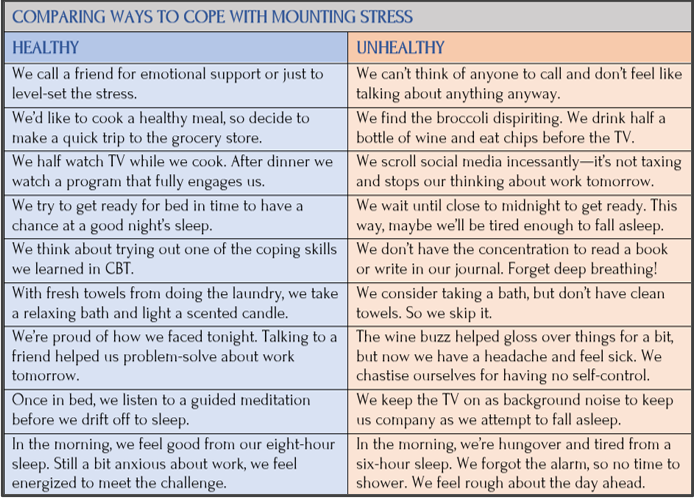
Maybe if recognized earlier in the day what was bothering us or how we wanted to handle tomorrow’s work issues, we would’ve taken steps to care for ourselves and have a relaxing, calming evening — rather than one resulting in a headache and bad start to the next day.
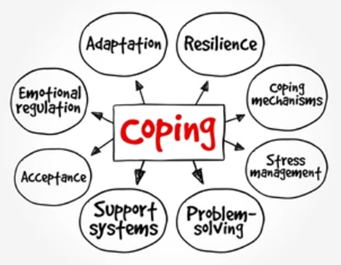
Adaptive or healthy coping mechanisms are protective mechanisms that help in the moment and can also forestall having additional bad moments. They can decrease the adverse effects of stressors as they occur and reduce them from occurring in the first place. Those of us who rely more on coping strategies — problem-solving, information-seeking, planning ahead, relaxation — tend to adapt better to stressors. We also adapt best when our coping efforts match the demands of the moment. Research confirms those of us who are flexible in how we cope show better adaptation or adjustment and better outcomes than those who have more restricted or rigid ways to cope or who avoid coping. There are many types of coping, both healthy or unhealthy. Two main types:

Photo: From Dan Bartlett, “5 tips for anxiety and panic attacks”
- Problem-based coping: We make efforts to change the source of the stress, perhaps by removing the stressor from our life. Perhaps we’re in an unhealthy relationship and feel angry and sad about the way we’re being treated. Instead of dealing with our emotions, we decide to end the relationship AND take care of ourselves in a healthy way.
- Emotion-based coping: Here, we make attempts to deal with the emotions we’re feeling when we have a reason we don’t want to take any direct action (we need to pass the exam) or we can’t change the situation (our grandparent just passed). It’s out of our control, but it’s important to cope with our grief in a healthy way over time.
This also allows for emotional release of pent-up anxiety. We “move toward the stressor” by learning about it to understand why it’s happening and accept it’s happening — and then figuring out how to confront it. Along the way of solving the problem, we seek professional or social support, we plan ahead, and we try healthy coping strategies, like relaxation.
Approach and Avoidance Coping Strategies
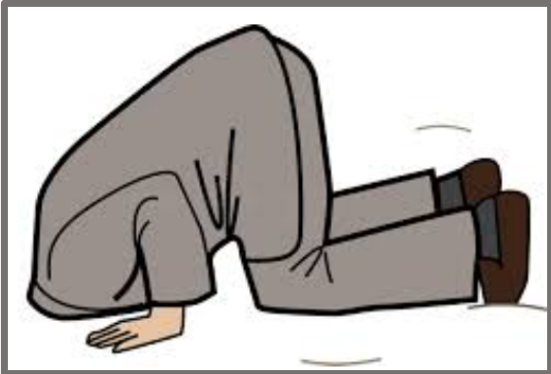
- Avoidance: In contrast, we avoid or distract ourselves from the stressor. We’re not working toward something good, we’re trying to get away from something bad. Psychology further breaks it down: in passive coping (cognitive/emotional), we try to disengage from the stressor by denying it, fantasizing it’ll go away by itself, or other non-acts. In active coping (behavioral), we take steps to physically avoid or escape the stressor by staying in bed or going out drinking, as well as other unhealthy behaviors (like risky sex with a stranger, illicit drugs, or overeating).
Photo: Dreamstime
Maybe we believe the stressor is short lived and so out of our control we feel there’s nothing we can do.
Research, however, finds avoidance strategies have extremely poor outcomes long term. They tend to worsen the problem and lead to more distress, anxiety disorders,and PTSD. This in turn can indirectly affect physical health, as a result of the smoking, drinking, poor eating habits, lack of exercise and sleep.
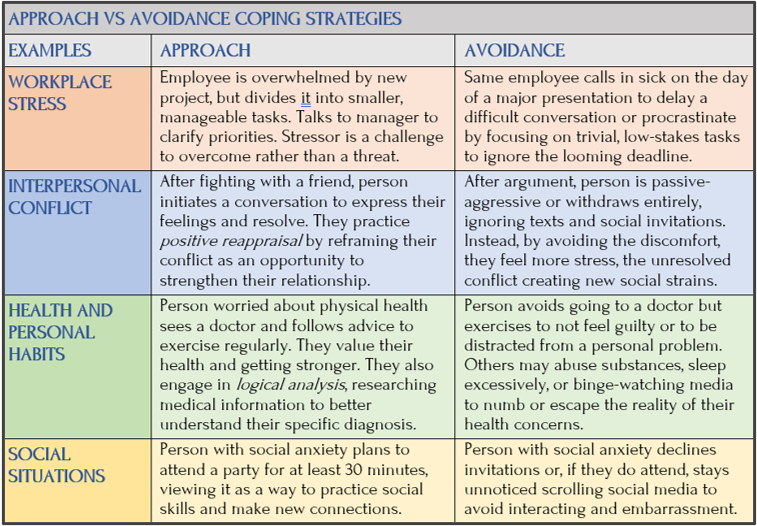
Sources: Susan Roth and Lawrence Cohen, “Approach, Avoidance, and Coping with Stress, APA PsycNet; Dan Bartlett, “5 Tips for Anxiety and Panic Attacks”; Kaci Smith, “Approach Motivation vs. Avoidance Motivation: Why Self-Compassion Wins,” Belongly
I’ll conclude the series on anxiety with time-tested remedies for reducing stress and coping with daily life, which, together with therapy and/or medication, will certainly help any of us live a better and more fulfilling life.
Lifestyle Changes and Alternative Medicine
Herbal remedies: More research is needed to fully understand the risks and benefits of herbal remedies as anxiety treatments. So far, results are mixed, with several study participants reporting no benefits. Even though many doctors are not particularly well-informed about herbal remedies or supplements, it’s still important to make sure they’re safe and won’t interact with other medications (pharmacists are knowledgeable). A few examples:
- Herbal supplements, such as kava and valerian, increase the risk of serious liver damage.
- Passionflower or theanine have a calming effect, but are often combined with other herbs — it’s hard to know if effective.
Deep breathing is the body’s chill pill: Perhaps begin with self-care therapies that include breathing exercises and meditation.
Photo: Getty Images
Before a person seeks medication, I strongly encourage them to try nonpharmacologic interventions. What I regularly teach in my office — is deep breathing. There are a number of different methods, but it is basically deep, slow breath in through the nose in a five-three-eight pattern. So, a deep breath in for five counts, holding that breath for three, and then exhaling for at least eight counts. —Sandra Swantek
Swantek encourages patients with anxiety disorders to do this at least three times daily — and even more often during an anxiety episode or when trying to fall asleep. She says, “That’s the simplest intervention possible and activates the parasympathetic nervous system (PNS), which is essentially our own personal chill pill. That’s why it’s such a good intervention — you’re literally mustering up your own body’s calming reflex.”
Tips to Deal with Anxiety
In this blog series, I’ve dealt more with severe anxiety disorders, not “healthy,” evolutionarily derived anxiety. That doesn’t make anxiety a good thing to endure, because untreated it can develop into an anxiety disorder.
I’ve chosen and edited the following tips, from a number of sources, including HelpGuide. I believe some tips are aspirational, but maybe not realistic. HelpGuide’s first tip “Stop chronic worrying” is like telling an insomniac to “just go to sleep” (this happened to me). That’s what this one sounds like, so I changed it to “Try to reduce chronic worrying.”
Photo: Instagram
Tip 1: Ease stress
Try to reduce chronic worry. Worrying can be habit-forming and take over conscious thought. A good antidote to anxiety spiking is to become conscious of it. Identify the trigger. Challenge anxious thoughts and learn to accept uncertainty.
Allow a worry period. For the rest of the day, put off thinking about what’s bothering us until tomorrow’s worry period. This stops negative thought loops. It takes practice.
Take time each day to relax. Practice self-care, even for 10-15 minutes a day.
Take a break from reality. Everyday stressors — whether financial hurdles or interactions with difficult family members — contribute to overall anxiety. Turn off the news. Read a book.
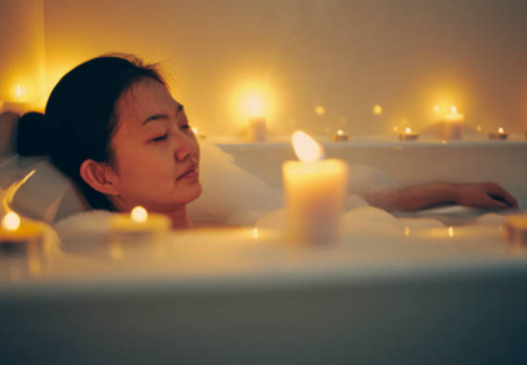
Photo: RichLegg/Getty Images
Lighten our load. Try to give up, turn down, or delegate some responsibility.
Try to relax and control anxiety. Even for a few minutes a day. Practice relaxation techniques:
- Mindfulness meditation, progressive muscle relaxation, deep breathing, tai chi, yoga, gratitude, journaling
- Light a scented candle. Take a bath. Sit in silence with eyes closed
- Listen to a “calming” app (sounds of nature, rain). Listen to music. Sing or dance to music.
Tip 2: care for our body
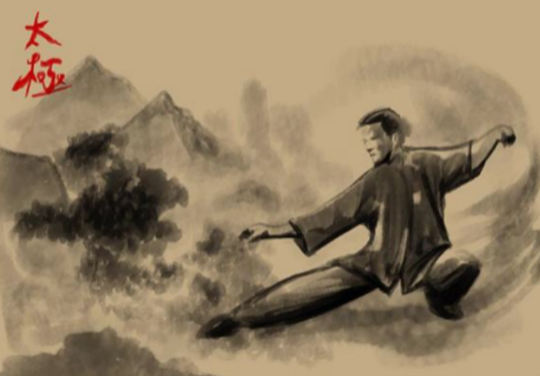
Photo: Vecteezy
Every source offering health tips emphasizes exercise, drink/eat in moderation, weight control. Like gnats you want to swat away, it comes at you from all directions. But that’s because healthy habits have a significant impact on anxiety. The better we treat ourselves, the less likely we’re to feel stressed, fatigued, and negative throughout the day. Build up to it.
- Exercise regularly. Rhythmic, aerobic exercise of moderate-to-low intensity (walking or jogging for 15-30 minutes at least three times a week) reduces anxiety. Actually, any regular physical activity — bike riding, dancing, running, playing pickleball — reduces anxiety. Break it up in short periods if that’s easier.
- Get enough sleep. Research shows a lack of sleep can exacerbate anxious thoughts and feelings. Aim for 7-9 hours of quality sleep a night.
- Eat a healthy diet and stick to regular eating habits as much as possible. Use your health insurance plan’s offers for free sessions with a nutritionist.
- Reduce or stop caffeine, alcohol, nicotine, and unregulated drugs. Caffeine and alcohol can make anxiety worse. Cigarettes calm in the short term — but in the long term, nicotine is a powerful stimulant leading to higher levels of anxiety.
Tip 3: Shift our Perception of Anxiety
Physical sensations of anxiety — shaking, knot in the gut, rapid heartbeat — become things we fear and try to avoid. Instead, it may help to view such sensations as temporary and natural — something to accept and learn to work with.
In his book, DARE: The New Way to End Anxiety, Barry McDonagh offers four steps to shift perceptions of anxiety. When trying the DARE process, he writes, visualize anxiety as an occasional visitor to embrace and, eventually, it’ll wander off. DARE stands for:
- Defuse. Anxiety may build on internal “what if” questions. “What if my anxiety spirals out of control?” Respond with, “So what?” You’ve experienced anxiety before, and it’s harmless.
- Accept. Allow sensations to exist without trying to fight them off. We don’t need to control a rapid heartbeat. Resist the urge to label anxiety symptoms as good or bad.
- Run toward it. Tell ourselves we’re not anxious, but excited. Demand more sensations by “calling anxiety’s bluff.” Our perception of anxiety as just a flood of adrenaline is important.
- Engage. Once anxiety subsides, don’t fixate on fleeting feelings. Instead, start a new activity. Focus senses on whatever we’re doing. This helps ground us in the present again.
Tip 4: connect with others
We may want to curl up within ourselves and avoid the world, but loneliness and isolation can trigger or worsen anxiety. Talking about anxiety can often make concerns and ruminations seem less overwhelming and more manageable. Take baby steps:
- Expand our social circle. There’s no shortage of ways to branch out — sharing thoughts and feelings with someone trustworthy or meeting someone for a walk. It’s never too late to make new friends — most people are looking. I actually found a dear friend through an online group. If you’re able to, join community groups or clubs (do you quilt, knit, paint, read books, like old movies, cook, bake, play ping pong?), or volunteer.

Photo: Adobe Stock
- Look to people who are going through the same thing. Find a self-help or support group with a specific anxiety disorder, such as group therapy for SAD by age group. We might also learn or share coping techniques that’ve worked for us.
In Conclusion
This ends my 18-part series on anxiety disorders — a subject far too complex to fully capture, but one that becomes less opaque the more we understand it.
Here’s what I hope comes through, more than any single strategy or study: anxiety isn’t a personal failing, and it’s not fixed. It’s something that can be understood, worked with, and, over time, lose some of its grip.
Treatment helps — therapy, medication, structured approaches — but daily decisions count just as much. As we learn more about our stress reactions, we can respond earlier when stress begins to rise. We can move toward what’s difficult or step away. We can care for ourselves in small, steady ways, even when we don’t feel like it.
Anxiety can erode things gradually. We may not notice it taking over until there’s a day when that’s all we feel. The relaxation and meditation tools don’t come easily. Avoidance wins, and we’re exhausted. That doesn’t undo the work. It’s part of it.
 English