
Narcissism and the Rest of Us
Show Table of Contents
INTRODUCTION
NARCISSISM DEFINED
2. Is There a Narcissist in Your Life?
3. Narcissus and the Origins of Narcissistic Thought — Part I
4. Narcissus and the Origins of Narcissistic Thought — Part II
5. Narcissus and the Origins of Narcissistic Thought — Part III
6. A Narcissist’s Self-Defense — Part I
7. A Narcissist’s Self-Defense — Part II
8. A Narcissist’s Self-Defense — Part III
NARCISSIST PERSONALITY DISORDER VS TRAITS
9. When Narcissism is a Personality Disorder
10. Narcissism and the Maladaptive Umbrella
11. Malignant Narcissism and the Narcissism Spectrum
12. When Narcissism is Compounded by Comorbidity
NURTURE VS NATURE
15. Narcissism: Flipping Self-Esteem on its Head
16. The Double-Edged Sword of Grandiose Narcissism
17. The Happy Narcissist
18. Famous Narcissist Leaders
NARCISSISM’S DARK SIDE
19. Narcissistic Rage and Narcissistic Self-Awareness
20. Trait Narcissism and the Illusion of Control
21. Beyond Narcissism: Dark Personality Traits — Part I
22. Narcissist Sociopaths: Dark Personality Traits — Part II
ROMANTIC LOVE AND BOUNDARY-SETTING WITH A NARCISSIST
23. Romantic Love with a Narcissist — Part I
24. Romantic Love with a Narcissist — Part II
25. The Narcissist’s Non-Apology Apology
26. Boundary-Setting with Narcissists — Part I
27. Boundary-Setting with Narcissists — Part II
28. Boundary-Setting with Narcissists — Part III
29. Shattering Narcissus’ Mirror… So They Can Live
CONCLUSION
30. On Narcissism: What About the Rest of Us?
5. Narcissus and the Origins of Narcissistic Thought — Part III
From the moment of birth, we define ourselves by the care, attention, and love we receive from our primary caregivers, especially mom. Knowing this for sure is impossible, unless we can vividly recall and articulate the experiences of our first year or two. Instead, 20th-century psychiatric experts devised theories, notably object relations theory, to propose what’s going on in that sweet little infant head. Some of it makes intuitive sense, but some of it pries the lid off our sealed assumptions of how we become us.
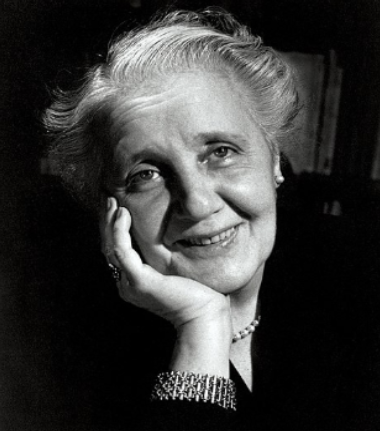
Source: Melanie Klein Trust
Object Relations Theory and Unconscious Phantasy
Object relations theory was developed in the 1940s-1950s by prominent British psychoanalysts, primarily Austrian-British Melanie Klein (1882-1960). Klein focused on early childhood instinct, which she called unconscious phantasy (spelling it with a ph to distinguish it from fantasy). “Phantasy is the outward aspect of psychic life and the basis of the infant’s emerging mental life, modified by the environment as the infant develops.”
From the moment the infant starts interacting with the outer world, he is engaged in testing his phantasies in a reality setting. I want to suggest the origin of thought lies in this process of testing phantasy against reality; that thought is not only contrasted with phantasy, but based on it and derived from it. —Melanie Klein, Wikipedia
As the theory goes, infants internalize mental images and patterns of significant caregivers, which form their future expectations and interactions with others. A caregiver who feeds the infant creates a good object representation based on the comfort they provide (good mommy), but also internalizes a separate image of the same object if they don’t respond to cries of hunger (bad mommy). Over time, these separate internal objects integrate as building blocks for self-identity and a more complex and realistic understanding of these significant people.
Melanie Klein, 1952, Wikipedia
The child’s relation to an object (the mother’s breast) is a prototype for future interpersonal relationships. Objects can be both external (a physical person or body part) and internal, comprising emotional images and representations of an external object (good breast vs. bad breast). Conceptualizing internal objects is linked to Klein’s theory of unconscious phantasy, and development from the paranoid-schizoid position to the depressive position. —Lucy Etherton, “Melanie Klein and Object Relations Theory,” Simply Psychology
Sources: Julie Hall, “Anatomy of a Narcissist: The Inner Workings of the Narcissistic Personality, Psychology Today; Sonya Matejko, “Understanding Object Constancy in Borderline Personality Disorder and Narcissism,” Psych Central ; Imo Lo, “Are Your Loved Ones Out of Sight, Out of Mind? Psychology Today; Lucy Etherington, “Melanie Klein and Object Relations Theory,” Simply Psychology
Paranoid-Schizoid and Depressive Positions
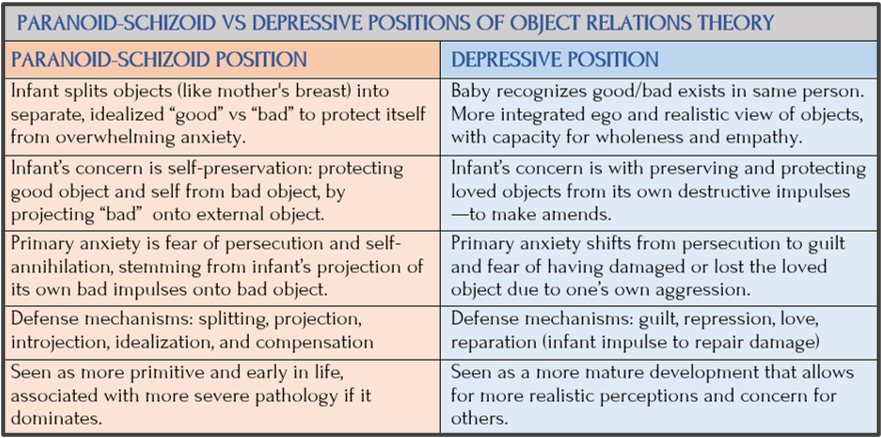
During 1935-1946, Melanie Klein’s theory evolved to include two distinct developmental “positions” — not stages, because healthy development oscillates between them from birth and continues to a greater or lesser extent into childhood and adulthood.
In the paranoid-schizoid position, infants split objects into all good/all bad, leading to a “constellation of anxieties, defenses, and internal and external object relations”:
Klein believes infants suffer a great deal of anxiety caused by the death instinct within, by the trauma experienced at birth, and by experiences of hunger and frustration. She assumes the very young infant to have a rudimentary though unintegrated ego, which attempts to deal with experiences, particularly anxiety, by using phantasies of splitting, projection, and introjection. —Melanie Klein Trust
In the depressive position, 1-year-olds start recognizing the integrated object as both good and bad, but experience guilt and remorse over destructive impulses toward the loved object.
At its core, the depressive position concerns loss and mourning: mourning the separation of self from the mother, mourning the loss of the narcissistic phantasy where the child’s ego was the world, mourning the objects it has hurt or destroyed through aggression and envy. But from the ruins, there arises first the feeling of guilt, then the drive for reparation and love. —Lucy Etherton, “Melanie Klein and Object Relations Theory,” Simply Psychology
The depressive period is also when a toddler says No! to gain control over its environment, assert their separate self, test boundaries, and express frustration when the caregiver thwarts their will. Klein called the No! phase this time of transition from one position to the other.
This next chart compares the paranoid-schizoid and depressive positions as part of object relations theory:
Sources: Lucy Etherington, “Melanie Klein and Object Relations Theory,” Melanie Klein Trust
The “Good-Enough Mother”
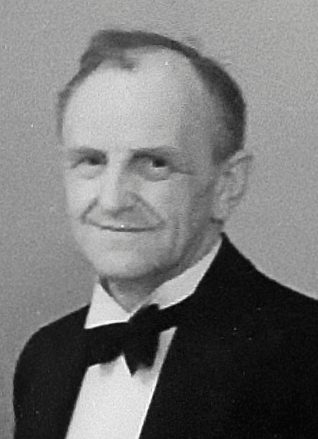
Donald Winnicott, Wikipedia Commons
English pediatrician/ psychoanalyst Donald Winnicott (1896-1971) developed the influential concept of the “holding environment,” claiming “the ordinary foundations of health are laid down by the ordinary mother in her ordinary loving care of her own baby.” He regarded the mother’s attentive holding, bathing, and feeding of her child as central to the baby’s experience of maternal security in “the continuation of reliable holding in the ever-widening circle of family and school and social life.”
Winnicott recognized the child’s capacity for whole-object relations:
- Relating to the object: Child initially relates to a subjective object — a projection of their needs and feelings.
- Destroying the object: Child tests caregiver’s boundaries through destructive impulses and aggression.
- Survival of the object: Caregiver must survive these “attacks” without retaliation, proving their independence and resilience to the child.
- “Using” the object: Child enters relationship based on shared reality, as they perceive care-giver as real and separate — not as an extension of self. This successful transition allows the child to love and depend on a person they can also experience as frustrating, leading to a more mature and resilient sense of self over time.
Donald Winnicott, Ceméa France
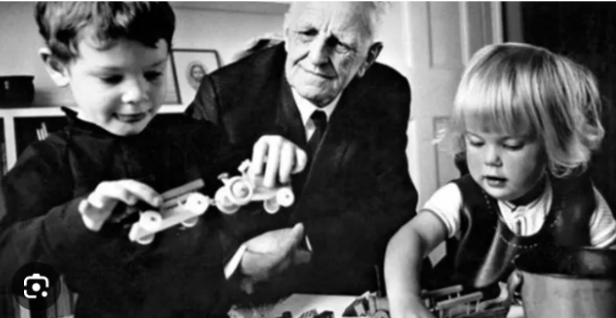

Polish artist Rafał Olbiński, Superficial Analogy (2020). Linda Berman, “How Can We Understand the Secret Connections Between Our Inner and Outer Worlds?” Ways of Thinking
Winnicott emphasized the infant-mother relationship, with the mother not needing to be perfect, but just “good-enough” — sufficiently responsive to protect the baby’s “illusion of omnipotence,” like a cared-for baby not feeling hungry for too long before being fed. Her quick response to cries of hunger gives the baby a sense that whenever it’s hungry, food magically appears. To feel this powerful allows a baby to feel confident, calm, and curious — able to learn without having to invest energy in defenses.
The word “theory” is a turn off for all but the nerdiest of us. But in the case of object relations theory, we stand to gain surprising insights into ourselves. When we were tykes, we needed and expected devoted attention and loving care from mom and dad. Their care, along with whatever turmoil came at us, was indelibly inked on our developing psyches. As psychiatric experts will say, early childhood experiences — for good or ill — are the bedrock of our self-identity and self-regard, shaping our capacity for love, intimacy, and connection throughout life.
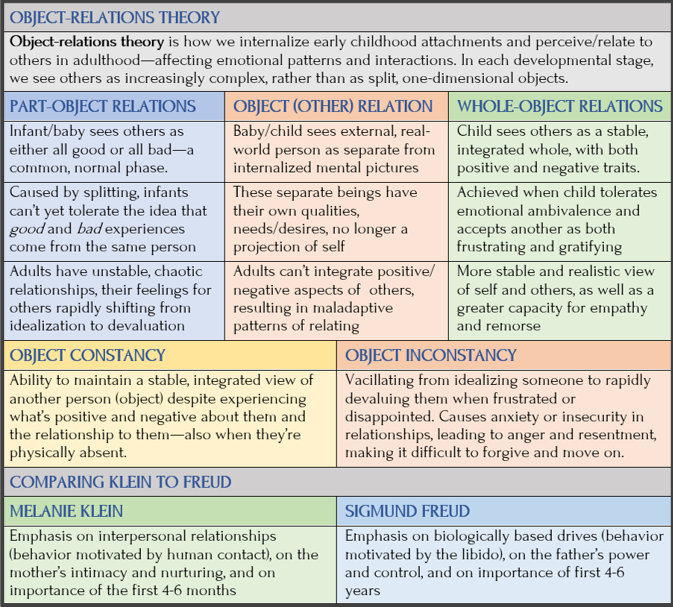
Object relations theory is how the psych world understands healthy/unhealthy development from birth.
Object refers to the very closest people to us as young children (primarily parents or caregivers), but also to parts of these people (think Freudian childhood phases, like the breast for sustenance), or symbolic representations of people and objects.
Object relations theory bridges our inner world of thoughts and feelings (intrapsychic) with our external relationships (interpersonal). Babies form internalized representations or mental images of significant others (especially primary caregivers) based on their experiences. The theory focuses on the relation of self to others (self-object), where a sense of self is shaped by these early relational patterns. Healthy development involves integrating good/bad aspects of self-object into a more realistic, whole view (object constancy). —Wikipedia
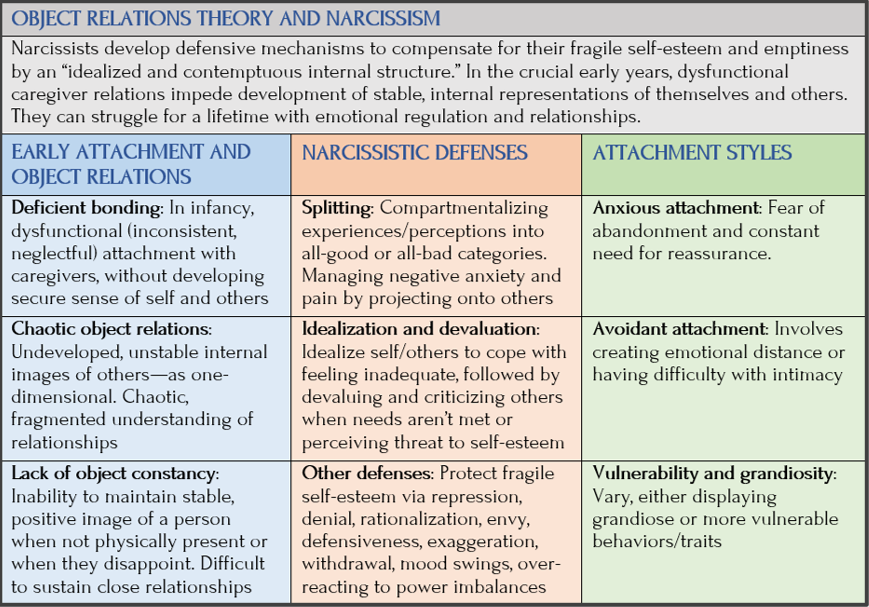
Object Relations Theory and Narcissism

Object relations theory suggests a different outcome for those eventually diagnosed with narcissistic personality disorder (NPD). In the Kleinian view, from infancy on, childhood is full of conflict and terrifying emotions.
Their secure attachments and consistent care prepare them for a secure sense of self and stable, loving relations with others. But some don’t often get it—and this is why psychiatry views narcissism as a developmental failure.
Sources: Psychology Today, VeryWellMind, Wikipedia
Object Relations Psychotherapy
Psychotherapy follows object relations theory that a healthy psyche integrates positive/negative aspects of self and others, leading to a more integrated self-identity and more fulfilling relationships. This is difficult with narcissists, sadly, because they lack a stable self-identity and struggle with self-doubt and emptiness. More often, they try on different identities or cling rigidly to external forms of identification.
Applying knowledge from Melanie Klein’s object relations theory may be useful when dealing with a narcissist. Often a person with strong narcissistic tendencies relates to the people closest to them more as objects than human beings. A narcissist primarily fixates on their own feelings, so neglects to contemplate how others feel. This egocentric perspective hinders the narcissist from resonating with a feeling that differs from their experience. Negating a person’s emotions in the context of an interpersonal relationship is one way a narcissist dehumanizes loved ones.” —Psychologist Erin Leonard, “Understanding a Narcissist From an Object Relations Perspective, How a narcissist manipulates and controls by playing favorites,” Psychology Today
Here’s a case study from clinical psychologist Luke Allen, PhD, who applies object relations therapy to his client. [See next post on defensive mechanisms. The case refers to the client in the plural. Edited/paraphrased for clarity and brevity]:

Photo: Stock Adobe
Imagine a client with extreme health anxiety (hypochondria) with an early history of great conflict and injury. The client is the eldest child, and the mother didn’t take care of them or their younger siblings. The client’s mother is currently in a nursing home and in poor health. The client formed an entire “victim identity” around early conflict and injury. It makes sense for them to be sick in some way. It may also help them get attention. Left to take care of their mother alone, they’re overly wrapped up in it, though contact with their mother is extremely distressing and unpleasant.
The client identifies completely with their mother’s desperation at not getting needed attention and care from her caretakers.
The client’s involvement is ultimately a projective identification, not genuine empathy or concern. The client actually believes they would be better off if their mother died.
Primitive projection helps the ego to overcome anxiety by ridding it of danger and badness. The ego also uses introjection of the good object as a defense against anxiety…. The processes of splitting off parts of the self and projecting them onto objects are of vital importance for normal development, as well as for abnormal object-relations. Equally important, the effect of introjection on the good object, first of all the mother’s breast, is a precondition for normal development, forming a focal point in the ego and making for cohesiveness of the ego…. Much of the hatred against parts of the self is now directed towards the mother. This establishes a basis for aggressive object-relations. —Luke Allen, “Object Relations Therapy: An Overview”
Coming Up Next

Object relations and narcissism is best understood in the defense mechanisms the narcissist uses, consciously or unconsciously, to compensate for their structural weaknesses in self-worth and relationships with others. In Post 6: A Narcissist’s Self-Defense — Part I, I begin to look at narcissistic self-defenses.
 English