Narcissism and the Rest of Us
Show Table of Contents
INTRODUCTION
NARCISSISM DEFINED
2. Is There a Narcissist in Your Life?
3. Narcissus and the Origins of Narcissistic Thought — Part I
4. Narcissus and the Origins of Narcissistic Thought — Part II
5. Narcissus and the Origins of Narcissistic Thought — Part III
NARCISSISTIC DEFENSES
6. A Narcissist’s Self-Defense — Part I
7. A Narcissist’s Self-Defense — Part II
8. A Narcissist’s Self-Defense — Part III
NARCISSIST PERSONALITY DISORDER VS TRAITS
9. When Narcissism is a Personality Disorder
10. Narcissism and the Maladaptive Umbrella
11. Malignant Narcissism and the Narcissism Spectrum
12. When Narcissism is Compounded by Comorbidity
NURTURE VS NATURE
15. Narcissism: Flipping Self-Esteem on its Head
16. The Double-Edged Sword of Grandiose Narcissism
NARCISSISM’S DARK SIDE
19. Narcissistic Rage and Narcissistic Self-Awareness
20. Trait Narcissism and the Illusion of Control
21. Beyond Narcissism: Dark Personality Traits — Part I
22. Narcissist Sociopaths: Dark Personality Traits — Part II
ROMANTIC LOVE AND BOUNDARY-SETTING WITH A NARCISSIST
23. Romantic Love with a Narcissist — Part I
24. Romantic Love with a Narcissist — Part II
25. The Narcissist’s Non-Apology Apology
26. Boundary-Setting with Narcissists — Part I
27. Boundary-Setting with Narcissists — Part II
28. Boundary-Setting with Narcissists — Part III
29. Shattering Narcissus’ Mirror… So They Can Live
CONCLUSION
30. On Narcissism: What About the Rest of Us?
10: Narcissism and the Maladaptive Umbrella

Photo: Getty Images
Narcissistic personality disorder (NPD) is clearly a severe, often debilitating lifelong condition. Luckily we’re not likely to encounter an NPD person because it’s fairly uncommon. More common and less severe are forms of narcissism that don’t meet DSM-5 criteria. Potentially serious, lifelong traits, they’re also more treatable — if the individual is motivated to change.
The difference between NPD and “subclinical” variations of narcissism is one of degrees: about the extent to which thoughts, emotions, and behaviors persist, life is disrupted, and relationships to self and others are affected.
Another difference is prevalence rates. “Clinical” NPD is rare, affecting only .05-1.5% of the population — which remains a fairly constant number.
Reports that narcissism is on the rise means more subtypes are recognized. It remains difficult to get an accurate count because incidences go unreported, but researchers have estimated upward of 10% of people in their twenties suffer from severe enough forms of narcissism to compromise their relationships.
Freud told us [see post 3] we’re all born narcissists. And we remain so to some degree for life — our tendencies and traits on the spectrum range from deficient to healthy to malignant, with lesser-to-greater degrees of severity, and great variations from person to person. While there are recommended treatments to mitigate symptoms and improve quality of life, most disordered narcissists won’t receive effective care because of their disinclination to change. However, for those willing to scale the rocky terrain toward greater health and wellbeing, maladaptive narcissistic behaviors are more treatable than NPD.
When Narcissism is Not a Disorder
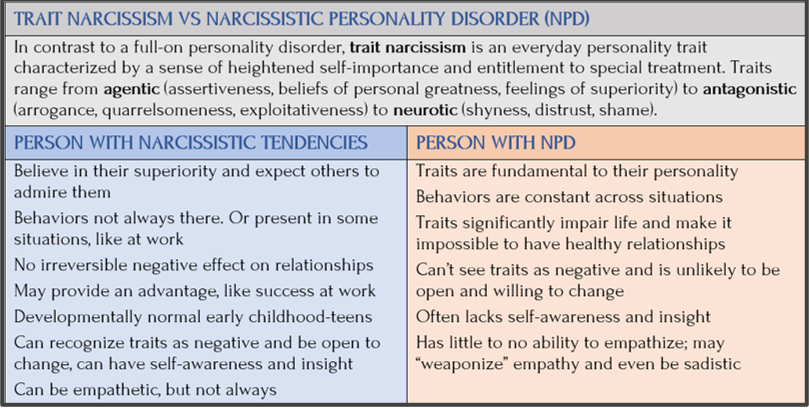
Someone who has narcissistic traits — but not the disorder — will show some of the same behaviors as NPD, just not as persistently or as intensely.
Sources: VeryWell Health; Stathis Grapsas, et al., “The Why and How of Narcissism: A Process Model of Narcissistic Status Pursuit, PubMed/NIH
The Maladaptive Umbrella
The maladaptive umbrella is a term of art to conceptualize how various destructive traits, behaviors, and subtypes of pathological narcissism fall under the general category of maladaptive narcissism. The distinction between adaptive (healthy) and maladaptive (unhealthy) narcissism has emerged from decades of research and clinical work [see Glossary for more detail on terms].
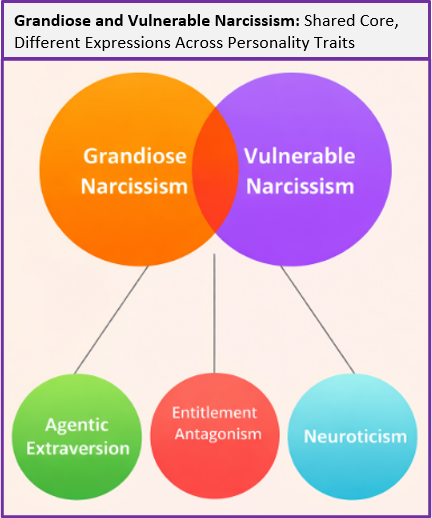
According to psychologists Emanuel Jauk and Philipp Kanske, there’s general agreement that the nature of narcissism is multifaceted, with different subtypes showing more or less of key features, like feelings of self-importance and entitlement. Differences show up in how individuals express these traits — and what impact they have on themselves and on others.
Not all sources agree on how many narcissistic subtypes are nestled under the maladaptive umbrella, but most recognize five — where healthy crosses a line to unhealthy but stops before becoming NPD. In this post, I’ll cover the first two, which are most prevalent. The next post will tackle the other three subtypes.
Adapted from Emanuel Jauk and Philipp Kanske, “Can neuroscience help to understand narcissism? A systematic review of an emerging field,” PubMed/NIH.
Two Sides of the Same Coin
The two biggest subtypes — grandiose (overt or extroverted) and vulnerable (covert or introverted) narcissism — are really two sides of the same coin. According to psychologist Berit Brogaard, Ph.D., writing in Psychology Today, “Both subtypes have self-centeredness as a core feature, but the self-absorption is expressed differently in the two cases.” Both also share an overarching preoccupation with needing to feel special and needing to feed their narcissistic supply to protect their inflated ego, whether directed outwardly or inwardly. Same for psychologist/author Craig Malkin, who doesn’t see vulnerable narcissism as opposed to grandiose, but as a different, introverted version of the same pathological sense of entitlement. Both types exist on the unhealthy end of his narcissism spectrum.
Grandiose (Overt/Extraverted) Narcissism
Most of us think a narcissist is someone full of themselves, selfish, and easily enraged when things don’t go their way. This person may be an insufferable braggart, but not until they’re full-blown egomaniacs are they grandiose narcissists.

Grandiose narcissism is characterized by extraversion, low neuroticism, and overt expressions of feelings of superiority and entitlement. Owing to their grandiosity, they believe they are somehow above the rest of us, and they, therefore, are entitled to special treatment. In their view, our job is to cater to their needs. They are true egomaniacs. —Berit Brogaard, Ph.D., “Vulnerable Vs Grandiose Narcissism: Which Is More Harmful?” Psychology Today
Elizabeth Darrow, The Narcissist, painting
Grandiose narcissism is characterized as a blend of agentic and antagonistic features — continuous with but less intense than narcissistic personality disorder (NPD) — hiding insecurity with arrogance. To achieve their goals, they can be charming, smart, and capable leaders, with seemingly impressive achievements. But their gains are mostly at the expense of others. They have no issue with stepping over “underlings” in their pursuit of power, status (including fame), and wealth. They routinely overestimate their abilities — thinking they’re better, more capable, and smarter than the rest of us. Grandiose narcissists often are less susceptible to criticism than vulnerable narcissists, since they’re more self-assured in their superiority. Common traits [synthesized from sources listed at the end of this post]:
- Arrogance and bragging about talents, achievements — often trivial or fabricated.
- Entitlement, superiority, and status-seeking, believing they deserve special treatment and should only be seen in the company of the “rich and famous.”
- Outgoing, often loud, dominating, and insufferable, unlike others around them.
- Excessive need for praise, attention, validation, and recognition, so others can prop up their narcissistic self-image (feeding “narcissistic supply”).
- Manipulation, exploitation, and willingness to undermine and disregard rules and norms to maintain status and achieve goals.
- Competitive, often aggressive to be seen as superior and, when they fail, become enraged and aggressive.
- Lacking in empathy and self-awareness, without understanding or sharing the feelings or motivations of others, not having insights into their own emotions.
- Sensitive to criticism, engendering a deep-seated rage or intense frustration when their inflated self-image is challenged or when they’re disappointed.

Are They Really Okay?
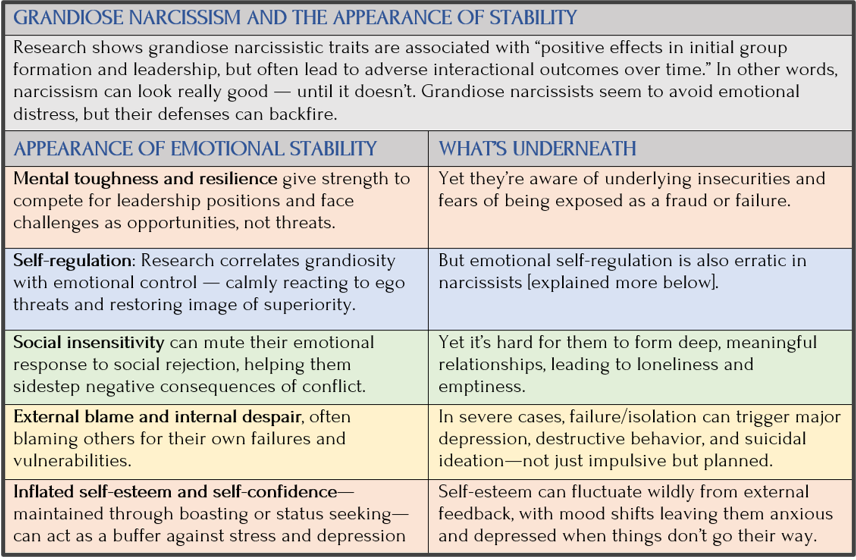
Research suggests grandiose narcissists feel less sad, anxious, or lonely compared to other subtypes. This may be due to their uncanny use of defense mechanisms [see posts 6-8] to pump up their appearance of emotional stability, despite unstable relationships.
Vulnerable (Covert/Introverted) Narcissism

Less well known and harder to manage is vulnerable narcissism. The Cleveland Clinic, notes this “introvertive form of narcissism may cause covert narcissists to feel bad about themselves, so they play the victim — when actually a sneakier, more subtle version than overt narcissism.” It’s actually more insidious than grandiose narcissism — which is easier to spot and do something about it. Covert types mask their grandiosity so others will see their insecurity, anxiety, and fragility and not suspect the ego beneath. Secretly they feel superior and have little empathy for the rest of us. Their relationships suffer because of this secrecy, lack of trust, suspicions, and use of emotional manipulation (guilt, self-pity, silent treatment) to see to their needs.
Selah Sophia, “A Covert Narcissist’s Wonderland … and much like Alice, down the rabbit hole I went,” Medium
Vulnerable narcissism reflects introversive self-absorbedness, high neuroticism, hypersensitivity even to gentle criticism, and a constant need for reassurance. As Dr. Craig Malkin points out in Rethinking Narcissism, vulnerable narcissists “are just as convinced that they’re better than others as any other narcissist, but they fear criticism so viscerally that they shy away from, and even seem panicked by, people and attention.” —Berit Brogaard, Ph.D., professor/director, Brogaard Lab for Multisensory Research, University of Miami, “Vulnerable Vs Grandiose Narcissism: Which Is More Harmful?” Psychology Today
In contrast to grandiose narcissism, vulnerable narcissism is characterized by a blend of neurotic and antagonistic features. The Cleveland Clinic lists these traits:
- Hypersensitive to criticism: Where overt is combative, covert is defensive. To avoid being humiliated or mocked, they insult, act passive-aggressively, or plot revenge. They may not reveal their “self-importance,” but feel misunderstood or never wrong. Relationships are difficult.
- Difficulty fitting in: They suffer social anxiety yet focus on themselves to the exclusion of others. They seek love and appreciation, but can hide or suppress who they are, even from romantic partners, for years.
- Self-deprecating: They internalize negative self-talk not only about themselves, but about what others think of them. They talk down about themselves to get sympathy and attention, often without knowing why.
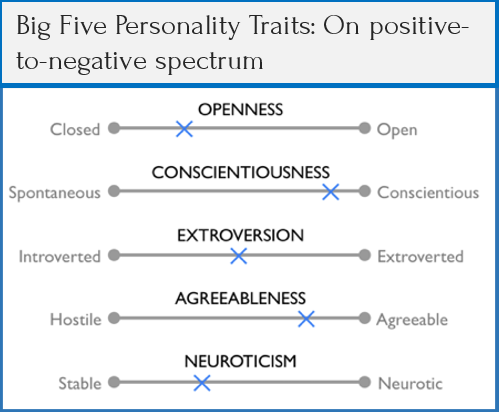
Big Five Personality Traits in Five-Factor Model, each on a positive-to-negative spectrum. From Anabelle Lim, “Big Five Personality Traits: The 5-Factor Model of Personality,” Simply Psychology
- Prone to depression and anxiety — and shame: Their pain and suffering are real, but they might share how they feel to get more attention.
- Hyper-focused on self-importance: Appearing humble, they’re still craving admiration and attention to cover feelings of inadequacy.
In Simply Psychology, mental health writer Anna Drescher applies the Five Factor Model of Personality — a widely used personality test that assesses each of the “big five personality traits” on a positive-to-negative spectrum — to vulnerable narcissism: low agreeableness (antagonism), low extraversion (introversion), and high neuroticism (emotional instability).
Antagonism [low agreeableness] is characterized by anger, hostility, opposition, and resistance towards others.
Neuroticism relates to one’s emotional instability and how prone someone is to experiencing negative emotions, such as anxiety, depression, or irritability. Vulnerable narcissists tend to have low emotional stability and high levels of anxiety, depression, and irritability.
Because they are introverts, vulnerable narcissists often present as shy and reclusive.
But at their core, they are self-centered, entitled, and manipulative. While they may not overtly display their sense of superiority, they still fantasize about power and fame.
Unlike the more overtly grandiose narcissist, the vulnerable narcissist is fragile and self-doubting. They are hypersensitive to criticism and the feedback they receive from others, reacting with defensiveness or withdrawal when they are slighted.
Because they are so preoccupied with their positive self-image and so focused on their own needs and desires, vulnerable narcissists tend to suffer from poor mental health and social isolation. —Anna Drescher, “Vulnerable Narcissist: How to Spot Them and How to Cope,” Simply Psychology
In any discussion of grandiose and vulnerable narcissism, we have to appreciate advancements in research. According to Berit Brogaard, NPD (“clinical narcissism”) displays “oscillating states of grandiosity and hypersensitivity.” So, a diagnostic test, the Pathological Narcissism Inventory, encompasses hypersensitivity/vulnerability AND grandiose measures [lightly edited for brevity]:
In the Pathological Narcissism Inventory, grandiosity is measured by the patient’s responses on a 5-point scale to questions like “I often fantasize about being recognized for my accomplishments,” “I often fantasize about being rewarded for my efforts,” and “I want to amount to something in the eyes of the world.”
Whereas hypersensitivity/vulnerability is assessed by responses to questions like “It’s hard for me to feel good about myself unless I know other people like me,” “It’s hard to show others the weaknesses I feel inside,” and “I like to have friends who rely on me because it makes me feel important.”
Owing to the apparent lack of a common core between the subtypes of narcissism, most personality researchers regard grandiose and vulnerable narcissism as independent traits. In fact, the two traits co-occurring or oscillating in clinical NPD suggests that they do have a common basis. —Berit Brogaard, Psychology Today
Brogaard concludes, the acknowledged presence of both grandiosity and vulnerability in NPD is the reason there’s no official diagnosis for the less intense pathological subtypes.
Austrian and German researchers, led by Emanuel Jauk, also found grandiose and vulnerable narcissists share a common core of narcissistic traits, including what they called contempt-proneness. More than differing scores on extraversion, vulnerable narcissists are more neurotic and hypersensitive to criticism than grandiose, making them more prone to overreact emotionally — always on the verge of “bursting open with hatred.”
Brogaard explains Jauk et al.’s research this way [lightly edited for brevity]:
In vulnerable narcissism, the self-image is dissociated into an explicit, positive self-image and an implicit, negative self-image. The positive self-image is associated with excessive pride. The negative self-image is associated with shame and humiliation. When receiving only positive feedback, the narcissist can keep the negative shame-filled self-image hidden below conscious awareness. But when external feedback is critical, they are forced to confront their negative self-image and feel deeply ashamed.
In contrast, no hidden negative image threatens to make a dent in the grandiose narcissist’s positive self-image. Negative feedback, therefore, doesn’t have as profound an impact on them. But the deep shame turns the vulnerable narcissist into a combustible compound destined to explode in a frightening outburst of anger or all-consuming fit of hatred. This hostile reaction to insinuations of imperfection is also known as “narcissistic rage.” —Berit Brogaard, Psychology Today
Coming Up Next
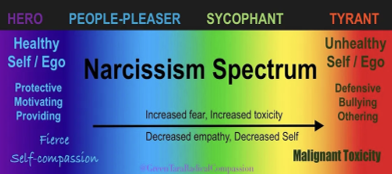
In Post 11: Maladaptive Umbrella and the Narcissism Spectrum, I cover the next three narcissism subtypes and end with the narcissistic spectrum. These additional varieties — antagonistic, communal, and malignant — also not official diagnoses, are assumed to be less common, and relate more closely to grandiose than vulnerable. Characteristics of each of these subtypes also exists on a sliding scale from healthy to unhealthy to pathological, so there’s a tremendous variability in encountering individuals who don’t seem to conform to “classical” narcissism.
It takes some discernment, but eventually patterns emerge that make it clear. One hint: all roads lead to self, away from us, without too much regard for how we feel in reaction to what they do or say. Narcissism in lesser forms is easier than NPD to treat, if the subject is willing.
 English