Narcissism and the Rest of Us
Show Table of Contents
INTRODUCTION
NARCISSISM DEFINED
2. Is There a Narcissist in Your Life?
3. Narcissus and the Origins of Narcissistic Thought — Part I
4. Narcissus and the Origins of Narcissistic Thought — Part II
5. Narcissus and the Origins of Narcissistic Thought — Part III
NARCISSISTIC DEFENSES
6. A Narcissist’s Self-Defense — Part I
7. A Narcissist’s Self-Defense — Part II
8. A Narcissist’s Self-Defense — Part III
NARCISSIST PERSONALITY DISORDER VS TRAITS
9. When Narcissism is a Personality Disorder
10. Narcissism and the Maladaptive Umbrella
11. Malignant Narcissism and the Narcissism Spectrum
12. When Narcissism is Compounded by Comorbidity
NURTURE VS NATURE
15. Narcissism: Flipping Self-Esteem on its Head
16. The Double-Edged Sword of Grandiose Narcissism
NARCISSISM’S DARK SIDE
19. Narcissistic Rage and Narcissistic Self-Awareness
20. Trait Narcissism and the Illusion of Control
21. Beyond Narcissism: Dark Personality Traits — Part I
22. Narcissist Sociopaths: Dark Personality Traits — Part II
ROMANTIC LOVE AND BOUNDARY-SETTING WITH A NARCISSIST
23. Romantic Love with a Narcissist — Part I
24. Romantic Love with a Narcissist — Part II
25. The Narcissist’s Non-Apology Apology
26. Boundary-Setting with Narcissists — Part I
27. Boundary-Setting with Narcissists — Part II
28. Boundary-Setting with Narcissists — Part III
29. Shattering Narcissus’ Mirror… So They Can Live
CONCLUSION
30. On Narcissism: What About the Rest of Us?
1: Narcissism and the Rest of Us: An Introduction

Reading and writing about narcissism feels qualitatively different from writing about neurodivergence, bipolar disorder, or anxiety — subjects of my other blog series. And that’s because of what’s missing from the personality of narcissism. Empathy is missing.
Empathy is an essential response to the human condition. It’s how we make sense of the thoughts and feelings within and between us. But writing about people who are unlikable, even terrifying, who brag, manipulate, and don’t listen? I’m not quite sure how to treat this condition. It’s confusing. My other subjects were about understanding and compassion. Every mental health condition but this one, it seems, brings out our empathy.
Our natural inclination might be to feel empathy for a narcissist who is trying to change and keep their abusive tendencies in check.
Nicolas Pussin, Echo et Narcisse, 1629, Musée du Louvre
Even if we can’t do that, we can grapple with how society should treat its narcissistic citizens – what they deserve. Certainly there’s a reason narcissists seek empathic romantic partners, despite not having those feelings themselves.
In this new series, I hope to continue to access empathy when faced with what sometimes appears as a study in psychopathy.
My answer to this dilemma in this 30-part series is to focus more on those of us living with or among narcissists. I’ll mix personal stories with historical theories, contemporary research, and professional commentary. I’ll avoid pop references to narcissism name-calling, but will examine all its forms and levels of intensity and disorder. Perhaps the humanity of these individuals will peek through the cracks.
What Psychologists Know: We’re All Narcissists
Narcissists, psychopaths, pathological liars, sociopaths, narcissistic sociopaths, and others who show unhealthy behavior in relationships may have commonalities and differences. Since experts don’t agree to what each term precisely means, narcissist is the term used here. —Psychologia

Photo: Shutterstock
Yes, narcissist is the term I’ll use here, though I’ll point out distinctions, as they do exist. First, the difference between healthy and unhealthy narcissism, a theme I’ll return to in several posts.
Whether we know it or not, we’re all naturally narcissistic. But there is a distinction. Like most everything these days, narcissism exists on a spectrum. We can all locate ourselves on the spectrum, without having all the same characteristics nor the same degree of intensity — only the most extreme cases have a severe version of most if not all the worst traits.
Healthy Narcissism
Healthy narcissists can have high self-esteem, with a realistic sense of self-worth. We’re self-confident, but neither feel superior to other people nor are we entitled to special treatment. We’re empathetic, value others, and can form mutually trusting and meaningful relationships, especially with romantic partners and close friends. As high self-esteem/healthy narcissists, we appreciate others’ success without feeling ego-threatened. We see constructive feedback as an opportunity for growth rather than personal attack. We’re successful at boundary-setting, take responsibility for our actions, and are willing to apologize.
Unhealthy Narcissism
Narcissism is an adjective. It’s not a diagnosis. It’s a descriptive term that usually signifies a personality pattern — characterized by inconsistent or superficial empathy, entitlement, grandiosity, arrogance, chronic validation-seeking, hypersensitivity, a propensity towards rage, especially when the person is frustrated or disappointed, and then incapacity to deal with frustration and disappointment. —Psychologist/professor Ramani Durvasula, author of Don’t You Know Who I Am? How to Stay Sane in an Era of Narcissism, Entitlement, and Incivility, from podcast with Stephan Spencer, Get Yourself Optimized
In contrast to healthy narcissists, unhealthy or pathological narcissists feel entitled to special treatment, but their fragile sense of self-worth causes them to constantly seek validation and admiration from others. They struggle with empathy, making it difficult for them to understand or care about the feelings and needs of others. This has a powerful effect on their relationships, which tend to be shallow and self-serving. They frequently exploit or manipulate others — sometimes to achieve personal goals, other times to take pleasure in their pain and suffering. Meanwhile, their self-esteem is highly volatile, often fragile, making them overly sensitive to criticism, quick to react with anger or defensiveness — even when faced with a minor comment they perceive as negative. Severe narcissists are arrogant, self-absorbed, envious, and refuse to take responsibility or apologize for poor or abusive behavior.

In later posts, I’ll distinguish between the many forms of narcissism . Narcissistic personality disorder (NPD) is the sole clinical diagnosis referenced in the Diagnostic and Statistical Manual of Mental Disorders, Fifth Edition, published by the American Psychiatric Association — which I’ll refer to throughout the blog as DSM-5.
A Second Narcissism Spectrum on Comorbidity
Narcissism on a spectrum is usually considered from healthy to least severe to most disordered (later I’ll discuss a spectrum with healthy in the middle). There’s also a second type of spectrum: from narcissism as a single condition to existing with co-occurring (comorbid) conditions, say, NPD + depression. Comorbidities are common with personality adaptations. Then there’s malignant narcissism, which is actually comorbid antagonistic narcissism + antisocial personality disorder (ASPD), which exponentially worsens an already bad condition.
Healthy vs. Unhealthy Narcissism
Like young children, we need to think of ourselves as capable of learning, creating, and achieving. We need a dose of healthy narcissism to recognize ourselves, our needs, solve problems, and become independent and confident people. As babies and toddlers, we can’t push through to childhood without going through a narcissistic phase.
I read somewhere that narcissism takes a turn from healthy to unhealthy when it exploits others. Emotional manipulation is the calling card of unhealthy narcissism. It sees the world through its own set of lenses. It’s challenged in empathy because that requires looking though another’s lenses. Narcissism demands to be seen and heard without seeing and hearing.
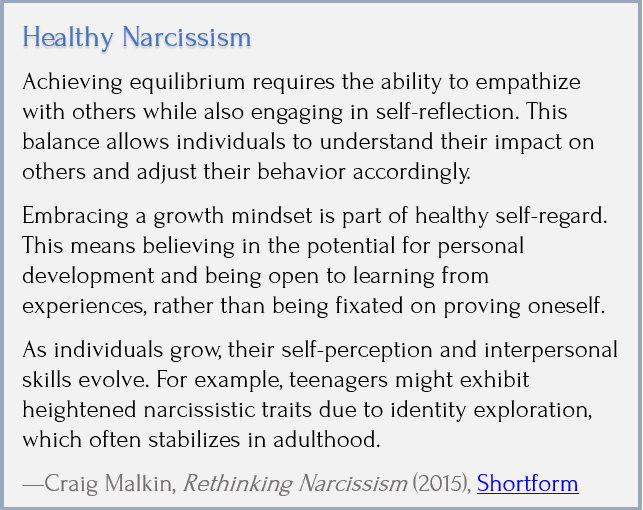

Photo: Microsoft Bing
Adele is a beautiful, highly intelligent, and creative person who does not recognize or appreciate these qualities in herself. She mentioned in passing that she never looks in the mirror. You may remember that in the Greek myth, Narcissus falls in love with his reflection. Adele is not in love with her reflection and this creates problems for her. When completing a difficult project at work, she experiences no pleasure or satisfaction, just a grim sense of “on to the next problem.” When people comment on her style and grace she is disconcerted. In her romantic life, she is surprised and taken aback when someone attractive shows interest in her.
Healthy narcissism is related to self-esteem and self-worth but it’s not exactly the same. It’s taking pleasure in one’s beauty, in the workings of one’s mind, in the accomplishment of a tough job well done. It is ecstatic joy in oneself. Although the joy of healthy narcissism can be fleeting, it is a powerful and sustaining sensation. —Susan Kolod, “What Is Healthy Narcissism?” Psychology Today

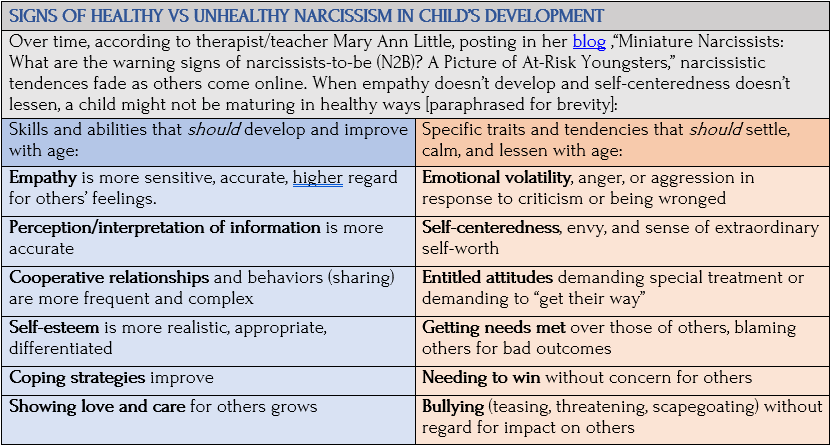
Psychologist Susan Kolod — supervising analyst, faculty, and co-editor of the Contemporary Psychoanalysis in Action blog, William Alanson White Institute, NY — talks about narcissistic behavior in young children as developmentally appropriate. Their needs are out-front, as are their demands to get them met — immediately. No parent believes their toddler is thinking about other people’s feelings when they scream in frustration, fatigue, or hunger. But we’ve also witnessed moments when our tyrannical little narcissists actually show love and caring, maybe when we’re not feeling well or the dog looks sad.
Photo: Deposit Photos
The next chart looks at what Mary Ann Little calls “miniature narcissists,” discerning between healthy and unhealthy narcissistic development:
Source: Mary Ann Little, Miniature Narcissists,” blog
Milestones Aren’t Clearcut
Most of us know when a child isn’t acting age-appropriately. The demanding 4-year-old may still be cute, but not so the demanding 14-year-old. According to Amy Brunell’s research, “Understanding and Coping in Social Relationships with Narcissists,” Cambridge University Press, parents, teachers, and even classmates can detect when something’s off in a child’s development. But it’s the parents’ job not to shut down in the face of it, to be open and take action.
My older son Jaden had a friend who was quick, smart, and handsome, but — to me — clearly troubled. The signs were there, and I observed him over years with concern. He was arrogant, defiant, mean to smaller children, and short-fused. Eventually, as a tenth grader, he turned on my son, doing an unspeakable act of vandalism and privacy invasion, requiring the school administration to become involved (the principal wouldn’t discuss it with me, except to tell me he’d been in trouble before). I called his mother to suggest her son needed help, but instead she blamed a third boy for the incident and hung up on me. Almost immediately, the boy withdrew from the school system. We never saw or heard from them again.
Photo: Caroline Leavitt, “It’s fine by Me,” by Per Pettersen, 2012, Boston Globe

Narcissism in the Family
In this series, I’ll make personal references to those I believe have narcissistic tendencies, but are not full narcissists. In a way, this unnamed problem in my life has made me acutely aware of how people can treat others who may be more vulnerable — or unsuspecting. Or, how their own vulnerability causes them to behave in unacceptable ways to compensate for low self-regard. The good news is that more research is now being devoted to better understand the impact narcissists have on others, not just on the narcissist. As a researcher wrote, “Narcissism is the new borderline personality disorder (BPD),” indicating that BPD has received enormous attention over the past two decades — and it’s narcissism’s turn.
One reason narcissism has gained attention among scholars and laypeople alike is because of its implications for social relationships. Narcissists’ behaviors frequently have negative consequences for others. Whether their relationships are with coworkers or close relationship partners, interactions with narcissists can be challenging and emotionally taxing. Despite this, there is a sparse amount of research that addresses how to cope with difficult narcissistic relationships. —Amy Brunell, “Understanding and Coping in Social Relationships with Narcissists,” Cambridge University Press
I’ll circle back to Brunell’s findings and advice in this blog, but I must tread carefully here. Unless we’re psychiatric professionals, we can’t diagnose those we love, befriend, or work with — none of us should label people because labels stick. But, and I need to add this, when patterns emerge, we see. When we’re repeatedly hurt by the same things, we question.
More to the point is how we control what we can — how we react to a person we believe is toxic. What it means to feed a person’s narcissistic supply — the attention, admiration, recognition, or validation that a narcissist demands from us to bolster their fragile ego. Boundary-setting becomes a particularly effective way to commit to the relationship AND keep it from swamping us.
The first step is always to identify the problem. To see it clearly. We all know a case when something was obvious to us but not to the person it was happening to. What if the person it was happening to is us?
Coming Up Next

In Post 2: Narcissus and the Origins of Narcissistic Thought — Part I, I’ll start with the powerlessness of a young person to guard against the narcissistic behaviors and actions of a parent or older sibling, and how that becomes life-defining. The point of this blog series is not necessarily to help narcissists themselves (who mostly don’t believe they need help, but for the rest of us.
 English