On Bipolar Disorder
Show Table of Contents
INTRO
1. On Bipolar Disorder: Introduction
2. Jaden’s Story: A Journey to Mania
3. The Bipolar Rockies: A Witness to Mania
4. Bipolar Spectrum Disorder: More Than Mood Swings
5. How Bipolar Risk Takes Shape
6. A Sensitive System Under Stress
TIME
8. Bipolar Disorder and Circadian Rhythms: Why Sleep Isn’t Just Sleep — Part I
9. Bipolar Disorder and Circadian Rhythms: The Goal is Stabilization — Part II
SIGNIFICANCE AND MISREADING
10. Reward Sensitivity and Bipolar Vulnerability
11. Bipolar and Cannabis: Relief, Risk, and Regulation
12. Bipolar, Hypomanic Personality, and Narcissism: Similar Traits, Different Meanings
DIAGNOSIS AND SYSTEM FAILURE
13. Bipolar Diagnosis, Misdiagnosis, and the Hidden Barrier of Stigma
14. When Diagnoses Overlap: Bipolar, ADHD, Borderline
15. When Bipolar Disorder Affects the Body
16. The Raw Shock of a Bipolar Diagnosis
TREATMENT AND COPING
17. Bipolar Treatment: Medication Non-Optional
18. Bipolar Treatment: It Takes a Village
19. Coping With Bipolar: Things to Do
20. Famous People and Bipolar Disorder
21. Future Breakthroughs: New Bipolar Research
22. Bipolar Poetry: Inside My Mind
10. Reward Sensitivity and Bipolar Vulnerability

The artist L’Aziza, with her paintings, said her manic phases gave rise to an irrepressible urge to paint and to create. Geneva, 2018. From “Capturing the Highs and Lows of Bipolar Disorder Through Photography,” The New York Times
When my son Jaden was 24, he set a goal that surprised — and delighted — me. He decided to buy the three-story rowhouse he was renting with three roommates. Not someday, but now. He set his mind to it and worked hard to assemble a down payment. His grandmother and I contributed. He saved and even invested some money with unusual discipline. His focus was electric. I remember thinking: I may have under-estimated his drive, his entrepreneurial spirit. And he pulled it off. He signed the closing papers and the keys were handed over.
One week later, his system tipped into its first manic and psychotic episode. His first hospitalization. With that, his world collapsed.
For these past 13 years, I’ve held these two events separately in my mind: his achievement and the promise of that moment — and the onset of a serious mental illness that seemed to put an end to his dreams. But science suggests they may not have been separate at all. They may have been connected by the same underlying system.
Some people — and I suspect my son is among them — don’t just enjoy progress. They feel it viscerally. A new idea creates a physical surge of energy. They pursue goals with unusual intensity. Success can feel disproportionately energizing, and sleep can become secondary to momentum. Once activated, thoughts and behavior can accelerate.
The Reward Funnel
By now, we understand how deeply rooted bipolar disorder (BD) is in neurobiology, genetics, psychology, and lived experience. The same mind–brain–body systems that generate drive, motivation, and the promise of possibility can, in those vulnerable to bipolar disorder, become unusually sensitive over time.
Regulation becomes harder. Rhythms less stable. But no matter what unfolds — whether internally driven or influenced by external events — it has nothing to do with personality quirks, moral failure, or weak character.
In this post, I’ll introduce several concepts that researchers use to understand and describe the processes of reward sensitivity, temperament, and vulnerability — along with the biological motivational systems that shape patterns of response and carry risk for BD. Some of these words may sound familiar, but their meanings change in research.
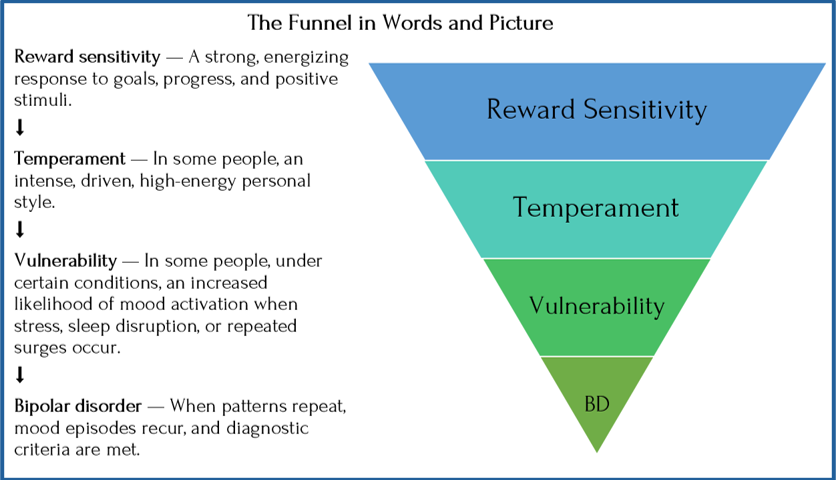
To understand bipolar disorder, we have to set it against the backdrop of health. We all share the same basic body systems. BD reflects a particular pattern within those systems. One way to picture this is to imagine a backward map, from the full expression of bipolar disorder — with recurring mood episodes and shifts in energy, sleep, and functioning — toward a picture of healthy functioning. Imagine an inverted pyramid or narrowing funnel.
Unseen at the rim of the funnel is the biological system called reward circuitry and our natural responsiveness to it. At each narrowing, fewer people move further toward illness — and most never do. There’s nothing inevitable about progressing through the funnel. It represents probability, not destiny.
In this diagram, I’ll take the four steps one by one:
Graphic: Jan Swan, with Chat GPT

Reward is the Brain’s GO System
Reward conjures up pleasant images: getting a poem published in a respected journal, receiving praise from someone you admire, or being thanked for returning a lost dog. It also conjures up associations of indulgence, pleasure-seeking, weakness, and lack of discipline.
But when it comes to what propels us forward in life, reward plays a much larger role. Reward is our brain’s GO system — as central to our functioning as our beating heart. It’s governed by an intricate set of biological processes that tell us this matters, go toward it.
Reward is why we get out of bed to face the day. Why we pursue increasingly challenging goals. Why new romance can energize us or a new idea can light us up. Our reward system tags something as meaningful — and then suffuses it with energy.
Think about the last time you felt genuinely excited about something. What did you feel in your body? Warmth? Energy? Anticipation? In those moments, most of us don’t think about neural circuits and dopamine pathways. But those systems are working behind the scenes.
When the GO System Is Naturally Strong
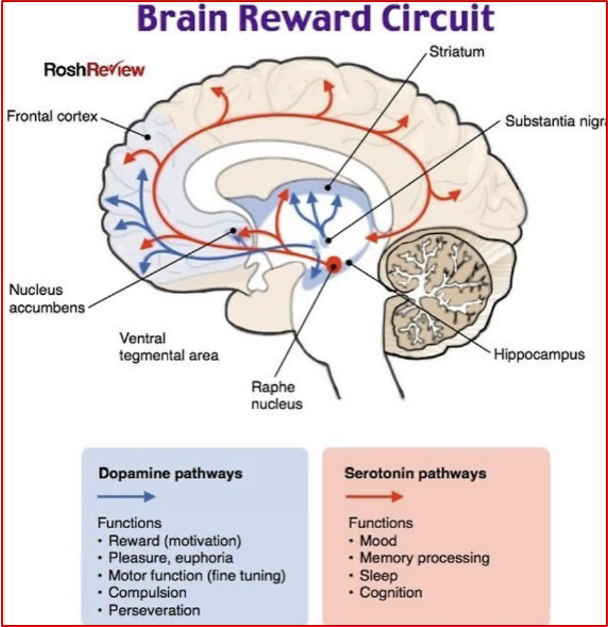
Neuroscientists see reward as a natural biological process. The theoretical reward system links to the brain’s dopaminergic pathways — neural circuits connecting the ventral tegmental area (VTA), nucleus accumbens, (NAcc), and prefrontal cortex (PFC). These pathways form part of the brain’s mesolimbic reward system, which evolved to help our forebears pursue what is beneficial for survival and make life more meaningful and plentiful.
When we anticipate something rewarding — achievement, recognition, novelty, connection — this circuitry releases signaling chemicals, primarily dopamine, to energize goal-directed behavior. In other words, the brain associates such stimuli with a positive or desirable outcome. We then adjust our behavior in search for that particular positive stimulus.
Reward is a coordinated release of neurotransmitters, with dopamine in a central position. Dopamine mediates the reward value of food, drink, exercise, sex, social interaction, and substance abuse.
Dopamine, in fact, is less about pleasure itself than about what neuroscientists call incentive salience: the sense that something is worth pursuing, described as the feeling of wanting rather than simply liking.
Here’s how a cardiologist talks about rhythm, regulation, and reward:
Like the heart, the mind depends on rhythm. In cardiology, a regular pulse with healthy variability signals the presence of life in a balanced state of autonomic regulation and resilience. A flatline means the absence of life, while a wildly erratic rhythm can represent impending cardiac arrest or a stroke. The same holds for the brain’s reward circuitry. We need stimulation to stay engaged, but without rest and recovery, the system breaks down.
When dopamine surges too often, we lose the physiologic alignment between heart, breath, and brain that keeps us in a homeostatic and grounded existence. Restoring that rhythm means replacing spikes with steadier patterns of reward. In other words, trading the surge for the drip. —Aseem Desai, MD, cardiologist/heart rhythm specialist, “Retrain Your Brain’s Reward System: How to create a steady dopamine flow instead of chasing highs,” Psychology Today
Bipolar Treatment: Anchoring the Shifting Clock
Scientists emphasize that the reward system isn’t a single brain structure but a coordinated network linking motivation, learning, memory, and behavior. As researcher Robert Lewis, et al, describes it, “The mesolimbic system, also known as the reward system, is composed of brain structures responsible for mediating the physiological and cognitive processing of reward.” (The Brain’s Reward System in Health and Disease, PubMed Central/NIH)h
Through our reward system, the brain learns to associate certain experiences with positive outcomes, reinforcing behaviors that help us pursue them again. Although everyone shares this same basic circuitry, researchers have found these systems don’t operate with exactly the same intensity in everyone. Those differences — which we’ll explore shortly — help explain why motivation and drive can look so different from one person to another. And how those differences tend to define us as individuals.

Elisabeth worked with the photograph to portray the way mania induces a whirlwind of ideas, feelings and sensations, which leave her exhausted. Geneva, 2018,” The New York Times. Photo: Matthieu Zellweger/ Haytham-Rea
When Sensitivity Meets Vulnerability
This brings us to reward sensitivity — how strongly our biological motivational system responds to opportunity, progress, or success. For many of us, high-reward sensitivity is an advantage. It can support creativity, entrepreneurship, and productivity. It helps us aim for ambitious goals and stay engaged in pursuing them.
Psychologists describe this system as the behavioral approach system (BAS), proposed by Jeffrey Gray in 1970. BAS reflects the brain’s tendency to move toward rewards and goals. When BAS activates, we feel energized, focused, hopeful, and motivated to act.
In spectrum conditions, this system may be unusually responsive. When something meaningful happens — a breakthrough, recognition, success — the surge of energy can exceed the brain’s usual ability to regulate it.

This man worked with the photographer to convey his scary dreams, with visions of people wishing to talk to him and invade his mental space. Rolle, Switzerland, 2017,” The New York Times. Photo: Matthieu Zellweger/Haytham-Rea
What begins as excitement or ambition can gather momentum, accelerating faster than the system can stabilize. At that point, the experience can feel less like focused motivation and more like a loss of balance. The difference is not the presence of motivation. It’s the amplitude of the response.
Activation, Acceleration, and Amplification
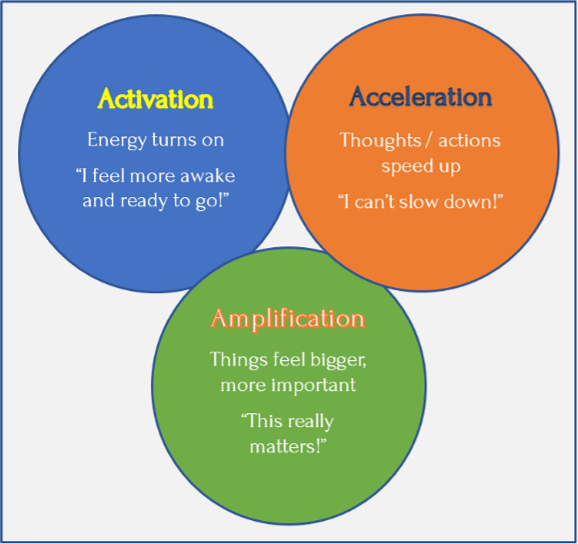
When something excites us — a new idea, a success, a sense that something important is happening — our energy rises. We feel more focused, more ready to act. With bipolar disorder, this process can unfold differently. Three things tend to happen at the same time, building on their own momentum: energy rises (activation), things start moving faster (acceleration), and everything begins to feel more significant (amplification).
Researchers use these terms to describe how a normal motivational surge can gradually move toward bipolar overstimulation. On their own, each of these processes is familiar. Together, they can begin to shift the system — throwing things off balance:
- Activation itself is healthy and necessary. Without it, nothing moves. As it rises, more energy becomes available. It becomes easier to start things — we may take on more, think more, engage more.
Graphic: Jan Swan and ChatGPT
- With acceleration, everything moves faster. Thoughts connect more quickly, ideas multiply, and we’re more driven to move from one thing to the next, often without pausing.
- At the same time, amplification intensifies our experience. Things can feel more urgent, meaningful, or rewarding than they might otherwise. A small success can feel like a major breakthrough — and it can be hard to step back from.
These are not separate steps, but interacting processes that don’t always rise at the same rate.
When these changes start feeding off one another — especially in the absence of stabilizing factors like sleep and circadian rhythm — it can become difficult to slow down. More energy leads to more activity. More activity creates more stimulation. That stimulation makes everything feel even more important.
This might explain why the transition into hypomania or mania is not simply a matter of “more energy,” but of energy, speed, and intensity rising together — and increasingly influencing one another.
What began as motivation can start to feel like uncontrolled momentum
Sleep Loss and Reward Activation: A Feedback Loop
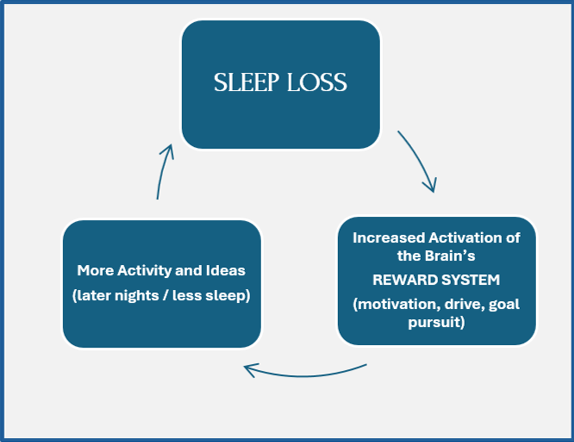
In bipolar disorder, sleep and the brain’s reward system — the network that drives motivation, curiosity, and goal-directed activity — are closely connected. Instead of feeling tired after sleep loss, a person may experience increased energy, productivity, or racing ideas. This can create a feedback loop in which sleep loss activates the reward system, leading to more activity and even less sleep. This can push the system toward a manic episode. Graphic: Jan Swan and ChatGPT
Looking back now, I can recognize activation, amplification, and acceleration in my 24-year-old son before anyone said reward system, vulnerability, or bipolar disorder. At the time, it looked like purpose, self-confidence, ambition — the qualities parents hope their children will have.
I couldn’t know then (but know now) that Jaden was activated (appearing goal-driven), his brain and body naturally amped up on dopamine (looking like ambition), and he was accelerating toward overheating and under-sleeping (looking like excitement and pride in his achievement).
It seems the same system that fuels intense drive can, in some people, run hotter than intended. What I couldn’t have known was that sleep loss, financial risk-taking, cannabis sensitivity [see next post], and racing thoughts were about to overload my son’s highly sensitized system.
Differences in BAS sensitivity influence how strongly people respond to rewards and how intensely they pursue goals. This doesn’t mean illness. But for some people, it moves them further down the funnel. The next narrowing is temperament.
Temperament: How Strongly Our Engine Tends to Run
If reward sensitivity describes the biology of our motivational system (BAS), temperament describes how that biology shows up in real life. It’s the person’s natural style of energy and responsiveness to opportunity. It answers an obvious question: If everyone has a reward system, Temperament is one of those familiar words with a specific meaning in psychology. It’s doesn’t mean someone is temperamental. Instead, temperament consists of relatively stable emotional and behavioral patterns—in energy level, emotional intensity, speed of thinking, social boldness, and less sleep — that begin forming early in life and continue shaping how a person responds to the world. Stable, but not fixed — experience can influence it, but it rarely changes abruptly.
Temperament also includes sensitivity to stress, emotional depth, and reactivity to loss. So:
- Reward sensitivity = the underlying biological systems that, in some individuals can contribute to temperament.

Recording artist Maguire composes songs during mania. She collaborated with photographer Matthieu Zellweger on this portrait.” The New York Times
- Temperament = the overall enduring, biologically influences patterns of energy and emotion that emerge across systems — some of which overlap with the systems that increase vulnerability to bipolar disorder — but temperament alone isn’t the disorder and doesn’t guarantee it.
In the narrowing funnel, reward sensitivity is a car engine. Temperament is the style of driving that car.
Vulnerability: When a Powerful System Becomes Easier to Overload
Bipolar vulnerability is not only about potential mood swings. In some people, it can involve an amplified response to reward. The same brain systems that fuel ambition and drive can also increase susceptibility to escalation and overcommitment.
For people who experience success, praise, excitement, and new opportunities more intensely than others, this heightened response to reward can fuel achievement — while also increasing the risk of overextension, impulsive decisions, and addictive patterns.
Science refers to this as a brain system (reward circuitry), not personality. Researchers Sheri Johnson and Charles Carver define an intense focus as behavioral amplification drive — ambition, escalation, risk — not identity or personality labels. They’ve shown that heightened reward responsiveness predicts increases in hypomanic symptoms following major goal attainment.

The man worked with the photographer to convey how his mania brings visions of sliding beneath the earth and opening doors to other worlds. Geneva, 2018. Photo: Matthieu Zellweger/Haytham-Rea
This means that people with bipolar disorder — and even those at risk for it — often show heightened responsiveness to reward. So even when good things happen, when they feel particularly good, vulnerability for hypomania/mania can rise.
Four Vulnerability Traits
Researchers studying bipolar vulnerability often see this temperament expressed through a recognizable cluster of traits:
- Drive: Persistent internal push toward goals, problem-solving, and accomplishment.
- Goal orientation: Organizing energy around projects, ambitions, or long-range plans.
- Positive emotionality: Enthusiasm and optimism when anticipating something promising.
- Confidence: Sense of momentum and initiative that fuels persistence.
Research also finds people with this temperament tend to become highly energized by progress and success. Their focus sharpens, excitement turns way up, and motivation intensifies. Far from being pathological, these are admirable qualities — often seen in leaders, entrepreneurs, project managers, artists, musicians, and writers. These are traits many people value in a partner, colleague, or friend.
But when this temperament is paired with a highly sensitized motivational system, the same qualities that propel a person forward can also make the system vulnerable. Making it easier to push out of balance.
When I first began reading about these temperament patterns, I had a strange feeling of recognition. The description sounded less like an illness and more like a portrait of certain people I love — and others we recognize in public life. It’s an observable pattern.
Most people have naturally moderate reward systems. In terms of lighting, you could say they live under a diffuse, steady light. Their emotional and motivational systems brighten and dim gradually. When something good happens — success, opportunity, a promising idea — their internal lights come up a little. When disappointment arrives, the lights soften. The system adjusts, but it rarely flares.
But the people we’re following through the funnel appear wired with a very different lighting system. Their brains respond to possibility with stage lighting — dramatic spotlights that flood the zone when something meaningful appears. Everything brightens. Colors sharpen. Possibility feels tangible.
Neither system is inherently better. The spotlight system can power extraordinary creativity, ambition, and persistence. But it can also brighten faster than the system was designed to regulate. What begins as illumination can become glare.
Bipolar Disorder: The Bottom of the Funnel
For the small percentage of people still moving down our narrowed funnel, the first signs of illness begin to appear.
My son Jaden bought his rowhouse at age 24 in early July. By mid-July he was being stabilized in a psychiatric ward with strong antipsychotics.
After exhausting his disability leave, he returned to work and lasted maybe another month. A family member came to help with the house, which Jaden had physically trashed when his mania turned into a psychotic episode. The family member helped roommates retrieve their deposits so they could move out, and I took over all payments.
In the bright spotlight that once showed my son’s entrepreneurial promise came rambling and colliding thoughts, destructive acts, and eventually the police.
This is the nature of bipolar disorder. It falls to the bottom of the funnel.

View of courtyard from University Hospital Zurich’s closed emergency psychiatric ward, with a reflection of a patient with severe depression sitting on a couch. August 2018. Photo: Matthieu Zellweger/ Haytham-Rea
There’s nothing romantic or enlightening about it. It’s about managing vulnerability, body rhythms — and sometimes even brilliance.
Coming Up Next

In this and prior posts, I have discussed systems of amplification — stress systems, time systems, reward systems. Next we’ll move into a real-world, reward system amplifier: cannabis. In Post 11: Bipolar and Cannabis: Relief, Risk, and Regulation, I will touch on a topic that generates a lot of heat in the world of bipolar advice. There are experts who can explain why it tampers with brain activity in a way that makes regulation (mood, circadian rhythm, navigating daily life) more difficult, and then there’s the “user’s” voice. Essential aid or drug habit? Hard to tell.
 English