On Forgiveness and Estrangement
Show Table of Contents
INTRODUCTION
A LONG HUMAN CONVERSATION
- Why Humans Evolved to Need Both Forgiveness and Exclusion
- Forgiveness: Between Moral Ideals and Human Reality
- Estrangement: From Unthinkable to Acceptable
- Estrangement: Ambiguity, Memory, and the Limits of Repair
- How Science Adds to the Conversation
CONNECTION, SAFETY, PEACE
- Why Forgiveness Is So Hard
- Brothers Apart: A Story of Sibling Estrangement
REPAIR OR LETTING GO WELL
- Moving Forward Without Simple Answers
- Living Beyond All-or-Nothing Choices
7: Why Forgiveness is So Hard

It makes sense to follow a post on the neurobiology of forgiveness with one exploring why forgiveness is so difficult. We may be hardwired both to forgive and to avoid manipulation and exploitation. We forgive to remain part of the ingroup and avoid exile to the outgroup, but we can’t allow the bullies and abusers to see our vulnerability and bend us to their will.
Forgiveness is a deeply human psychological process shaped by evolution, memory, emotion, relationships, identity, and context. Yet, most people are disinclined to reconcile in the moment, when feelings of hurt and terrible acts of betrayal feel raw and, well, unforgiveable.
Photo: Divorcedgirlsmiling
Contemporary trends show more of younger generations are making such decisions to become estranged from aging parents, exchanging filial duty for personal safety and wellbeing. Families are torn apart for many reasons, but the decision to walk away is never taken lightly.
Why, then, doesn’t forgiveness come naturally after we’ve been hurt? We’re told of the mental health benefits of forgiveness, but research also shows mental health benefits from estrangement, especially in the case of abuse and trauma. Most of us are disinclined to reconcile in the moment, when hurt and betrayal still feel raw.
Most of our first instincts — even if fleeting — are to strike back or walk away. In post 6, I summarized research that finds what makes forgiveness possible is perspective-taking, coping, and social valuation. We exercise cognitive control, emotion regulation, and a search for what makes sense for us and our relationships before becoming ready to forgive — after a time of deliberation, psychological healing, empathy, and readiness.
Forgiveness then is a negotiation between belonging and self-protection.
Revisiting Forgiveness as a Product of Evolutionary Forces
In post 2, I discussed the evolutionary basis for forgiveness and exclusion. It’s good to remember just how ancient these instincts are.
In “Forgiveness Through an Evolutionary Lens,” Psychology Today, Glenn Geher, PhD, talks about the cost-benefit analyses our forebears must have weighed in deciding how to handle conflict. They had to negotiate between two competing systems: preserving relationships and avoiding exploitation. In essence, evolution prepared us to resolve uncertainty: Can I trust you? Will this happen again? Will I lose status or be exploited? What are the risks and benefits of preserving relationships with offenders or the larger community (family, workplace, circle of friends)?
Today, we’re still engaging a process as old as our species. As Geher writes:
For good evolutionary reasons, forgiveness is a process — one that often includes outrage on the part of the victim, guilt and remorse on the part of the transgressor, and then, possibly, forgiveness on the part of the victim.” —Glenn Geher, “Forgiveness Through an Evolutionary Lens,” Psychology Today,
Conducting these mental risk-benefit analyses after a serious offense is often psychologically tricky. There are many crosswinds at play. If it’s not our brain networks firing a mile a minute, it’s the social, cultural, familial, and ethical pressures we all live under.
The following two graphics illustrate what goes into a risk-benefit analysis and a forgiveness decision-making process:
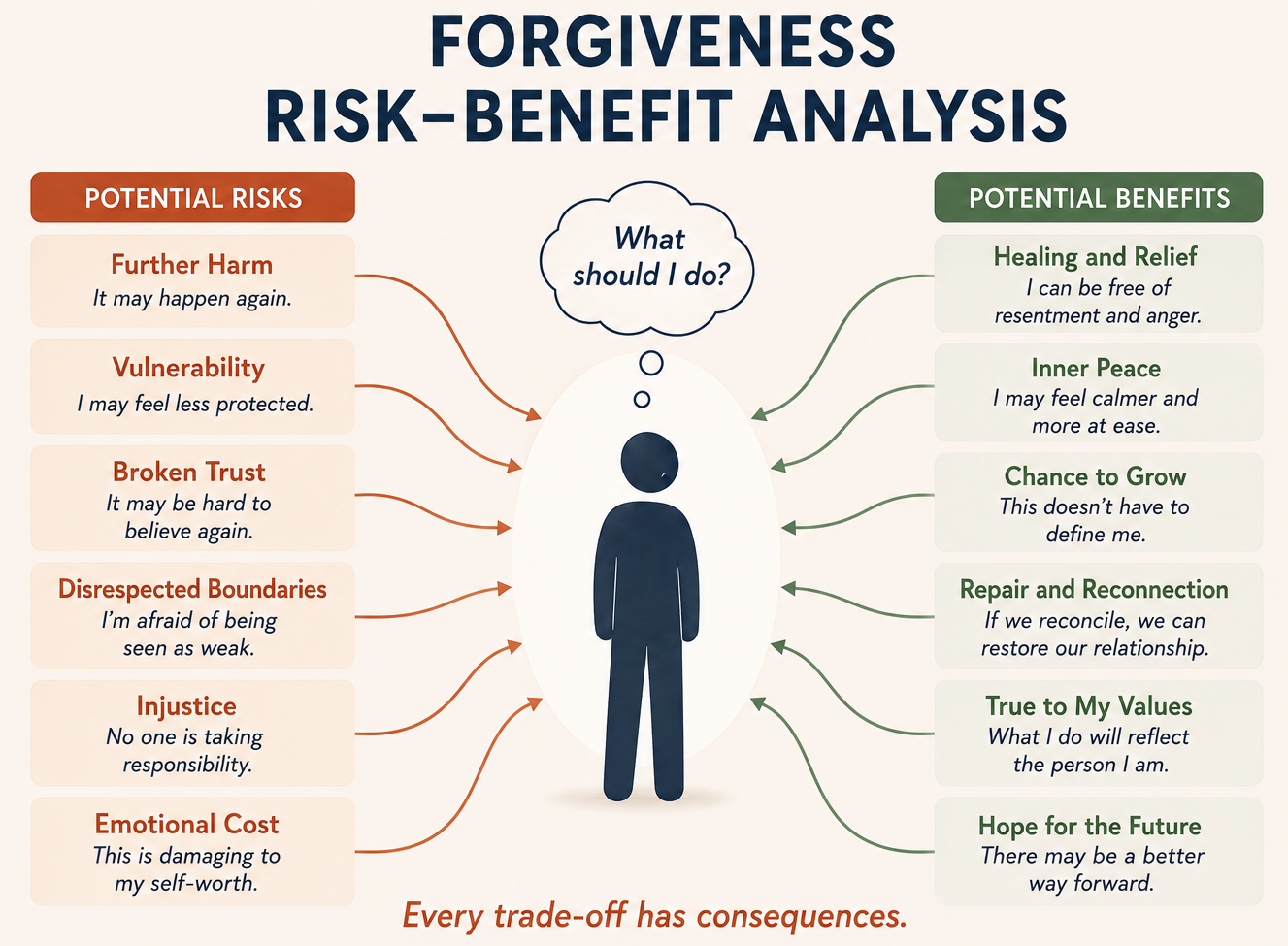
Taking time to conduct a psychological risk–benefit analysis after a serious offense allows us to weigh competing considerations. While we can’t know whether forgiving will bring healing and protection or invite further harm, we must still decide — amid uncertainty — which path is most likely to lead to a desirable outcome. Graphic: Jan Swan, with ChatGPT
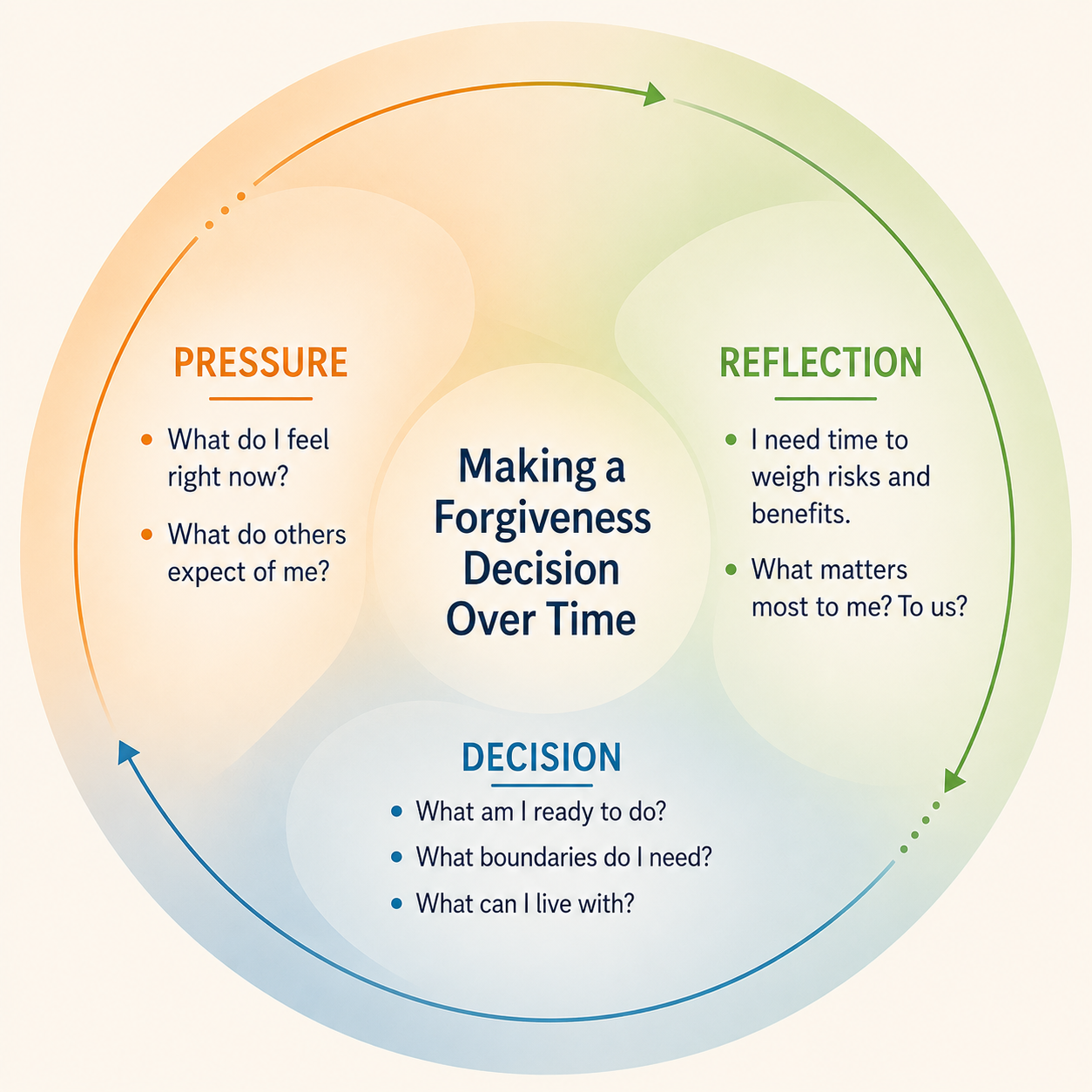
Forgiveness decisions rarely unfold in a straight line. We may move through pressure, reflection, and decision more than once as feelings, circumstances, and relationships change over time. Graphic: Jan Swan, with ChatGPT
MY STORY
I was part of a work team that met routinely for hours-long meetings to discuss our work. In one such meeting, the project leader interrupted me for the second time. I then interjected, “Excuse me. I don’t mind if people disagree with me, but please don’t interrupt me before I can finish my thoughts.” The room went quiet. The project leader was clearly angry. The big boss was also in the room. It was a showdown, and it didn’t look good for team dynamics.
In that moment, I wasn’t deciding whether to forgive, but whether remaining silent would cost me more than speaking up.

Photo: iStock
It wasn’t the first time I felt shut down by the project leader. I was determined to be seen as an equal contributor to others, regardless of rank. This was the benefit side of my analysis.
The cost was potentially considerable. Because the project leader ranked higher, I was on less sure footing. The big boss stayed quiet — clearly wanting us to work it out. In many subtle ways, the project leader could have sidelined me and made work life uncomfortable. The interaction upset me, but I didn’t know how to restore our relationship.
We didn’t talk for several days, but finally the project leader came to make amends, without quite apologizing for her behavior. Nonetheless, I took the opportunity to accept and move forward.

Photo: Getty Images
Ultimately, there were no repercussions. Later on, my direct boss told me he intervened and let the project leader know the ball was in her court. Everyone involved, directly or as a witness, appreciated the resolution to an uncomfortable situation.
Would I do it again? Maybe in a less reactive, frustrated way. I might have spoken to the project leader privately and explained how the interruptions made me feel. But on further reflection, my quick response also had an immediacy that a later conversation would’ve lacked.
Anthony Lopez’s work [also see post 2] helped me understand why my immediate reaction wasn’t forgiveness at all — it was self-protection:
Imagine being handed a clean slate. What would you choose to let go of? What if, instead of another promise to change your habits, you chose to forgive someone who’s hurt you? If you’re like most people, the very thought of forgiving an enemy probably makes you feel a bit uneasy. This doesn’t make you a bad person – it just makes you human.
Forgiveness is emotionally difficult for a good evolutionary reason: a psychological motivation to unconditionally respond to exploitation with meekness or submission simply could not evolve. What we more commonly see in nature is some form of retaliation in response to transgressions, or just plain avoidance. —Anthony Lopez, PhD, “Evolution Makes Forgiving Hard,” ProSocial World
I wasn’t consciously thinking about evolutionary psychology — but that’s exactly what my brain was doing. Forgiveness evolved so we keep up our relationships despite what may transpire in a social context. When it goes well, forgiveness can give us relief and allow us a way forward. But forgiveness also carries risk. Attempts at reconciliation sometimes backfire, reopening wounds instead of healing them. It might even be a reason some people don’t stand up for themselves, from fear of retaliation or loss of face.
The Calculus of Forgiveness
If evolution explains why forgiveness exists, then modern psychology explains why it has become so complicated in our own time: navigating status, our sense of belonging, future retaliation, our relationships, and our self-respect.
One especially important complication is the subject of research by Gennaro Pica and Emanuele Fino — “‘You Treated Me Like an Object, I Don’t Forgive You!’: The Effect of Dehumanization on Interpersonal Forgiveness from the Victim’s Perspective,” PubMed Central. We learn that modern psychology adds another layer. The authors explain:
Relationships are essential to human beings’ functioning and well-being, though sometimes they can represent a source of conflict and discomfort. Conflicts among partners, relatives, and friends are not rare and, if not solved, can damage pre-existing relationships and impact upon individuals’ health and well-being.
It is important to remember that it is the perception of damage by a victim which determines the nature of the event …. Being victim of a transgression perceived as denying one’s humanity was found to influence the victims’ cognitive and emotional responses and the subsequent course of interpersonal relationships. —Gennaro Pica and Emanuele Fino, PubMed Central
PERCEIVED DEHUMANIZATION
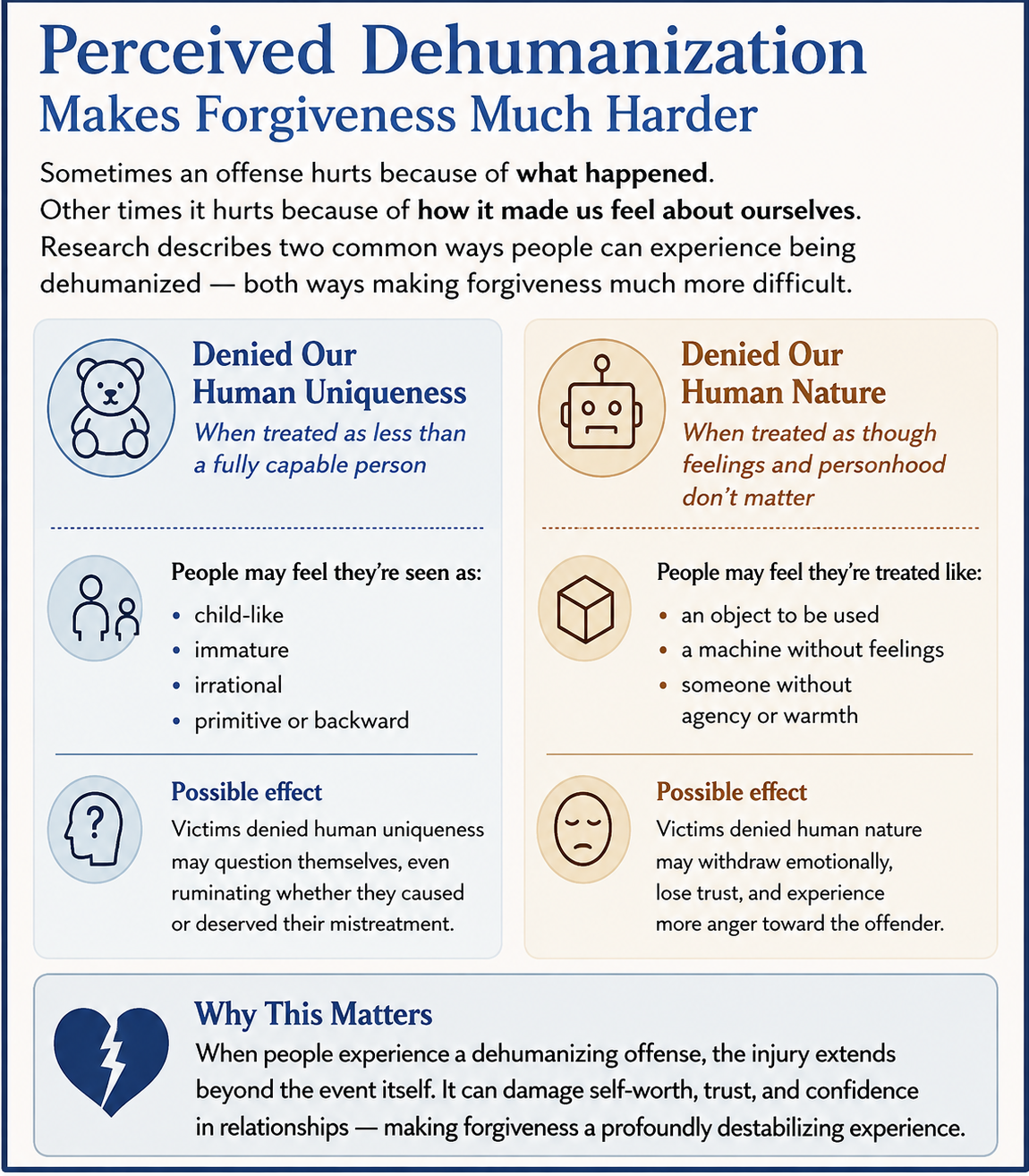
Graphic: Jan Swan, with ChatGPT, based on research by Gennaro Pica and Emanuele Fino, PubMed Central
Pica and Fino suggest that perceiving ourselves as victims of a “dehumanizing offense” can damage self-perception and confidence in our relationships — potentially affecting our ability to forgive. They cite previous research that classifies four main forgiveness categories, “varying in proximity to the act of forgiveness”:
- Characteristics of the victim: Individual differences and cognitive, emotional, and motivational factors
- Characteristics of the victim-offender relationship: Commitment, closeness, importance of the relationship
- Behavior of the offender: Whether the offender apologized
- Characteristics of offense: How severe and harmful the victim perceives the offense to be, as well as time passed since the offense
Simply put, our perception of an offense has one of the greatest influences on whether forgiveness becomes possible.
Perceived dehumanization has far-reaching consequences. Research by Pica, Fino, and colleagues suggests that:
- If people feel they’re being dehumanized by someone from an “outgroup,” they’re more likely to dehumanize that group in return and even support aggressive or violent actions against them.
- Treating members of one’s “ingroup” (such as colleagues) with equality-based respect increases people’s sense that they are being treated as fully human.
- Feeling socially excluded can make people feel less fully human themselves, diminishing qualities such as emotional warmth, openness, and individuality.
- When people feel that others don’t recognize them as equals, they often become painfully self-conscious, leading to feelings of shame and self-doubt.
- When people feel their very existence or personhood is denied, they may mentally shut down, experiencing a sense of emptiness, fewer meaningful thoughts, and even a diminished sense of self — feelings often amplified by anger toward the offender.
- This psychological withdrawal, together with sadness and anger, is associated with a reduced capacity to forgive.
RESPONSIBILITY, MOTIVATION, TIME
When the victim perceives the offender’s behavior and the nature of the offense as more severe, they’re less likely to forgive. More findings:
- A mitigating factor in forgiveness is the extent to which the offender takes responsibility. According to Pica and Fino, the victim accepts an apology as the offender’s admission of responsibility. If truly sincere and well-intentioned, it shows not only their regret, but also their intention never to repeat the offense in the future.
- If the victim perceives the offense to be motivated by bad intentions, rather than, say, indifference or carelessness, they’re more likely to feel anger and other negative feelings — with a greater impact on their likelihood to forgive.
- Psychological distance from an offense can make it easier to gradually let go of those aspects of the experience that matter less over time — a process researchers call selective forgiveness — whether we committed the offense or others did.
In Sum

Overall, research suggests a victim’s perceptions of being treated in a dehumanized fashion can cause them to be less willing to forgive the offender. At the same time, their perceptions of the offense can lead to negative rumination, displaced anger, and feelings of shame and self-doubt.
To me, these findings describe many attributes of psychological trauma. Damaged relationships may leave people questioning whether they are capable of healthy relationships — or even deserving of them. When these experiences begin in childhood, they can leave lifelong marks on self-worth, emotional stability, and the capacity to trust others.
Jean-Léon Gérôme,Pollice Verso (detail), 1872, Phoenix Art Museum
Forgiveness is difficult because multiple protective systems are all trying to keep us safe at the same time. Many protective systems are operating simultaneously: our neurological systems, evolutionary proclivities to both retaliate and belong, fear of exploitation and dehumanization, need for safety accountability (apology), repaired trust, perceptions, time, trauma, and modern-day estrangement. These systems of protection are important for survival and wellbeing, but can compete as priorities and impel us to tolerate uncertainty, ambiguity, and confusion.
No Wonder Forgiveness is Hard
When the entirety of this human dynamic is considered, we can see the act of forgiveness is as complex an undertaking as anything required of us, whether in one-on-one relationships, families, and society-at-large. We can also better understand how estrangement might be the better response to feeling dehumanized, bullied, controlled (as in narcissistic abuse), or emotionally neglected.
While my focus has been on the individual and their mental health, we should remember that group conflict (ingroup vs outgroup; international conflict; racial, ethnic, or religious discrimination) is a dangerous acceleration of factors that can lead to wars, hate crimes, genocide, and other societal ills.
Forgiveness asks us to consider the other person, but we must first consider ourselves. As individuals we must not succumb to external pressures to behave and act in ways that hurt us. The research I discussed here provides useful insights into the highly individual nature of forgiveness and its opposite. We should never allow our sense of what’s right for us to dictate what’s right for someone else. It would be wrong and has the potential to cause further damage in terms of loss of self, loss of relationships, and loss of a sense of belonging.
Forgiveness has been wired into the human psyche from the beginning of humankind. As much as our nervous systems are built to protect us from harm, harm occurs. Only after questions of safety, trust, belonging, identity, justice, and future risk begin to settle does forgiveness even become psychologically possible.
Perhaps that’s the greatest consolation. Forgiveness isn’t only about character or moral strength. There are deeply human reasons why it’s so difficult to do.
Coming Up Next

In Post 8: Estrangement — and Why It’s a Choice, I return to estrangement from the perspective of individuals who made the decision to end contact with a close family member. From the Pica and Fino quote above, in this post, I’d like to imagine being handed that blank slate and find out what at least some individuals are, in fact, willing to let go of.

Jean-Léon Gérôme,Pollice Verso, 1872, Phoenix Art Museum
Copyright ©2026 Jan Swan
 English