On Forgiveness and Estrangement
Show Table of Contents
INTRODUCTION
A LONG HUMAN CONVERSATION
- Why Humans Evolved to Need Both Forgiveness and Exclusion
- Forgiveness: Between Moral Ideals and Human Reality
- Estrangement: From Unthinkable to Acceptable
- Estrangement: Ambiguity, Memory, and the Limits of Repair
- How Science Adds to the Conversation
CONNECTION, SAFETY, PEACE
- Why Forgiveness Is So Hard
- Brothers Apart: A Story of Sibling Estrangement
REPAIR OR LETTING GO WELL
- Moving Forward Without Simple Answers
- Living Beyond All-or-Nothing Choices
6: What Science Adds to the Conversation
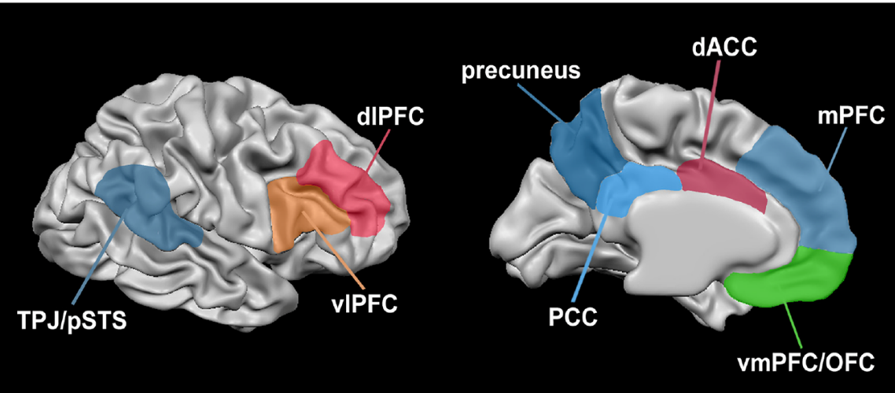
Forgiveness in the brain emerges from several interconnected brain systems working together: cognitive control, including emotion regulation (red/orange), understanding another person’s perspective (blue), and evaluating social and moral significance (green). —Emiliana Simon-Thomas, “How Forgiveness Changes You and Your Brain,” Greater Good Magazine
Whether or not we tell the person who has caused us harm, forgiving them is good for our mental and physical wellbeing. And we can’t understand how this is possible without relating to the processes going on in the brain while we’re gathering ourselves to forgive.
In this post, I hope to provide insights from neuroscience research, much of it from brain-imaging studies. I describe brain regions and functions not to follow this closely (no need to memorize vmPFC/OFC!), but to note the complexity of our brain anatomy and all its interconnected processes.
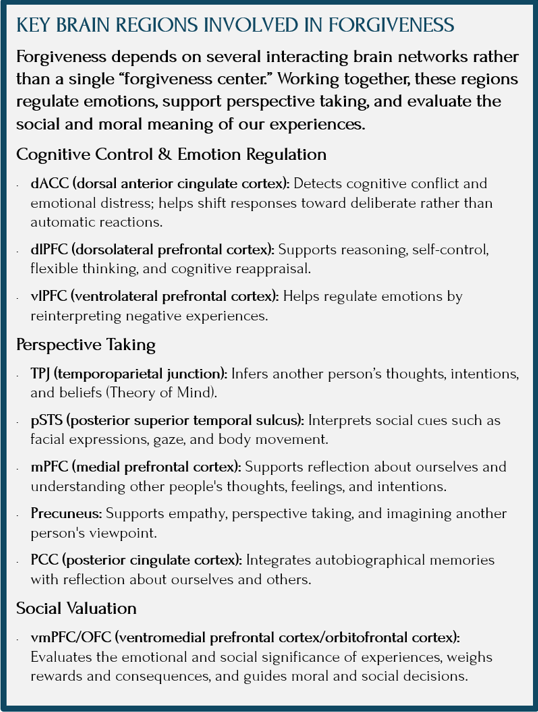
In the graphic above, along with the accompanying text box, we can see that brain imaging studies suggest that forgiveness engages several interacting brain networks. This is our first clue as to why it’s both a difficult process to muster and a rewarding one, with the potential for lasting mental health benefits, as succinctly explained by research writer Emiliana Simon-Thomas:
In brain studies of forgiveness, researchers find that forgiving activates structures and pathways in the brain that improve resilience and social connection more broadly, and empower you to step beyond painful experiences in an energized, motivated, and connected way ….
The good news is that the structures and pathways in the brain that it exercises have other advantages to mental wellbeing. If we’re holding a grudge or just passively waiting for hurt to subside rather than practicing forgiveness, the strength-building processes that come with forgiveness do not happen. —Emiliana Simon-Thomas, “How Forgiveness Changes You and Your Brain,” Greater Good Magazine
I appreciate Simon-Thomas’ reference to “strength-building processes” that don’t happen short of authentic, internally realized acts of forgiving. We can’t cheat our way through this. But with practice, our mental capacities that support forgiveness do become stronger.
Because that’s how our brains function. Mental processes that are repeatedly used become more established and recur more naturally. On the negative side, it’s one reason deeply ingrained habits and patterns are so difficult to change. But on the healthy side, using our brain’s capacities for health and wellbeing become self-fulfilling.
Some rudimentary knowledge about the brain helps us with self-compassion and empathy for others.
The source for this section is research writer Emiliana Simon-Thomas, “How Forgiveness Changes You and Your Brain,” Greater Good Magazine. All graphics are original, written by Jan Swan and designed in collaboration with Chat GPT.
Forgiveness as a Strength-Building Process
Here I’ll paraphrase Simon-Thomas’ three interacting psychological capacities involved in forgiveness and show how they relate to brain function [all graphics are original to the author and her ChatGPT partner]:
1. PERSPECTIVE-TAKING
The first system [see BLUE area in above graphic] also includes the anterior insula, which helps us sense both our own emotional and bodily states and those of other people. TPJ and STS [see “Key Brain Regions” text box] allow us to see another person’s point of view, rather than reacting from our own perspective. This adds emotional meaning and context to what happened, as in sensing the other person’s anger may have resulted from their experience of childhood abuse or poverty.
Also involved are pathways between the two brain hemispheres that span the mPFC, precuneus, and PCC. This shared processing is significant to forgiveness, empathy, and understanding of another’s perspective.
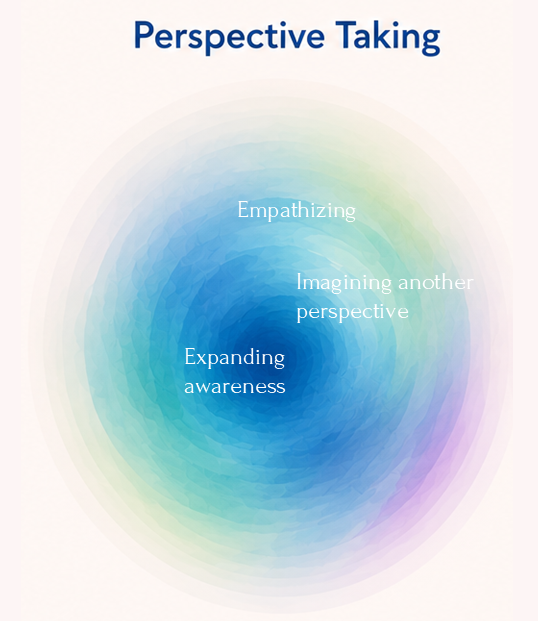
Forgiveness often begins when we can hold two realities at once — our own pain and another person’s experience. By deliberately exploring how events may have looked or felt from their perspective, we can possibly see both the person and the situation differently — perhaps in a way that validates their thoughts and feelings. That broader awareness doesn’t erase the hurt we feel, but it gives us more ways to understand what happened and decide how we want to move forward. Graphic: Jan Swan, with ChatGPT
Activation may signal both the forgiver’s own feelings about the prospect of forgiving (which can be hard), as well as their felt impression of the perpetrator’s experience — both of which influence the motivation to forgive….
Putting ourselves in the shoes of the person who caused harm is part of the process of forgiveness …. We may also realize that holding on to our own enduring distress and anger will not restore justice or solve the problems that led to the harm, but will only continue hurting us — so why continue? —Emiliana Simon-Thomas, Greater Good Magazine
When someone we love repeatedly behaves in hurtful ways because of serious mental illness (SMI), forgiveness often isn’t about excusing the behavior. It’s about deciding whether carrying anger and resentment serves any purpose. The emotional injury is real. So is empathy for the suffering of another that contributed to their behavior. As Simon-Thomas notes, why continue harboring such feelings if they won’t ever lead to resolution.
The important point is recognizing that forgiveness asks the brain to do something that’s mentally demanding. Despite our own pain we must imagine another person’s experience. That’s hard to do, which helps explain why forgiveness rarely comes quickly.
2. COPING
The second system [red/orange] — involving dlPFC, vlPFC, and dACC — helps us pause, regulate distress, and reinterpret painful experiences instead of reacting automatically.
In forgiveness, these brain regions help us track and focus attention in order to be intentional (a function of cognitive control). “Rather than spiraling into despair after an anxiety reflex, you can pause to reevaluate information and your own understanding of the situation….” It speeds up our recovery from distress to restore calm and contentment, as well as foster learning and growth.
And the learning curve may be steep enough to set us back on our heels. We need to resist a natural tendency to be overly reactive in situations that can add fuel to the fire and end with escalating the amount of emotional damage caused to both sides.
Someone close to me once suggested that my first task wasn’t to prove I was right but to help the other person feel calmer — even if that meant apologizing for my part before discussing theirs. Coping like this is a process of validating the other person’s emotions to trigger a positive set of responses — not ones that escalate conflict.
Neuroscience suggests forgiveness is a regulatory task and a process. Our brains first have to calm down enough to think clearly.
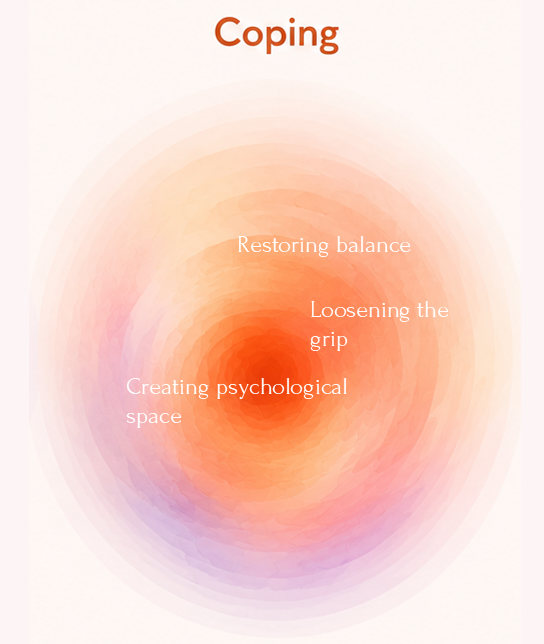
Strong emotions such as hurt, anger, or resentment naturally narrow our thinking and pull us toward immediate reactions. As their intensity gradually subsides, we can use that psychological space to reflect, reconsider, and respond intentionally — to make choices that reflect our values, our relationships, and our own wellbeing, rather than simply reacting in the heat of the moment. Graphic: Jan Swan, with ChatGPT
3. Social Valuation
Finally, the third system [green] — the brain’s OFC and vmPFC — helps us decide and evaluate which response to take and what best aligns with our long-term goals, values, and relationships.
In forgiveness, we can choose to let go of immediate reactions of anger and hostility — and, instead, direct our mental energy to actions that contribute to our wellbeing. We can begin changing things for the better. Cognitive control reduces rumination not just by regulating emotion (hugely important), but by reducing rumination.
This is where it gets hard. When we’re hurt, we often don’t have capacity in that moment to forgive. But when we step back, we just might make the decision to forgive, apologize, and make peace. In my own life, I find this to be true: with repeat offenders that I love (my son), I take the long view, even in the absence of an apology. With people that I’ve cared for (friends), it depends on how much I care now.
Perhaps this is the most surprising of the three components: the brain continues evaluating safety, trustworthiness, and future consequences. Forgiveness unfolds over time. If we pay attention, our brain allows us to use internal judgment more wisely.
In sum:
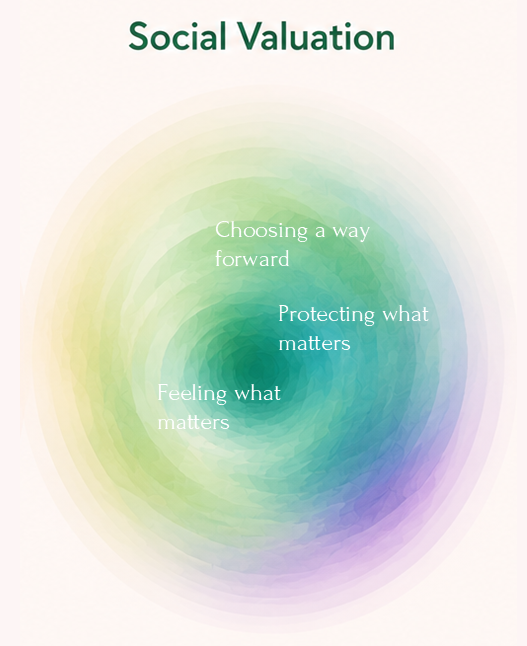
Strong emotions such as hurt, anger, or resentment naturally narrow our thinking and pull us toward immediate reactions. As their intensity gradually subsides, we can use that psychological space to reflect, reconsider, and respond intentionally — to make choices that reflect our values, our relationships, and our own wellbeing, rather than simply reacting in the heat of the moment. Graphic: Jan Swan, with ChatGPT
Forgiving activates brain systems that also equip us to empathize, take other people’s perspectives, cope with difficult emotional experiences, and stay tuned in to and act in accordance with core values and goals. By strengthening these capacities, practicing forgiveness can help us improve well-being in the vast and diverse array of social and emotional moments that make up our lives, and in a lasting way. —Emiliana Simon-Thomas, Greater Good Magazine
As our understanding grows, we continually reassess questions of safety, trust, responsibility, and future possibilities. This ongoing evaluation helps us decide whether forgiveness, reconciliation, firmer boundaries, or continued distance best supports our wellbeing and the relationships that matter most.
A Theory of Forgiveness
Drawing on several recent studies, researchers M.M. Fourie and colleagues propose a theory of forgiveness that weighs “potential gains in healing valuable relationships against the likelihood of future harms — and how the dynamic interplay between these two factors affects decision-making.”
It takes three factors to increase our “social fitness” to benefit from forgiveness:
- Not being motivated to seek revenge
- Not resorting to stonewalling or avoidance behavior
- Being willing to reconcile, as consonant with our values.
By shifting our motivation from anger/avoidance to reconciliation, we can benefit from continued positive interaction with the “transgressor” — the authors refer to the transgressor’s resources and cooperative support they provide if relationships remain intact — provided future exploitation doesn’t recur.
The next section is based on a research study by M.M. Fourie, et al., “Parsing the components of forgiveness: Psychological and neural mechanisms,” 2020, Neuroscience and Biobehavioral Reviews, Science Direct.
A Summary of Neuroimaging and Behavioral Research
For those desiring more detail about the most significant results of neuroimaging studies that assesses volunteers’ behavior in response to stressful situations, the chart below is my understanding and paraphrasing of Fourie and colleagues’ research paper:
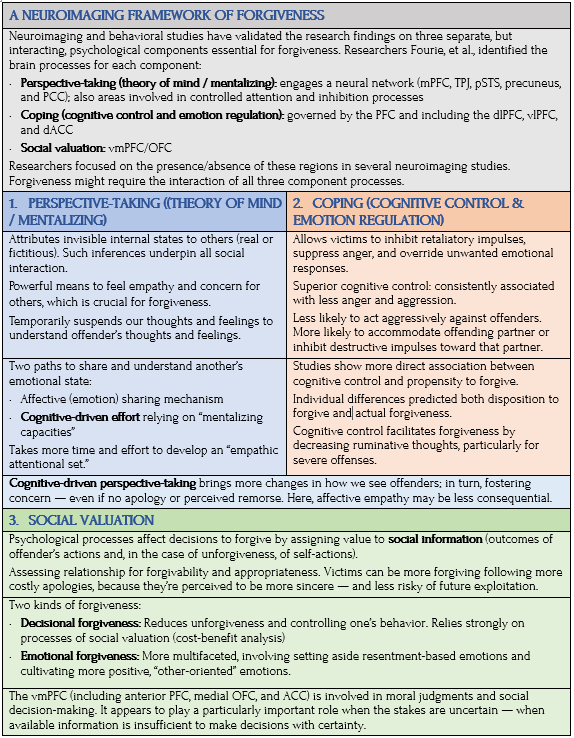
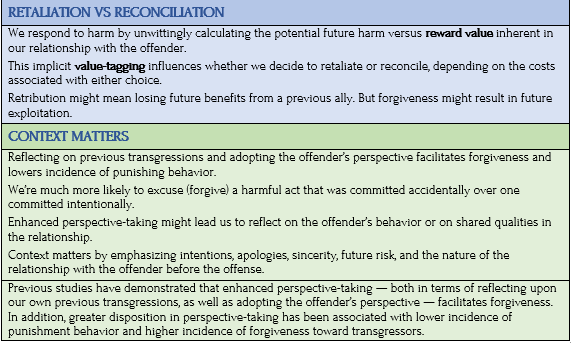
Source: M.M. Fourie, et al., “Parsing the components of forgiveness: Psychological and neural mechanisms,” 2020, Neuroscience and Biobehavioral Reviews, Science Direct
Where Neuroscience and Lived Experience Meet

Discussing brain anatomy — and the ways various subregions communicate — is a marvel of sophisticated neuroimaging technology. But we need to exercise some caution. Promising insights and early evidence are exciting but don’t yet suggest that neuroscience has all the answers. If anything, the evidence shows why forgiveness is psychologically difficult, why it varies so much from person to person, and how it can increase both self-understanding and compassion without telling us what we ought to do. Neuroscience helps explain how we make these decisions, but it doesn’t tell us which decision is morally or philosophically correct. The brain gives us capacity, but not conclusions.
Photo: iStock
Instead, we raise questions in search of guidance about our relationships. But our fears of reconciliation aren’t solely based on what already happened (if even known, as in early childhood), but on what might yet still happen. There’s no way around this. We must base our decisions to forgive another on incomplete information and more questions:
- Will they change?
- Can I trust them?
- Was it intentional?
- Will it happen again?
Neurological scans can’t provide all the answers, but brain science provides the rationale for why we need to dig deep to find our own answers. The value of neuroscience is that it enlarges our compassion, for ourselves and for others. That’s where neuroscience and lived experience finally meet.
WHAT DOES THIS MEAN FOR YOU AND ME?
I also think of a close friend whose adult son hasn’t spoken to him in years. He has repeatedly attempted reconciliation. On one occasion, while visiting his son’s city, he went to his apartment simply hoping to say hello, leaving behind a note. To some, this may read as an earnest act of repair; to others, it was perceived as invasive. That single act reveals how differing interpretations of behavior can be a confounding feature of estrangement.
Estrangement is not abstract to me, and these experiences have left me with no simple conclusions. It’s intimate, painful, morally complex, and deeply human. Sometimes repair is possible. Sometimes love isn’t enough. And sometimes the line between self-protection and loss is far harder to see when standing inside the family itself.

Photo: iStock
So what lessons can we take to heart when learning about complex brain processes that seem both ancient and remote? How does this knowledge help an older parent who hasn’t heard from a son or daughter for five years? How does it help a sibling who forgives but has no desire to reconnect? Or the person who has actually harmed another but is unable to come to terms with what they’ve done in order to make amends.
I don’t have answers, and I’m not qualified to give them if I do. I can only share what has worked for me in the face of difficult and at times explosive family dynamics. For me, it’s learning, thinking, finding purpose, not giving up, and trying to be more loving and caring.
If we’re upset by someone who has been nasty, unfeeling, passive aggressive, or just plain aggressive, we need to stand back and assess the situation with a cool head.
From there we can recognize who we are in relation to our values, our commitments, and our personal goals. Only then can we make a judgement about what’s the right thing for us to do — not for what they should do, but what we need to do in relation to the offense and its impact on our lives now and in the future. We need to let go of anger and resentment for our mental health — even though lessening our anger will also benefit them.
My first inclination is to forgive and maintain contact, but that’s not always possible nor desirable. It bears repeating: it’s about making decisions in the absence of certainty.
Here’s Mr. Rodgers (from the movie starring Tom Hanks) talking about a man with a beaten up face:
Someone has hurt him more than his face. He’s having a hard time forgiving the person who has hurt him.
It’s a decision we make to release a person from the feelings of anger we have at them.
It’s strange, but it’s hardest of all to forgive someone we love. —Mr. Rodgers, From A Beautiful Day in the Neighborhood.
Coming Up Next

Photo: iStock
Perhaps the greatest lesson from forgiveness neuroscience is the mind’s remarkable capacity to expand. We begin with our own pain, our own story, our own immediate reactions. Then, when we can, we widen our awareness to imagine another person’s perspective, create psychological space before reacting, and reflect on what truly matters before deciding how to move forward. These processes don’t tell us whether to forgive, but give us greater mental capacity to be empathetic, regulate difficult emotions, and act with intention.
Having said this, it’s still not an easy process to go through. In Post 7: Why Forgiveness is So Hard, I explore this very human response to not forgive, even when faced with compelling reasons to do so.
Copyright ©2026 Jan Swan
 English