On Forgiveness and Estrangement
Show Table of Contents
INTRODUCTION
A LONG HUMAN CONVERSATION
- Why Humans Evolved to Need Both Forgiveness and Exclusion
- Forgiveness: Between Moral Ideals and Human Reality
- Estrangement: From Unthinkable to Acceptable
- Estrangement: Ambiguity, Memory, and the Limits of Repair
- How Science Adds to the Conversation
CONNECTION, SAFETY, PEACE
- Why Forgiveness Is So Hard
- Brothers Apart: A Story of Sibling Estrangement
REPAIR OR LETTING GO WELL
- Moving Forward Without Simple Answers
- Living Beyond All-or-Nothing Choices
3. Forgiveness: Between Moral Ideals and Everyday Reality
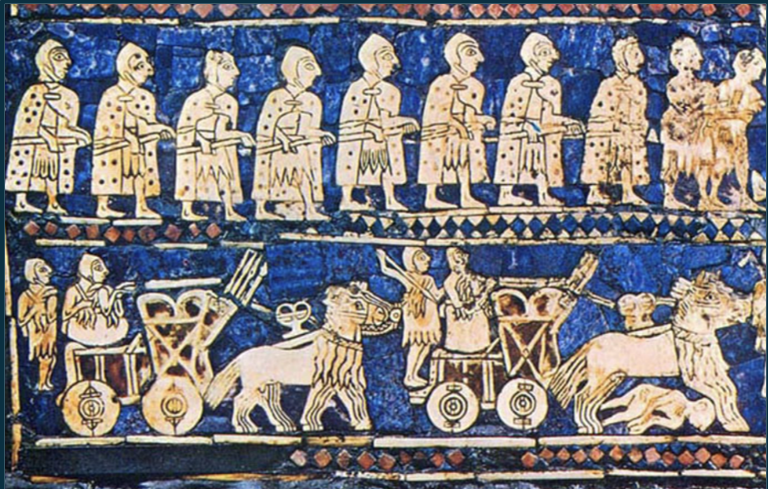
Sumerian commemorative mosaic, 2550 B.C. “Standard of Ur” (detail), Illustration History
We can recognize forgiveness and exclusion as adaptive responses which helped early Homo sapiens make decisions about conflict and clan — keeping our species intact for hundreds of thousands of years. In this post, I shift from instinct to interpretation through the multiple lenses of religion, philosophy, and culture. asking the same questions posed in post 1 plus one new question:
- Why do we hurt people close to us?
- Why is forgiveness so difficult and beyond some entirely?
- What would our lives be like if we chose one path over the other?
- What do we do with each other after we’ve wronged them or been wronged by them?
As I read about forgiveness as a concept — based on expert summaries of philosophical, psychological, cultural, and historical thought — I understand it to be as rich and varied a concept as we are a people. Forgiveness is significant to every religious tradition, whether east or west. Yet, it doesn’t require religion for us to believe in its value and moral imperative as a cornerstone of being a people — as it’s built into our political and justice systems, our family and work lives, our relationships. In fact, it’s such a vast topic that the best I can do is cherry pick my way through contemporary articles and social science papers to represent its complexity.
Older than the Bible. Fresher than Today’s News
Across traditions, the experts tell us, there are recurring ways of thinking about forgiveness that are passed from generation to generation. It can be something we do to improve relationships or something we don’t do because we’re no longer willing to feel hurt and resentful. Some think the act of forgiving means we forgive everything — the person, the hurt, the act — along with our willingness to let go of our pent-up emotions. But experts take a different view: we can reject the act without rejecting the person.
I listened to a podcast with psychologist Robert Enright, PhD, “Speaking of Psychology: The power of forgiving those who’ve hurt you,” American Psychological Association. Enright is also a professor of educational psychology at the University of Wisconsin-Madison and cofounder of the International Forgiveness Institute. Here’s what he says [lightly edited]:
Forgiveness is a moral virtue, where you are good to those who are not good to you, without excusing, without forgetting it might happen again, without necessarily reconciling, and without throwing justice under the bus.
When we’ve been treated unjustly by others, a lot of unhealthy anger sneaks into our heart that we’re not aware of. And with that drip, drip, drip of anger onto the heart, onto the emotions, day after day and even year after year, people start to become deeply angry or resentful. That can turn into anxiety and depression and even low self-esteem.
Paradoxically, as we reach out with goodness toward those who are not good to us, and it’s our choice (it shouldn’t be forced), that drip, drip, drip of anger starts slowing down. In its place, we start having that goodness toward the other. That actually counteracts the toxic anger, reducing and even eliminating the effects of the trauma. Anxiety and depression literally can leave, and we get our life back. —Psychologist Robert Enright, PhD, “Speaking of Psychology: The Power of Forgiving Those Who’ve Hurt You,” American Psychological Association podcast
My notion of forgiveness is not yours, and yours may not match the person who hurt you. We may never agree to what it means. Total absolution vs I forgive but don’t forget. And yet ambiguity — partial, imperfect understandings of what forgiveness means — may be good enough. Maybe not morally aligned with religion or ethically aligned with philosophy, but psychologically sufficient for healing and personal growth. That’s the focus of this series.
Sally and Sue — Part 1

Photo: Dreamstime
Sally asked Sue three months ago if she’d take her dog while Sally took a one-week vacation. Sue agreed. She knew Sally’s dog and was comfortable with having him. Unfortunately, Sue neglected to mark the days on her calendar, so when Sue’s son and his wife wrote to say they were coming the same weekend, Sue saw a conflict brewing. Her son was highly allergic to dogs, but Sue was not about to turn down a visit for her prior commitment — and now there was little time for Sally to make other plans. Sue and Sally had a heated exchange on the telephone, with Sally hanging up on her.
Who, exactly, has been wronged here?
Inherited Concepts of Forgiveness
When we step back from our individual circumstances — our families, work and financial pressures, social and relationship issues — we can see how much we’re shaped by inherited traditions and moral codes. Most of us know when we’ve wronged another person. Sometimes as adults, we look back on past actions and wonder how we could’ve been so clueless, thoughtless, hurtful, or selfish. We are a flawed and fallible species and, across time, we’ve turned to religion, family, and community to help guide us.
Today, when we scan across cultures, philosophies, and religious (and anti-religious) traditions, we see forgiveness as a fusion of different traditions. Our understanding has been shaped by these overlapping influences. Practices that once felt “foreign” — yoga, meditation, breathwork — are commonplace. Often we don’t notice how much they’ve changed the way we think about ourselves and each other.
Past moral imperatives are now diffused within these influences. And that can be confusing. We aren’t always sure what to expect of our traditions — or what they ask of us. There’s no big reveal here. I’m as unsure about the “right thing to do” as the next person. Back to Enright:
It’s good first to understand the effects of the injustice against us, seeing that it’s quite negative and that we’ve been living with negative effects, like restlessness and too much anger and the like. And then we have to make a decision. How are we going to heal from that?
Many people come to forgiveness when they’ve tried everything under the sun. So they say, “Nothing’s worked. I’ll try forgiveness.” So we decide — a free will decision without coercion from others. What I then say is hit the forgiveness gym to do the forgiveness work, to become forgivingly fit. We start thinking about the one who hurt us in new ways.
We see they’re more than the injustice against us. We see their personhood. When we do that, then we’re ready to give this moral virtue-like quality, which is goodness to the other. That’s when the healing begins in the heart of the forgiver, which leads to finding new meaning and purpose in our own life.
We say, “Hey, I have a new way of dealing with trauma I had never thought of before.” That’s when we get a true psychological change that’s transformative in a very positive way. —Podcast with Robert Enright, American Psychological Association
When someone hurts us, it can feel justifiable or even satisfying to nurse a grudge. But psychologists find that forgiveness, when done right, can lead to better mental, emotional, and even physical health for the forgiver. Enright and many others discuss how we know if we’re ready to forgive, the difference between forgiveness and reconciliation, whether any harms are truly unforgivable, and how to forgive someone who isn’t sorry for what they’ve done.
Western and Eastern Thought on Forgiveness
What follows is a simplified overview of how major world religions understand forgiveness:
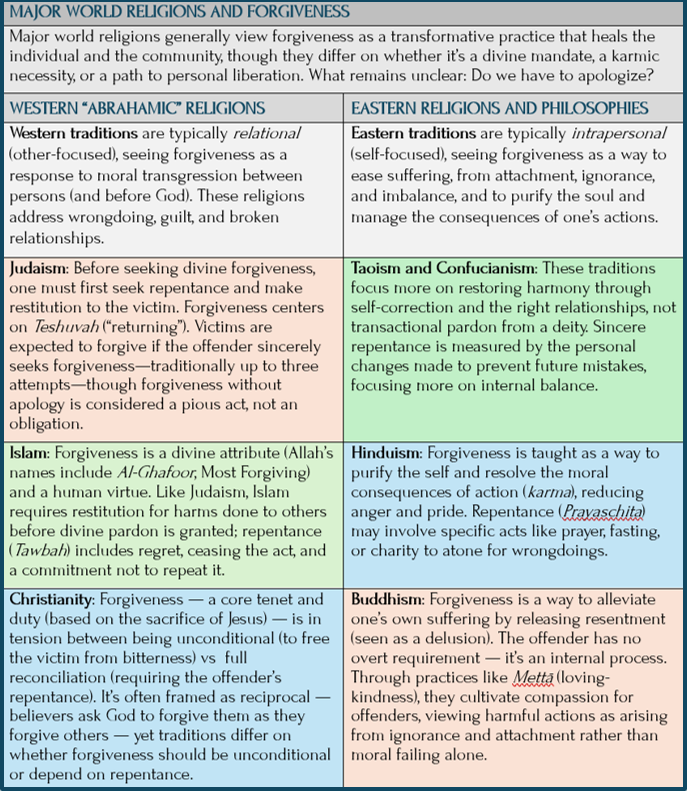
Sources for both charts: Luke Russell and Brandon Warmke, “Forgiveness,” and David Wong, “Chinese Ethics,” Stanford Encyclopedia of Philosophy and Plato.Stanford; “Teshuvah or Repentance: The High Holidays provide a special opportunity to repent,” My Jewish Learning; Omar Suleiman, PhD, “Ramadan Series 2026: Will Allah Forgive Me?” Yaqeen Institute: Forgiveness in Islam; “Buddhism A–Z: Forgiveness,” Lion’s Roar; and “Forgiveness” (Hindu Dharma section), Wikipedia
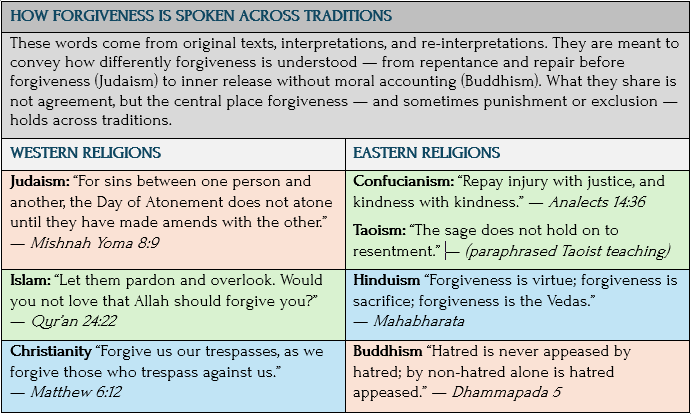
We can hear these differences in the language — in the words each tradition uses to describe what forgiveness is and what it’s for:
Sally and Sue — Part 2
If we return to Sally and Sue — a real (personal) story with details changed to protect the innocent — the situation no longer looks as simple as apologizing for a scheduling mistake. It’s about responsibility, expectation, and what each owes the other.
Does Sue, who found herself double-booked, owe Sally an apology before anything else can happen? Is Sally expected to let go of her anger for the sake of the friendship? Or is this a moment when the relationship itself has to be reconsidered?

Sally believed Sue should have come to her with a solution already in hand — either asking her son and daughter-in-law to visit another weekend or finding a suitable replacement dogsitter. Sue, however, bristled at the idea that she was morally responsible for the dog’s care. She felt Sally, as a good friend, should understand that one’s children take precedence over a friend’s pet. These were not interchangeable attachments. But Sue’s ability to reflect on her own role became clouded by Sally’s reaction and her abrupt ending of the call.
What happens after the immediate friction matters a lot for their future relationship. A friendship that felt solid a week ago could be permanently damaged. Both women were hurt by the exchange, and both retreated in their own ways — pulling back from the discomfort and from the possibility that they might share some responsibility for what went wrong.
If they hope to repair the rift before Sally’s trip, someone has to take the next step. But who? Since Sally hung up, does she reach out? Or does Sue, who assumed wrongly that Sally would simply excuse her from the commitment? What role does forgiveness play in what happens next?
A Moral Quandary
Most of us share some sense of the conflict that pulls us in different directions — to be generous and let go, to seek immediate repair to the breach, or to subscribe to the golden rule — toward forgiveness. Unfortunately, our traditions don’t always agree on what forgiveness actually requires in this moment. Nor do they erase the heightened emotions stirred by conflict: anger, resentment, pride, defensiveness, or feelings of having been wronged.
Taking no action may mean we prefer the route of least resistance. Or we may believe forgiveness isn’t required, especially if the hurt we feel is at risk for being overlooked or repeated.
As attributed to Confucius, “To be wronged is nothing, unless you continue to remember it.” This suggests that unresolved anger can become its own nightmare.
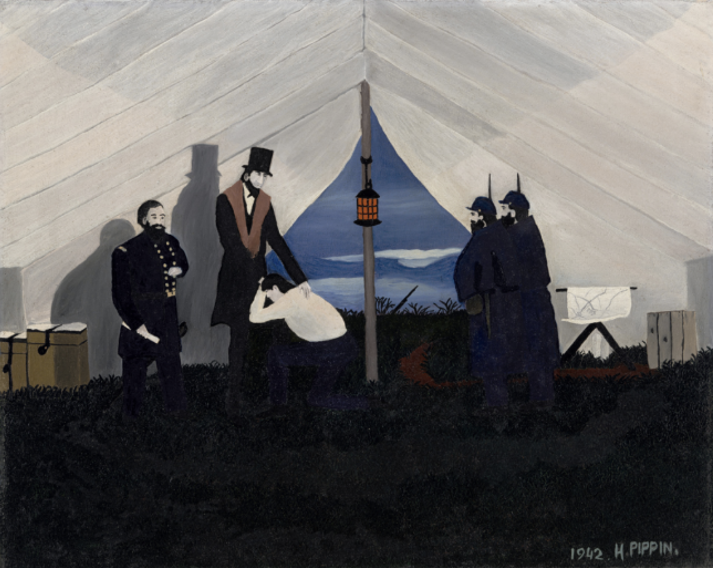
Horace Pippin, Abraham Lincoln, the Great Amancipator, Pardons the Sentry, 1942, The Museum of Modern Art. Folk Artwork
Part of the conflict is internal. One voice tells us to forgive freely. Another insists on accountability before anything can move forward. A third wants to preserve the relationship, even at some cost to ourselves. Yet another asks us to consider whether a boundary has been crossed that can’t — or shouldn’t — be allowed.
Whether or not apology and repair come naturally, forgiveness is an internal process independent of what the “offender” does in response. When expectations diverge, as with Sally and Sue, conflict can deepen rather than resolve. The need to receive an apology from the other may actually mean more to them than the relationship.
Tensions often go unresolved just because they run deep. They show up in how hurt we feel and in what we sense is fair. To forgive too quickly can feel like dismissing what mattered. To withhold forgiveness can feel like keeping the pain alive. Even the idea of being the “bigger person” asks us to rise above something, but doesn’t always tell us how we’ll feel when the dust settles.
Sally and Sue — Part 3
Given the moral and emotional ambiguity of forgiveness, it’s no wonder Sally and Sue are struggling with the conflict and their strong reactions to it. They both see themselves as faultless and as deserving of the other’s apology.
Sue is quite clear that her own children coming to visit takes precedence over Sally’s needs. Perhaps because Sally doesn’t have children, Sue assumes she can’t fully understand the pull a mother feels toward her own children — and that affection for a dog simply isn’t the same. The fact that Sally elevated a simple situation to a catastrophe is on her. That was her choice to get so infuriated that she hung up on her good friend. Sue doesn’t appreciate her friend’s behavior and her unwillingness to make things right. At first, Sue doesn’t believe she needs to apologize.

Sally is still incensed that Sue couldn’t understand what a terrible predicament she put Sally in — days before she flies out to meet her cruise ship. Now on her vacation she has a cloud over her head and will worry about her dog being in a stranger’s care (she was able to find someone on Rover, who seems okay, though it’ll cost her plenty). Surely Sue’s children could’ve come another time. In Sally’s eyes, Sue fundamentally misunderstands that her dog is family. Her dog’s care might be more important than … perhaps … their friendship. There, she said it. Sue will have to apologize if Sally is ever to forgive her.
There’s an impasse. Both take a few days to calm down from their agitation over what should’ve been a calm exchange.
But here’s what actually happens: Sue comes around. Once she gets over her hurt feelings, she begins to see Sally’s side of things. She assesses the friendship, which extends back decades, and doesn’t want to lose it. Before Sally leaves for her vacation, Sue calls, apologizes, and wishes her a good trip. She tells her she’ll pick up the dog for the second half of the week after her children leave.
Sally also goes through a process before the call. She still feels bruised, but knows Sue was right about seeing her kids. She just wishes she was less cavalier about canceling on her. But she doesn’t want to go off on her vacation with bad feelings between them. Once Sue calls, Sally needs little convincing to accept her apology and offer one of her own — for the abrupt hang-up and her own emotional escalation. She also really appreciates Sue’s willingness to take the dog for the last few days of her trip. They make up.
Forgiveness did not erase the hurt, nor did it make either woman entirely right or wrong. But once pride gave way to perspective, reconciliation became possible — because Sue chose to make the first overture. That’s what it takes, sometimes.
In Sum
No matter what traditions of forgiveness we’ve inherited, they profoundly shape what we expect of ourselves in conflict — and what we expect from others if the relationship is to continue. As Lopez writes, the need to reckon with forgiveness is embedded in our human social DNA. We grapple with it, resist it, embrace it, and shape our lives around the choices it demands.
But social DNA comes up against complicated situations. What we expect from another and what they’re willing to give can cause confusion and mixed signals. The more complex the situation, the more morally ambiguous it becomes. What feels like the “right thing to do” to me may feel insufficient — or even wrong — to another. I may feel I’m being particularly generous in how I choose to forgive, while, from another perspective, it may look like denial or avoidance. And what feels like self-respect to one may feel like refusal to repair to someone else.
Which is why, in moments like the one between Sally and Sue, the question isn’t just what happened — but what each of them believes should happen next.
Coming Up Next

In Post 4: Estrangement: From Unthinkable to Acceptable, I explore how one of humanity’s oldest social taboos has become, for many, a psychologically legitimate response to harm. As family life becomes less about duty and obligation and more about personal wellbeing, estrangement becomes a viable option for self-protection and autonomy. What was once seen primarily as abandonment may now be understood, in some circumstances, as survival — revealing just how profoundly our expectations of family, identity, and repair have changed.
Copyright ©2026 Jan Swan
 English