On Forgiveness and Estrangement
Show Table of Contents
INTRODUCTION
A LONG HUMAN CONVERSATION
- Why Humans Evolved to Need Both Forgiveness and Exclusion
- Forgiveness: Between Moral Ideals and Human Reality
- Estrangement: From Unthinkable to Acceptable
- Estrangement: Ambiguity, Memory, and the Limits of Repair
- How Science Adds to the Conversation
CONNECTION, SAFETY, PEACE
- Why Forgiveness Is So Hard
- Brothers Apart: A Story of Sibling Estrangement
REPAIR OR LETTING GO WELL
- Moving Forward Without Simple Answers
- Living Beyond All-or-Nothing Choices
5: Estrangement: Ambiguity, Memory, and the Limits of Repair

Boucicaut master (French), “Death of Brunhilde, Queen of France” (detail), Fates of Illustrious Men and Women, 1413-15, J. Paul Getty Museum
Estrangement may be one of psychology’s clearest reminders that family rupture can’t isn’t a question of right or wrong, but instead reflects the fragile — and often painful — limits of reconciliation, accountability, and change.
The decision to go “no contact” is rarely clean or emotionally uncomplicated. More often, it can feel like losing your footing on a slippery trail — or perhaps being swept into something far more forceful, like going over Niagara Falls in a barrel. Estrangement may offer protection, relief, or survival, but it also thrusts individuals into profound uncertainty. Life before and after estrangement is often marked by ambiguity, with no guarantee that separation will bring peace, healing, or long-term psychological clarity. It is precisely this uncertainty — this collision of grief, memory, hope, fear, and unresolved attachment — that makes estrangement so psychologically destabilizing, both for the person who steps away and for those left behind.
Why Ambiguity Is Psychologically Destabilizing
By its very nature, estrangement involves deeply felt but divergent understandings of harm, accountability, memory, and justice. These competing truths contribute to what makes estrangement so psychologically destabilizing: while separation ends contact, perhaps permanently, it also intensifies emotional, moral, and relational uncertainty. And it doesn’t necessarily improve over time.
The following section was drawn from several experts cited in this and the prior post: Karl Pillemer, Fault Lines: Fractured Families and How to Mend Them (Cornell Family Reconciliation Project); The Harris Poll / Purposeful Empathy, national survey data on family estrangement (Karl Pillemer/Will Johnson); Becca Bland and Stand Alone (UK), with Centre for Family Research, University of Cambridge, Hidden Voices: Family Estrangement in Adulthood (2015); Joshua Coleman, Rules of Estrangement; and context data from Pew Research Center studies on political polarization and family division.
PROTECTION AND GRIEF

As experts note, estrangement often begins as an act of self-preservation — a declaration we can’t endure another round of emotional injury. Yet even when separation feels necessary, self-protection may exchange one form of suffering for another: profound grief. To break from someone once central to our identity — parent, child, sibling, or partner — may remove immediate pain but may open us to longing for what was hoped for and wasn’t realized. We mourn for the part of ourselves that may forever feel that loss. An uneasy alliance of safety and sorrow.
Bisa Butler, The Safety Patrol, 2018, Art Institute of Chicago
BOUNDARY AND LOSS
In estrangement, even necessary boundaries can’t restore trust or healthy relationships. Love may not be enough. A boundary intended to preserve dignity or mental health may also sever rituals, shared history, family continuity, and belonging. What protects us can simultaneously alienate us from the “emotional architecture” of our self-identity. Boundaries become permanent and make loss more poignant.
Édouard Vuillard, Interior, Mother and Sister of the Artist, 1893, The Museum of Modern Art, New York
UNRESOLVED NARRATIVES
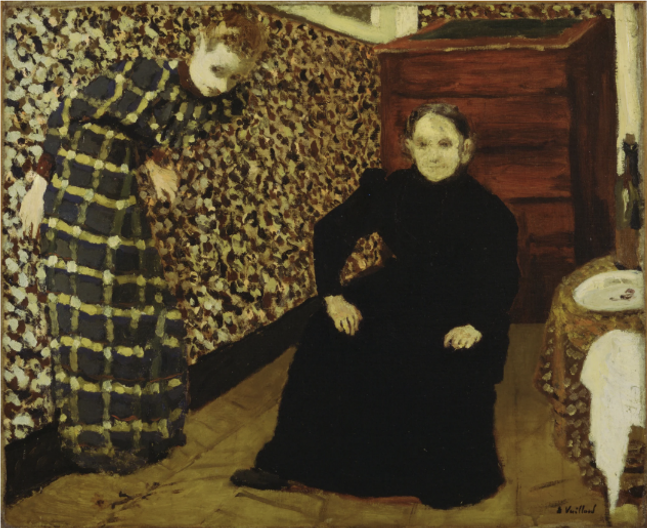
In families, each family member may differently understand shared experience. Their competing narratives may not be equally accurate, but they’re psychologically real to those who hold them. To my mind, this is the central anguish — perhaps the crux — of estrangement: when we’re unable to bridge the gap between conflicting tales of what occurred, or what may still be occurring. Estrangement can persist because our narratives become irreconcilable. We can’t give them up and are doomed by them.
UNRESOLVED WOUNDS
The central conundrum of estrangement is foreclosing opportunities to resolve injuries that were never adequately acknowledged or dealt with: trauma, betrayal, neglect, invalidation, addiction, or chronic harm. Time alone can’t resolve hidden wounds, particularly when rooted in childhood or severe dysfunction. Ending the relationship may not end the questions:
- Could it have been different?
- Was I right?
- Was there another path?
As we change and grow further apart, these questions remain open.
Estrangement as Ambiguous Loss

Morris Hirshfield, Angora Cat, 1937-39, The Museum of Modern Art. Folk Artwork
Estrangement is what psychologist and family therapist Pauline Boss calls ambiguous loss — a profoundly unclear loss marked by chronic uncertainty. While Boss described broader situations than estrangement (like soldiers missing in action or Alzheimer’s patients), her concept of ambiguous loss succinctly describes grief for those who are physically alive, yet psychologically or relationally absent. This creates a uniquely unsettling form of grief because the relationship is neither fully present nor fully gone.
In Joshua Coleman’s podcast interview with Boss, she explains the benefit of naming this kind of loss:
Coleman: Can you say why it’s important for us to have specific labels for our experiences?
Boss: I’m coming from a stress perspective, not a medical one. I believe we have pathologized a lot of loss that can be understood through the stress model. We can’t cope with something unless we know what it is. I simply gave a name to a kind of loss that had been ignored. It’s something people are experiencing. They can begin to cope with it once they have seen it.
Coleman: Say something else about that name as opposed to a name like a mental illness or medical diagnosis or syndrome.
Boss: It’s an innocuous name. In fact, a rather poetic name. People accept it rather readily, even children. There’s no resistance to that name, where there is resistance to saying, for example, someone who’s grieving has this DSM diagnosis. That makes them feel bad, because they now have some quality in themselves that has failed underneath all of this. –Joshua Coleman interview of Pauline Boss, Understanding Families podcast, You Tube
Boss’ work reinforces how estrangement resists neat categorization. Unlike a death, estrangement produces chronic uncertainty because the relationship’s meaning remains unresolved. Naming ambiguous loss can reduce an individual’s shame and confusion without pathologizing the sufferer.
Boss worked with victims of the Japanese tsunami who found ways of coping with ambiguous loss that were quite different from narrower Western responses to grief. She tells of a woman who let go of her child’s hand when overtaken by the tsunami, who believed her child found a loving woman on the other side to care for her. In some Western approaches, a clinician might focus on forcing acceptance of death. In this context, preserving uncertainty allowed the mother a measure of peace.
Estrangement is painful not simply because of the loss itself, but because society offers few meaningful frameworks for understanding it outside blame, pathology, or simplistic narratives of closure.
Guilt vs Shame
Boss says, “Normalize guilt — but not shame.” For estranged parents especially, this distinction can help them understand how shame attacks the self and doesn’t allow for accountability or repair. In contrast, guilt addresses behavior and may permit growth. Shame is “I’m ruined (there’s nothing to be done!),” and guilt is “I did something wrong, (so I can correct!).” In Coleman’s interview, Boss explains:
Part of what estranged parents struggle with is not only the loss but the feelings of rejection, shame, and humiliation. The loss of a role …. The idea of ambiguous loss is useful because it’s hard for them to sort all the other feelings that get attached to the shame, the loss, the humiliation, the feelings of rejection.
If estrangement is to happen to us, we only have control over changing ourselves. One way to begin the work is to make ourselves more appealing to the younger generation to come back. It requires an acknowledgement of our own weaknesses or what we might have done that was wrong — without shame.
Shame is the problem — not guilt, which is normal — because it has to do with self-esteem and self-loathing. We need to move it from shame to ordinary guilt. We’ve all got guilt, we’ve all been imperfect parents and imperfect children of our parents. So I would try to normalize guilt, empower the people to change themselves, and then eventually perhaps reconnect.
First perhaps by writing. It needs to be done very carefully. We can’t tell our kids what to do but we can be in charge of what we do and make ourselves the kind of person they would like to visit with or they would like their children to spend time with. — Joshua Coleman interviewing Pauline Boss, You Tube
Boss’ point is not that parents should carry endless blame or that adult children should be pressured to return. But that shame makes insight harder. Repair, if possible, usually requires guilt to motivate change without collapsing into shame.
COMPETING INDIVIDUALISM VS. HUMAN SYSTEMS
Boss’ sociological perspective sees estrangement as both deeply personal and culturally shaped. She offers an important counterpoint to forms of self-care that prioritize individual wellbeing to the exclusion of broader human systems. As she puts it, “You need both to take care of yourself as an individual, but you also need to be part of a human system…”
Her view highlights the tension between personal boundaries and self-protection on one hand, and accountability, change, and relational responsibility on the other.
Boss is careful not to undermine legitimate estrangement in cases of abuse or danger. Rather, she complicates simplistic narratives that frame cutting off family as inherently virtuous, reminding us that while estrangement may sometimes be necessary, it also carries broader human consequences.

Andries van Bochoven, Portrait of the Painter Andries van Bochoven and his Family, 1629, Centraal Museum, Utrecht, the Netherlands. From Rachel Witte, “Family in Art: Missing Our Loved Ones,” Daily Art Magazine
AMBIVALENCE AS NATURAL
“Ambivalence is the natural outcome of ambiguity,” says Boss. For those facing estrangement, this idea may itself offer relief: the pain of estrangement is not necessarily something we fully resolve, but something we may instead learn to live with. Because estrangement resists clear endings, both Boss and Coleman reject the popular notion of closure as “myth.” Boss explains in Coleman’s interview:
Coleman: I understand that ambiguity does strange things to our behavior, but I know that in general it causes great stress. What is the myth of closure?
Boss: The myth of closure is the title I chose. I’ve been working on this for a long time. It came out of my work with ambiguous laws. In my early writings, I said it’s painful for people because there is no closure. That was a mistake to say it that way, because I don’t think closure is desired in any case, even with a clear-cut death.
We now know that the grief literature for ordinary death says we can live with the grief of that kind of loss. We do not have to get over it, but we need to find some meaning and some purpose in it.
I saw that with families that had ambiguous loss, which I consider a huge mountain to climb to find meaning … where someone disappears either in body or mind. But if they could do it, I thought that people with a clear-cut death could do it as well.
Closure is a myth. What we need to remember is that it’s okay to think about the person who is lost or gone. It’s normal, and it’s normal grieving. And whether the person is dead or alive, you miss them.

Ernst Ludwig Kirchner, Street, Dresden, 1908, The Museum of Modern Art
Boss argues that grief doesn’t require “getting over” profound loss, even in clear-cut death. Rather, we learn to live with grief, find meaning within it, and allow loss to remain part of our emotional reality. In estrangement, where the person is physically alive but relationally absent, this challenge may be even greater.
Boss also warns against “artificial closures” — ghosting, abrupt alienation, or emotionally simplified endings — that may sever contact without resolving grief.
In this context, radical acceptance may be psychologically more realistic than closure: accepting that reconciliation may never come, while recognizing that life can still hold meaning and value despite unresolved loss.
ESTRANGEMENT IS SOMETIMES NECESSARY, BUT NEVER NEUTRAL
Boss emphasizes that the cultural pendulum may, at times, swing too far from preserving connection (where possible) toward self-protection (at all costs). Self-protection is not a guarantee of freedom from hurt. In Coleman’s interview, Boss offers a sharp critique of modern hyper-individualism:
We have towering rates of loneliness and atomization and social isolation and part of it is everybody’s pursuing their own individual ideas of happiness.
My field of psychology and psychotherapy does in some ways enormous harm by supporting these ideas that the most important thing is your pursuit of your own individuality and happiness and self-growth. And if anybody or anything stands in the way, then you should just cut them off — and that’s somehow an act of existential courage.
I’m cutting out that person because they’re bad for my mental health. Well, it may be that person you’re cutting out is a grandmother or grandfather that your children adore. Or you’re basically ruining your parent’s life in your pursuit of your mental health. —Pauline Boss, podcast with Joshua Coleman
These are strong words. Boss is not arguing that people should remain in abusive, dangerous, or chronically harmful relationships. Nor is she dismissing the legitimate necessity of estrangement in some cases. Rather, she’s challenging the idea that estrangement is morally pure simply because it is self-protective.
Collateral loss
Cutting off contact may preserve one life while profoundly destabilizing another. That tension is part of what makes estrangement tragic for so many families. Liberation or rejection. Survival or attachment. It may be impossible to resolve truth with memory, and preservation with the enduring ache of what repair couldn’t restore.
Before permanent rupture, Boss urges consideration of more nuanced questions:
- Can accountability occur?
- Can boundaries be restructured?
- Can contact be limited rather than eliminated?
- Can harm be acknowledged without total annihilation of connection?
Instead, it might be helpful to see relationship options along a spectrum: from full reconciliation to limited contact, to structured distance, to symbolic connection — before the absolute step of estrangement.
Some relationships clearly can’t be safely preserved. But many others may deserve more imagination, more language, and more structured alternatives before complete rupture.
My Story

Photo: Stocksy
In my writing, I have shared a great deal of deeply personal information about my family, because it is, after all, what has motivated much of the work I do here. But estrangement is particularly difficult to write about because I’m standing inside it. What I may want for healing, repair, or reconciliation is not necessarily what my sons want for themselves. And perhaps that’s precisely the point: competing truths. Self-protection versus reconciliation. Boundaries versus heartache. I don’t always know where one ends and the other begins.
I have loving relationships with both of my sons, yet a rupture between them — now seven years old — has neither softened with time nor led one son to respond to the other’s fragile overture. And so we persist as an imperfect family: an isosceles triangle with no base.
DEPENDENCY CONFLICT
With my older son, I live with the fear that unresolved dependency itself may someday become a pathway to estrangement. He remains financially dependent on me and struggles, or perhaps can’t yet manage, to respect my financial boundaries. My attempts to reduce that dependency have often been met with fierce resistance. If I were ever forced to impose hard limits unilaterally, I fear genuine love might not be enough to prevent estrangement.
REPAIR THROUGH ACCOUNTABILITY, PERSPECTIVE-TAKING, AND CHANGE

With my younger son, we too were once at risk of alienation, perhaps even estrangement. Had I continued blindly, without questioning my own assumptions or attempting to understand why our relationship had become strained, I believe we may have fractured more deeply. Instead, I was forced to confront our differing understandings of family history, including his own reasons for maintaining distance from his brother. That process required me to listen differently, reconsider painful truths, and ultimately change. Today, we share a deeply loving and mutually supportive relationship.
Saltimbanques are street acrobats (Italian saltare: to jump — plus banco: bench, platform, or stage). The figures seem to float above the ground in a strange, barren landscape. The pale colors add to a vague, dreamlike feeling, as if they’re trapped in limbo, stuck in a state of uncertainty. Pablo Picasso, Family of Saltimbanques, 1905, National Gallery of Art
FAILED REPAIR AND CONFLICTING INTERPRETATIONS
I also think of a close friend whose adult son hasn’t spoken to him in years. He has repeatedly attempted reconciliation. On one occasion, while visiting his son’s city, he went to his apartment simply hoping to say hello, leaving behind a note. To some, this may read as an earnest act of repair; to others, it was perceived as invasive. That single act reveals how differing interpretations of behavior can be a confounding feature of estrangement.
Estrangement is not abstract to me, and these experiences have left me with no simple conclusions. It’s intimate, painful, morally complex, and deeply human. Sometimes repair is possible. Sometimes love isn’t enough. And sometimes the line between self-protection and loss is far harder to see when standing inside the family itself.
In Sum: Estrangement is Psychologically and Morally Complex
Estrangement isn’t a psychologically simple or morally uncomplicated decision. It’s neither merely selfish abandonment nor inherently heroic boundary-setting, but one of the most consequential interpersonal decisions a person can make. Sometimes necessary, sometimes avoidable — but always painful. Rarely is it free of collateral loss.
The central challenge is not choosing between easy opposites — self-protection vs family obligation — but discerning when protection genuinely requires separation. It means determining when pain, imperfection, or accountability may still be survivable within continued connection, even when limits are necessary.
Modern psychology hasn’t simplified family rupture. If anything, it has made it more morally and emotionally complex. By giving us language for trauma, boundaries, invalidation, abuse, ambiguous loss, and competing truths, psychology has helped many people name harms that were once minimized or ignored. But it has also forced us to confront difficult questions about what we owe ourselves and each other.
Researchers like Pillemer, Coleman, Boss, and others suggest that estrangement is personal AND cultural. Family rupture reflects larger societal forces in defining autonomy, obligation, identity, happiness, and fulfillment. Hyper-individualism may at times encourage premature disconnection, while older traditions may demand harmful endurance at too great a cost to the individual. The swinging pendulum itself creates tension.
Estrangement can save lives, end cycles of abuse, protect mental health, and preserve dignity where repair is impossible or unsafe. But estrangement may also calcify misunderstanding, deepen loneliness, and destabilize entire families. Especially for young adults, it may foreclose possibilities for future healing that may otherwise emerge through time, acceptance, or change.
Boss’ concept of ambiguous loss offers perhaps one of the clearest psychological insights: estrangement is destabilizing not only because of loss, but because it often lacks finality. The person is absent, yet still alive. Love may persist alongside grief, anger alongside longing. Relief may sit uneasily beside guilt. Closure, in this view, may be less realistic than learning to live with ambivalence.
Ambivalence is a psychologically coherent response to profoundly complex relationships.
Estrangement frequently becomes a battle of competing truths — differing understandings of memory, harm, responsibility, love, and justice. Family members may share history, yet live inside radically different emotional realities. This divergence can make reconciliation extraordinarily difficult, but not always impossible.
Repair, where it occurs, begins with humility, accountability, and a willingness to change. It’s painful but necessary to confront one’s own limitations without collapsing into shame. As Boss stated, shame freezes growth; guilt permits it.
Not all relationships can continue, especially when the damage is severe. But the limits of repair don’t always preclude its possibility. Healing mostly begins with reconciliation or meaning-making, radical acceptance, and learning to live with unresolved conflict and loss.
This is an intensely human struggle — one shaped by survival, grief, memory, autonomy, attachment, and the enduring hope that even when relationships cannot be fully restored, greater wisdom, compassion, or clarity may still emerge.
In the end, estrangement asks some of the hardest questions we can face:
- How do we protect ourselves without losing ourselves?
- How do we honor harm without calcifying pain?
- How do we preserve dignity while remaining open to change?
- And when repair proves impossible, how do we still make meaning from what remains?
These are not easy questions. But perhaps they are the questions estrangement, at its most painful, forces us to ask.
Coming Up Next
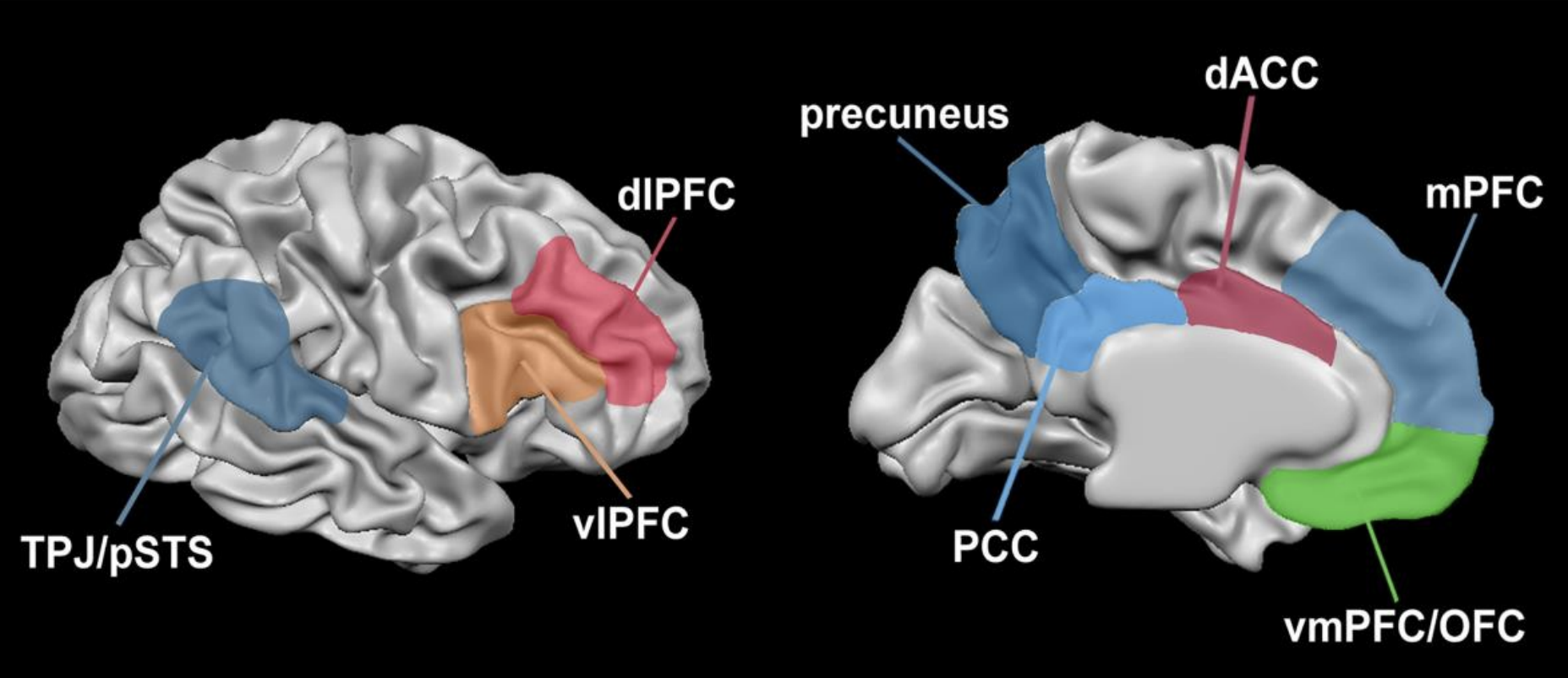
In Post 6: How Science Adds to the Conversation covers some of what neurobiology finds about brain changes when forgiving and the effect it can have on our mental and physical health. This is a growth area in research.
Copyright ©2026 Jan Swan
 English