On Forgiveness and Estrangement
Show Table of Contents
INTRODUCTION
A LONG HUMAN CONVERSATION
- Why Humans Evolved to Need Both Forgiveness and Exclusion
- Forgiveness: Between Moral Ideals and Human Reality
- Estrangement: From Unthinkable to Acceptable
- Estrangement: Ambiguity, Memory, and the Limits of Repair
- How Science Adds to the Conversation
CONNECTION, SAFETY, PEACE
- Why Forgiveness Is So Hard
- Brothers Apart: A Story of Sibling Estrangement
REPAIR OR LETTING GO WELL
- Moving Forward Without Simple Answers
- Living Beyond All-or-Nothing Choices
1. On Forgiveness and Estrangement:
An Introduction
After writing for these past several years on topics like bipolar disorder and narcissism — and about my family’s experiences with serious mental health conditions — I find myself returning to the twinned themes of forgiveness and estrangement. These are rarely static states, but rather deliberate, often necessary, directions we take when stressed relationships begin to break down. Toward peace or safety.
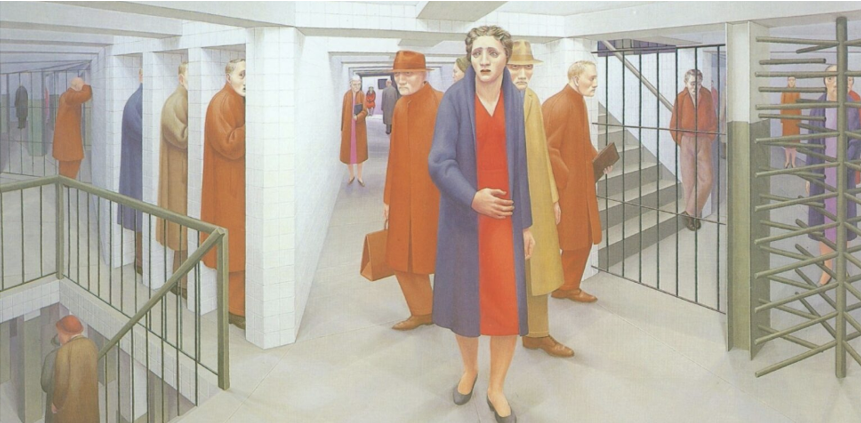
George Tooker, The Subway, 1950. Wendy Gray, “George Tooker: A Purveyor of Modern Alienation and Despair,” Daily Art Magazine
Wronging and Being Wronged
Everyone has the experience of wronging and being wronged — if we’re honest with ourselves. The people we’re closest to are often the ones we hurt the most, and the ones who hurt us most deeply. These are also the relationships we most want to preserve, unless by doing so continues the hurt — or even trauma.
Wanting to preserve a fraught relationship doesn’t mean we know how to do it. When conflict builds — whether through misunderstanding, repeated injury, or conflict that cuts more deeply — the path forward is not always clear. We may want repair over the longer term, but we also want immediate relief. We may want to keep the connection — but not at any cost.
While it may seem counterintuitive, efforts to repair a relationship are often harder than pulling away from it. Even when people want to reconnect, the work of acknowledging harm, taking responsibility, and feeling uncomfortable can be overwhelming. It’s not only difficult to forgive or to ask for forgiveness — it can also be difficult to accept. Sometimes it’s too little, too late. And sometimes a relationship that was once close can’t survive another attempt.
This doesn’t mean forgiveness wears the white hat and estrangement the black one, because taking either route might make sense in the moment. For as much as we seek a life of connection, we also seek protection and safety. There are times when those needs pull in different directions. When that happens, the choices we face can feel less like decisions and more like turning points — life-altering ones.
Our choices need to be respected, if not accepted, by those who would want a different outcome. I am that person, wanting a different outcome. Finding some measure of peace has required me to reckon with what remains unresolved — with relationships that may not mend, and with the limits of what one person can make happen.
There are many questions. Why do we hurt people close to us? Why is forgiveness so difficult — for some, out of reach? What would our lives be like if we chose one path over the other?
This series begins there.
F&E and Mental Health

Mental health issues can complicate close relationships and the conflicts that arise within them. When needs and emotions are intense and hard to sort through, the path forward may be murky, the choices existential — like preserving a sense of self or risking isolation and loss.
Take this made-up conversation between older sister Anna and younger brother Mark, after an unpleasant exchange:
Photo: Dreamstime
“I just need a little space,” says Anna.
Mark goes still. “From me.”
“No — from everything. Work’s been —”
“So now I’m everything that’s wrong.”
“That’s not what I said.”
“It’s what you mean.” His voice rises. “You always do this — pull back, go cold, act like I’m the problem.”
“I’m not going cold. I’m overwhelmed.”
“With me.”
Anna shakes her head. “With everything.”
Mark paces, running a hand through his hair. “You think I don’t see it? The way you look at me? Like you’re already halfway out the door.”
“I’m right here.”
“Yeah,” he says, not hearing her. “Until you’re not.”
Anna’s shoulders drop. “Maybe we should talk later.”
Mark laughs, sharp and brittle. “Of course. That’s what you do. ‘Later.’”
She doesn’t answer.
“Fine,” he says. “Go.”
Mark and Anna have had versions of this conversation before. Here, Mark’s misreading of Anna isn’t just a mistake — he hears what she’s saying as settled fact. The escalation comes from that certainty, and from his personalization: her state of mind becomes, in his mind, about him. The ending still leaves the same fork: repair or retreat.
In these situations, forgiveness and estrangement don’t play out in predictable ways. For some, the work of repair — acknowledging harm, taking responsibility, staying in difficult conversations — may feel out of reach. For others, stepping back or away may feel like the only way to regain stability.
In my narcissism series, I wrote about patterns in which the narcissist avoids accountability, no matter the impact on the other person. They’re often unwilling to apologize or engage in repair, even as the fear of abandonment remains close to the surface. When the narcissist’s partner begins to recognize the pattern, estrangement can become a way to seek protection from further harm.
Forgiveness vs estrangement also plays out differently in people with mental health conditions, personality disorders, or addiction. It’s a question of one’s capacity to deal with the accumulation of disagreement, misunderstanding, bullying, frustration, and trauma — often driven by desperation, fear of loss, and threats to self-worth.
More broadly, forgiveness and estrangement depend on a person’s ability to tolerate conflict, manage strong emotions, and stay in relationship when things become difficult. That ability is not evenly distributed. Research consistently finds that estrangement is more common among people dealing with mental health conditions, personality disorders, or addiction, where emotional intensity, instability, or impaired insight can make repair harder to sustain. Past experiences and the accumulation of hurt over time can further narrow what feels possible in a relationship.
MOTIVATIONS TO ATTACK OR AVOID
At the surface level, it’s not always clear what drives our responses to conflict — even more so if we misinterpret what has prompted the conflict. We might follow our first impulses to retaliate, withdraw, ignore, or sever ties for reasons we don’t fully understand and find ourselves faced with unwanted resistance and rejection. This can lead to a second wave of hesitation, second-guessing ourselves, and then feeling worse but stuck. None of this is simple.
Qualities we tend to associate with healthy relationships — empathy, perspective-taking, emotional steadiness, a willingness to grow — can be hard to draw on, especially under stress. And when those qualities break down, so does our ability to repair what’s been damaged.

Photo: Vecteezy
There are many ways to understand these opposing pulls within us. Psychology, philosophy, and religion have all tried to make sense of them in different ways. But at the most basic level, we live with competing drives — toward connection and toward self-protection — and we don’t always know which one will prevail.
The Art of Listening

Each of my post series so far started with a personal spark of recognition that there was a path forward to being a better person for my sons. I didn’t say mother, because I think I’m already fairly good at that: love, compassion, ongoing support where and when needed.
Yet something was missing from my commitment to them, especially since they’ve experienced a lifetime’s worth of suffering from mental illness before they were even out of their twenties. That missing piece was listening. I didn’t want to listen because I needed to deny their experiences. I unconsciously refused to validate their childhood wounds and traumas because that infringed on my version of events — which turned out a lot sunnier than theirs.
Now both my sons are in their thirties. I believe I’ve changed. Some of the change has come from what I’ve learned through researching and writing this blog. But most of it, I believe, is from my sons gently — and not-so-gently — confronting me.
There’s a very human tendency to interrupt others because what they say triggers thoughts that feel relevant, but are mostly about ourselves. Listening doesn’t come easily for many of us – and when I think about it now, I’m sorry I didn’t do better.
Now I say to people who don’t listen, in a moment where I can get away with it: “Do you want to know whether you really listen to other people? Think back over the last ten minutes of conversation and ask yourself two things: were you the only voice you heard, and what did the other person actually say?” If you can’t recall, you’re not listening. You’re just talking.
I started by asking close friends whether they think I listen. What I heard back was this: you do talk plenty, but you do listen. If I ask my older son Jaden, who I wrote about in the bipolar series, whether I listen, he would most likely say sometimes — but not when things grow heated between us. But Etan, my younger son, would probably say: you’ve worked on this, and it shows. I believe him. I’ve made an effort. As a result, I have no more interest in being with people who are incapable of listening — no matter how wonderful they are.
I will return to the art of listening in a later post. For now, I’d like to close this post with a short piece I wrote several years ago, after encountering a friend of a friend at an afternoon party.
Swimming in Thailand

I was introduced to this tall, elegant woman with a lovely smile. Someone I’d like to know, I thought. Later, I saw her sitting alone on the deck, apart from other guests talking, drinking, milling around platters of good food.
Not quite sure she’d welcome my company, I took a chance and spoke a greeting, not anticipating these would be the only words I’d speak. She started out slowly, her words building and gaining force. Before long, I was mired in mini-sagas, one after another, filled with detail vivid to the speaker and inconsequential to the listener.
Any words from me simply uncorked more bottled-up stories.
Amid a volley of monologues without pause, my mind lifted off, floating close enough to hear sounds without giving away my elevation. I’d let out some air to test for a conclusion — only to be sent aloft by new gusts of verbiage.
A brief mention of a Thai college student prompted ten or fifteen minutes on travel and work in Thailand — on homes, weather, women and rare displays of emotion, except for the national Tai Chi performer in drag. He was emotional.
This could’ve been fascinating, if not so relentlessly one-sided. I was waiting for the punchline that would make me laugh, like Swimming in Cambodia. But it never came.
I tried to change direction, bringing up a personal topic, only to have it swept aside and replaced with another story. Not twenty minutes in, I was already looking for a graceful exit and, at first distraction, escaped. Later, her husband thanked me for talking to his wife. That was odd.
Did he thank me because his wife was often abandoned at social gatherings? Or because he admired my fortitude?
The next day, over coffee, I tried to make sense of it. Why talk at someone without concern for the person before you? She needed me there, but not for anything I had to say. I had stopped encouraging her. I didn’t react. I didn’t comment. I didn’t realize it then, but her husband was watching from a distance, satisfied this time she wasn’t alone. This time she found someone new, I imagine him thinking.
With some people, it seems, there’s an illusion of exchange. One part listening to ten parts talking, each small response each small response serving up another bout of self-as-hero monologue. Those who know better steer clear. Newcomers, like me, get caught.
Or did I miss something? An opportunity to listen differently, to connect to someone unlike myself, or simply to understand what she needed from that moment.
This happened five years ago, and I still remember the feeling of being both relevant and irrelevant at the same time. I needed to be there for her to talk, but I hardly needed to say a word. It stopped mattering to me to figure her out. What stayed with me was something else.
My relationships with both sons were often strained during their twenties. I worried they would grow estranged or — hardly better — become dutiful but not close, caring but not sharing. I worked hard to prevent that.
But life intervened, as it often does. My sons have been estranged from one another for close to seven years. This series is my attempt to make sense of that reality — from as many perspectives as I can hold.
Coming Up Next

This series will move in a kind of circle — starting with the difficulty of forgiveness, turning toward estrangement as a response that can offer relief or safety, and then returning to forgiveness, not as an obligation, but as one possible way forward.
The scope of this topic is wide, but my focus will be narrow: how forgiveness and estrangement play out in close relationships, and how they affect mental health.
I’ll draw on research where it’s helpful — including work on evolution, attachment, and the mind-body connection — but always with the aim of making sense of lived experience.
At times, I will use terms like offender and victim for clarity, even when those roles are not fixed or easily defined. I’ll try to use them carefully, and only when they help us see something more clearly.
Post 2: Why Humans Evolved to Need Both Forgiveness and Exclusion explores the relationship between forgiveness, revenge, and evolution.
Copyright ©2026 Jan Swan
 English