On Neurodivergence and Otherness
Show Table of Contents
INTRO
1. On Neurodivergence and Otherness: An Introduction
SENSES AND SENSORY SENSITIVITIES
2. Senses Count
3. Neurobiology for Dummies
4. Sensory Transmission and our Reward System
5. Sensory Receptors are the Body’s Cellular Plan
6. A Synthesis: Sensory Systems and our Emotions—Part I
7. A Synthesis: Sensory Systems and our Emotions—Part II
8. Sensory Disorders and Sensitivities
9. Etan’s Story
10. Synesthesia: Difference, But Not Disorder
11. Synesthesia, Creativity, Artistry—Part I
12. Synesthesia, Creativity, Artistry—Part II
AUTISM AND THE NEURODIVERSITY MOVEMENT
13. From “Mental Defectives” to Autism Spectrum Disorder
14. Changing Conception of Autism
15. Autism Diagnoses and Behavior Patterns
16. Autism Treatments that Help
17. Early Start Autism Treatment: A Case Study
18. Neurodivergence and the Neurodiversity Movement
19. Neurodiversity Takes Flight
ADHD
20. ADHD and Neurodevelopmental Disorders
21. ADHD: A Preponderance of Risk Factors and Symptoms
22. ADHD: Inattentive, Impulsive…and Hyperactive?
23. ADHD: Named, Renamed, Still Needs a New Name
24. ADHD: Treatment and Coping Skills for All Ages
LGBTQ+
25. Neurodiversity and the LGBTQ+ Fight
26. LGBTQ+ Identity and Expression
27. LGBTQ+ and Mental and Behavioral Healthcare
ON LANGUAGE
28. Language Matters In and Around Neurodiversity
29. Neurodivergent Language Difficulties
30. Disability-Inclusive Language Guidelines
ON CREATIVITY AND GIFTEDNESS
31. Neurodiversity and Creativity
32. Giftedness is a Piece of Neurodivergence
SELF-IDENTITY
33. Self-Identity: The Cornerstone of Neurodiversity
34. Early Theories of Self-Identity Formation
35. Contemporary Theories of Self-Identity Formation
36. Authenticity and the Search for Self
37. Self-Schemas and Neurodivergence
38. Self-Labeling and Parts Work
39. Cognitive Complexity and Empathy
IMPROVING LIFE FOR NEURODIVERGENT PEOPLE
40. Reducing Neurotypical-on-Neuroatypical Conflict, Part I
41. Reducing Neurotypical-on-Neuroatypical Conflict, Part II
42. Communicating Across the Neurospectrum, Part I
43. Communicating Across the Neurospectrum, Part II
44. Neurodiversity: Advocacy, Education, and Lifestyle
45. Neurodiversity and Work
IN CONCLUSION
46. In Conclusion: Neurodivergence and Inspiration
2. The Senses Count

Jan Brueghel the Elder, The Senses of Hearing, Touch, and Tasting, 1618 (lost in fire), copy c. 1620, Prado Museum, Madrid
Through our senses we understand the world and its effect on us and how we connect to changes in our bodies. Unless we stub a toe or are startled by the doorbell, we might not be aware of the thousands of sensory experiences we have minute to minute, hour to hour.
Did I say thousands? According to the Sound Learning Centre, London, in total “we receive through our five senses more than 11 million bits of information each second of the day, while our conscious mind can only deal with one subject at a time at a rate of less than 100 bits per second.” That’s why we need our brains to filter the sensory clutter, because our conscious minds would otherwise…go mad.
Sensory information reaches our brains and triggers responses with or without our awareness — and nearly instantaneously. These lightning-quick reaction times kept our
forebears alive when they spied a hungry predator. Biologically, senses motivated them — and us — to reproduce.
Bernard Baars and Nicole Gage provide more extraordinary data in their 2010 book, Cognition, Brain, and Consciousness, excerpted in ScienceDirect: A sensory stimulus reaches the brain unconsciously in 100 milliseconds or 1/10 second. We’re conscious of a small percentage of the stimuli in 200 milliseconds or 1/5 of a second. Baars and Gage explain time-and-spatial scales for cognitive integration of gazillions of stimuli. First, a definition of Hz:
1 hertz (Hz) = 1 cycle/second. 1 cycle = 1 complete wave of alternating current or voltage
Brain events at different time and spatial scales go on at the same time, like a symphony’s notes, phrases, and musical movements. When you listen to a song, you are conscious of only a few notes at any time, but the notes you hear fit into a larger cognitive structure so you can appreciate how the entire song develops.
Movie frames are shown at 24 images/second, or about 40 milliseconds/frame, to show smooth movement. Slower rates than 24 Hz start to look jerky, like early silent movies. However, a movie plot takes many minutes and hours. If you can’t remember the crime beginning a mystery film, finding the perpetrator at the end won’t make sense. Understanding movie plots requires cognitive integration — their time scales and structures must be combined to make sense. The brain keeps track of all simultaneously.
At the long end of the time scale, it can take years to learn a difficult skill, like skiing or playing guitar. Infants learn their first language over several years, while adults tend to keep their basic personality structure over decades. Such long-term processes depend
upon the same brain as 100-millisecond events.
Source: Neurodivergent Insights
In the time domain, therefore, we need to understand about 10 orders of magnitude, from 1/1,000 th of a second (a millisecond) for a single neuron to fire, to more than 100,000 seconds/day and tens of millions of seconds/year. —Bernard Baars and Nicole Gage, Cognition, Brain, and Consciousness, 2010, excerpted in ScienceDirect
Did your brain explode? Not only do we think and feel all day long, but we make cognitive sense of the millions of seconds of stimulus-and-response activity going on, under, and over consciousness for our lifetimes. Everyone knows the five senses we’re taught as children. But did you know about the vestibular sense or proprioception or interoception? What about mechanoceptors? Senses allow us to stand, sway, move, perceive, connect to, and interact with the environment, other people, and the larger world.
Just How Many Senses Do We Have?
While schools still teach us there are five senses — an idea that came courtesy of Aristotle and permeates popular culture — the count is at odds with science. Try grabbing an ice cube with one hand and a red-hot poker with the other and tell me what you feel can be encompassed by the favorite five. Go on a white-knuckle ride at any theme park and convince me everything you experienced was down to sight, sound, and touch. You probably had your eyes closed anyway. There is clearly more to sensation than these five categories. So how many senses do we have? —Bruce Durie, New Scientist
Our bodies contain millions of sensory receptors divided into X number of senses. The antiquated idea of five senses can be further broken down. The skin alone has at least four different types of sensory receptors for touch, temperature, pain, and proprioception (body
awareness). Each eye’s retina contains 125 million rods and six million cones, which is 70% of all the sensory receptors in the body. The inner ear’s cochlea contains 4,000 specialized sound receptors—or hair cells—that convert vibrations into electrical impulses sent to the brain. [Data from Homework.Study]
Every source I consulted had a different senses count and taxonomy. In New Scientist, Durie’s senses count compares 10 senses (“conservative”) to 21 (“accepted”) to 33 (“radical”). The visual system could count as 1 sense (the eye), 2 (light and color), or 4 (light, red, green, and blue).
I queried Quora and found biology professor emeritus Ken Saladin, who sees Aristotle as the father of senses:
The idea that humans have just 5 senses dates back to Aristotle’s De Anima, written about 350 BCE. The 5 senses Aristotle called our “outward wits” are vision, hearing, taste, smell, and touch. It’s a philosophy as antiquated and nearly useless today as is the notion there are just 4 elements — earth, air, water, and fire. Aristotle thought, reasonably for his time, every sense must have a sense organ — thus the 5. One problem for Aristotle’s time was there were no microscopes, and our sense receptors are mostly microscopic. Another was little knowledge of spinal cord and brain anatomy and function and no experimental physiology to back up or test purely speculative reasoning.
Yet the 5 senses myth lingers. As an 8-year-old, I didn’t think to question this, but I’m dismayed to see even some low-level biology textbooks repeat the myth, as if science doesn’t know anything more today than it did 2,140 years ago. —Ken Saladin, Biology Professor Emeritus, Quora

Saladin explains why it’s difficult to give an exact number [bulleted and paraphrased]:
- Temperature sense: Heat and cold are not just variations. Molecular-cellular mechanisms of sensing above/below normal skin temperature are different. Hot and cold have different nerve endings and neural pathways to the brain.
- Tactile sense: Light and deep touch use different receptor types in the skin, use different pathways in the spinal cord, and arrive at different interpretive centers in the brain. Some touch receptors respond to texture, others to pressure, and still others to vibration.
- Pain, taste, visual senses: Stomach pain uses different receptors and pathways than muscle or surface skin pain. Ditto for taste buds and visual light and color senses, all relying on discrete receptors, pathways, and brain centers.
Saladin’s 22 senses:
Taste (gustation)
Smell (olfaction)
Vision
Hearing
Dynamic
Equilibrium (body motion)
Static equilibrium (body position or orientation)
Light touch
Heavy touch
Texture
Pressure
Stretch
Fast pain
Slow pain
Somatic pain
Visceral pain
Blood chemistry
Common chemical sense
Cold
Heat
Vibration
Proprioception
Hair movements
Bruce Durie’s “radical” 33 senses:
GUSTATORY (5 TASTES):
Sweet
Sour
Bitter
Salty
Umami
OLFACTORY (1 SMELL):
Smell (200+ receptor types)
OCULAR (4 VISUAL):
Light
Red
Green
Blue
AUDITORY (1 HEARING):
Hearing
TACTILE (2 TOUCH):
Light touch
Pressure
NOCICEPTORY (3 PAIN):
Cutaneous
Somatic
Visceral
MECHANORECEPTORY (5):
Balance (2): rotational and linear acceleration
Proprioception/joint position
Kinaesthesis muscle stretch (2): Golgi tendon organs and muscle spindles
TEMPERATURE (2):
Heat
Cold
INTEROCEPTORY (10):
Blood pressure (2): arterial and central venous
Head blood temperature
Blood oxygen content
Cerebrospinal fluid pH
Plasma osmotic pressure (thirst?)
Artery-vein blood glucose difference (hunger?)
Lung inflation
Bladder stretch
Full stomach
Special vs General Senses
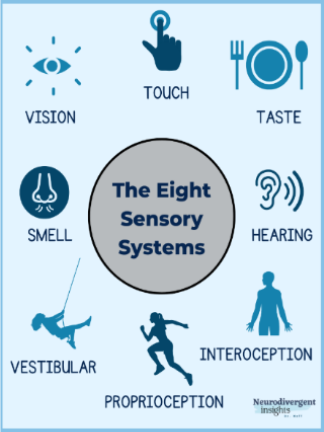
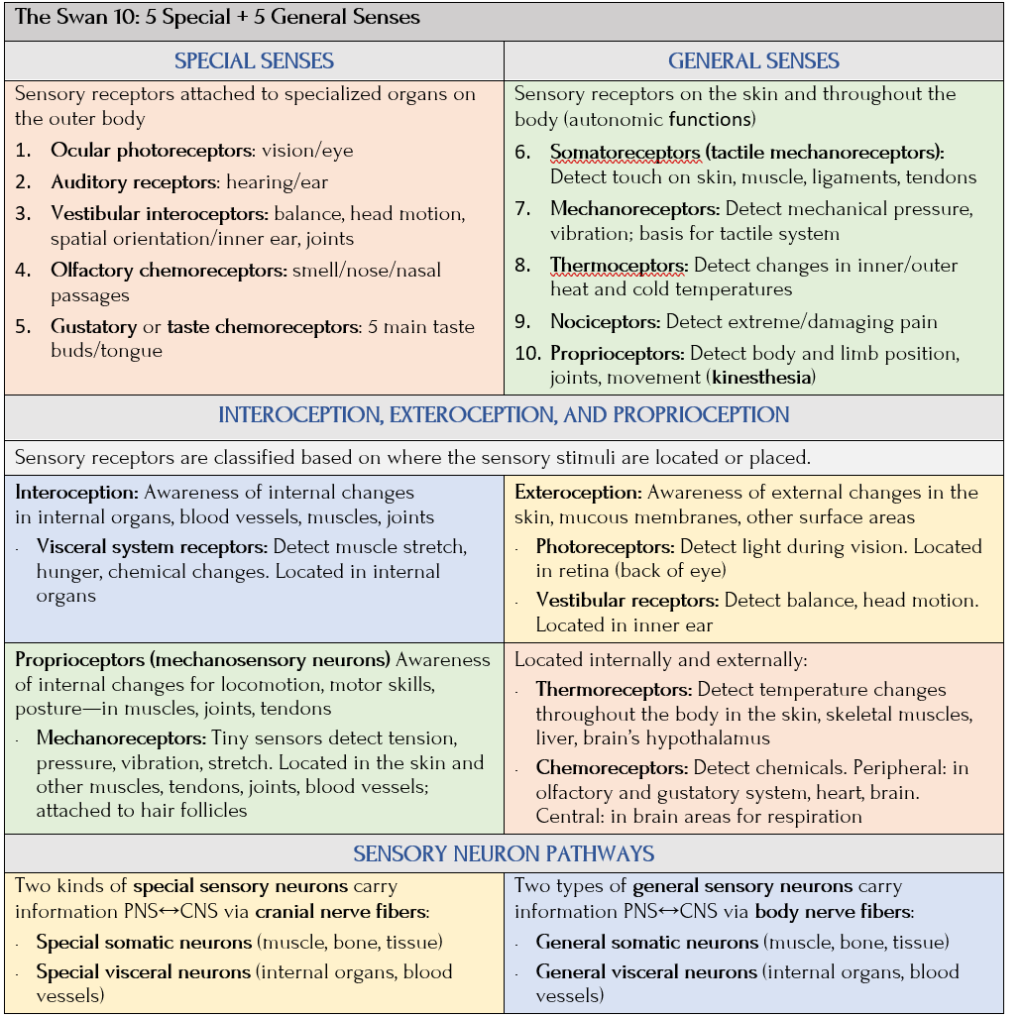
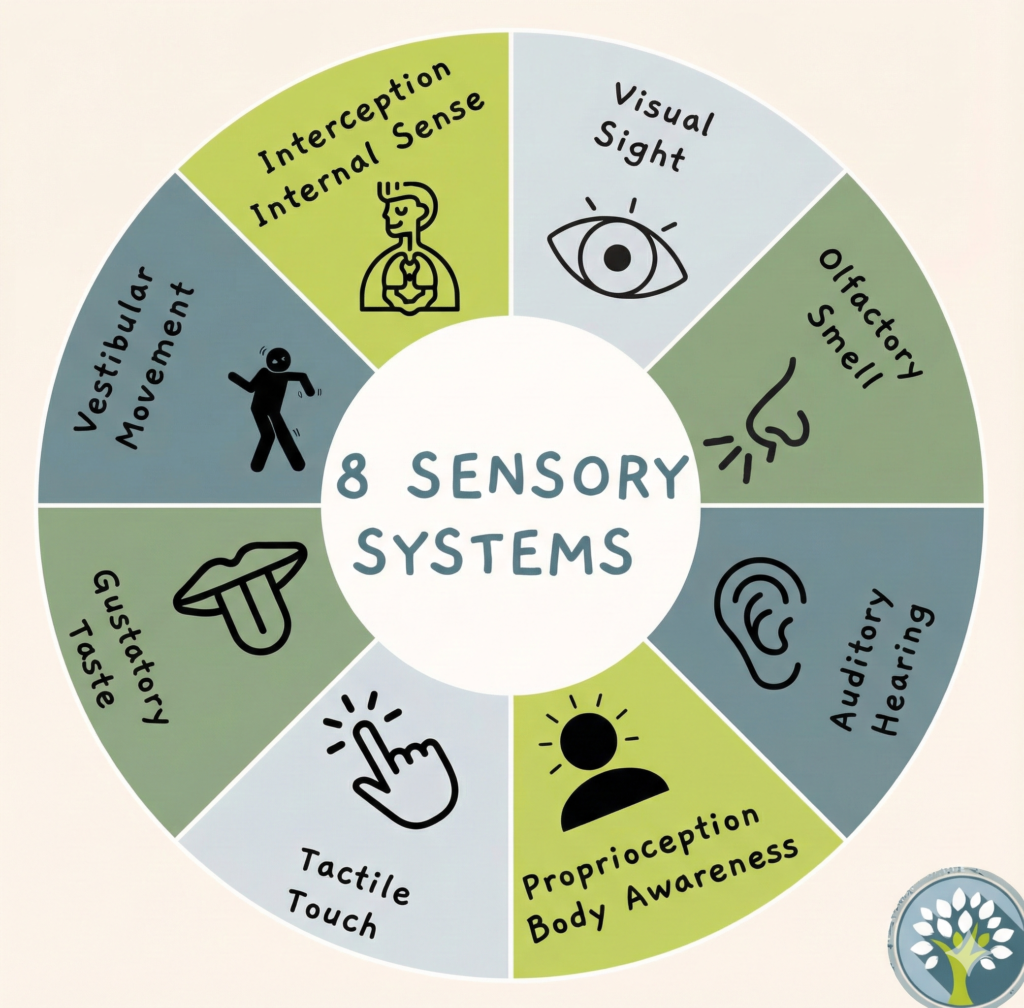
Most current sources are comfortable with eight: the original five external (special) senses of vision, hearing, touch, taste, and smell — and the three internal (general) vestibular (balance/ equilibrium), interoceptive (pain, pressure, vibration, temperature), and proprioceptive (body awareness, movement) senses. One could live with this, but science is on the move. So I’ve devised the “Swan 10” — a riff on the Durie 10—capturing all body sensations, with differentiated sensory receptors that show up and overlap across the body.
At least science agrees to differentiating the millions of sensory receptors scattered throughout our bodies as special or general senses, divided by their different transit routes. Specialized nerve fibers run to-and-fro the peripheral (PNS) and central (CNS) nervous systems. Brain areas then sort, mix with thoughts/memories/feelings, interpret, prioritize, and respond.


Our Working Sensory System
The Swan 10 is a neurotypical prototype — all senses are intact, neurochemical systems are firing, and brains are receiving, interpreting, and responding to internal/external stimuli. When it’s working, we don’t think about it until we need glasses or stub a toe. Or until our child doesn’t quite process sensory stimuli as expected, because we expect our senses to behave. We can:
- Predict what certain fabrics will feel like to our touch. We expect to feel the soft ridges of corduroy before we do — and not be disappointed.
- Be delighted when, on a reality cooking show, the hamburger and the toaster turn out to be cakes, because they defied our expectations by fooling the eye.
- Wonder why gravity doesn’t knock us flat to the ground or pull us backwards, like in the godawful Gravitron that spins us around fast enough to confuse our proprioception.
- Wonder why breezes blowing through our hair provide unusual sensory stimulation (sensory receptors are wrapped around every hair follicle)—but not understand why some love the sensation, and others can’t tolerate it.
- Be protected from pain because, as our fingertips touch the hot stove, sensory receptors communicate SOS to our pain center and back again in lightning speed—and we pull away before getting burned. Or slap the mosquito before it bites us. Or sit down when dizzy.
Source: Family Achievement Center
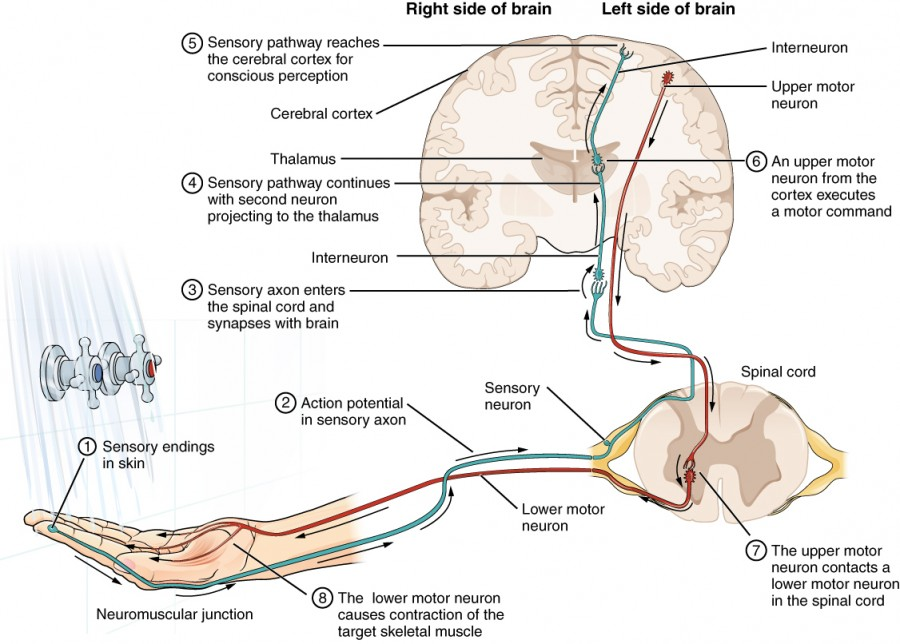
Activation and Response in the Sensory Nervous System, Wikipedia
Sensation allows us to quickly detect information about our physical surroundings.
Without it, we would be incapable of successfully navigating the world; gone would be our ability to discern a friendly greeting from a fire alarm, a paved street from a pothole,or salubrious fruit from rotten milk. —Micaela Rodriguez and Ethan Kross, Sensory
Had I understood the sensory system when my 4-year-old son Etan was diagnosed with a sensory integration disorder [see post 9], I would’ve known the senses were a ND gateway indicator. And when both my sons were later diagnosed with ADHD (then, ADD), I would’ve better prepared them for young adulthood.
While so many brain-mind-body processes are effortlessly automatic, for neuroatypicals with sensory impairments they’re not automatic or easy or easily learned. That’s why understanding “normal” must precede understanding difference.
Coming Up Next
In Post 3: Neurobiology for Dummies, I’ll describe “normal” by reaching into neurobiology — just enough to make the sensory process clear. Websites either bring us overly basic information (the senses are seeing, hearing…) or plunge us into incomprehensible science — unless an ENT doctor is whispering into your auditory receptor.
And yet I persevered (love that phrase!). I hope this information explains why it’s more challenging to live life differently wired from the rest of us, who default to the norm and meet society’s expectations.
Copyright ©2026 Jan Swan
 English