
Striatum
« Back to Glossary IndexThe striatum is a group of interconnected nuclei (including the caudate nucleus and nucleus accumbens) located deep within the brain that help link motivation, emotion, learning, and reward-related signals to behavior and action. Traditionally associated with movement and the execution of motor tasks, the striatum is also involved in more complex cognitive and social functions including reward processing, reinforcement learning, decision-making, habit formation, and social behavior. Different regions serve somewhat different functions: the ventral striatum (which includes the nucleus accumbens) is more strongly associated with motivation and reward, while dorsal regions contribute more heavily to action selection and habitual behavior. Research increasingly suggests that striatal systems may reinforce not only pleasurable experiences but also behaviors linked to social outcomes such as fairness, cooperation, and even retaliatory responses. Also see Reward System and Reward Learning.
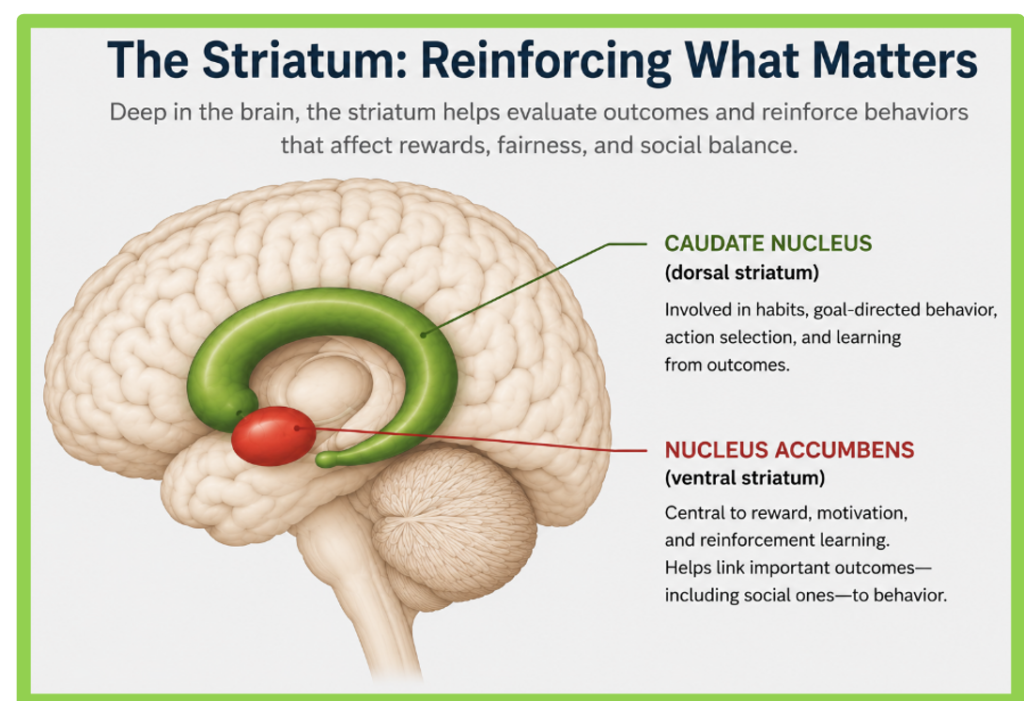
The striatum evaluates the significance of events and outcomes, reinforces behaviors that lead to valued outcomes or restore balance, and may drive actions such as standing up for self, protecting others, or responding to unfairness. Studies show retaliatory actions can activate these same systems, reflecting the brain’s sense that such action restores fairness, protects self, or corrects a social imbalance.
 English