6 – A Synthesis: Sensory Systems and our Emotions—Part I
On Neurodivergence and Otherness
Show Table of Contents
INTRO
1. On Neurodivergence and Otherness: An Introduction
SENSES AND SENSORY SENSITIVITIES
2. Senses Count
3. Neurobiology for Dummies
4. Sensory Transmission and our Reward System
5. Sensory Receptors are the Body’s Cellular Plan
6. A Synthesis: Sensory Systems and our Emotions—Part I
7. A Synthesis: Sensory Systems and our Emotions—Part II
8. Sensory Disorders and Sensitivities
9. Etan’s Story
10. Synesthesia: Difference, But Not Disorder
11. Synesthesia, Creativity, Artistry—Part I
12. Synesthesia, Creativity, Artistry—Part II
AUTISM AND THE NEURODIVERSITY MOVEMENT
13. From “Mental Defectives” to Autism Spectrum Disorder
14. Changing Conception of Autism
15. Autism Diagnoses and Behavior Patterns
16. Autism Treatments that Help
17. Early Start Autism Treatment: A Case Study
18. Neurodivergence and the Neurodiversity Movement
19. Neurodiversity Takes Flight
ADHD
20. ADHD and Neurodevelopmental Disorders
21. ADHD: A Preponderance of Risk Factors and Symptoms
22. ADHD: Inattentive, Impulsive…and Hyperactive?
23. ADHD: Named, Renamed, Still Needs a New Name
24. ADHD: Treatment and Coping Skills for All Ages
LGBTQ+
25. Neurodiversity and the LGBTQ+ Fight
26. LGBTQ+ Identity and Expression
27. LGBTQ+ and Mental and Behavioral Healthcare
ON LANGUAGE
28. Language Matters In and Around Neurodiversity
29. Neurodivergent Language Difficulties
30. Disability-Inclusive Language Guidelines
ON CREATIVITY AND GIFTEDNESS
31. Neurodiversity and Creativity
32. Giftedness is a Piece of Neurodivergence
SELF-IDENTITY
33. Self-Identity: The Cornerstone of Neurodiversity
34. Early Theories of Self-Identity Formation
35. Contemporary Theories of Self-Identity Formation
36. Authenticity and the Search for Self
37. Self-Schemas and Neurodivergence
38. Self-Labeling and Parts Work
39. Cognitive Complexity and Empathy
IMPROVING LIFE FOR NEURODIVERGENT PEOPLE
40. Reducing Neurotypical-on-Neuroatypical Conflict, Part I
41. Reducing Neurotypical-on-Neuroatypical Conflict, Part II
42. Communicating Across the Neurospectrum, Part I
43. Communicating Across the Neurospectrum, Part II
44. Neurodiversity: Advocacy, Education, and Lifestyle
45. Neurodiversity and Work
IN CONCLUSION
46. In Conclusion: Neurodivergence and Inspiration
6. A Synthesis: Sensory Systems and our Emotions—Part I

In my blog series on anxiety, I wrote about building-block emotions and their distinctive features. Primary emotions — fear, joy, disgust — are autonomic. They happen before awareness kicks in. Secondary emotions — anxiety, humiliation, shame — layer on top of primary emotions, but now with full awareness. Our emotions mix with cognition. Our mood states mix with reflection, memory, anticipation…
Feelings are steeped in all aspects of who we are — what science calls our environmental cues: our childhood, family, culture. Our past experiences and how we’re doing today. Then there’s what we were born with — our genetic makeup. Our
physical and mental health. We gain a picture of our emotional health from how our responses AND our anticipation of future responses move from “normal” to unhealthy. And for some of us, to anxiety or mood disorders.
Evolutionarily essential emotions that protect/propagate our species describes neurodivergence and its many applications to our lives today — the difference between fear (primitive, automatic, short-lived) and anxiety (secondary, anticipatory, longer-lived) and sensory/emotional systems that function typically and atypically.
Psychologist Bruce Wilson (see post 1) writes in Psychology Today: “The science of neurodiversity has advanced a more complex and positive view toward mental health disorders. Neurodiversity doesn’t ignore or negate the real challenges associated with brain disorders, but instead offers a deeper, more diverse view of human experiences diagnosed as disorders.”
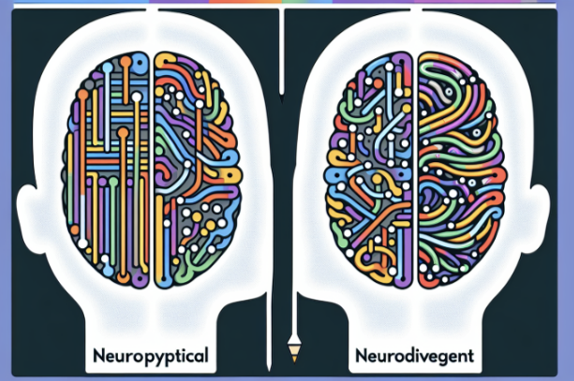
Sensory Systems are Part of the Neurodivergent Story
We need to understand how “normal” sensory/emotional systems work before we can see how they work atypically in neurodivergent people. With a handle on the biology/physiology/neurology that contributes to who we are, maybe we can learn why some of us are born ND, what aspects of living are affected and in what way, at what intensity, and what to do about it.
Sensory experience elevates the diversity of the human experience.
I found this statement in my notes but didn’t cite it. I like its message. What does it mean? Sensory experience is so profoundly different person to person that it’s hard to detect patterns of behavior, either healthy patterns or so-called “deficient” ones.
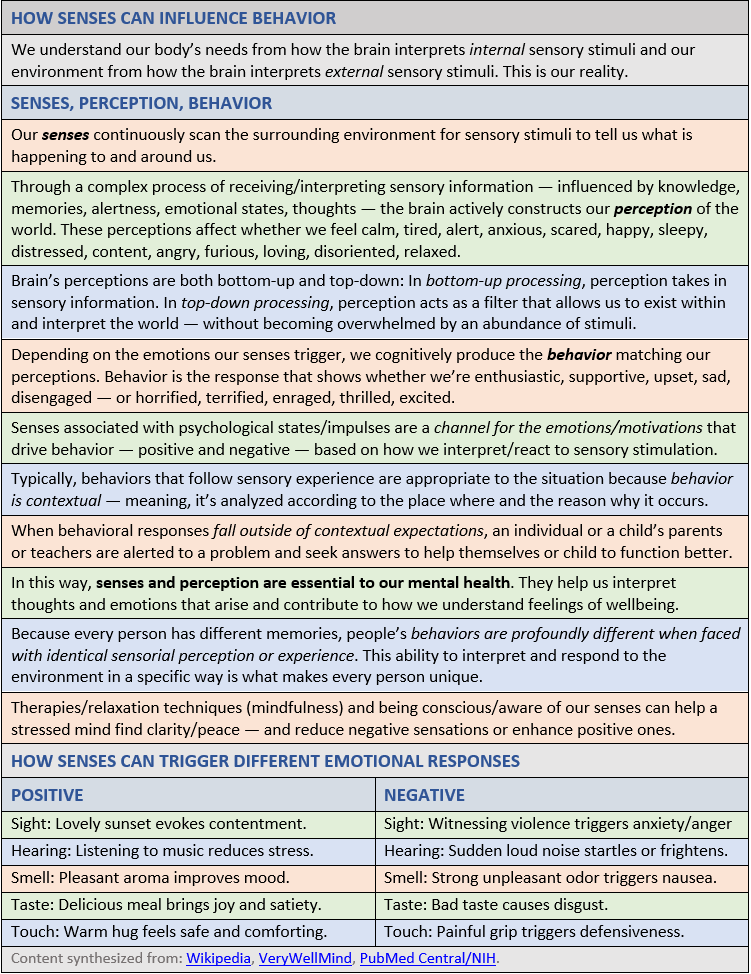
Hugging someone to comfort them may make them feel grateful and connected to you in that moment. Or it may be too much for them, and they might recoil, cry out, or move to escape. We need to know so we act appropriately — without pulling back ourselves. Autistic or sensory-overloaded people might not be able to tolerate being touched or manage their responses.
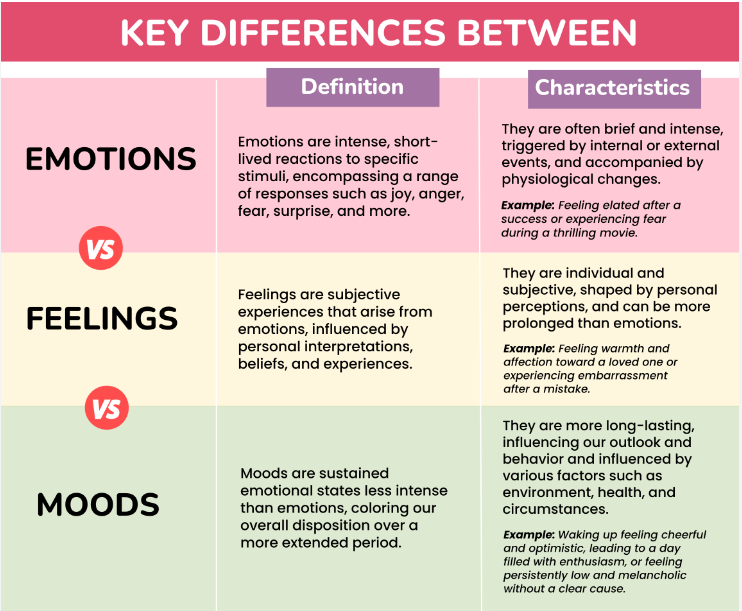
Emotions vs Feelings vs Moods
Source: Mental Health Kids
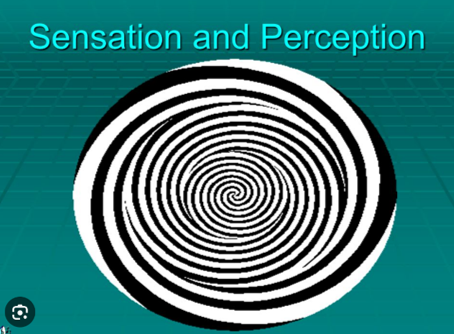
Emotion and feeling aren’t strictly synonymous terms, and mood showcases long-term feeling states, as Frank Ninivaggi describes [see next section]. Each term conveys subtle distinctions depending on how long it lasts and the role of cognition.
Features in the charts build accumulatively. The foundation is emotion: primary, pre-cognitive, automatic, short-lived. The middle is feeling: secondary, subjective, cognitive, individualized. The top is mood: sustained, attitude, behavior, longer duration.
These distinctions are key to considering all inputs to our emotional states: genetic predispositions, physiological bio-chemistry, and what influences us every day. Change is daunting — and we should be proud when we make progress.
Quitting cigarettes is harder for you than for your friend because of your temperament, genetic makeup, and how/where you were raised. Similarly, it’s harder for you than your friend to find a nurturing place in society when you have ADHD or a sensory disorder, you’re queer neurodivergent, or on the autistic spectrum.
The way we process sensation and emotion — and what the brain does in both—shows the mind-brain-body connection.
Next, I draw from three articles on sensation/emotion that don’t reach consensus but overlap on some of their conclusions.

Source: Wikipedia Commons
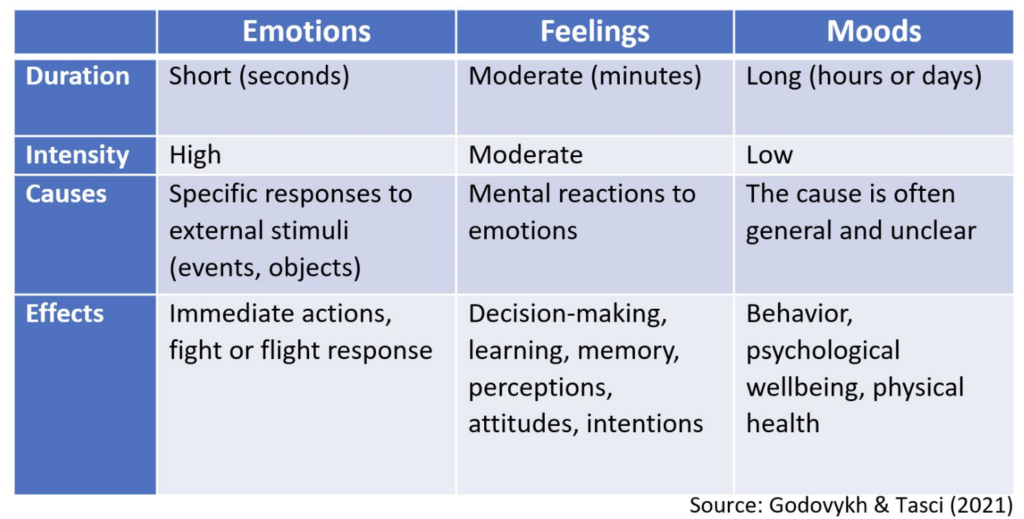
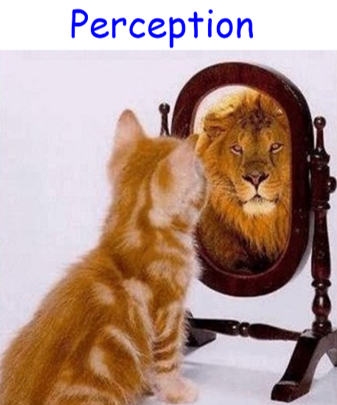
Our brain perceives sensations but doesn’t always react. OpenStax’s “Anatomy and Physiology Lesson” on Sensory Perception explains the significant distinctions between sensation, perception—and awareness:
Sensation is when sensory stimuli activate sensory receptors.
Perception is when sensory receptors process sensory stimuli into a meaningful pattern, involving awareness.
Our brains can’t process — that is, perceive — anything that wasn’t sent there through what we saw, bumped into, heard, ate, or felt (summer breeze) — or what caused pain (in the dentist chair) or discomfort (freezing in the dentist chair). But, as described above, tons of sensations don’t penetrate the chatter. If I’m super focused listening to music, I probably won’t perceive the distant train sounding its whistle as it travels by. But if I’m listening to the music somewhat distractedly and sounds of the distant train remind me of my childhood hearing passing trains, I will probably perceive, process, and remember the sensation.
Making Sense of Emotional Intelligence
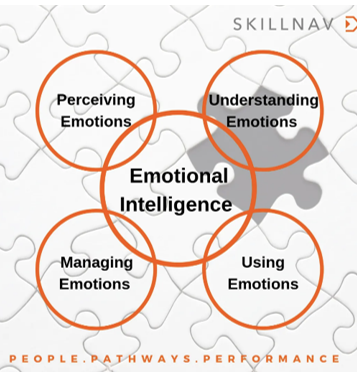
In his book, Making Sense of Emotion, Frank Ninivaggi —Yale-New Haven Hospital physician, Yale medical school assistant professor, and psychiatrist, Devereux-Glenholme School, Connecticut — breaks down emotional processing into “learnable steps” to help people heighten their emotional intelligence (EI). The following is from Ninivaggi’s article in Psychology Today.
Source: SlidePlayer
Source: Warami Eresanara, “5 ways to show emotional intelligence in the workplace,” Medium.com
Ninivaggi sees EI as “emotional literacy” or “emotional knowing” — a four-step “learnable process” from when an emotion is stimulated or triggered to when it is expressed. As we better understand our emotions, he writes, we are on our way to raising our EI.
Other psychology models divided EI into three branches: perception, understanding, and emotional regulation. Ninivaggi counter proposes what he thinks makes more sense clinically. For people to learn/improve EI, they must take four discernible, fluid steps of emotion sensation, emotion perception, emotion conception (made up of “nonconscious modulation” and “conscious regulation”), and emotion performance utilization and real-life consequences. I will only discuss the first two steps.
I perked up at “emotion sensation,” a pre-cognitive step that is key to defining neurodiversity. (I also found the term “sensation emotion” — revealing confusion in the neuropsychology field?)
Nonconscious Emotion Becomes Conscious Feeling
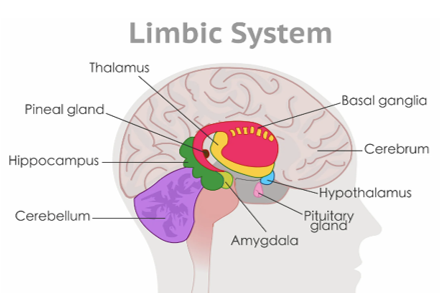
Remembering that emotion is foundational, Ninivaggi writes, “Emotion indicates a nonconscious, physiological sensation.” The senses automatically generate pre-conscious emotions and trigger the brain’s amygdala and limbic system. Cognition happens once these pre-conscious emotions travel from the limbic system to the brain’s higher cortex — becoming what Ninivaggi calls cognitive enhancements. Once the brain’s cognition is triggered, cognitive enhancements occur in memory, attention, and learning. Post-cognitive feelings are layered onto emotions. We perceive these feelings consciously.
Emotion processing begins with emotion sensation and emotion perception — with each step, the mind collects and sorts more data. This fluid, learning process leads to EI — changing, growing, fulfilling our destinies to be mentally, emotionally healthy, and happy beings.
Emotion Sensation
According to Ninivaggi, emotions grow in complexity as we notice/distinguish sensations.
Source: SlidePlayer
The implicit, visceral launchpad of all emotion begins here. Sensation is an unorganized awareness coded by the senses and sensed in the body. No specificity exists other than the raw experience of the stimuli-sense organ connection. A physical stimulus in the environment emits energy detected and absorbed by the sensory organ. This energy becomes neural messaging or “transduction.” It travels from the body’s periphery to the central nervous system…. Sensation in the periphery produces sensations felt both subliminally (nonconsciously) and consciously. Their only meaning is to withdraw or to attract. —Frank Ninivaggi, “Making Sense of Emotion,” Psychology Today

Emotion Perception
Through transduction, stimulated sensory receptors send nerve impulses “bottom-up” to the central nervous system (CNS). The brain differentiates, interprets, and transmits “top-down” nerve firings to be experienced — or perceived — as visual image, sound, taste, odor, touch, balance, or pain.
A lot of brain activity goes on in emotion perception, involving the thalamus (an egg-shaped, mid-brain gray matter that relays sensory and motor information), the amygdala (an almond-shaped organ deep in the limbic system that safeguards basic survival/sex and basic emotional reactions, like anger, fear, and pleasure), and cerebral cortex (gray matter mostly made up of neurons sending new information via electrical signals throughout the brain).
Perception is explicit, conscious awareness. The two processes of sensation and perception co-occur with no absolute distinction. —Frank Ninivaggi
Beyond emotion sensation and emotion perception is emotion conception, modulation, regulation, and performance utilization (it’s fascinating and worth reading Ninivaggi’s book). For our purposes, I’ve explored two overlapping processes:
Senses and emotions relate in the realm of the nonconscious. When we become aware of the sensations and emotions swirling around us, we are having feelings that will last longer, be more memorable, and affect us more. —Frank Ninivaggi
Source: Simple Psychology
Coming Up Next
In Post 7: A Synthesis: Sensory Systems and our Emotions—Part II, I’ll continue exploring emotion sensation (also called sensory emotional processing). Though scientists approach the topic differently, they agree senses and emotions are separate but intertwined. More research is needed to understand how we, the people, function —sensorily, emotionally, viscerally, cognitively, and behaviorally — for good or ill.
Copyright ©2026 Jan Swan
 English