On Neurodivergence and Otherness
Show Table of Contents
INTRO
1. On Neurodivergence and Otherness: An Introduction
SENSES AND SENSORY SENSITIVITIES
2. Senses Count
3. Neurobiology for Dummies
4. Sensory Transmission and our Reward System
5. Sensory Receptors are the Body’s Cellular Plan
6. A Synthesis: Sensory Systems and our Emotions—Part I
7. A Synthesis: Sensory Systems and our Emotions—Part II
8. Sensory Disorders and Sensitivities
9. Etan’s Story
10. Synesthesia: Difference, But Not Disorder
11. Synesthesia, Creativity, Artistry—Part I
12. Synesthesia, Creativity, Artistry—Part II
AUTISM AND THE NEURODIVERSITY MOVEMENT
13. From “Mental Defectives” to Autism Spectrum Disorder
14. Changing Conception of Autism
15. Autism Diagnoses and Behavior Patterns
16. Autism Treatments that Help
17. Early Start Autism Treatment: A Case Study
18. Neurodivergence and the Neurodiversity Movement
19. Neurodiversity Takes Flight
ADHD
20. ADHD and Neurodevelopmental Disorders
21. ADHD: A Preponderance of Risk Factors and Symptoms
22. ADHD: Inattentive, Impulsive…and Hyperactive?
23. ADHD: Named, Renamed, Still Needs a New Name
24. ADHD: Treatment and Coping Skills for All Ages
LGBTQ+
25. Neurodiversity and the LGBTQ+ Fight
26. LGBTQ+ Identity and Expression
27. LGBTQ+ and Mental and Behavioral Healthcare
ON LANGUAGE
28. Language Matters In and Around Neurodiversity
29. Neurodivergent Language Difficulties
30. Disability-Inclusive Language Guidelines
ON CREATIVITY AND GIFTEDNESS
31. Neurodiversity and Creativity
32. Giftedness is a Piece of Neurodivergence
SELF-IDENTITY
33. Self-Identity: The Cornerstone of Neurodiversity
34. Early Theories of Self-Identity Formation
35. Contemporary Theories of Self-Identity Formation
36. Authenticity and the Search for Self
37. Self-Schemas and Neurodivergence
38. Self-Labeling and Parts Work
39. Cognitive Complexity and Empathy
IMPROVING LIFE FOR NEURODIVERGENT PEOPLE
40. Reducing Neurotypical-on-Neuroatypical Conflict, Part I
41. Reducing Neurotypical-on-Neuroatypical Conflict, Part II
42. Communicating Across the Neurospectrum, Part I
43. Communicating Across the Neurospectrum, Part II
44. Neurodiversity: Advocacy, Education, and Lifestyle
45. Neurodiversity and Work
IN CONCLUSION
46. In Conclusion: Neurodivergence and Inspiration
5. Sensory Receptors are the Body’s Cellular Plan

The prior post skimmed the surface of neuro-biology, about how our brains communicate with stubbed toes and empty stomachs. In this post, we’ll look at our sensory system. Impulses from sensory receptors — literally everywhere in our body, including our teeth and hair follicles — transmit as nerve signals. What ultimately determines how we perceive a stimulus is the point at which the nerve fiber (the axon) terminates in the central nervous system (the CNS).
This is more than a HS biology refresher. In neurotransmission, what we sense depends on what our sensory receptors sense. It’s a life-affirming lesson, the ultimate prize delivered to us by our sentient bodies thinking complex thoughts, perceiving, moving and feeling, caring, and loving. And creating art and playing sports.
In the give and take that’s life, we need to protect our nervous systems from the beginning of the path (point of stimulus) to its mix with cognition (in the brain) to its final destination (muscles/glands), so we move, react, act. Some of it voluntary and a lot involuntary. We nourish our brains through intellectual and artistic pursuits, building relationships, seeking our community, and treating our bodies well. We hurt ourselves by masking and maladapting behaviors that interrupt our natural processes. And many of us are born with built-in obstacles to
natural processes that we have to first understand before we can overcome them.
Transmission of Stimuli via Sensory Receptors
Nothing has confused me more in writing this blog than understanding the difference between nerves and neurons, nerve endings and dendrites, neurotransmitters and transmission—exactly what happens at the receiving vs transmitting ends of neurons. I know why — the way it’s explained and the way terms are used in different sources have made this a muddle — for the lay reader. The science flies over my head. But, if you stay with me, I think I can explain it now.
Sensory Receptors are Specialized Neurons
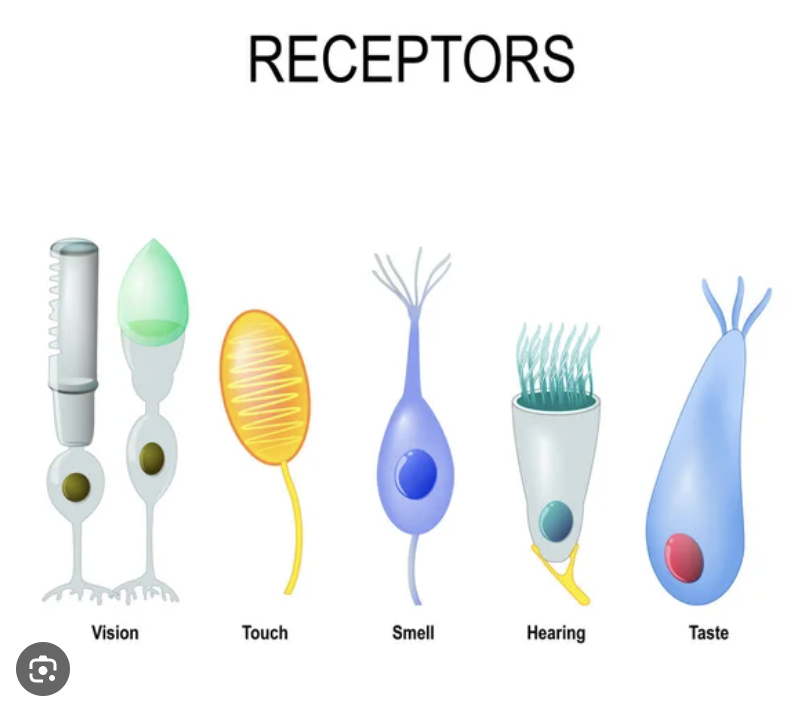
Neurons are nerve cells. Sensory receptors are specialized neurons located everywhere — skin, sense organs, internal organs — all highly differentiated to interpret information (“the message”) correctly. Did I just get poked or was that a love tap? Did that beeping sound tell me I got a new text or is my coffee ready? Do I smell smoke?
Science classifies sensory receptors by: I. Structure or cell type, II. Location or where you find them in the body, and III. Function or specialized roles. Each receptor has two ends: one designed to receive the message from other neurons and the other to send that message on to other neurons. This sensory communication takes place neuron-to-neuron until the message reaches the brain. I was poked. My phone was pinging me. No smoke.
The message is sent by electrochemical impulses. At the point of transmission, they are electrical but are converted (transduced) to chemical impulses (neurotransmitters) that get released into the synaptic cleft. The receiving end of the next neuron reconverts the message to electrical to travel to the neuron cell body (soma) and along the axon to reach the axon terminal. The cycle repeats. Where it gets complicated is in the variety of message types and sources (internal/external), neuron endings, and what everything’s called. Illustrations help. Also rereading the last post explaining “potentials” will help.
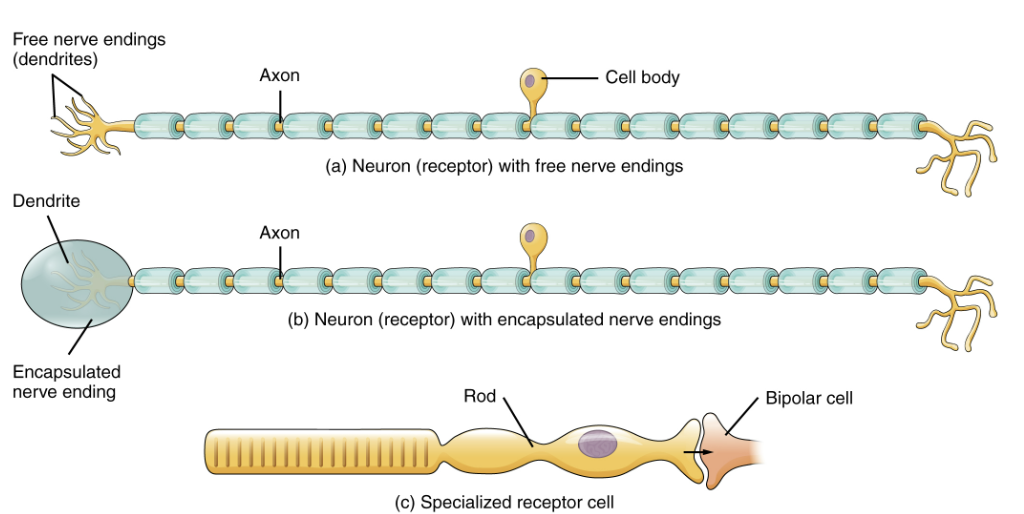
Three Receptor Classifications by Cell Type. Source: Oregon State
I. Structure of Sensory Receptors
Neuron receptor (a) has “free” nerve endings — finger-like dendrites can wiggle around and embed in sensitive tissues, including the skin’s middle/surface layers (dermis/ epidermis) that detect pain (nociceptors) or temperature (thermoreceptors).
Neuron receptor (b) has encapsulated endings — dendrites are encased in connective tissue, with enhanced specialization and sensitivity to sensory stimuli. Located in the skin’s middle layer (dermis), they respond to pressure and touch (mechanoreceptors).
Directly Generate Action Potentials
For both types of neuron receptors (a)(b) — with free or encapsulated dendrites — receptor (or generator) potentials directly generate action potentials (rapidly firing electrical impulses), if stimuli are “graded” strong enough. The triggered action potentials travel along the neuron’s axon, carrying impulses from the receiving end to the transmitting end. This connects with the next neurons in the chain — and to the spinal cord/brain.
The third type of receptor (c) is a specialized receptor cell — each one differentiated for each sense organ with a special sense (vision, hearing, smell, taste, equilibrium). They are also found in:
- Connective tissues: bind organs and cells, provide support and protection, store fat.
- Epithelial tissues: line the body’s outer surfaces and internal cavities, form glands.
- Muscle tissues: allow the body to move.
- Nervous tissues: electrically active, allow communications from stimuli to essential functions: sensory perception, motor coordination, cognitive processes.
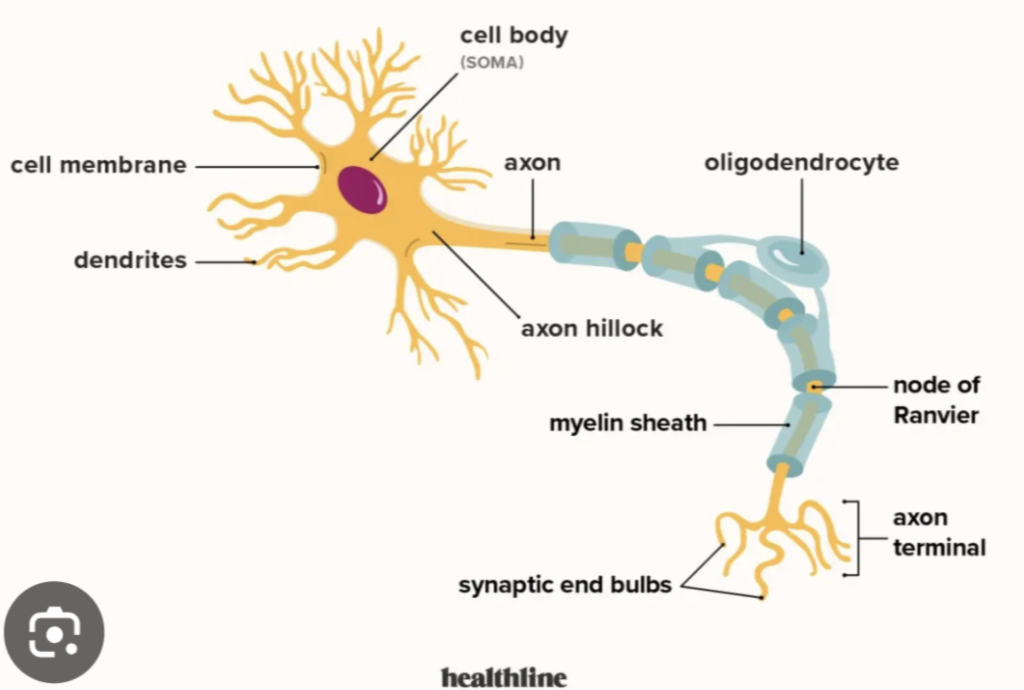
Dendrites receive message (electrical impulses) from other neurons. Message travels to cell body (soma), along the axon, to the axon terminal. Message converts to chemical neurotransmitters, releases into synaptic cleft to bind to another neuron’s dendrites. Diagram by Sophia Smithtra, Healthline
Indirectly Generate/Inhibit Action Potentials
Specialized receptor cells have postsynaptic potentials — graded potentials that indirectly generate nerve impulses — which then initiate or inhibit action potentials. More detail:
- Action potentials are caused by presynaptic neurons releasing neurotransmitters from the axon’s terminal into the synapse and binding to receptors on postsynaptic terminal (neuron or muscle cell).
- In light stimuli, photoreceptors (distinctive rod cells in the retina) release neurotransmitters onto a bipolar cell that sends a nervous signal across the synaptic cleft to the optic nerve.
Neurons and Nerve Endings
Neurons (nerve cells) are the basic building blocks of the nervous system, also including glia (non-neuronal cells supporting/protecting neurons) and the brain/spinal cord. These specialized nerve cells are the brain’s information-processing units responsible for receiving/ transmitting information. Each part of the neuron — from dendrite to terminal buttons, found at opposite ends of the soma/axon — is key to communicating information throughout the body.
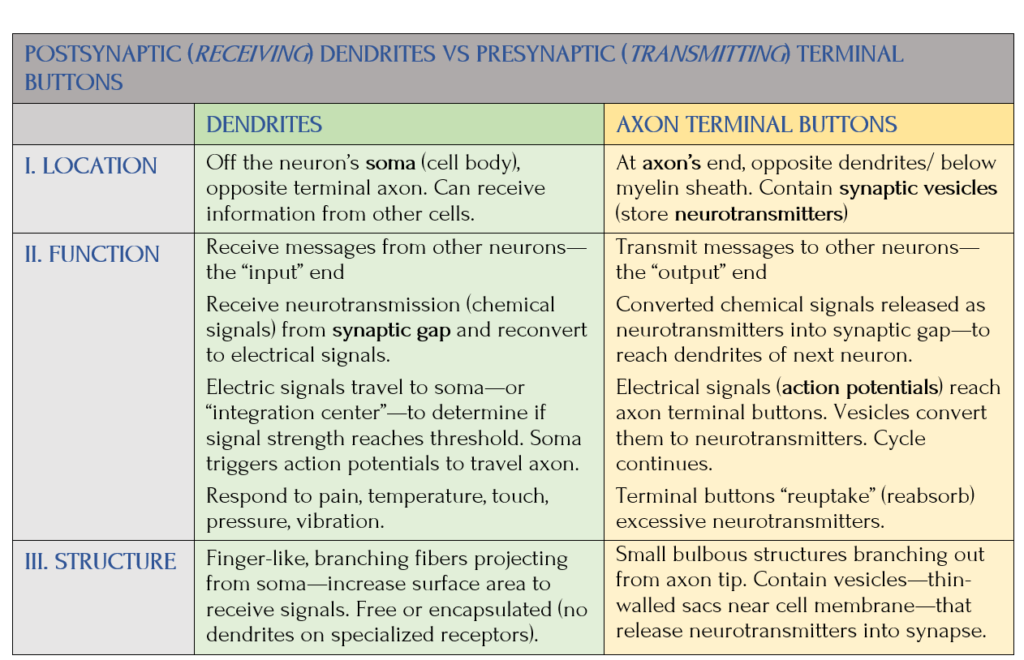
II. Location of Sensory Receptor Cells
Sensory receptors are also classified based on the stimuli’s location or placement. The three types are: exteroceptors, interoceptors, and proprioceptors.
Exteroceptors respond to external stimuli: photoreceptors in the eye or somatosensory receptors in the skin. They enable us (and all living organisms) to transfer information and changes from the environment and react, as needed. It helps animals to survive as predator or prey, act with defiance, navigate, and reproduce. Exteroceptors are near the skin’s surface and are sensitive to stimuli occurring outside or on the body’s surface — tactile sensations (touch, pain, temperature) — and for vision, hearing, smell, and taste.
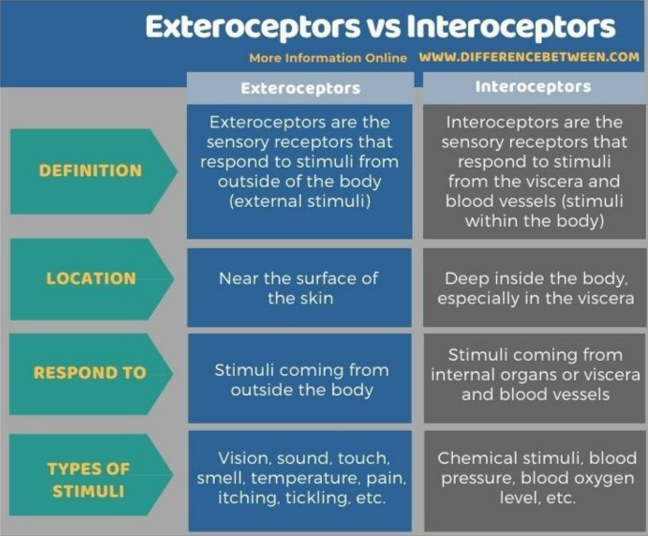
Interoceptors are within the body, recognizing and responding to any internal changes. These receptors are associated with the autonomic nervous system, which regulates involuntary processes in our viscera or organs (heartrate, respiration, digestion) and in our blood vessels (temperature change, blood pressure, blood pH) — changes we recognize when we feel thirsty, hungry, sexual arousal, cold/hot, pain, or nausea.
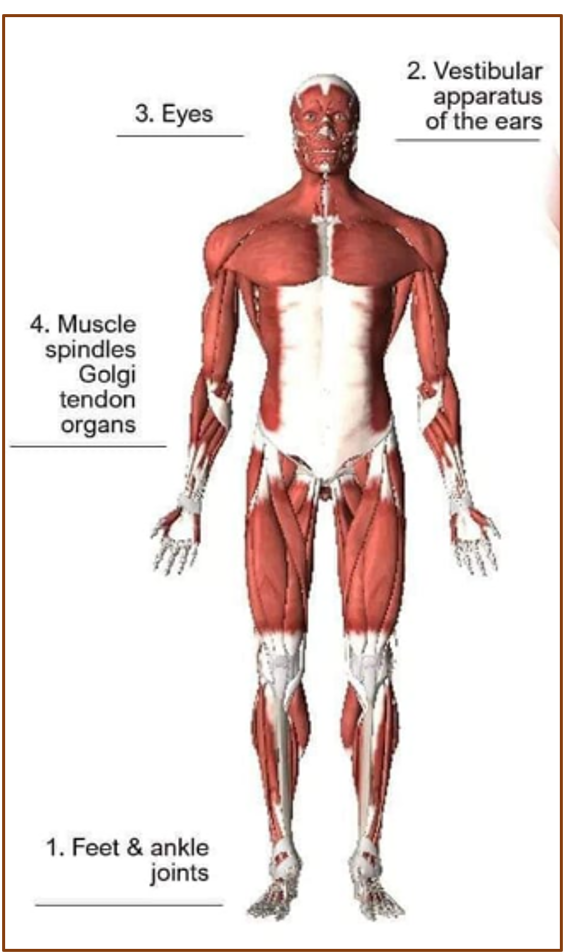
Proprioceptors respond to stimuli in the body’s moving parts—skeletal muscles, tendons, ligaments, and joints — required for locomotion, motor skills, and posture. They sense muscle movement, tension in tendons during muscle contractions, and sense movement in the ligaments. If you’re a fish, proprioceptors detect vibration and help with navigation. If you’re human, there are two proprioceptors worth noting.
- Vestibular apparatus — three semi-circular canals in our inner ear — helps us maintain balance and equilibrium, whether standing still or dancing Swan Lake. Sensory hair cells detect our position and keep us upright as the force of gravity pulls us toward the earth.
- Auditory receptors are located in the inner ear’s cochlea. Another ear part, the organ of Corti, contains hair cells that transmit auditory signals via the cochlear nerve to the brain.
III. Function of Sensory Receptor Cells
The final classification of sensory receptors is function, divided by how the receptors transduce stimuli into neural signals or how mechanical stimuli, light, or chemical change affects cell membrane potential (difference in electrical potential between inside and outside of a cell):
Thermoreceptors respond to temperature changes. External thermoreceptors are present in the skin and tongue — and are sensitive to temperatures above (heat) or below (cold) normal body temperature. Internal thermoreceptors reside in the hypothalamus, which responds to internal changes and maintains homeostasis. Blood-sucking insects and vipers use thermoreception to detect their host or locate their prey.
Chemoreceptors detect and respond to chemical stimuli, like those for smell (olfactory receptors in the olfactory epithelium of the nasal roof), taste (gustatory receptors in the taste buds on the tongue), or changes in body chemistry (variations in oxygen, carbon dioxide, and hydrogen ions in the blood). Olfactory sensory hairs or sensilla are present in ants’ and bees’ antennae. Taste sensilla are present in insect mouthparts, legs, or on antennae.
- Pheromones: Many animals and insects use chemoreceptors (pheromones) to find a mate, communicate alarm, or mark their territory. However, there’s a lack of scientific consensus as to what defines a pheromone and whether human substances (like sweat) are secreted by one individual to be received by a second.
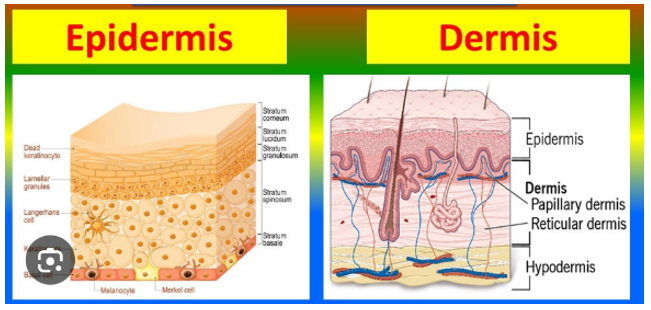
Source: “Difference between Epidermis and Dermis,” Medical Knowledge Online
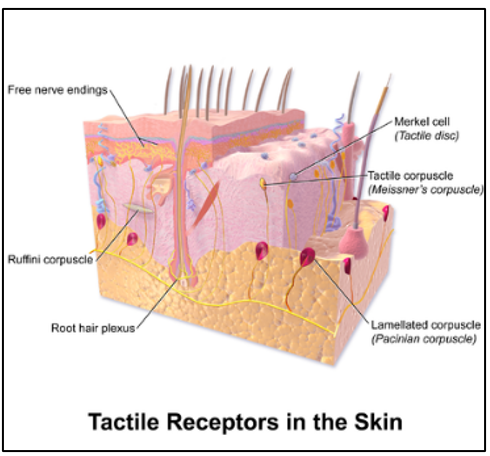
Mechanoreceptors are distributed at different depths and respond to different temporal frequencies and types of pressure. Source: Blausen.com. Wikipedia
Photoreceptors, found in the eye retinas’ rods and cones, respond to light.
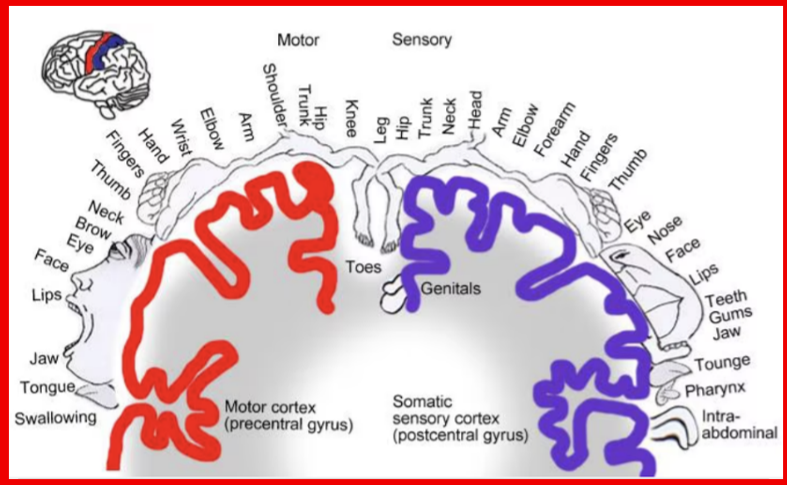
Somatosensory or tactile receptors in the skin have many different types of neurons at different layers of the epidermis and dermis. They can sense great variation in touch —from light, soft touch to vibrations to heavy and continuous pressure to deep pressure. They also detect pain and temperature.
Osmoreceptors, related to chemoreceptors and located in the hypothalamus, regulate sodium and water balance to maintain osmotic pressure — essential for cells to function. Increased salt intake leads to higher sodium concentration and rapid distribution through the body — stimulating thirst.
Mechanoreceptors are tactile receptors in the skin responding to touch, movement, stretching, or gravity. Changing shape when pushed or pulled, they transform mechanical energy into electrical energy. Mechanoreceptors help with hearing and equilibrium in the inner ear, help in maintaining body balance and upright posture in gravity, and are the basis for most aspects of somatosensation.
Nociceptors, related to chemoreceptors, are pain receptors that identify any extreme/damaging thermal or mechanical stimuli through chemicals released from tissue damage or intense mechanical stimuli. The brain interprets the pain.
Vestibular receptors are responsible for maintaining and monitoring balance, sense of orientation, and acceleration of our heads in any direction. The inner ear has five vestibular receptor organs, which help to maintain balance, making up the vestibular labyrinth. Two receptors respond to acceleration in a straight line, such as gravity.
Source: Medscape
Receptors we don’t have: Snakes’ heat sensors or bees’ ultraviolet light sensors. Also:
- Electroreceptors can sense any change in the electric field. Sharks and stingrays can detect electric fields generated by moving water, helping them catch prey, navigate, defend themselves, and identify the opposite sex. Some fish with electric organs for defense can deliver a high-voltage shock.
- Electromagnetic receptors can detect the earth’s magnetic field. Migratory birds and sea turtles use electromagnetic receptors to orient themselves and navigate. For us, the only electromagnetic energy that we can perceive by our eyes is visible light.

Migratory birds and sea turtles use electro-magnetic receptors to orient themselves and navigate, Scuba Diving. Photo: Jeff Nicholson

Sharks and stingrays detect electric fields generated by moving water, helping them catch prey, navigate, defend themselves, and identify mates. Source: Alamy
Coming Up Next

This ends our discourse on neurobiology. In the next two posts, I’ll talk about the relationship of our sensory system to our emotions as separate, but interrelated aspects of how we react to our environment and how we’re aided or hindered by the ways our sensory system functions.
Copyright ©2026 Jan Swan
 English