Insular Cortex or Insula
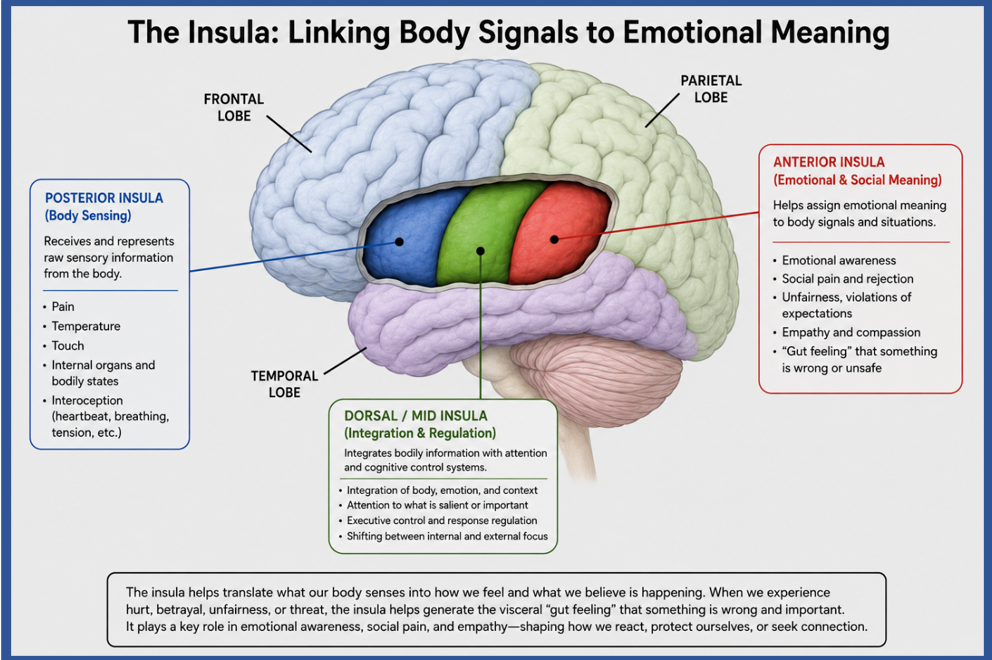
« Back to Glossary IndexThe insular cortex (insula) is a brain region buried deep within the folds of the cerebral cortex beneath portions of the frontal, parietal, and temporal lobes. The insula helps integrate sensory information from the body with emotional, cognitive, and social experience. It participates in sensory processing (including taste, pain, and bodily sensations), emotional awareness, decision-making, self-awareness, and the interpretation of internal bodily states (interoception) such as heartbeat, breathing, temperature, and physical discomfort. Research increasingly suggests the insula plays an important role in detecting emotionally important or salient experiences and linking bodily sensations to feelings, motivation, and behavior. The insula is commonly divided into functionally distinct regions:
- Anterior insula: Front portion of the insula, involved more strongly in emotional awareness, subjective feeling states, empathy, and integrating bodily signals with emotional, cognitive, and motivational processes. Studies suggest it may contribute to the visceral “gut feeling” that something is wrong and is active during experiences involving social pain, unfairness, conflict, and emotionally significant interpersonal events.
- Posterior insula: Back portion of the insula, functioning more as a sensory processing region that receives and relays bodily information — pain, touch, temperature, movement-related sensations.
- Dorsal anterior insula: Region associated more strongly with executive control, attention, working memory, response inhibition, and coordination among larger brain networks. It appears important for shifting attention between internal experiences and external demands.
Also see Anterior Insula (AI), Anterior Cingulate Cortex (ACC), Salience, and Interoception
 English